Affiliate Marketing for Startups: Complete Guide
Affiliate marketing for startups is an operating system—locks, cost, recruit, rates, tracking, first 100 sales, then diagnose a flat roster.
Compare CPS, CPA, CPL, revenue share, and hybrid affiliate commission structures. Industry ranges from Shopify, plus a risk-based way to choose.

TL;DR: An affiliate commission structure is the rule that decides which event pays a partner, and how much. Start with risk allocation (who funds the payout before revenue lands), match the model to your product’s revenue shape, then set the rate inside published industry bands such as Shopify’s 5%–15% for physical goods and 20%–50% for digital products.
Most founders treat affiliate commission structures as a percentage debate. That is the wrong first question. The structure decides which event triggers money, who carries cash-flow risk, and whether a creator will bother promoting you at all.
If you are designing affiliate commission structures for a digital product, SaaS plan, or co-selling storefront, you need a model you can explain in one sentence and defend with margin math.
Key takeaways:
Affiliate commission structures are the contractual rules that define which partner-attributed event pays out, how the payout is calculated, and over what time window that credit lasts.
In plain terms: the structure is the shape of the deal; the rate is the height of the deal. A 30% CPS offer and a $50 CPA offer can both be “high,” but they reward different behavior and put risk on different balance sheets.
Three parties sit inside every structure:
Tracking (cookies, server-to-server postbacks, codes) is the plumbing. The structure is the commercial logic riding on top of that plumbing. Shopify’s guide names the common consumer models as pay-per-sale, pay-per-click, pay-per-lead, pay-per-install, and recurring commissions (Shopify). impact.com groups flexible program overlays as tiered, performance-based, time-limited, product-specific, and hybrid (impact.com). You will usually combine one base model with one overlay.
The wrong structure does not just “underpay.” It selects the wrong partners and trains them to optimize the wrong event.
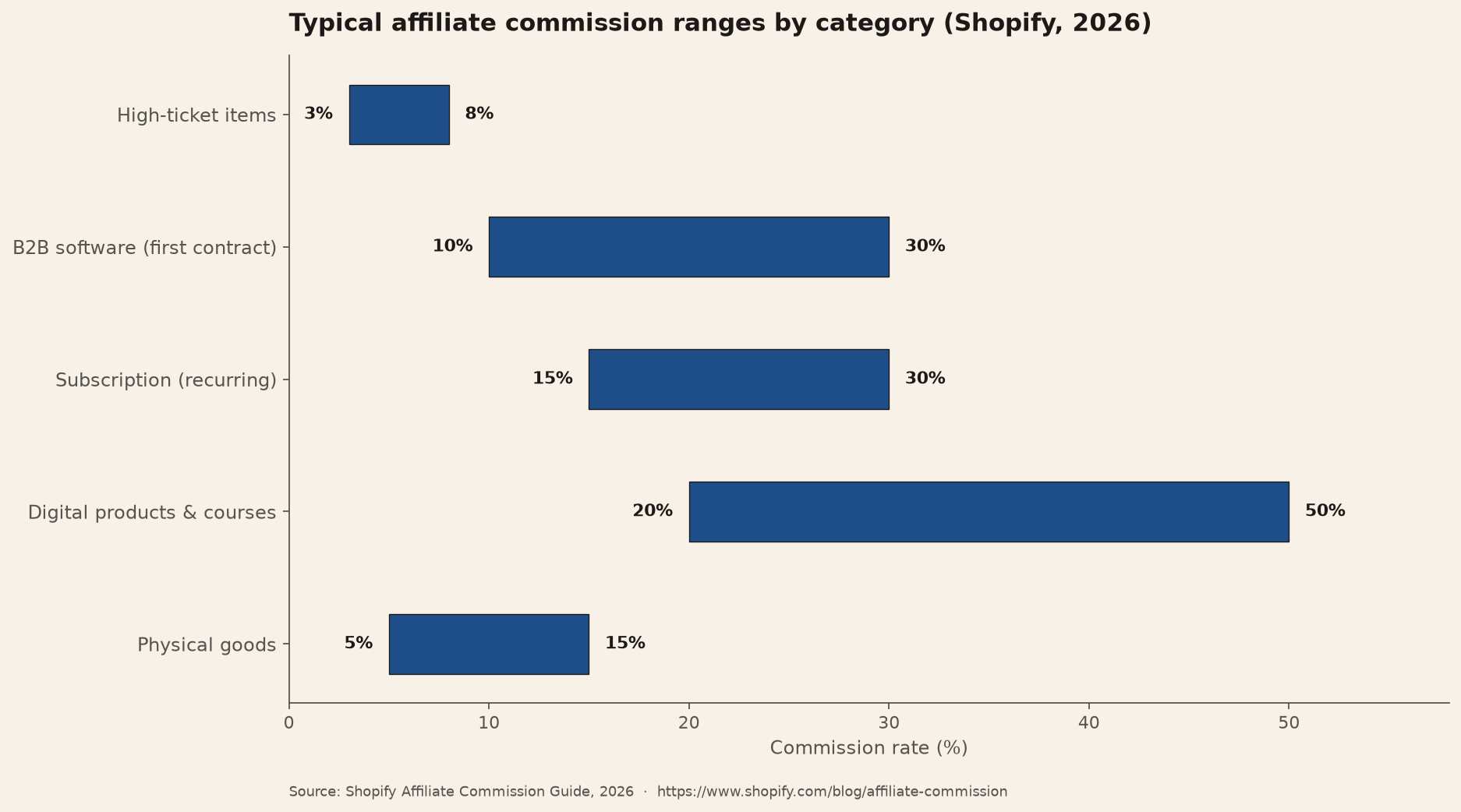
Source: Shopify, Affiliate Commission Guide (2026). https://www.shopify.com/blog/affiliate-commission
Affiliate commission structures work by pairing a qualifying event with a payout formula and an attribution window. Open with the event, not the percentage.
| Model | Qualifying event | Typical payout shape | Who carries more risk | Best fit |
|---|---|---|---|---|
| CPS / PPS (pay-per-sale) | Completed purchase | % of order or fixed $ per order | Shared; merchant pays after revenue | Ecom, digital downloads, one-time offers |
| CPA (cost per acquisition) | Defined acquisition (sale, funded account, activated sub) | Fixed $ (sometimes % of first invoice) | Merchant if definition is loose; affiliate if definition is strict | Apps, fintech, high-consideration offers |
| CPL (cost per lead) | Qualified lead / form / demo request | Fixed $ per accepted lead | Merchant (pays before close) | B2B, insurance, long sales cycles |
| PPC (pay-per-click) | Click | Fixed $ per click | Merchant | Awareness tests; easy to game |
| PPI (pay-per-install) | App install / first open | Fixed $ per install | Merchant | Mobile / PLG install goals |
| Revenue share / recurring | Ongoing customer payments | % of recurring revenue for a term or lifetime | Affiliate (waits on retention) | SaaS, memberships, subscriptions |
| Hybrid | Fixed leg + performance leg | e.g. small CPA/CPL or upfront + RevShare/CPS | Split by design | Creator programs, fintech, subscriptions |
Shopify documents PPS, PPC, PPL, PPI, and recurring as the everyday consumer vocabulary (Shopify). Performance marketers often say CPA / CPL / RevShare for the same underlying risk tradeoffs (Vibrant Performance).
Use these as starting envelopes, not promises:
| Category | Published range | Source |
|---|---|---|
| Physical goods (fashion, home, beauty) | 5%–15% per sale | Shopify |
| Digital products and online courses | 20%–50% per sale | Shopify |
| Subscription services | 15%–30% recurring | Shopify |
| B2B software and services | 10%–30% of first contract value | Shopify |
| High-ticket items (furniture, mattresses) | 3%–8% per sale | Shopify |
Shopify also notes that well-known publishers often sit around 10%–15%, with some brands stretching to 20% for visibility, and that some subscription brands pay 75%–100% of the first month instead of a thin lifetime share (Shopify). Holds of 30–60 days before payout are common to absorb returns (Shopify).
There is no public dataset that states the optimal commission for every indie app niche on feat. Marketplace cards on feat. often show double-digit percentages in a rough 10%–40% band, but each listing sets its own terms and that observation is not a universal rate (feat. FAQ).
impact.com’s flexible structures are overlays on the base model (impact.com):
In 2024, impact.com also reported commission payments up 11% year over year as partners drove 15% more orders and brands paid a 3% higher commission rate, with loyalty/rewards partners earning 35% of commission spend, content review 24%, and network partners 22% (impact.com). Structure choices redistribute that spend across partner types.
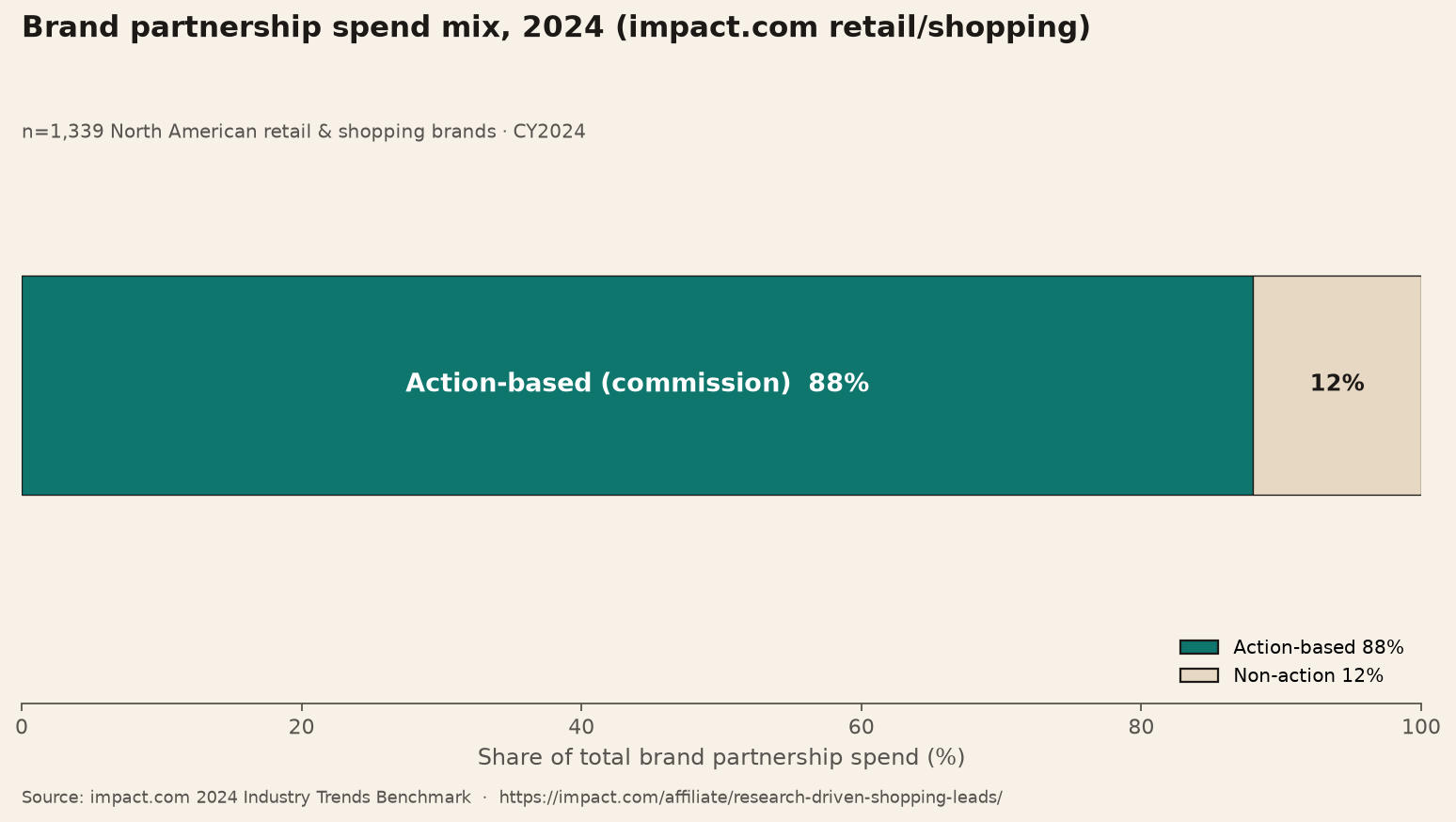
Source: impact.com, 2024 Industry Trends Benchmark Report. https://impact.com/affiliate/research-driven-shopping-leads/
Use this order when you design affiliate commission structures:
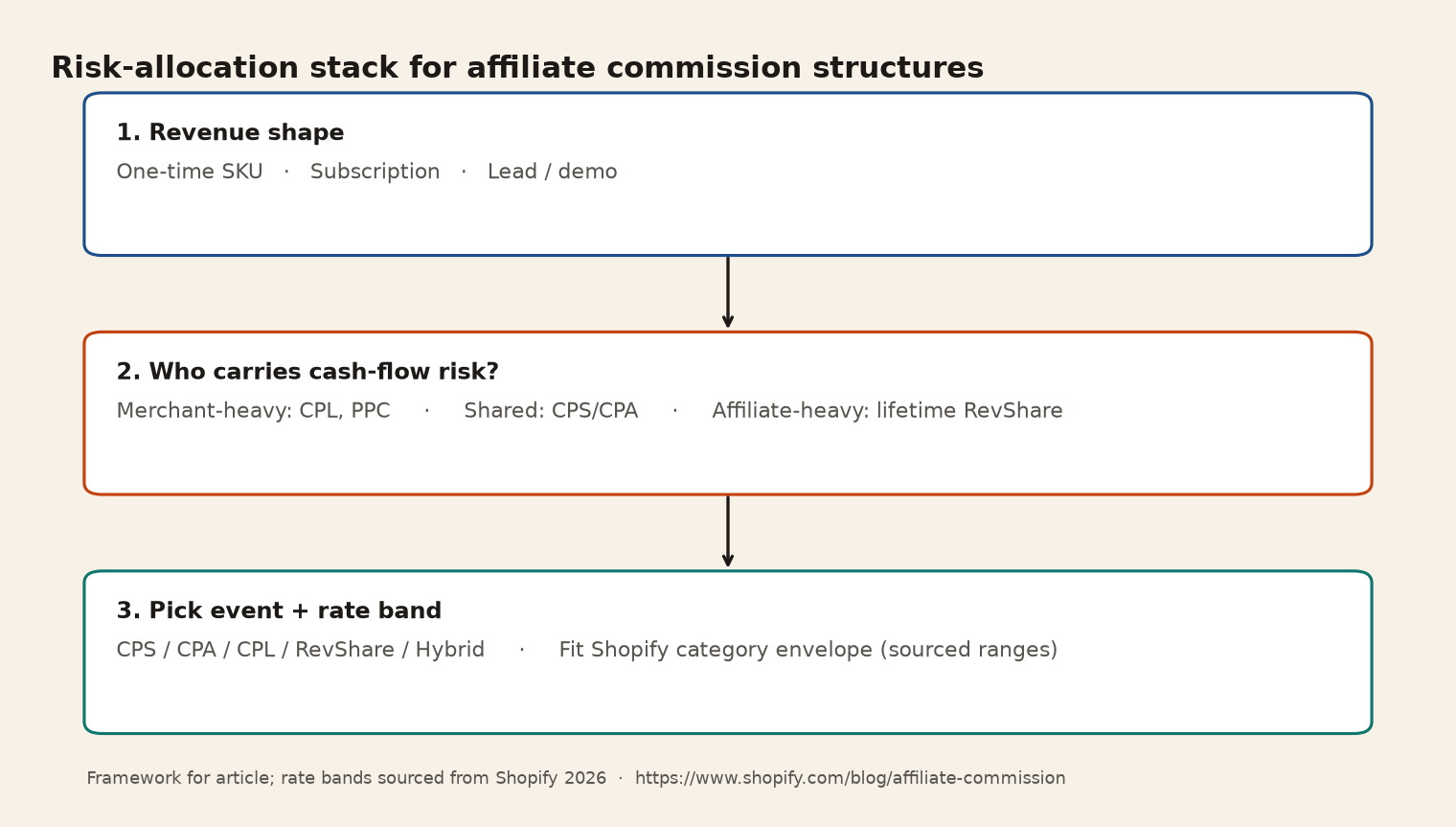
Source: Framework synthesized from Shopify model definitions and Vibrant Performance risk framing; rate bands from Shopify (2026). https://www.shopify.com/blog/affiliate-commission
Classic affiliate networks pay for a click that lands on the merchant’s site. Co-selling platforms generate a co-branded storefront so the affiliate’s identity stays in the conversion path. The commission structure still has to answer the same risk question. The difference is packaging: the partner is not only a traffic source; they are a named seller on a forked page. That is closer to sponsorships vs affiliates vs co-selling than to a coupon feed. If your rates feel stuck, the problem may be packaging, not only the percentage. See why creator affiliate programs pay too little.
Q: What are the main affiliate commission structures? A: The main base models are pay-per-sale (CPS/PPS), CPA, CPL, pay-per-click, pay-per-install, and revenue share or recurring commissions. Programs then add overlays such as tiers, product-specific rates, time-limited boosts, or hybrids that combine a fixed leg with a performance leg.
Q: What is a good affiliate commission rate by industry? A: Shopify’s 2026 guide cites typical ranges of 5%–15% for physical goods, 20%–50% for digital products and courses, 15%–30% recurring for subscriptions, 10%–30% of first contract value for B2B software, and 3%–8% for high-ticket goods. Treat those as envelopes, then fit your margin.
Q: When should I use revenue share instead of a one-time commission? A: Use revenue share when customer value arrives over renewals and you want partners to care about retention. Cap the term (for example 12 months) if lifetime payouts would blow your LTV-to-CAC target. Some subscription brands instead pay a large share of month one, then little or nothing afterward.
Q: How do hybrid affiliate commissions work for creators? A: A hybrid pairs a fixed component (upfront fee, small CPA, or CPL) with a performance leg (CPS or RevShare). The fixed leg buys creative effort; the performance leg keeps incentives aligned. Disclose both legs when the creator endorses the product.
Q: Do affiliates have to disclose commissions? A: Yes, when the payment is a material connection that audiences would not reasonably expect. The FTC advises clear, conspicuous disclosures such as stating you earn commissions from purchases through your links; labels like “commissionable link” alone are usually not enough.
Affiliate commission structures are risk contracts dressed as marketing. Choose the event, assign the risk, set the rate inside published industry bands, then add at most one overlay. That sequence beats copying a competitor’s headline percentage.
If you want partners selling through tracked, co-branded pages instead of naked links, browse live offers on the feat. marketplace and set terms you can actually honor.
Affiliate marketing for startups is an operating system—locks, cost, recruit, rates, tracking, first 100 sales, then diagnose a flat roster.
How to track affiliate sales: pick link cookie, coupon, pixel, S2S postback, or storefront checkout—then match Rewardful, Tapfiliate, or Impact.
Best affiliate programs for SaaS companies pass the Recurring Cap Test: labeled duration, cookie, seat type, payout rails—plus Rewardful’s ~24% planning band.