How to Track Affiliate Sales
How to track affiliate sales: pick link cookie, coupon, pixel, S2S postback, or storefront checkout—then match Rewardful, Tapfiliate, or Impact.
Affiliate marketing for startups is an operating system—locks, cost, recruit, rates, tracking, first 100 sales, then diagnose a flat roster.

TL;DR: Affiliate marketing for startups is a seven-stage operating system—go-live locks, loaded cost, seller recruitment, rate bands, attribution surfaces, first-100 sales math, then flat-roster diagnosis—not a plugin install. Rewardful’s SaaS sample (n=2,847) finds only 1.28% of affiliates sell and 15.6% of programs last. This hub maps each stage to a deeper spoke.
Most “affiliate marketing for startups” pages restart the launch tutorial. You do not need another one.
You need a map of the jobs that already have dedicated pages on this site: when to go live, what the stack costs, who actually sells, what to pay, how sales get attributed, how the first hundred closes happen, and what to do when the roster grows and revenue does not. Searchers who already hit why is our affiliate program flat even though we keep adding creators (a GSC query at striking distance) are past “what is affiliate marketing.”
This is the hub. Deep how-tos stay on the spokes. Seed-stage constraints live on how to create an affiliate program for a startup. Multi-seat agency/reseller work forks to how to create a partner program for a startup.
Affiliate marketing for startups is a performance channel where independent partners earn a commission for referred customers, run with founder-owned economics, a small warm roster, and software that matches how those partners actually sell.
It is not “open signup and hope.” It is not the same job as a PartnerStack-style B2B ecosystem with agencies and resellers. And it is not a marketplace of co-branded storefronts unless you chose that surface on purpose (affiliate marketing vs storefront).
For early teams the unit of progress is a sold partner and a locked commission—not a headcount of approved applications.
Affiliate marketing for startups matters because paid acquisition gets expensive while a few trusted sellers can compound—if you treat the program like ops, not a badge on the pricing page.
Affiliate marketing for startups works as a Startup Affiliate Operating System: seven stages you run in order, each with a spoke that owns the depth.
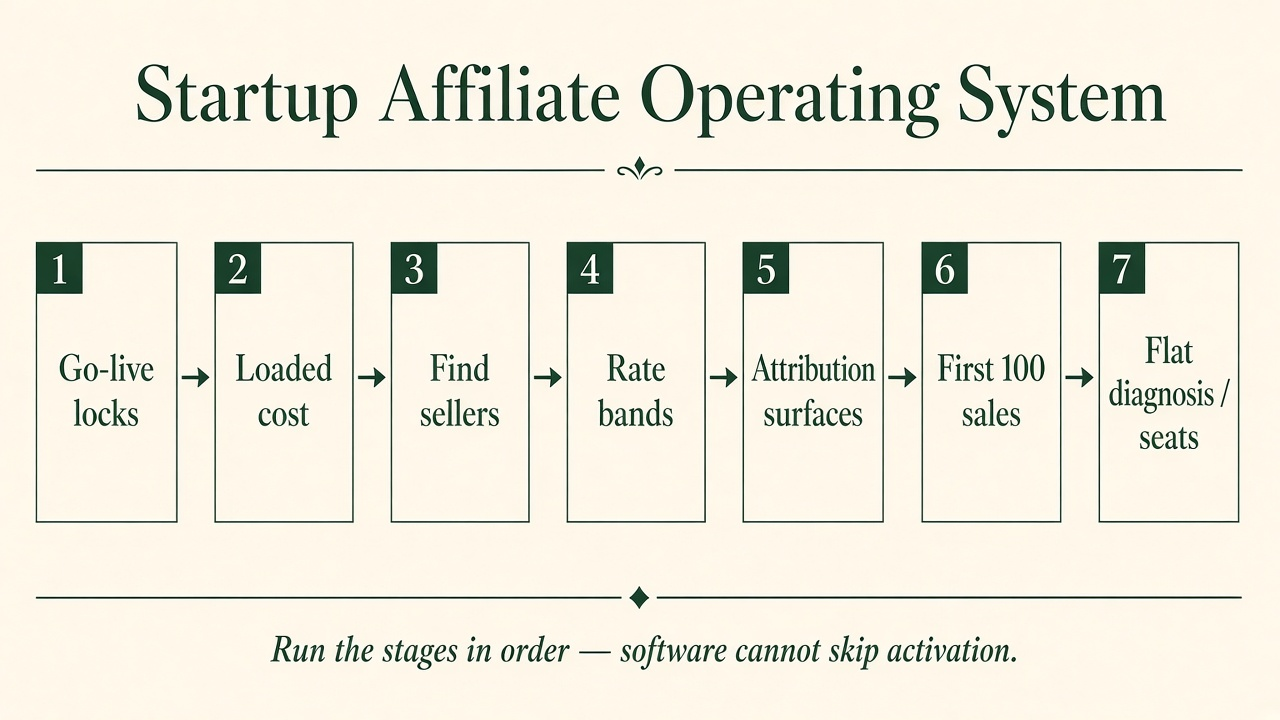
Source: Editorial Startup Affiliate Operating System mapping committed feat. spokes; activation and durability stats from Rewardful State of SaaS Affiliate Programs (n=2,847). Accessed 2026-10-08.
Do not recruit into a broken ledger. Lock economics, surface, contract, soft-launch partners, and activation meters first (how to start an affiliate program for your business). Seed-stage teams add capital and focus constraints on how to create an affiliate program for a startup. Publish terms partners can calculate (affiliate program terms of service).
Rewardful still sees only 12–18% of new merchants confirm installation within seven days (Rewardful). Finish a test purchase before the waitlist email.
Budget four layers: public sticker, usage meter, commissions, unpaid operator time (how much does it cost to build an affiliate program).
| Software rung | Published signal | Meter to watch |
|---|---|---|
| Rewardful / FirstPromoter | About $49/month starters | Affiliate-attributed revenue caps |
| Tapfiliate Launch | $89/month | Conversion caps (Launch 500/mo) |
| Impact | From $30/month + 2.5% partner-driven | Transaction % |
| PartnerStack | Demo / quote-only | Multi-seat B2B ops, not ten Stripe links |
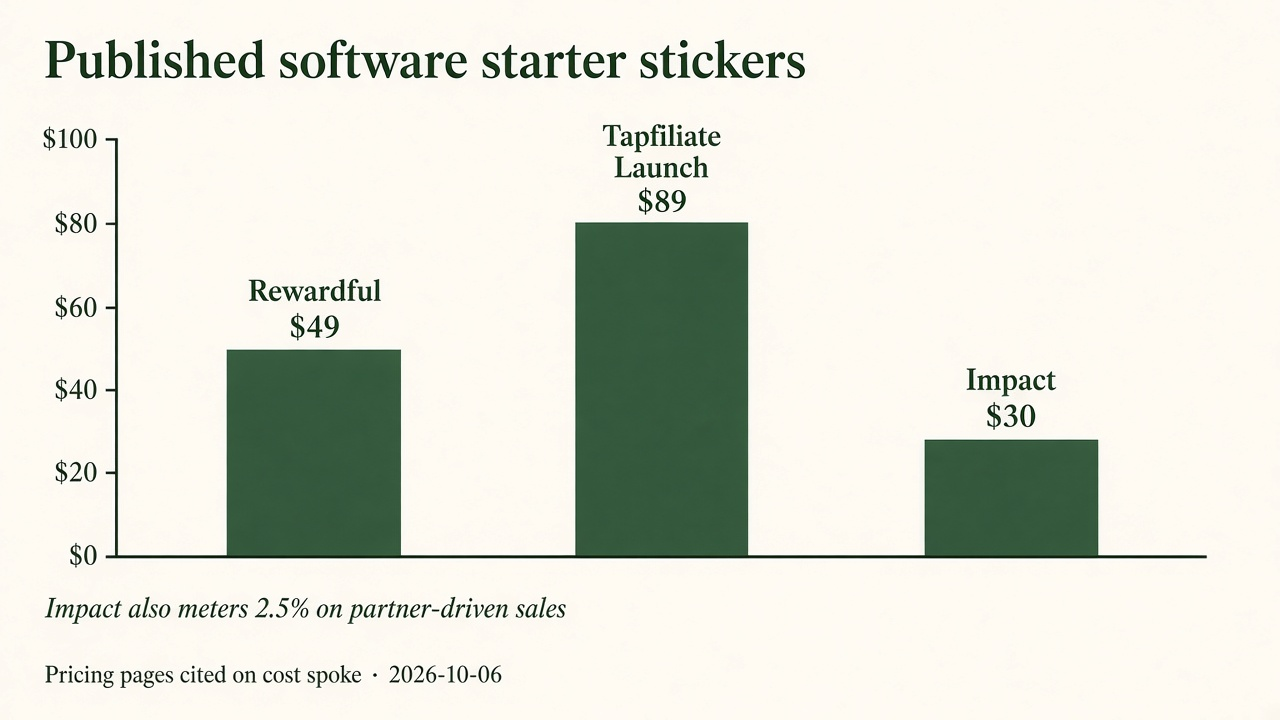
Source: Rewardful, Tapfiliate, and Impact pricing pages as cited on the cost spoke (checked 2026-10-06). https://www.rewardful.com/pricing · https://tapfiliate.com/pricing/ · https://impact.com/integrated-platform-prices/
Do not invent feat. fees. If the job is a co-branded seller page, compare jobs—not fake stickers (Rewardful vs feat; PartnerStack vs feat).
Open signup without enablement inflates applications. Rewardful’s funnel—7.6% refer, 1.28% sell—is why ten named sellers beat hundreds of silent joins (how to find affiliates who actually sell). SaaS-specific recruiting lives on how to recruit affiliates for SaaS and the general product playbook on how to recruit affiliates for your product.
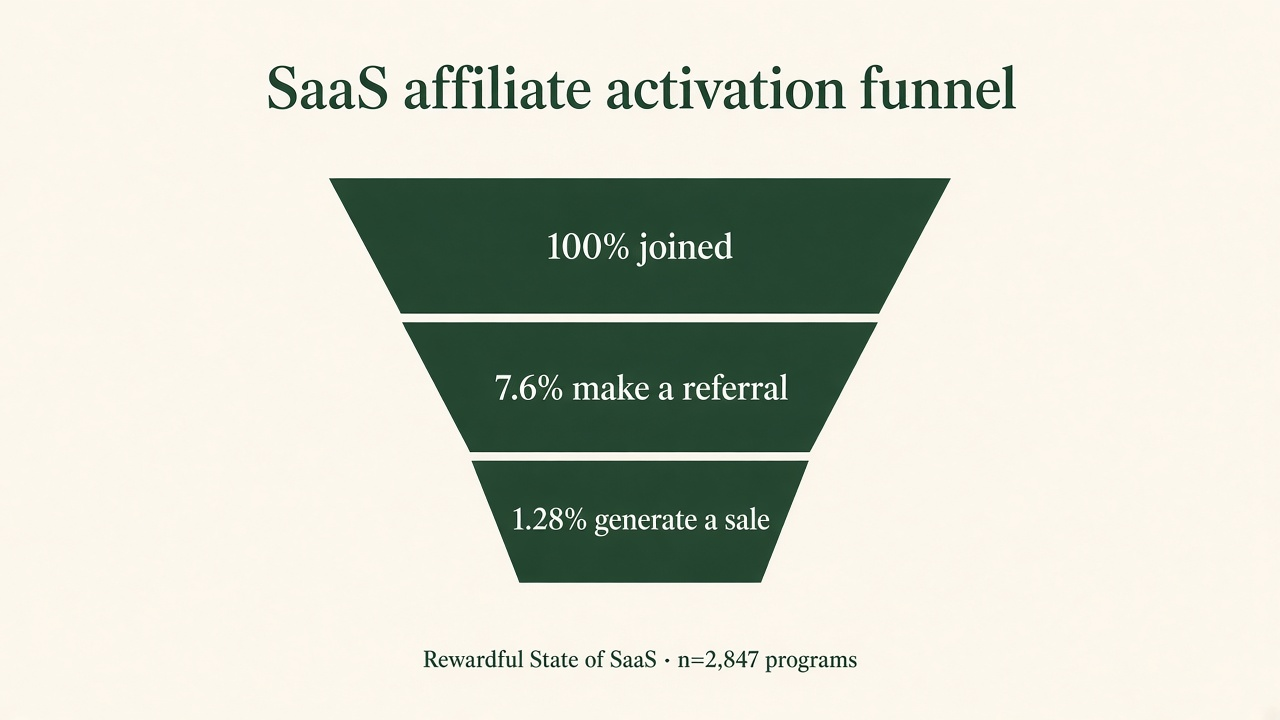
Source: Rewardful, State of SaaS Affiliate Programs Report (n=2,847 programs). https://www.rewardful.com/articles/state-of-saas-affiliate-programs-report
Start inside published envelopes, not vibes. Shopify’s planning bands: physical 5%–15%, digital 20%–50%, subscriptions 15%–30% recurring (Shopify). Rewardful’s sample average commission is 24.16% (Rewardful). SaaS-specific rate design: SaaS affiliate commission rates. Recurring vs one-time tradeoffs: recurring vs one-time affiliate commissions.
Raising 20% → 30% will not fix a partner who never posted. Rewardful’s own conclusion: commission structure alone rarely separates high performers.
Name how a sale gets credited before you argue about cookie days: link + cookie, coupon, pixel, S2S postback, or storefront checkout (how to track affiliate sales). Window × who-wins × overrides stay on affiliate cookie duration and attribution windows. Cloaking is presentation, not the ledger (affiliate link cloaking and tracking explained).
At Rewardful’s 0.8% average referral-to-sale conversion, 100 sales imply about 12,500 referred visits (how to get your first 100 affiliate sales). Activate a handful of named sellers inside 14 days; do not “solve” the funnel with more open signups. About 10% of affiliates generate a program’s affiliate revenue in that sample—plan for concentration.
If creators keep joining and GMV does not move, run the flat-program diagnosis before you buy a bigger PRM (why is our affiliate program flat). If the real job is agencies, resellers, or integrations—not CPS content partners—climb the Partner Seat Ladder (partner program for a startup). PartnerStack’s 2026 Network report puts Network partners at 14× the earn rate of non-Network partners and top offers at 20% / 25% / 30%—a B2B ecosystem argument, not a reason to overbuy on day one of a content-only program (PartnerStack).
| Stage | Job | Spoke |
|---|---|---|
| 1 | Go-live locks | Start an affiliate program · Startup constraints |
| 2 | Budget | Cost to build a program |
| 3 | Recruit sellers | Find affiliates who sell · Recruit for product |
| 4 | Rates | SaaS commission rates |
| 5 | Tracking | Track affiliate sales |
| 6 | First 100 | First 100 affiliate sales |
| 7 | Flat / seats | Flat program · Partner program |
Q: What is affiliate marketing for startups? A: A performance channel where independent partners earn commission on referred customers, run with founder-owned economics and a small warm roster. For startups it is an operating system—locks, cost, recruit, rates, tracking, first sales, diagnosis—not a plugin badge.
Q: How do startups start an affiliate program? A: Lock economics, surface, contract, soft-launch partners, and activation meters before recruiting, then soft-launch ten named sellers. Full sequence: how to start an affiliate program for your business.
Q: How much does a startup affiliate program cost? A: Published software starters include Rewardful/FirstPromoter at about $49/month, Tapfiliate Launch at $89/month, and Impact from $30/month plus 2.5% on partner-driven sales—plus commissions and unpaid operator time. Deep dive: cost to build an affiliate program.
Q: Why is my startup affiliate program flat? A: Usually weak activation, not missing software. Rewardful finds only 1.28% of affiliates sell. Diagnose enablement and seller quality before adding roster headcount (flat program spoke).
Q: When should a startup use a storefront instead of a tracker?
A: When named sellers need a co-branded shop and checkout seat, not only a ?via= link. Trackers win for Stripe CPS with existing audiences; storefronts win for collaborative selling (affiliate software vs storefront).
Affiliate marketing for startups is a seven-stage operating system. Run the locks, budget the loaded cost, recruit sellers, publish fundable rates, pick an attribution surface, chase first-100 math, then diagnose flat before you fork into a multi-seat partner program.
If your stage is creators selling your product through co-branded storefronts with a revenue split on every sale, start at feat..
How to track affiliate sales: pick link cookie, coupon, pixel, S2S postback, or storefront checkout—then match Rewardful, Tapfiliate, or Impact.
Best affiliate programs for SaaS companies pass the Recurring Cap Test: labeled duration, cookie, seat type, payout rails—plus Rewardful’s ~24% planning band.
Affiliate marketers get paid after lock, period close, threshold, and rail withdrawal—Impact, Amazon (~60 days/$10), Rewardful, and Stripe Connect compared.