Affiliate Marketing for Startups: Complete Guide
Affiliate marketing for startups is an operating system—locks, cost, recruit, rates, tracking, first 100 sales, then diagnose a flat roster.
How to track affiliate sales: pick link cookie, coupon, pixel, S2S postback, or storefront checkout—then match Rewardful, Tapfiliate, or Impact.

TL;DR: How to track affiliate sales starts with naming the surface that will own the commission—tracked link + cookie/click ID, affiliate coupon code, conversion pixel, server-to-server postback, or co-branded storefront checkout—then publishing conflict rules. Rewardful defaults to a 60-day cookie and first-touch attribution; Tapfiliate defaults to 45 days and supports coupons plus S2S. Safari can still cap script cookies at 7 days.
Most founders ask how to track affiliate sales and then install a tracker as if the software invents truth.
It does not. A sale is attributed when a chosen signal—cookie, code, pixel, postback, or checkout seat—survives from click to paid order. Cookie windows and “who wins” rules are separate dials; they live on affiliate cookie duration and attribution windows. Link presentation is a different job entirely (affiliate link cloaking and tracking explained).
This page is the surface fork. Window × rule × override math stays on the cookie article. Fraud patterns (stuffing, hijacking) stay on affiliate fraud and how to detect it.
Affiliate sales tracking is the system that connects a partner’s promotion to a paid order so commission can be calculated and paid.
It is not Google Analytics with a UTM glued on. Analytics can show traffic; the affiliate ledger must survive privacy prompts, device switches, and refunds. Operators who treat GA events as the payout source of truth get disputes—older Reddit threads already called browser-only affiliate ledgers a bad idea (r/Affiliatemarketing).
Tracking usually combines a click identifier, a persistence layer (cookie or server record), a conversion event (order paid / trial converted), and a conflict rule when two partners touched the same buyer. The product you buy—tracker, network, or marketplace—only implements those pieces.
How to track affiliate sales matters because unpaid partners stop promoting and overpaid partners train you to ignore the ledger.
How to track affiliate sales works as an Attribution Surface Stack: pick the primary surface that will own the commission, add backup surfaces only where that primary fails, write the conflict rules in plain language, then choose software that can enforce the stack.
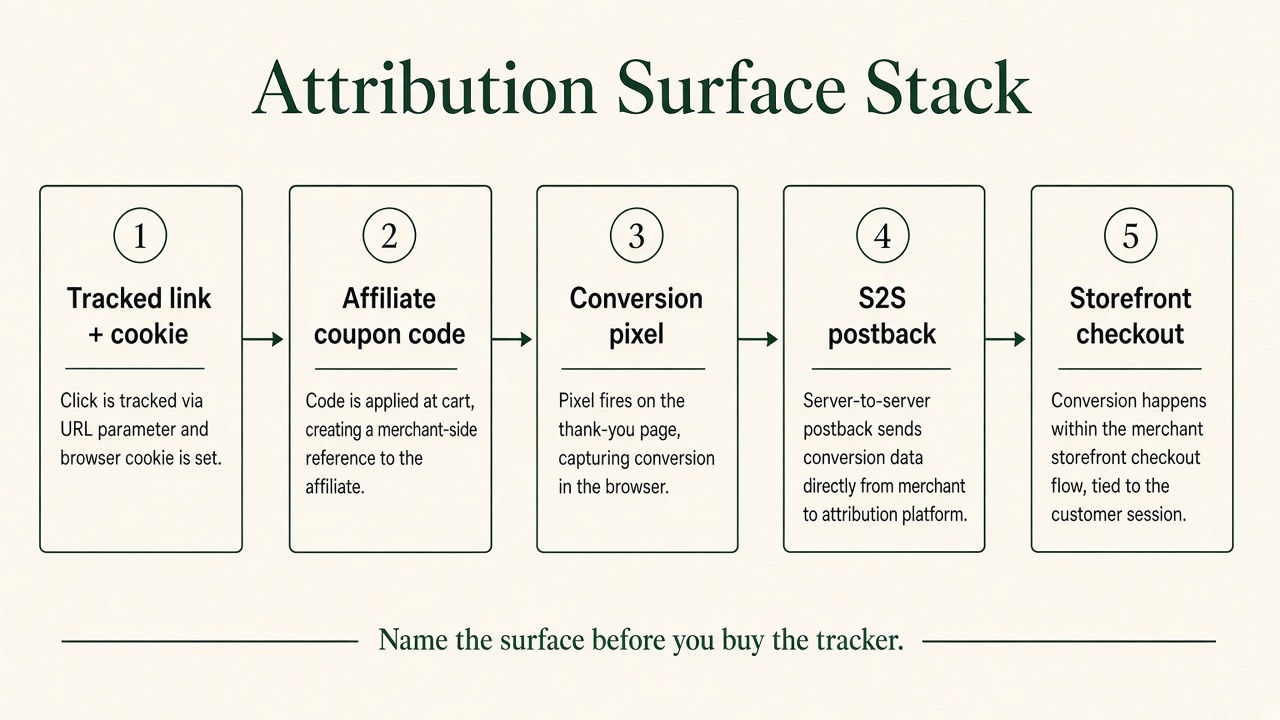
Source: Editorial Attribution Surface Stack for merchant affiliate ledgers; method names aligned with Tapfiliate tracking methods (links, coupons, pixels, S2S) and marketplace checkout seats. Accessed 2026-10-08.
The classic path: partner shares a unique URL, your system stores an affiliate ID (often in a first-party cookie), and a later purchase inside the window credits that partner. Rewardful’s help center defines the cookie window as how many days a referral stays eligible and defaults that window to 60 days per campaign (Rewardful Help). New Rewardful campaigns default to first-touch attribution, with last-touch available in settings (Rewardful).
This surface fails when the cookie never sets, expires early (Safari), or gets overwritten by a later click. It is still the right primary for content SEO and email links when buyers click through.
The code itself is the tracker. Checkout redemption attributes the sale even when nobody clicked (Tapfiliate). Creators on podcasts and TikTok lean on this because audiences remember phrases, not URLs. Reddit operators say the same: coupon attribution happens at purchase time, so cookie reject hurts less (r/Affiliatemarketing).
Publish whether a partner code beats a prior cookie, splits credit, or is banned for coupon sites. Silence here is how content partners quit.
A pixel (or JS snippet) fires on the thank-you page and reports order ID, value, and affiliate context back to the tracker. It confirms that a browser reached confirmation. It does not replace a ledger when ad blockers or ITP suppress the fire. Treat pixels as a backup signal, not the only truth.
Your server—or Stripe/Paddle webhook path—tells the affiliate platform a conversion happened, carrying the stored click ID. Tapfiliate positions S2S as the route that does not rely on cookies (Tapfiliate tracking). AffiliateRail’s survey notes fifteen of twenty platforms print some server-side route so the sale can match on the invoice (AffiliateRail). This is the recovery layer when Safari caps the cookie at seven days.
When the partner sells from a storefront you generate—not a bare ?via= link—the checkout session itself can carry the seller seat. That is a different product shape than a tracker bolted onto your existing Shopify or Stripe page (affiliate software vs storefront; affiliate marketing vs storefront). Use it when the job is “named sellers with a shop,” not “publishers with links.”
| Surface / setting | Published signal | Source |
|---|---|---|
| Rewardful cookie window | 60-day default, editable per campaign | Rewardful Help |
| Rewardful who-wins | First touch default; last touch optional | Rewardful |
| Tapfiliate cookie window | 45-day default; max 365; last click default | AffiliateRail (Sep 7, 2026) |
| 20-platform printed defaults | 30 (4) / 45 (1) / 60 (5) / 90 (4) days | AffiliateRail |
| Safari script-cookie ceiling | Often 7 days; 1 day after some decorated tracker arrivals | AffiliateRail citing WebKit ITP |
| Amazon Associates | Cart-add within 24 hours; cart hold usually ~90 days | Amazon Help |
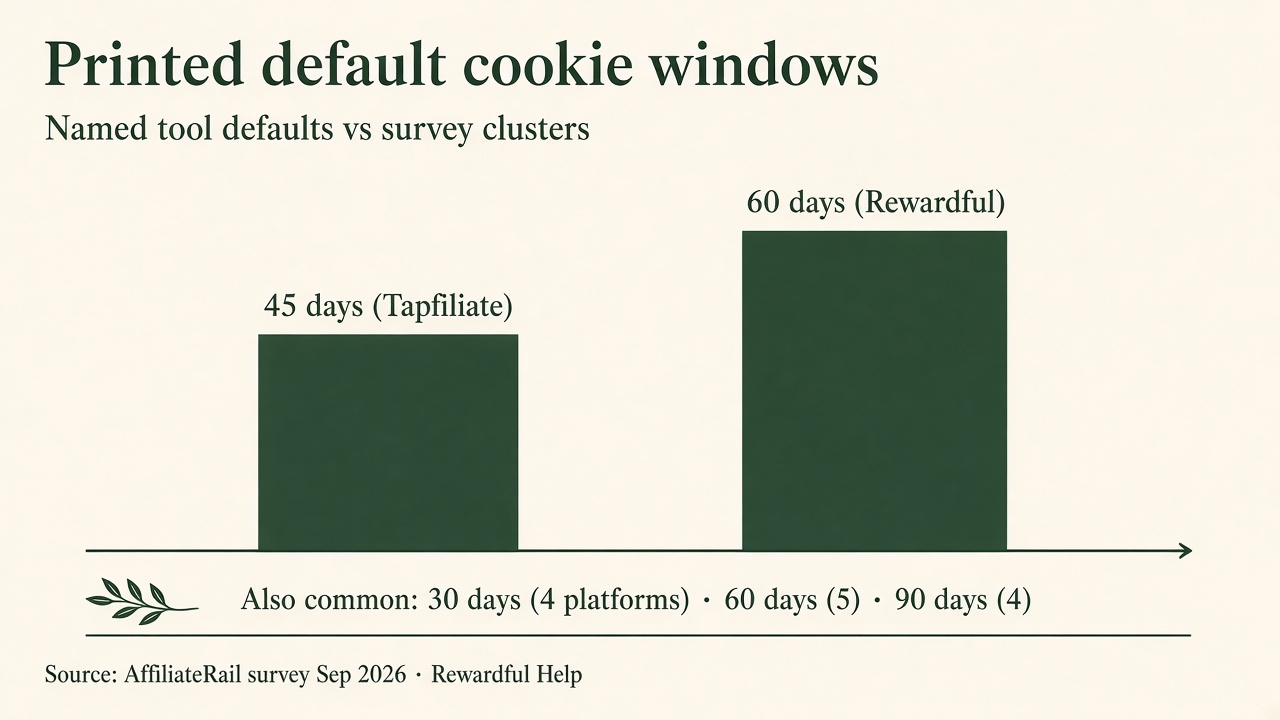
Source: Rewardful Help (60-day default); AffiliateRail Sep 2026 survey (Tapfiliate 45-day default; 30/60/90 cluster counts across 20 platforms). https://help.rewardful.com/en/articles/2155812-how-long-are-referral-cookies-valid · https://affiliaterail.com/blog/affiliate-cookie-duration
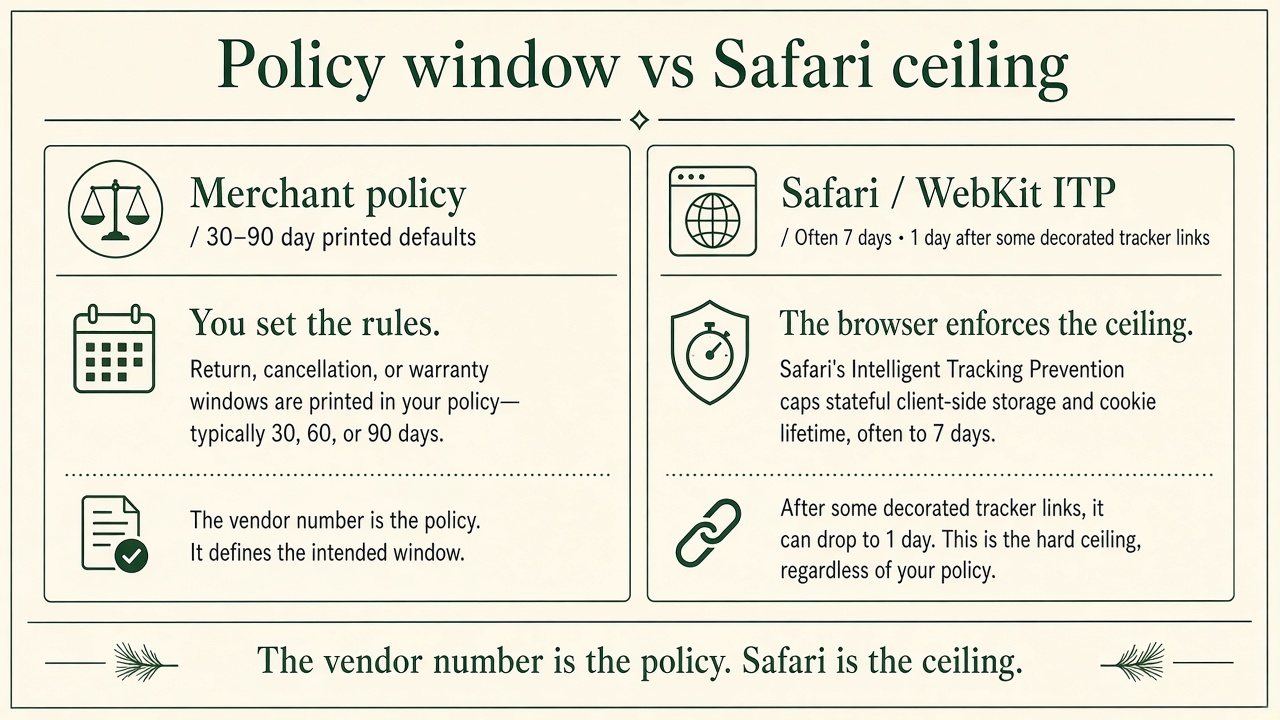
Source: AffiliateRail, “Affiliate cookie duration” (7 Sep 2026), summarizing WebKit ITP 2.1/2.2 caps against vendor-printed policy windows. https://affiliaterail.com/blog/affiliate-cookie-duration
| Primary surface | Usual tool class | When it wins | When it loses |
|---|---|---|---|
| Link + Stripe invoice | Rewardful / FirstPromoter-class tracker | One SaaS, founder-run affiliates | You need multi-touch PRM and deal reg |
| Links + coupons + S2S | Tapfiliate-class tracker | Creators need codes and postbacks | You only needed ten Stripe links |
| Network + contract terms | Impact / network stack | Enterprise partner ops | Overkill for a soft launch of 10 partners |
| Co-branded seller checkout | Marketplace storefront (e.g. feat.) | Sellers need a shop, not a pixel | You need enterprise lead registration |
Do not invent feat. fees. Published competitor stickers only—Rewardful starters are about $49/month on prior program cites (Rewardful vs feat); Tapfiliate seats scale by roster (Tapfiliate vs feat).
State in one page: cookie window, first vs last touch, whether affiliate codes override cookies, what a generic sitewide code does, and how refunds reverse commissions. Then test one forced path per surface: click→buy, code-only buy, Safari delayed buy with S2S on, and (if relevant) storefront checkout. If a path fails, fix the stack—do not add a second network.
Q: How do you track affiliate sales? A: Pick a primary attribution surface—tracked link with cookie or click ID, affiliate coupon code, conversion pixel, server-to-server postback, or storefront checkout—then enforce window and conflict rules in software that supports that surface. Back up browser-fragile paths with S2S or codes.
Q: Is a cookie enough to track affiliate sales? A: Often not. Rewardful and Tapfiliate still use cookies as a core path, but Safari can cap script cookies at about seven days, and consent banners can block client-side fires. Pair cookies with S2S or coupon attribution when delayed or cookieless buyers matter.
Q: How do coupon codes track affiliate sales? A: The merchant maps a unique code to an affiliate. When the code is redeemed at checkout, the sale attributes even without a prior click. Publish whether codes override, split with, or ignore an earlier cookie.
Q: What is server-to-server postback tracking? A: Your server (or billing webhook) sends the conversion and click ID to the affiliate platform without relying on the buyer’s browser. It is the usual recovery layer when pixels and cookies under-report.
Q: Can Google Analytics replace affiliate tracking software? A: No. Analytics can show tagged traffic; it is not a commission ledger with holds, refunds, and partner payouts. Use UTMs as a diagnostic layer beside a proper affiliate system.
How to track affiliate sales is a surface decision before it is a software decision. Climb the Attribution Surface Stack once, match Rewardful, Tapfiliate, a network, or a storefront to that surface, and write the conflict rules partners can actually read.
If your surface is creators selling through co-branded storefronts with a revenue split on every sale, start at feat..
Affiliate marketing for startups is an operating system—locks, cost, recruit, rates, tracking, first 100 sales, then diagnose a flat roster.
Best affiliate programs for SaaS companies pass the Recurring Cap Test: labeled duration, cookie, seat type, payout rails—plus Rewardful’s ~24% planning band.
Affiliate marketers get paid after lock, period close, threshold, and rail withdrawal—Impact, Amazon (~60 days/$10), Rewardful, and Stripe Connect compared.