Storefront vs Landing Page for Selling Digital Products
Storefront vs landing page for selling digital products: Unbounce's 6.6% median LP CVR, Monetate-cited 2x vs stores, and when a multi-SKU shop wins.
beehiiv vs Kit compared for newsletter monetization: free tiers, paid scale pricing, Ad Network vs Sponsor Network, and which model each platform fits.

TL;DR: beehiiv vs Kit is a monetization-model choice. beehiiv fits when the newsletter is the product you grow and monetize in-platform. Kit fits when email is the channel that sells products through deep automation. Free tiers and paid slopes tell different stories. Re-check vendor calculators before you migrate.
Feature lists lie. A free plan with 10,000 subscribers can still tax you with a locked recommendation. A cheaper Scale tier can still be the wrong tool if your money comes from a $497 course funnel you sell every week.
beehiiv vs Kit (formerly ConvertKit) is the ESP fork after you pick creator vs brand newsletter monetization. Pair this page with Paved vs beehiiv ad network, creator platform fee comparison, how to build a newsletter media kit, and what is a creator storefront.
beehiiv vs Kit is the comparison between two creator-facing email platforms that both send newsletters, sell access, and monetize audiences, but optimize for different primary jobs: growing and monetizing the newsletter as a media product (beehiiv) versus running email as a commerce and automation channel (Kit).
beehiiv’s own pricing FAQ positions Launch as free forever to 2,500 subscribers with unlimited sends, and paid plans from $49/month when you want monetization tools, AI, and advanced analytics (beehiiv). Kit’s Help Center positions the Free / Newsletter plan as 10,000 subscribers with broadcasts and commerce entry points, then Creator from $39/month for deeper automations (Kit).
Blog Herald’s useful line still holds: a media company monetizes attention; a creator business monetizes expertise (Blog Herald). This article is the platform consequence of that line. Ad-network fee incidence between Paved and beehiiv stays on Paved vs beehiiv.
The choice matters because free caps, paid slopes, recommendation take rates, and automation depth compound for years. Migrating after you wire commerce and sequences is expensive. Picking from a logo war is how you rebuild funnels for no good reason.
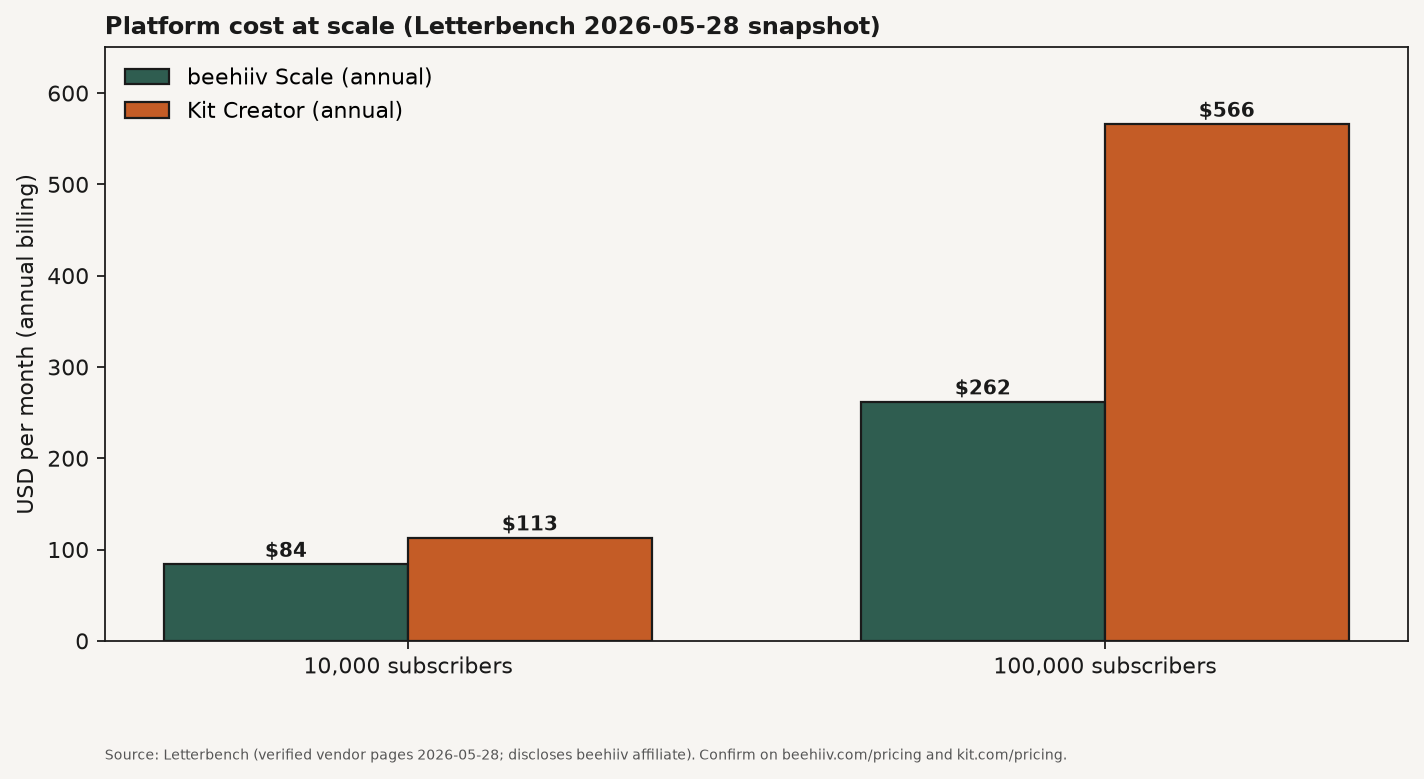
Source: Letterbench pricing verified from vendor pages on 2026-05-28 (discloses beehiiv affiliate). https://letterbench.com/beehiiv-vs-kit Confirm on beehiiv.com/pricing and kit.com/pricing before you budget.
They compare as different operating systems for the same inbox. Score free-tier traps, paid monthly cost at your real list size, native monetization take rates, and whether you need Kit-depth automations or beehiiv-native growth and ads. Then pick the tool that matches the model you already chose.
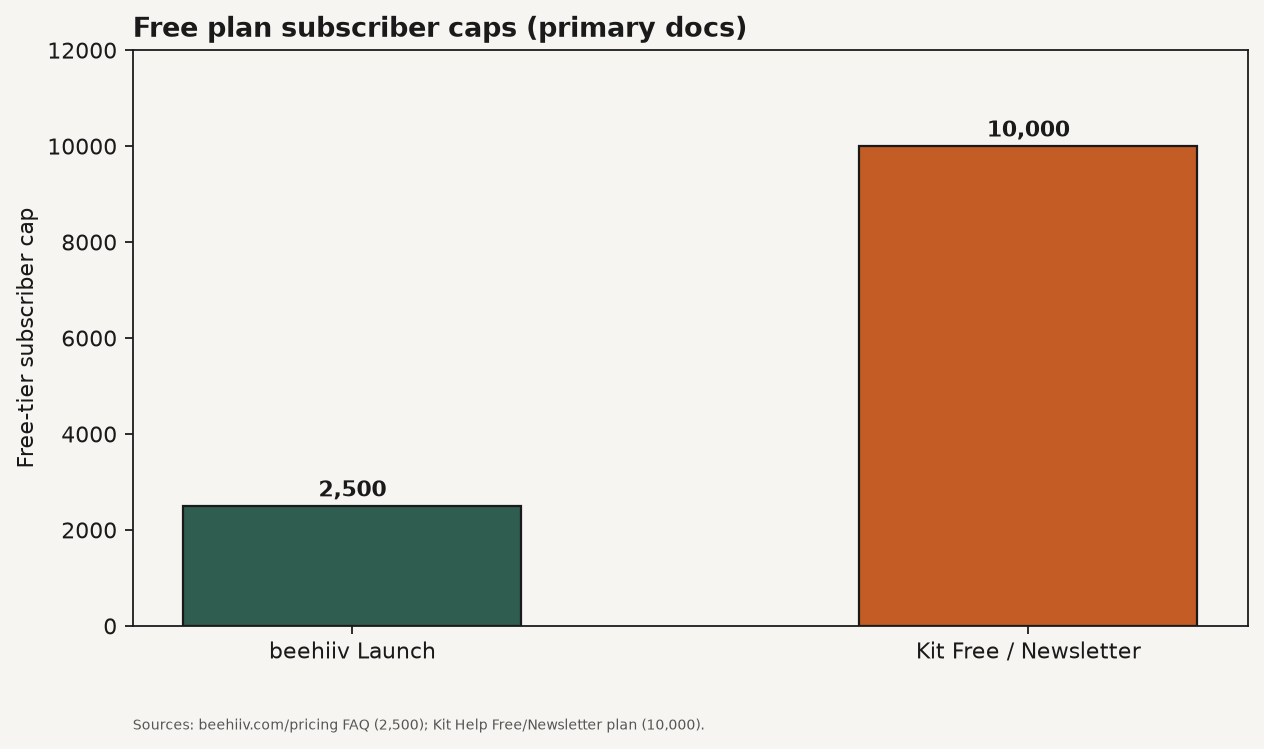
Source: beehiiv pricing FAQ (2,500 Launch) and Kit Help Free / Newsletter plan (10,000). https://www.beehiiv.com/pricing · https://help.kit.com/en/articles/16627071-the-kit-free-plan
| Dimension | beehiiv | Kit (formerly ConvertKit) |
|---|---|---|
| Primary job fit | Newsletter as product (media / growth / ads) | Newsletter as channel (products / funnels) |
| Free subscriber cap | 2,500 Launch (beehiiv) | 10,000 Free / Newsletter (Kit) |
| Free-tier catch | Monetization / advanced tools on paid | Kit-managed Recommendation; Kit keeps 100% of that slot’s Paid Rec earnings (Kit) |
| Paid entry (stated) | From $49/mo (beehiiv) | Creator from $39/mo at 1,000 subs (Kit) |
| Annual cost @ 10K (Letterbench 2026-05-28) | Scale about $84/mo | Creator about $113/mo |
| Annual cost @ 100K (Letterbench) | Scale about $262/mo | Creator about $566/mo |
| Paid subscription platform cut | 0% + Stripe (beehiiv) | Commerce / rec fees apply by product (see Kit pricing) |
| Native sponsor / ads rail | Ad Network on Scale+ | Paid Recommendations 23.5%; Sponsor Network notes in secondary sources |
| Automation depth | Available; simpler relative to Kit in most reviews | Visual automations and sequences are Kit’s core strength |
| Website / CMS | Built-in site tools | Landing pages / forms focus |
Letterbench discloses it earns beehiiv affiliate commission and verified prices on 2026-05-28. It also warns intermediate tiers may differ about 5-15% from interpolated breakpoints (Letterbench). Treat the ladder as a dated snapshot, not a forever contract.
| Subscribers | beehiiv (Letterbench annual Scale) | Kit Creator (Letterbench annual) | Notes |
|---|---|---|---|
| Free max | 2,500 | 10,000 | Primary vendor docs |
| 1,000 paid base | about $43/mo annual / $49 monthly | about $33/mo annual / $39 monthly | beehiiv FAQ + Kit Help + Letterbench |
| 5,000 | confirm calculator | about $89/mo monthly (Letterbench) | Prefer live slider |
| 10,000 | about $84/mo annual | about $113/mo annual | Letterbench May 28, 2026 |
| 100,000 | about $262/mo annual | about $566/mo annual | Matches Blog Herald ballpark |
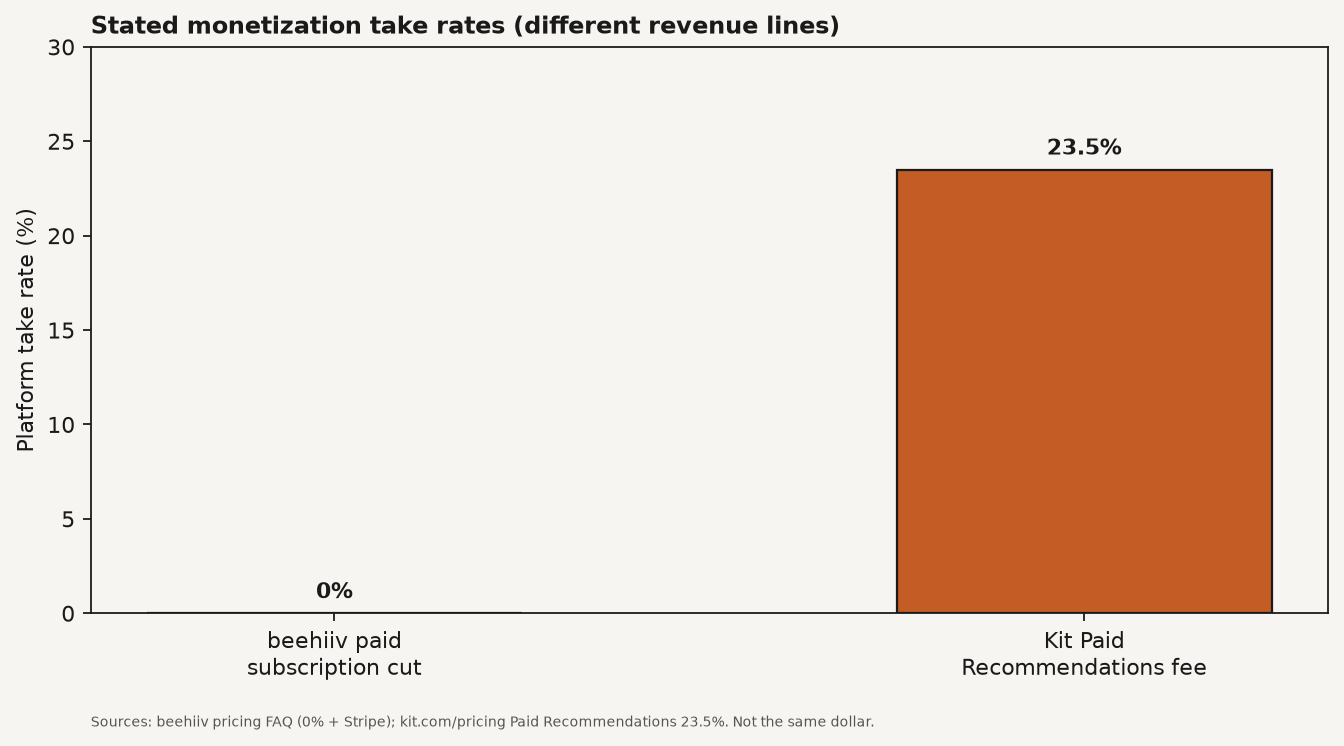
Source: Kit pricing page Paid Recommendations 23.5%; beehiiv pricing FAQ 0% paid subscription cut (Stripe separate). https://kit.com/pricing · https://www.beehiiv.com/pricing These are different revenue lines. Do not treat them as the same fee on the same dollar.
If you are a media-brand or hybrid operator selling inventory, beehiiv’s Scale stack (Ad Network, Boosts, growth tooling) matches the job. Still read Paved vs beehiiv before you assume network CPC replaces a media kit and direct IO.
If you are a creator-model operator selling courses, coaching, and gated offers, Kit’s automation and commerce depth often justify a higher seat price. Pair that with creator storefront and platform fee comparison when checkout lives outside the ESP.
If you are hybrid, pick the platform for the majority revenue line, then bolt the minority with integrations. Blog Herald’s about-70% heuristic is a planning shortcut, not a law (Blog Herald).
Letterbench’s migration notes are the boring part operators skip: CSV exports are clean; paid-subscriber Stripe re-auth can churn; automations and commerce products do not magically port (Letterbench). Budget rebuild days before you chase a monthly savings number.
Choosing beehiiv or Kit is a worksheet, not a Twitter poll. Name your majority revenue line first, price both platforms at your real subscriber count on the live calculators, price the free-tier catches in writing, and only then migrate.
These answers cover the ESP questions operators ask first: what beehiiv vs Kit means for newsletters, who should pick which platform, how free tiers differ, what paid scale costs look like today, and how this page differs from the Paved comparison.
Q: What is the difference between beehiiv and Kit for newsletters? A: beehiiv is built around the newsletter as a grow-and-monetize product (site, ads, Boosts, paid subs). Kit is built around email as a creator commerce and automation channel. Both send newsletters. They optimize different businesses.
Q: Who should choose beehiiv vs Kit? A: Choose beehiiv when most revenue is ads, paid subscriptions, and in-platform growth. Choose Kit when most revenue is digital products, coaching, and multi-step funnels. Hybrid operators should follow the majority line, then integrate the rest.
Q: How do the free plans compare? A: beehiiv Launch is free to 2,500 subscribers with unlimited sends. Kit Free / Newsletter is free to 10,000 subscribers, with a Kit-managed Recommendation slot Kit monetizes. Larger free cap is not automatically the better deal.
Q: Is beehiiv cheaper than Kit at scale? A: On Letterbench’s May 28, 2026 annual snapshot, Scale was about $84/mo at 10K and $262/mo at 100K, versus Kit Creator about $113/mo and $566/mo. Confirm your exact tier on each vendor calculator. Letterbench discloses a beehiiv affiliate relationship.
Q: How is this different from Paved vs beehiiv? A: beehiiv vs Kit compares email platforms and monetization tooling. Paved vs beehiiv ad network compares sponsorship fill rails and fee incidence once you are already sending. You may need both pages.
beehiiv vs Kit is a model-fit decision dressed up as a pricing page. Match the ESP to whether your newsletter is the product or the channel, price the free-tier catches, and confirm the paid slope at your real list size. If you want creators to sell a product you built, list it on feat..
Storefront vs landing page for selling digital products: Unbounce's 6.6% median LP CVR, Monetate-cited 2x vs stores, and when a multi-SKU shop wins.
A creator storefront is a shoppable page tied to a creator. Four surfaces: link hub, sell-own shop, retailer affiliate page, marketplace co-branded page.
Linktree vs storefront platforms: three jobs (link hub, sell-own, sell-others), published fees for Linktree, Beacons, and Stan, plus GMV break-even math.