Email Preference Center Best Practices
Preference center best practices: CAN-SPAM menu plus stop-all, Google one-click vs body preference pages, and SendGrid's labeled 20% unsub drop.
Paved vs beehiiv ad network compared: Paved's 30%/50% publisher cuts, beehiiv's $15k brand minimum, and who keeps a $1,000 sponsorship dollar.

TL;DR: Paved vs beehiiv ad network is a fee-incidence choice. Paved takes 30% of Marketplace bookings and 50% of Ad Network earnings from publishers. beehiiv pays CPC/CPM offers to Scale publishers while brand campaigns start at $15k. On a labeled $1,000 Marketplace booking, Paved leaves $700.
Publishers ask which logo fills remnant slots. Buyers ask which dashboard books inbox attention. Both questions skip the cut. Paved vs beehiiv ad network is not a feature checklist. It is who pays the platform, who picks the newsletter, and what is left after a completed campaign.
The full cluster map lives in the email marketing guide.
Pair this comparison with newsletter sponsorship rates by subscriber count, how to build a newsletter media kit, email marketing benchmarks by industry, digital product vs sponsorship revenue, and creator platform fee comparison.
Paved vs beehiiv ad network means comparing two newsletter monetization rails that both place brand messages in opted-in email, but bill the platform fee on different sides of the deal and give different control over which list runs the ad. Paved is a marketplace plus performance network. beehiiv’s Ad Network is an offer feed for beehiiv senders.
That definition already separates three jobs operators mash together. First, remnant fill when direct sales are quiet. Second, handpicked placements when brand fit matters. Third, direct outbound with your own media kit and rate bands. Networks do not replace the third job. They price the first two.
Community language matches the fork. r/beehiiv threads contrast network CPC with traditional flat sponsors. r/Newsletters asks whether Paved works for sub-1K lists and whether Booker under $500 is commission-free (r/beehiiv; r/Newsletters). Anecdotes are demand evidence, not fee schedules.
Fee incidence matters because a “free for advertisers” marketplace can still shrink publisher take-home, and an advertiser-funded network can still lock small brands out with a five-figure minimum. Read the cut before you read the case study on either landing page.
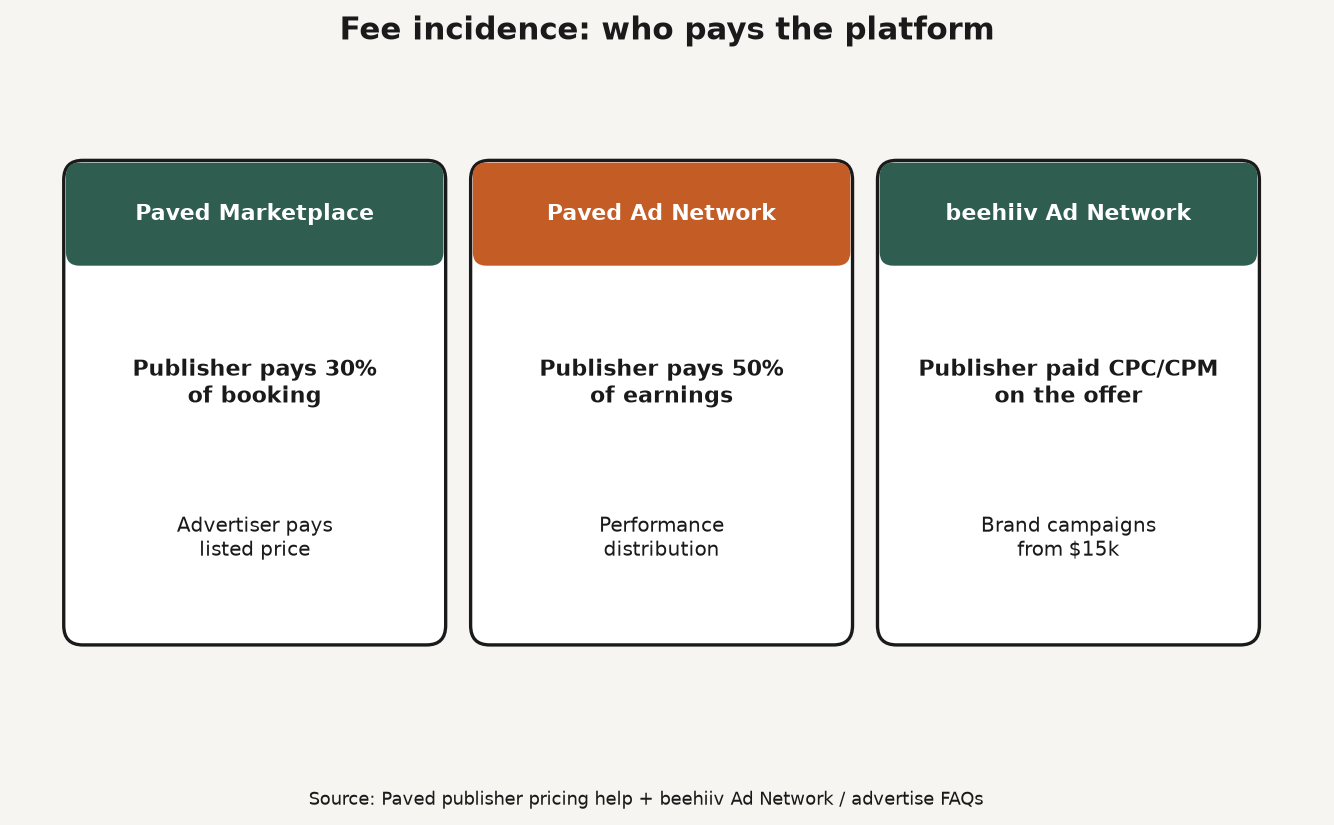
Source: Paved publisher pricing help + beehiiv Ad Network / advertise FAQs. https://www.paved.com/help/articles/8124389-paved-s-pricing-for-publishers
How Paved and beehiiv compare is a three-row decision: product path, fee incidence, and buyer gate. Start with who brings demand. Then run labeled take-home math on a fixed $1,000 so the percentage is not abstract. Skip blended eCPM tables that invent a single market rate.
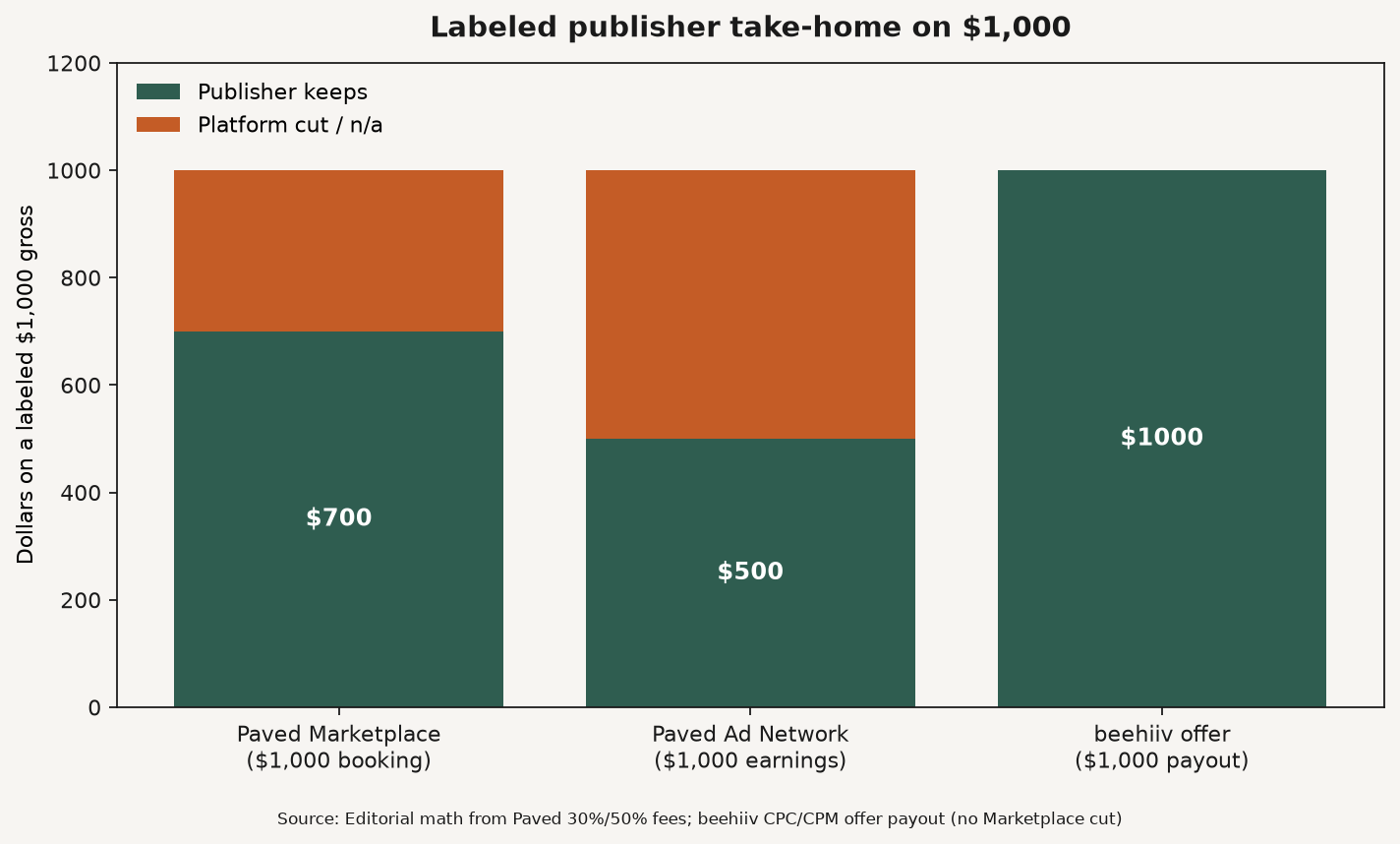
Source: Editorial math from Paved 30%/50% help-center fees and beehiiv CPC/CPM offer payouts (no Marketplace booking cut). See citation log.
| Dimension | Paved Marketplace | Paved Ad Network | beehiiv Ad Network |
|---|---|---|---|
| What it is | Browse and book specific newsletters | Matched distribution across network | Offer feed for beehiiv senders |
| Who picks the list | Advertiser | Paved matching | Publisher accepts/declines offers |
| Publisher fee (official) | 30% of booking | 50% of performance earnings | No 30% Marketplace-style booking cut; paid on CPC/CPM offer |
| Advertiser gate | No platform fee or monthly minimum; pay listed price | Campaign budget on network | Campaigns start at $15k |
| Hosting lock-in | Multi-ESP marketplace | Multi-ESP network | Must send on beehiiv |
| Exclusivity | Not required by Paved pricing docs | Same | Non-exclusive; can run direct too |
| Best fit | Handpicked brand-fit tests | Scale / performance volume | Remnant fill + low sales ops on beehiiv |
Sources: Paved Marketplace vs Ad Network, Paved pricing, beehiiv Ad Network, beehiiv advertise.
Hold the gross at $1,000 so the cut is visible.
| Path | Gross | Platform cut language | Publisher keeps (labeled) |
|---|---|---|---|
| Paved Marketplace booking | $1,000 | 30% of booking | $700 |
| Paved Ad Network earnings | $1,000 | 50% of performance earnings | $500 |
| beehiiv Ad Network offer | $1,000 CPC/CPM payout | Offer pays publisher on verified opens/clicks | $1,000 of that offer |
This table is fee math, not a promise that every campaign clears $1,000. beehiiv states estimated payouts are not guarantees and verified clicks can sit below raw post metrics (beehiiv).
Those rules matter more than a landing-page ROAS anecdote when you are planning calendar fill.
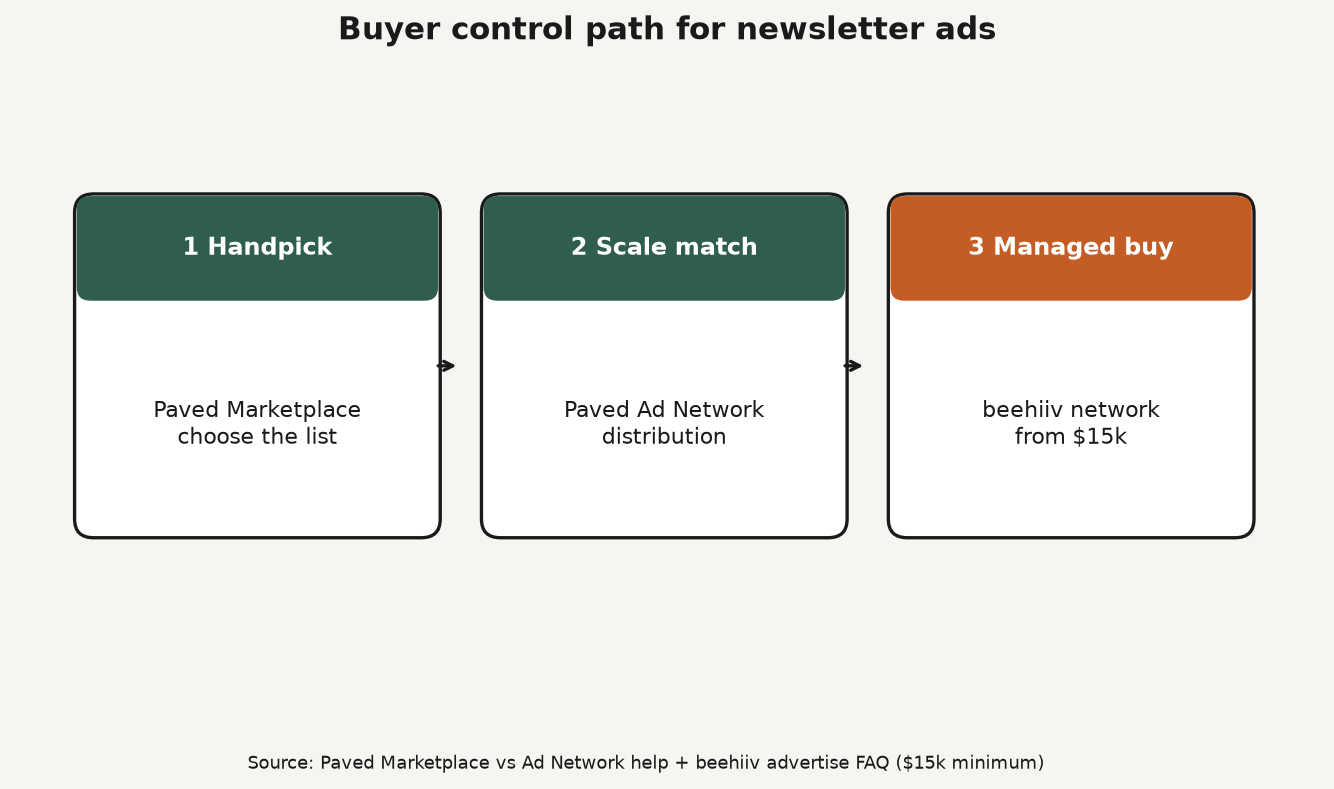
Source: Paved Marketplace vs Ad Network help + beehiiv advertise FAQ ($15k minimum). Editorial framework.
Secondary sites “report” Paved subscriber floors such as 25,000 / 50,000. Those are not quoted from Paved’s pricing page in this research run. Treat them as reported planning language until Paved publishes them in help docs. Do not chart them as official.
There is no public dataset for one official blended eCPM that makes Paved and beehiiv comparable on a single bar. Network fill rates, category CPMs scraped from private dashboards, and “average advertiser spends $50k/month” claims from secondary blogs stay out of the primary charts. Use fee incidence and the $15k gate instead.
Common mistakes in Paved vs beehiiv decisions are fee blindness, stale minimums, and treating network fill as your direct rate card. Fix the math and the live help-center fee numbers before you blame the niche, the audience, or the creative.
These answers cover the comparison questions operators ask first: what Paved vs beehiiv means, the live fee cuts, the beehiiv brand minimum, who keeps more of a dollar, and whether you still need direct sales. Use them as planning language, not as earned income promises.
Q: What is the difference between Paved and the beehiiv Ad Network? A: Paved is a multi-ESP sponsorship marketplace plus a performance Ad Network. beehiiv’s Ad Network is an offer feed for newsletters that send on beehiiv, paying publishers on CPC or CPM. Paved buyers can handpick lists on Marketplace; beehiiv brand campaigns are managed with a $15k starting gate.
Q: What commission does Paved take from publishers? A: Paved’s publisher pricing page states 30% on Marketplace bookings and 50% on Ad Network performance-based earnings, with fees only on completed campaigns. Booker is free aside from a small Stripe processing fee. Always re-check the help center before you model a year of inventory.
Q: What is the beehiiv Ad Network minimum spend for advertisers? A: beehiiv’s advertise FAQ says campaigns start at $15k, with many high-performing first buys in the $15k-$30k range over 4-6 weeks. Older secondary blogs that still say $10k are stale relative to that page.
Q: Who keeps more of a $1,000 sponsorship dollar? A: On a labeled $1,000 Paved Marketplace booking, the publisher keeps $700 after 30%. On $1,000 of Paved Ad Network earnings, $500 after 50%. A beehiiv offer that pays $1,000 in CPC/CPM leaves that $1,000 with the publisher as offer payout, while brand budgets still have to clear the $15k campaign floor.
Q: Should small newsletters skip networks and sell direct? A: Often yes for premium inventory. Networks help with remnant fill and sales ops, but direct deals need a proof pack and a price table. Start with how to build a newsletter media kit and sponsorship rates by subscriber count, then use network offers for slots you did not sell.
Paved vs beehiiv ad network is a fee-incidence and control choice. Model Paved at 30% Marketplace and 50% Ad Network, model beehiiv brand buys from $15k, and keep direct sales for inventory you can price yourself. If you also sell a product through creators, list it on feat..
Preference center best practices: CAN-SPAM menu plus stop-all, Google one-click vs body preference pages, and SendGrid's labeled 20% unsub drop.
Mailchimp vs Klaviyo: contact billing fork, send multipliers (10x/12x/15x), starting prices, and when ecommerce depth beats a general ESP.
Email list growth benchmarks: Omnisend 1.24B popup displays at 2.1%, form-type ladder, and levers that beat the average without inventing MoM %s.