Affiliate Marketing for Startups: Complete Guide
Affiliate marketing for startups is an operating system—locks, cost, recruit, rates, tracking, first 100 sales, then diagnose a flat roster.
Compare the best affiliate marketing tools by job: Amazon, Awin, Rewardful, Tapfiliate, and feat. storefronts. Stack layers. Skip mixed 22-logo lists.

TL;DR: The best affiliate marketing tools are a four-layer stack, not a 22-logo ranking. Layer 1 is the monetization surface (Amazon catalog, a shop, or a co-branded storefront such as feat.). Layer 2 is in-house tracking software (Rewardful and FirstPromoter start at $49/month; Tapfiliate Launch is $89/month). Layer 3 is a network or partnership cloud when you need discovery. Layer 4 is SEO, email, and link managers. Those last tools never replace the contract.
Most roundups of the best affiliate marketing tools dump Surfer, Awin, Rewardful, and Canva into one table. That is how you buy the wrong seat. An SEO editor does not pay your creator. A SaaS tracker does not give you Amazon’s catalog. A classic network does not fork an on-brand checkout for the people who already promote your product.
If you searched “best affiliate marketing” hoping for one winner, stop. Best affiliate marketing is a stack problem. Pick the layer that is missing, then add the next layer only when a real limit shows up.
This page sits next to best affiliate marketing platforms compared (network types and the ShareASale-to-Awin close). Here the job is tools: what you install, join, or generate so a click can become a paid split.
Key takeaways:
The best affiliate marketing tools are the software, networks, and selling surfaces that let a merchant or affiliate track a qualifying event and pay (or get paid) when it clears, plus the production apps that feed those clicks.
That definition is wider than “affiliate marketing software.” Software is one layer. Amazon Associates is not software you install on Shopify. Awin is not a WordPress cloaker. feat. is not a keyword research suite. Mixing them is the mistake Reddit operators keep naming: comparing performance networks to structured partner platforms as if they were the same product (r/AffiliateOps).
Four layers, in the order you should hire them:
The contract mechanics (ID, window, event, approval, payout, disclosure) are unchanged. Read how affiliate marketing works if you need that spine first.
Wrong tool choice looks like a content problem. It is usually a layer mismatch.
Why this comparison exists:
Compare layers first, then vendors inside one layer. Score a candidate on job fit, meter (revenue vs conversions vs network cut), cookie and payout rules, and who recruits the partner. Do not score it on recycled “average commission” integers. There is no public dataset for a global earnings crown.
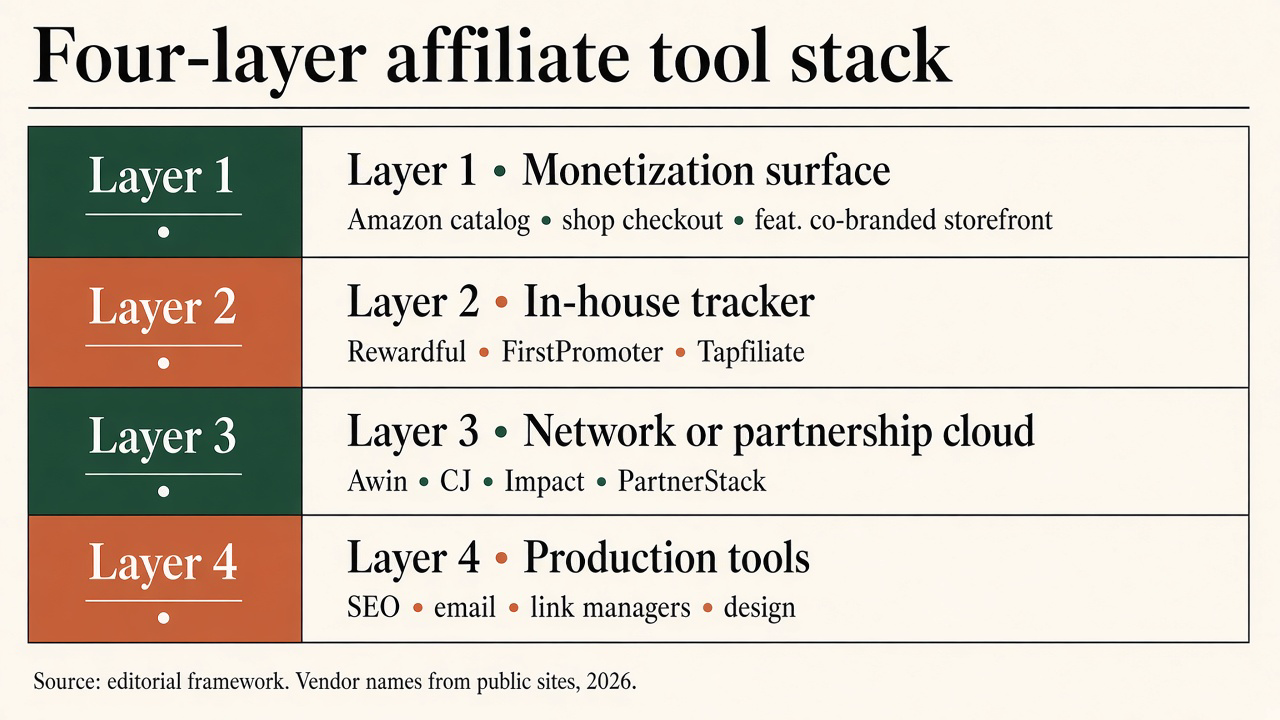
Source: Editorial Four-Layer Stack for this article. Vendor examples from Rewardful, FirstPromoter, Tapfiliate, Amazon Associates, and Awin public pages (accessed 2026-10-05).
A surface is where the buyer pays and whose brand they trust at checkout.
| Surface | Who it is for | What you get | What you give up |
|---|---|---|---|
| Amazon Associates | Affiliates monetizing broad product content | Huge catalog; published US category rates | Many verticals at 1%-4%; 24-hour cart-add window |
| Classic shop checkout + tracker | Merchants who already own the store | Your SKUs, your AOV, your refund policy | You must recruit and brief partners |
| Co-branded storefront (feat.) | Merchants who can name promoters; affiliates who want an on-brand page | Forked storefront after approval (handle, tracked URL, brand kit); split on the sale | feat. does not recruit affiliates for you; fees are shown in-product, not invented here |
| In-app shops (e.g. TikTok Shop) | Native social commerce | In-app discovery and seller-set rates | Platform rules and payout clocks you do not control |
Amazon. Use it when the page is a review or roundup of products Amazon actually stocks. Cite Table 1, not a blogger’s memory. Luxury Beauty and Amazon Explore pay 10%. Physical books, kitchen, and automotive pay 4.5%. Grocery and health and personal care pay 1%. Gift cards and several excluded lines pay 0% (Amazon). Qualifying items must hit the cart within 24 hours of the Associates click. Items that made the cart in that window can still convert until the cart expires, usually about 90 days (Amazon).
feat. advantages for users (plain, not a fee claim). Merchants list a product, set reward terms, and approve pitches. Approval generates a co-branded storefront instead of a new landing page built by hand for every promoter. Affiliates get their handle and a trackable URL on the same brand kit, then earn on attributed sales. Buyers check out on that page. Marketplace listing is optional. feat. does not promise traffic, approvals, or income (feat. FAQ / Terms). If you need Amazon’s catalog, stay on Amazon. If you need enterprise partnership ops across coupon, creator, and affiliate teams, that is Impact’s job, not feat.'s. If you already have people selling the event, the book, or the product, the missing tool is usually the storefront-plus-split, not another SEO login.
Creator checkout fees for selling your own digital goods (Gumroad, Stan, Whop) are a different comparison: creator platform fee comparison.
This is what people mean by “best affiliate marketing software.” You run your program on your offer.
| Tool | Entry sticker (monthly) | What the bill grows with | Trial | Best job |
|---|---|---|---|---|
| Rewardful | $49 | Affiliate-attributed revenue (Starter up to $7,500/mo) | 14 days | Stripe/Paddle SaaS, recurring commissions, 0% take of attributed revenue on the subscription |
| FirstPromoter | $49 | Affiliate-driven revenue (Starter up to $5,000/mo; max 1,000 affiliates on Starter) | 14 days, no card | SaaS/subscription programs that want links, coupons, and direct URLs |
| Tapfiliate | $89 Launch ($74/mo annual) | Clicks/conversions (Launch includes 500 conversions/mo); Scale $179/mo for unlimited affiliates and programs | 7 / 14 / 30 days by plan | Shopify/commerce catalogs and multi-integration tracking |
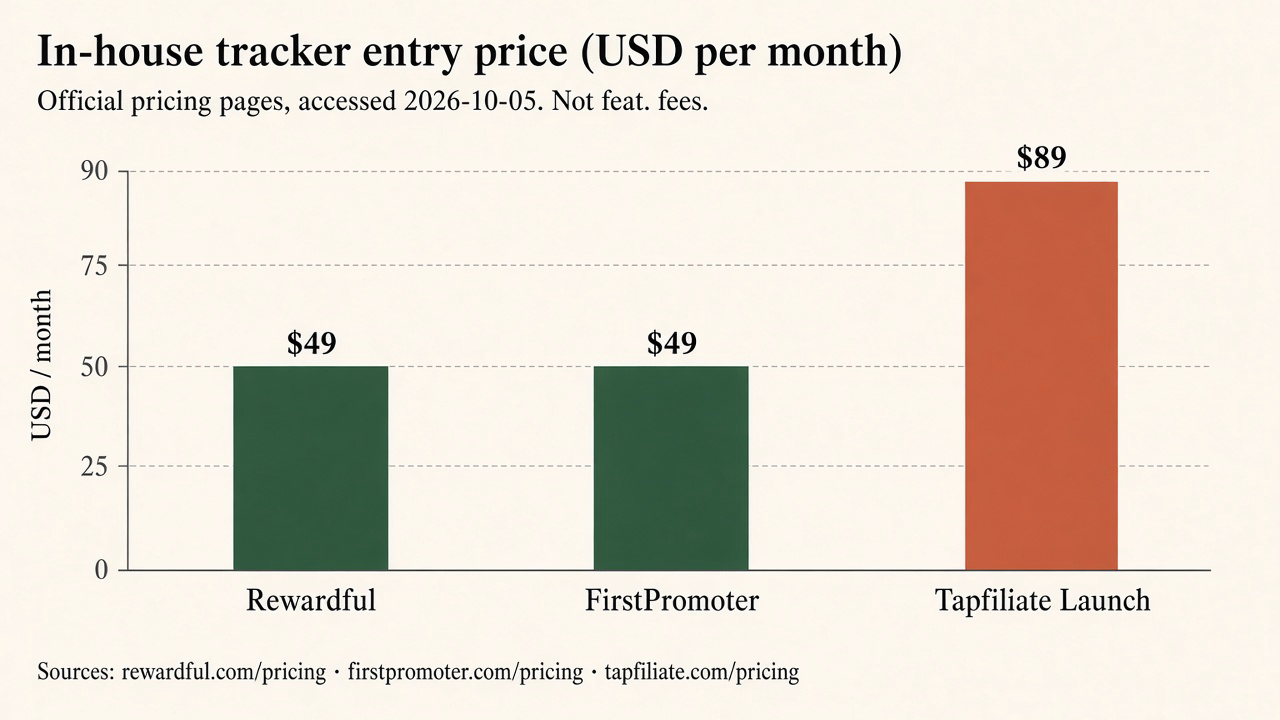
Source: Rewardful, FirstPromoter, and Tapfiliate official pricing pages, accessed 2026-10-05. https://www.rewardful.com/pricing https://firstpromoter.com/pricing https://tapfiliate.com/pricing/
Read the fine print on “0% transaction fees.” Rewardful’s subscription does not take a percentage of affiliate-attributed revenue. Optional Managed Payouts adds a 3% processing fee on payouts, and Stripe/PayPal/Wise still charge their own rates (Rewardful). FirstPromoter Starter caps affiliates at 1,000 and campaigns at 3 on that tier (FirstPromoter). Tapfiliate Scale is how you leave the Launch conversion cap.
SaaS founders on Reddit keep saying PartnerStack and Impact are overkill at this stage, and that FirstPromoter or Rewardful is the sane tracker (r/Affiliatemarketing). That is a layer-2 comment, not a slam on networks.
Join a network when you need other merchants (affiliate) or other partners (merchant) at a volume your inbox cannot recruit.
Awin is the live classic-network seat for programs that used to live on ShareASale (Awin). CJ remains a large publisher marketplace; roundups still treat publisher signup as free (Hostinger; CJ). Impact is the partnership-cloud ops layer. PartnerStack is the B2B SaaS partner marketplace. None of those generate a feat.-style co-branded fork of your indie offer the day you approve a pitch.
Affiliates like networks for one dashboard and one payout across many brands. Merchants pay for that convenience, sometimes with less data control. That tradeoff is old and still accurate in operator language (r/AffiliateSoftware).
Keyword tools, newsletter platforms, Canva, GA4, and cloaking plugins help you publish. They do not attribute a Shopify order or split a Stripe payment. Hostinger is not wrong that a serious affiliate business uses them. It is wrong when the headline “best affiliate marketing tools” implies Pretty Links competes with Rewardful.
Paid-traffic trackers (Hostinger lists Voluum from $89/month) belong here or in media buying, not in your first merchant program (Hostinger).
| Your job | Buy first | Add second | Do not buy first |
|---|---|---|---|
| Monetize review content | Amazon Associates | Awin or CJ for brand programs | Rewardful (you do not own Amazon’s checkout) |
| Launch a Stripe SaaS affiliate program | Rewardful or FirstPromoter | PartnerStack when you need a partner marketplace | Amazon category table |
| Run a Shopify catalog program | Shopify app or Tapfiliate | Impact only if multi-surface ops demand it | SEO suite as “affiliate software” |
| Pay people who already promote your product | Co-branded storefront (feat.) | One tracker or network for overflow | Five networks before one live storefront |
| Find software to promote as an affiliate | PartnerStack, Impact, or vendor portals | Direct programs | Treating feat. as a replacement for Amazon |
| Rank blog posts | Search Console + one SEO tool | Buying Impact to “do SEO” |
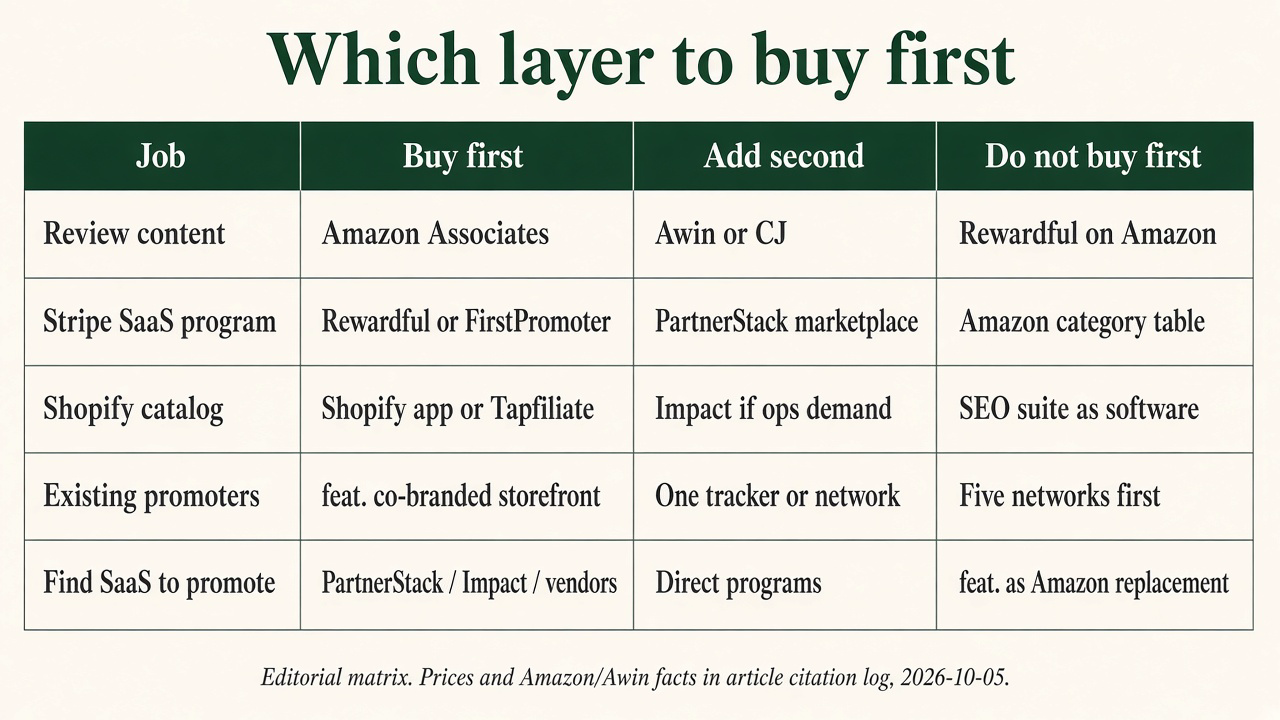
Source: Editorial matrix. Prices and Amazon/Awin facts from the citation log (accessed 2026-10-05).
Pick one primary layer, ship one tracked path, then add a seat. Each step is at most two sentences.
Q: What are the best affiliate marketing tools for beginners? A: Affiliates starting with product content usually join Amazon Associates first because the catalog is wide and the US rates are published. Merchants starting a program on their own Stripe or Shopify offer should pick a layer-2 tracker (Rewardful or FirstPromoter from $49/month, or Tapfiliate Launch at $89/month), not an enterprise partnership cloud. There is no public dataset that makes one beginner stack universal.
Q: What is the difference between affiliate marketing tools and affiliate marketing platforms? A: In practice, “tools” is the mixed bag (software plus SEO plus networks). “Platforms” on our site means the seat types: catalog, classic network, partnership cloud, SaaS partner platform, or direct storefront. Use this page to build a stack. Use the platforms comparison to pick a network type.
Q: Is feat. better than Amazon Associates or Impact? A: Different jobs. Amazon is a catalog you do not own. Impact is partnership ops for large, multi-surface programs. feat. forks a co-branded storefront when a merchant already has promoters to approve. If you need Amazon’s SKUs or Impact’s enterprise workflow, feat. is the wrong primary seat.
Q: How much do the best affiliate marketing tools cost? A: In-house SaaS trackers in this research start at $49/month (Rewardful, FirstPromoter) or $89/month (Tapfiliate Launch). Publisher access to Amazon and many network programs is not a SaaS seat fee, but commissions and cookie rules still apply. feat. listing fees and platform cut are shown in-product. We do not invent them here.
Q: Do I need SEO tools if I already have an affiliate network? A: Only if you publish content that must rank or convert on your site. An SEO suite does not track commissions or pay creators. Buy production tools after the tracked path works.
The best affiliate marketing tools are the smallest stack that matches the job. Surface, tracker, network, then production. Amazon wins catalog coverage. Rewardful and FirstPromoter win simple Stripe programs at a $49 start. Tapfiliate Launch is $89, not the stale $119 some listicles still print. feat. wins when the missing piece is a co-branded storefront and a split for people you can already name.
If you built the product and need those people to sell it with a page they did not have to design, start on feat..
Affiliate marketing for startups is an operating system—locks, cost, recruit, rates, tracking, first 100 sales, then diagnose a flat roster.
How to track affiliate sales: pick link cookie, coupon, pixel, S2S postback, or storefront checkout—then match Rewardful, Tapfiliate, or Impact.
Best affiliate programs for SaaS companies pass the Recurring Cap Test: labeled duration, cookie, seat type, payout rails—plus Rewardful’s ~24% planning band.