How to Turn Your Audience Into a Distribution Channel
Turn your audience into a distribution channel with a five-rung ladder—attention, trust, offer, sales surface, and economics—not follower vanity.
How to sell someone else's product online: affiliate link, co-branded storefront, dropshipping, or reselling. Compare what you own, risk, and keep.

TL;DR: There are four ways to sell someone else’s product online: an affiliate link, a co-branded storefront, dropshipping, or reselling. They differ in what you take on. A link or a storefront leaves the inventory, checkout, and refunds with the maker. Dropshipping makes you the store. Reselling makes you the owner of the stock. Pick the lowest rung that still pays.
Most people who search how to sell someone else’s product online are not asking for a side hustle. They are asking for a way to earn on a product they believe in without becoming a warehouse, a support desk, or a retailer by accident. The internet answers that with three separate listicles: affiliate marketing, dropshipping, reselling. Each one hides what you sign up to own.
I have sat on both sides of the commission. As a merchant I have paid it. As a promoter I have earned it. The question that decides everything is not “which model is trendy.” It is “what do I end up holding when a buyer clicks pay.”
Selling someone else’s product online means earning money when a buyer purchases an item you did not make, either by referring the buyer to the maker or by acting as the store yourself.
That definition hides a fork. In the referral version, you are a promoter. The maker is the seller of record, ships the order, and handles the refund. You earn a commission the maker sets. In the store version, you are the seller of record. The buyer pays you. If the box shows up broken, the email lands in your inbox.
The confusion in most guides comes from lumping both versions together as “selling other people’s products.” They are different businesses. One is distribution. The other is retail. The Ownership Ladder below separates them by what you take on.
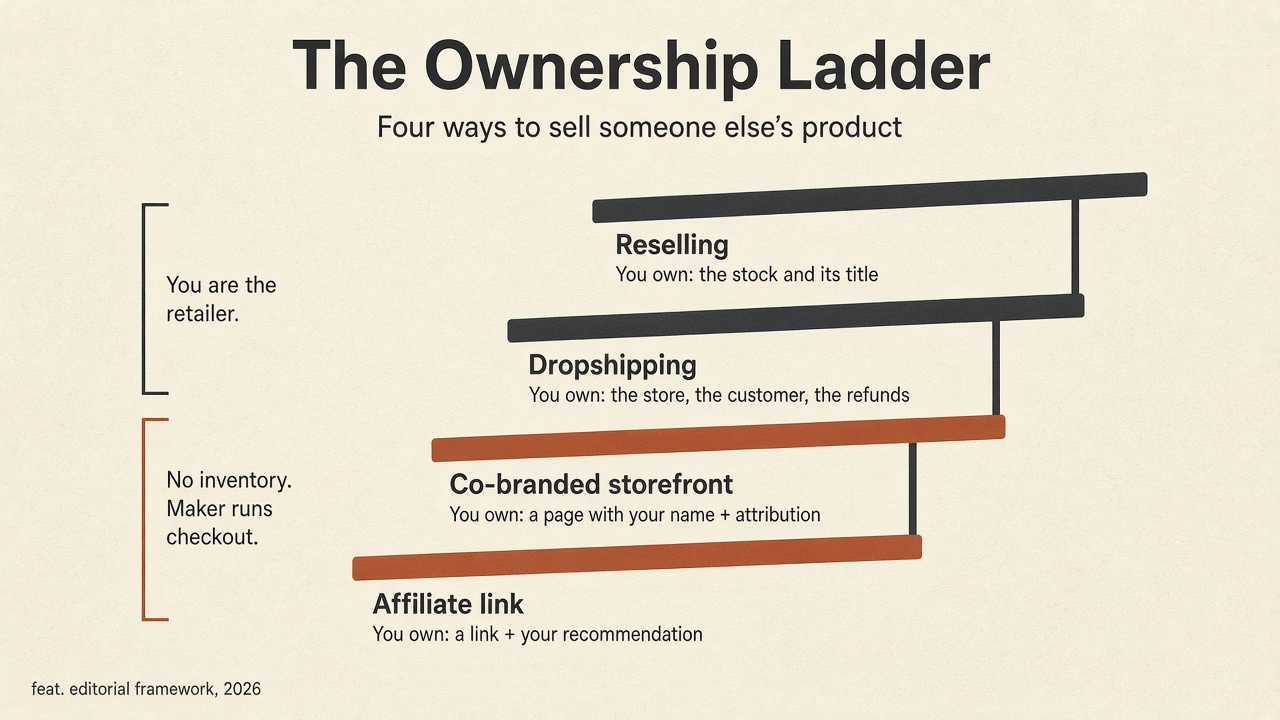
Source: feat. editorial framework, 2026. Legal basis for the resale rung: 17 U.S.C. 109(a). https://uscode.house.gov/view.xhtml?req=(title%3A17+section%3A109+edition%3Aprelim).
The model you pick decides your cash risk, your workload, and your legal exposure before you make a single sale. Two people can sell the same product and carry completely different businesses: one owns a link and a recommendation, the other owns a store, a refund queue, and a payment processor relationship. Choose the rung on purpose.
You can sell someone else’s product four ways. An affiliate link refers buyers to the maker’s checkout for a commission. A co-branded storefront gives you an approved page with your name on the maker’s offer. Dropshipping makes you the store while a supplier ships. Reselling means you buy genuine stock and sell it on. The first two need no inventory.
| Rung | What you own | Inventory | Who runs checkout | Who handles refunds | What you keep | Startup cash |
|---|---|---|---|---|---|---|
| Affiliate link | A tracking link and your recommendation | None | Maker | Maker | Commission the maker sets (Amazon 0%-10% by category) | None |
| Co-branded storefront | A sell page with your name, plus attribution | None | Maker, split at checkout | Maker | Commission the maker sets (Shopify bands 5%-15% physical, 20%-50% digital) | None |
| Dropshipping | The store, the customer, the payment relationship | None held, but you buy each unit after the sale | You | You | Gross margin (10%-15% open marketplace, 20%-50% Collective), before ads | Store, apps, ads |
| Reselling | The stock and its title | Yes | You or a marketplace | You | Your markup minus fees and unsold stock | Inventory |
Sources: Amazon Associates Table 1 (accessed 2026). Shopify affiliate commission guide (2026). Shopify, What Is Dropshipping (2026).
Use one of the first two rungs. With an affiliate link, you join the maker’s program, share a tracked URL, and get paid when a buyer purchases within the attribution window. Windows are short on big marketplaces: Amazon requires the item to be added to the cart within 24 hours of the click (Amazon Associates). Platform programs set their own ranges. TikTok Shop lets sellers set affiliate commissions between 1% and 80% of order value on targeted collaborations (TikTok Shop), covered in TikTok Shop affiliate marketing explained.
With a co-branded storefront, the maker approves you and you get your own sell page: your handle, the maker’s product, the maker’s checkout, and your attribution baked into the URL. That is the difference between a link and a storefront, covered in depth in affiliate marketing vs storefront. A link sends traffic to a page written for everyone. A storefront is a page that says the product came recommended by you.
Yes, as long as you sell as the maker’s promoter, not as the seller of record. On the affiliate and storefront rungs, the maker owns the product, and you hold permission to promote it. On the dropshipping rung, you never take delivery of the item, but you are the store, so you need a real supply agreement and you answer to the buyer.
If you want to be the store and hold the stock, you need to own it. In US copyright law, the first sale doctrine lets the owner of a lawfully made copy sell it without the copyright owner’s permission (17 U.S.C. 109(a)), and the Supreme Court held in Kirtsaeng v. John Wiley & Sons (2013) that this applies to copies made abroad (LII). In trademark law, the Ninth Circuit held in Sebastian v. Longs Drug Stores (1995) that reselling genuine goods under the producer’s mark, “and nothing more,” is not infringement (FindLaw). The limits matter: materially different goods, repackaging, or implying you are an authorized dealer can break that protection (Fordham IPLJ, 2022). This is not legal advice. Talk to a lawyer before you resell a brand at scale.
It depends on what you have. If you have an audience, even a small one, a link or a storefront keeps all of your effort on selling. If you have ad budget and want to own the customer list, dropshipping gives you that, at the price of support and refunds. The r/ecommerce thread had the sharpest line on it: “Dropshipping is a fulfillment model, not a business plan” (r/ecommerce).
My bias as a founder: most people asking this question want the earnings of a store without the liabilities of a store. That is the storefront rung. You get a page that is yours, a product you did not have to build, and a checkout you do not have to support.
At published bands, a $100 sale returns $0 to $10 through Amazon Associates, $5 to $15 on a physical-goods affiliate program, and $20 to $50 on a digital product. A dropshipped $100 sale shows $10 to $15 of gross margin from open marketplaces or $20 to $50 from vetted suppliers, but that is before ads.
| Path | Published band | Kept on a $100 sale | What the number is |
|---|---|---|---|
| Amazon Associates | 0%-10% by category | $0-$10 | Commission, no product cost |
| Physical-goods affiliate program | 5%-15% | $5-$15 | Commission, no product cost |
| Digital-product affiliate program | 20%-50% | $20-$50 | Commission, no product cost |
| Dropshipping, open marketplace suppliers | 10%-15% | $10-$15 | Gross margin, before ads and refunds |
| Dropshipping, vetted suppliers (Shopify Collective) | 20%-50% | $20-$50 | Gross margin, before ads and refunds |
Source: Amazon Associates, 2026. https://affiliate-program.amazon.com/help/node/topic/GRXPHT8U84RAYDXZ. Shopify, 2026. https://www.shopify.com/blog/affiliate-commission and https://www.shopify.com/blog/what-is-dropshipping. Editorial arithmetic on a $100 sale.
What nobody can tell you is average income. There is no public dataset of what people earn selling other people’s products across these four models. Anyone quoting one is selling a course. What is known is the envelope, and the fact that most link-holders never sell: Rewardful found only 1.28% of affiliates generate a sale across 2,847 SaaS programs (Rewardful, 2026). The rung does not do the selling. You do.
feat. is the storefront rung. Makers list products on the feat. marketplace. You browse for free and pitch to promote. There is no minimum follower count. When the maker approves you, feat. creates a co-branded storefront with your handle and a trackable link. Checkout runs on Stripe and splits each sale between the maker’s net, your commission, and the platform fee. The maker sets the commission and owns fulfillment. feat. does not guarantee sales, approvals, or payouts.
The honest tradeoff: Amazon has more products than any storefront marketplace, and dropshipping lets you own the customer. feat. is strongest for digital products, apps, memberships, and paid meetings, where there is nothing to ship and the commission bands run highest.
These six steps get you from “I like this product” to a tracked first sale without buying stock. Start on the lowest rung that pays, and only climb when you need something that rung cannot give you, like owning the customer list.
Q: How do I sell someone else’s product online without inventory? A: Join the maker’s affiliate program or get approved for a co-branded storefront. You share a tracked link or page, the maker runs checkout and ships, and you earn the commission the maker sets.
Q: Can I sell products I don’t own? A: Yes, as the maker’s approved promoter, because the maker stays the seller of record. To be the store and hold the stock, you must own genuine goods; the first sale doctrine allows that resale with limits on altered goods and implied affiliation.
Q: Is affiliate marketing or dropshipping better for selling other people’s products? A: Affiliate marketing is better if you want no inventory, no support queue, and no ad spend before your first sale. Dropshipping fits if you want to own the customer and can fund ads, since Shopify puts open-marketplace margins at 10% to 15% before ads.
Q: How much can you make selling other people’s products? A: No public dataset reports average earnings across these models. Published envelopes run from 0% to 10% on Amazon to 20% to 50% on digital affiliate programs, and your results depend on audience and offer fit.
Q: Do I need a big audience to sell someone else’s product? A: No. Makers approve promoters on fit, and on feat. there is no minimum follower count. A small audience that trusts your recommendation can outsell a large one that does not.
Selling a product you did not make comes down to one decision: how much of the business you want to hold. A link or a co-branded storefront leaves the stock, the checkout, and the refunds with the maker, and pays you the commission they set. Dropshipping and reselling make you the retailer, with the margin, the customer, and the liabilities. Climb only when the lower rung stops paying. If you want a product to sell from a page with your name on it, browse the feat. marketplace.
Turn your audience into a distribution channel with a five-rung ladder—attention, trust, offer, sales surface, and economics—not follower vanity.
Affiliate marketing for small creators works on trust density: one problem, one offer class, one surface, EPC math (median ~$0.14), FTC disclosure—not a follower floor.
How to create a storefront as a creator: name the job (route, sell-own, sell-others), pick Linktree, Stan, Beacons, or a co-branded page, then ship one hero offer.