Affiliate Marketing for Startups: Complete Guide
Affiliate marketing for startups is an operating system—locks, cost, recruit, rates, tracking, first 100 sales, then diagnose a flat roster.
Affiliate marketing tax implications: IRS 2026 1099-NEC $2,000 threshold, Schedule C, and SE tax for US merchants and affiliates. Not tax advice.

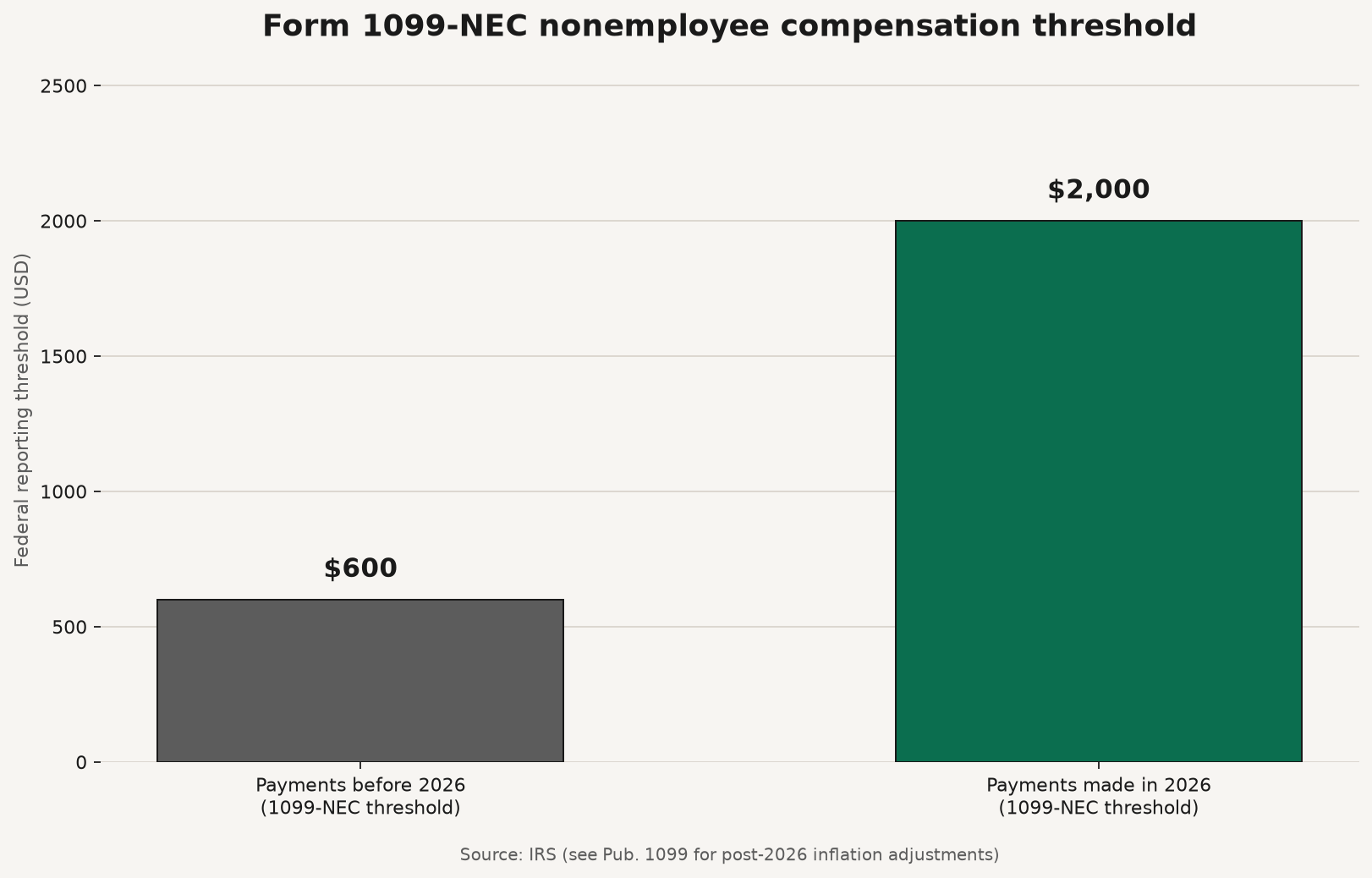
TL;DR: Affiliate marketing tax implications split into two jobs. Merchants may need Form 1099-NEC when US nonemployee commission totals hit the federal threshold ($600 before 2026 payments, $2,000 for 2026 payments). Affiliates generally report net profit on Schedule C and may owe 15.3% self-employment tax. No 1099 does not mean no tax. Not tax advice.
Disclaimer: This article summarizes publicly available US federal IRS guidance for education. It is not legal, tax, or accounting advice. Rules change. State and foreign rules differ. Talk to a qualified tax professional about your facts.
Affiliate programs create tracked commissions. Tax rules care about who paid whom, for what services, and whether an information return is due. Most blog posts still open with a $600 line and stop there.
Affiliate marketing tax implications matter on both sides of the affiliate marketing contract. Merchants need a clean W-9 and filing process. Affiliates need books that survive a year when the 1099 total does not match the dashboard. Pair this with affiliate commission structures so you know what you are paying, and with FTC disclosure rules so the marketing side stays compliant too.
Affiliate marketing tax implications are the US federal reporting and tax duties that arise when a business pays commissions to nonemployee promoters, and when those promoters treat the commissions as business income.
In plain terms: the merchant (or network acting as payer) may have to file Form 1099-NEC with the IRS and furnish a copy to the affiliate. The affiliate generally reports the income on their return, often as self-employment income on Schedule C, whether or not every payer issued a form (IRS FAQ on 1099-NEC and independent contractors).
Affiliate commissions sit next to other nonemployee compensation concepts the IRS lists for Form 1099-NEC box 1a, including fees and commissions for services performed as a nonemployee (IRS Instructions for Forms 1099-MISC and 1099-NEC). How your program routes money (direct ACH versus a payment network) can change which information return appears, which is why merchants should map payout rails before tax season.
The threshold change matters because half the internet still teaches the old $600 rule as if it were timeless, and because affiliates still owe tax when no form shows up.
Source: Internal Revenue Service. https://www.irs.gov/businesses/small-businesses-self-employed/am-i-required-to-file-a-form-1099-or-other-information-return.
There is no public dataset in this article for every state’s affiliate tax add-ons, sales-tax nexus theories, or foreign withholding. If you pay creators outside the US, get counsel before you invent a W-9-only process.
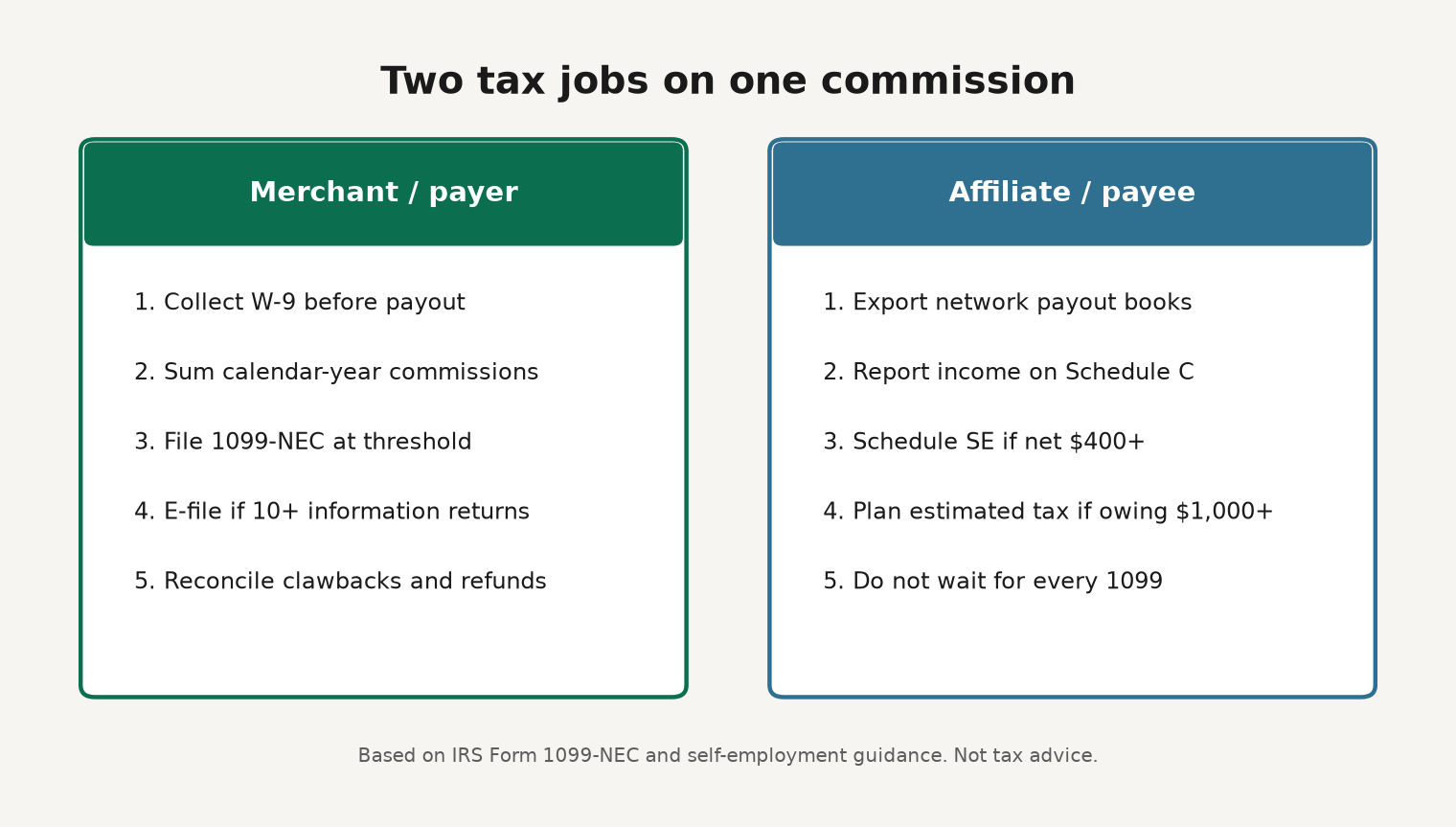
Merchants track who they paid and whether a federal information return is due. Affiliates track what they earned and what they can deduct. The 1099 is a matching document, not the definition of taxable income. Self-employment tax, when it applies, uses a separate rate stack from ordinary income tax brackets.
Source: Framework based on IRS Form 1099-NEC and self-employment guidance. https://www.irs.gov/faqs/small-business-self-employed-other-business/form-1099-nec-and-independent-contractors.
Collect a Form W-9 (or the correct foreign form when applicable) before the first payout so you have a legal name and TIN. Classify the relationship carefully: affiliates are usually independent contractors, but worker classification depends on behavioral control, financial control, and the relationship of the parties, not on the word “affiliate” in a contract (IRS FAQ). Keep a payer ledger that sums commissions per recipient for the calendar year.
File Form 1099-NEC for each person you paid, in the course of your trade or business, at least the applicable threshold in nonemployee compensation for services, including commissions that meet the IRS NEC tests (IRS Instructions). For 2026 payments, that dollar line is generally $2,000. For earlier years in the long $600 era, use $600. Payment-card or third-party network settlements may instead involve Form 1099-K for the settlement entity, which is a different reporting path (IRS payment list). Corporations are often excluded from NEC reporting, with important exceptions (for example, certain attorney and medical payments). Confirm the recipient type before you skip a form.
| Side | Primary federal artifacts | Common failure |
|---|---|---|
| Merchant / payer | W-9 on file, annual commission totals, Form 1099-NEC when threshold met, e-file if 10+ returns | Paying all year with no TIN, then scrambling in January |
| Affiliate / payee | Network payout exports, bank deposits, Schedule C, Schedule SE when required | Reporting only the 1099 total and ignoring smaller payers |
| Payment rail | ACH/check vs card/network processor | Assuming every payout produces the same form type |
If you are an independent contractor, the IRS generally points you to Schedule C for business income and Schedule SE for self-employment tax when net earnings hit $400 or more (IRS FAQ). Report the income you earned from the business. Do not wait for a perfect stack of forms. Reddit tax threads repeat the same operator truth the IRS implies: you can file self-employment income without a 1099 if your own records support the number.
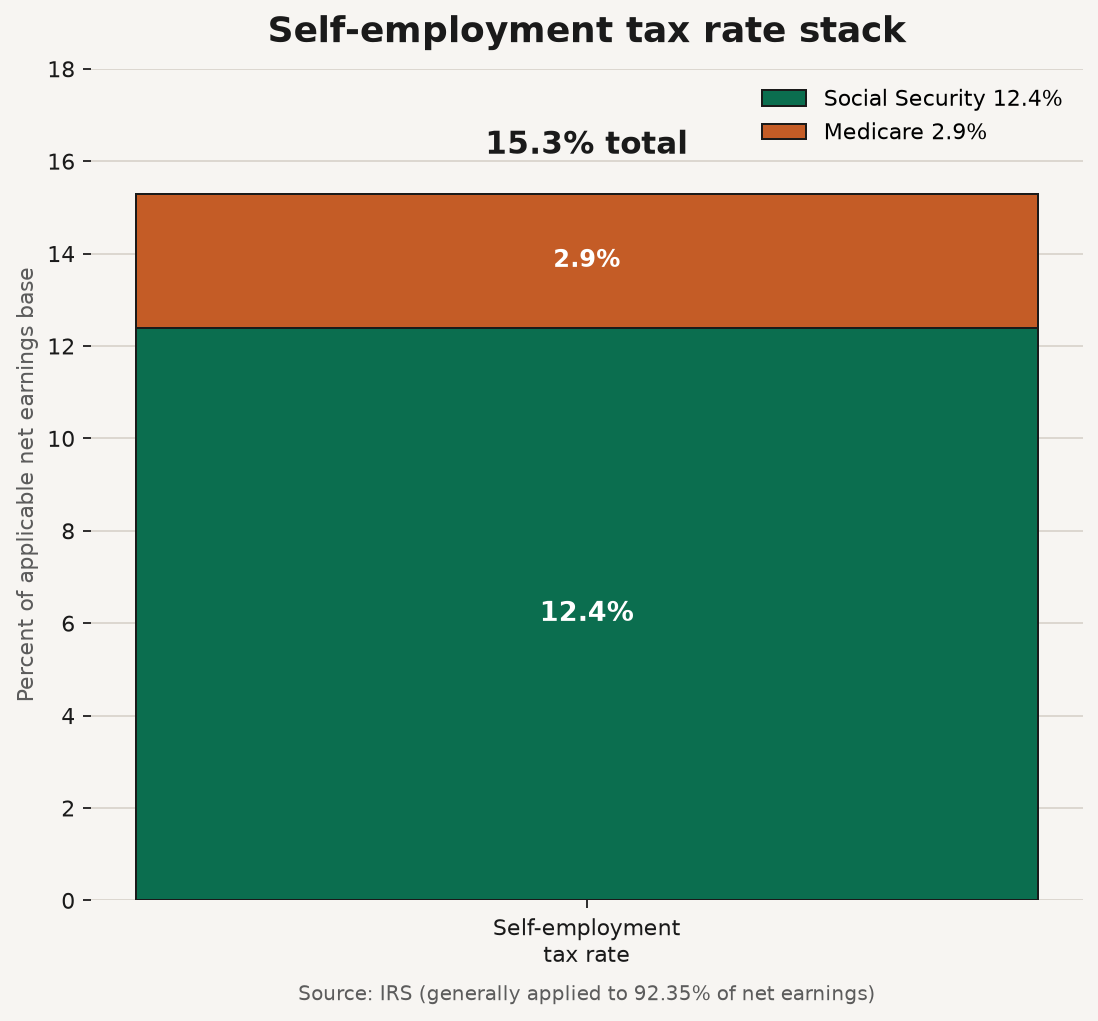
The self-employment tax rate is 15.3%: 12.4% Social Security plus 2.9% Medicare (IRS). Generally, 92.35% of your net earnings from self-employment is subject to that tax. The Social Security portion applies only up to an annual wage base that changes by year. The Medicare portion applies to all net earnings, with Additional Medicare Tax rules for higher incomes covered elsewhere in IRS materials (IRS Topic 554).
Source: Internal Revenue Service. https://www.irs.gov/businesses/small-businesses-self-employed/self-employment-tax-social-security-and-medicare-taxes.
Because payers usually do not withhold income tax when they have your TIN, many affiliates also need quarterly estimated tax payments. Individuals generally must make estimated tax payments if they expect to owe $1,000 or more when they file (IRS estimated taxes). Use Publication 505 and a CPA rather than a blog’s sample bill.
Recurring vs one-time commissions change cash timing, not the existence of taxable income. Multi-tier or sub-affiliate overrides can create extra payees on the same sale, which means more W-9s and more year-end totals. Fraud clawbacks and refunds should reconcile in your books so January totals match reality (affiliate fraud detection).
Use this operational checklist for US federal information reporting. It is not a substitute for a CPA review.
Q: What are the affiliate marketing tax implications for US sellers? A: Merchants may need to collect W-9s and file Form 1099-NEC when nonemployee commission totals meet the federal threshold for the payment year. Affiliates generally report taxable net profit on Schedule C and may owe self-employment tax. This is federal education only, not tax advice.
Q: Do affiliates get a 1099 for commissions? A: Often they receive Form 1099-NEC when a US payer pays at least the applicable threshold in nonemployee compensation for the year. For payments made in 2026, that threshold is generally $2,000. Affiliates can still owe tax when no form is issued.
Q: Do I pay self-employment tax on affiliate income? A: Many independent contractors must pay self-employment tax if net earnings from self-employment are $400 or more. The SE tax rate is 15.3% (12.4% Social Security and 2.9% Medicare), generally applied to 92.35% of net earnings. Confirm your status with a tax professional.
Q: What if I earned affiliate income but never received a 1099? A: Report the income using your own payout records. The absence of a Form 1099 does not automatically make the commissions nontaxable. Reconcile network reports to bank deposits before you file.
Q: Did the 1099-NEC threshold change for 2026? A: Yes for many nonemployee compensation payments. The IRS states the reporting threshold is $600 for payments made before 2026 and $2,000 for payments made in 2026, with later years subject to inflation-adjusted amounts in Publication 1099.
Affiliate marketing tax implications are a payer-reporting problem and a payee-income problem at the same time. Merchants should build W-9 and 1099-NEC ops around the IRS threshold for the year they actually pay. Affiliates should book commissions, deduct ordinary expenses with guidance, and plan for self-employment tax even when forms are missing. The 2026 federal shift to a $2,000 NEC line is the update most outdated guides still skip.
If you want affiliates selling through co-branded storefronts while you keep payout records clean, start at feat..
Affiliate marketing for startups is an operating system—locks, cost, recruit, rates, tracking, first 100 sales, then diagnose a flat roster.
How to track affiliate sales: pick link cookie, coupon, pixel, S2S postback, or storefront checkout—then match Rewardful, Tapfiliate, or Impact.
Best affiliate programs for SaaS companies pass the Recurring Cap Test: labeled duration, cookie, seat type, payout rails—plus Rewardful’s ~24% planning band.