How Much Stock Loss Is Normal on a Creator Campaign
Most marketers see under half of gifted creators post. Plan stock loss as majority silent inventory, then cut ghosts with opt-in and prune rules.
Influencer contract terms explained: usage, exclusivity, whitelisting, kill fees, payment, and FTC disclosure, plus a brand vs creator negotiation matrix.

TL;DR: Influencer contract terms explained: lock deliverables, payment, usage rights, exclusivity, revisions, and a kill fee in writing. The money moves on usage, exclusivity, and whitelisting more than the headline fee. FTC rules already require clear material-connection disclosure. Soft “#partner” language does not bargain that away.
Most brand-creator fights are not about the Reel. They are about a clause nobody defined: who can run the asset as an ad, which competitors are off-limits, and what happens when the brand cancels after edit day.
Influencer contract terms explained means treating the agreement as a rights-and-risk document, not a polite PDF stamped after a verbal “sounds good.” Rates pages tell you what people ask. This page tells you which terms actually move cash and liability.
Key takeaways:
Influencer contract terms are the written clauses that allocate deliverables, money, content rights, competitive restrictions, disclosure duties, and exit costs between a brand and a creator for a sponsored or gifted collaboration.
A brief tells the creator what to make. The contract says who owns the file, who can buy ads against it, when payment lands, and what a cancellation costs. Influee separates those jobs cleanly: creative direction lives in the brief; legal obligations live in the contract (Influee).
This page sits next to influencer marketing rates by follower count and platform (pricing) and whitelisting and Spark Ads explained (the paid-rights product). Rates without rights language leave money on the table. Rights without rates leave you guessing.
Eight clauses cover most campaigns (Influee):
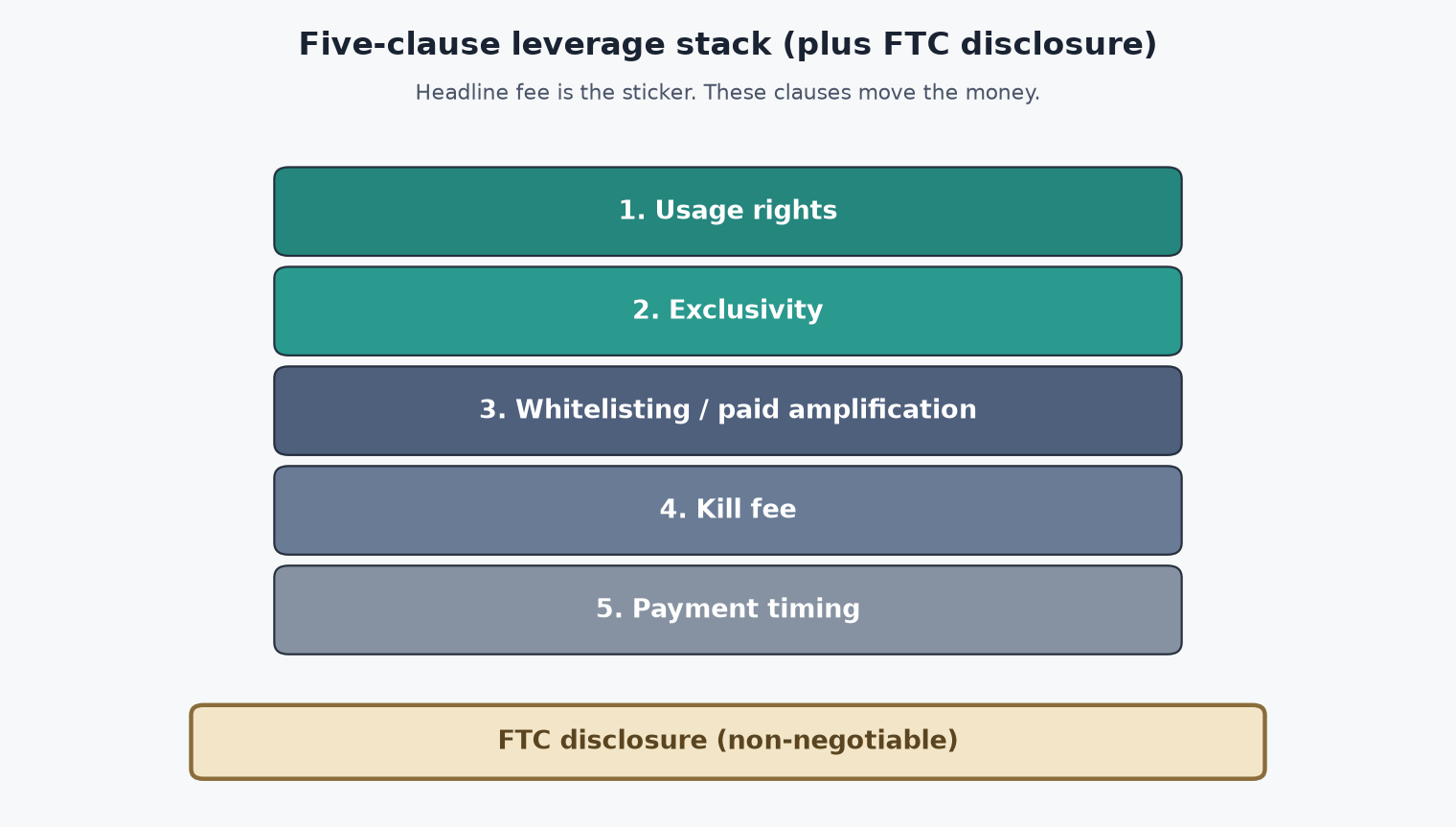
Source: Editorial framework combining Jacobs Counsel leverage emphasis (usage, exclusivity, whitelisting) with Influee clause set and FTC disclosure duty. https://jacobscounsellaw.com/deal-anatomy/creator-brand-deal
Handshake deals fail at the first ambiguity. The brand thinks “commercially” means Meta ads. The creator thinks it means a Story repost. Both walk into the same email thread with different movies in their heads.
Why the paperwork earns its keep:
Influencer contract terms work when each clause answers one job: what ships, who pays, who can reuse the asset, who is blocked from competitors, how edits work, how you exit, and how you disclose. The headline fee is the sticker. Usage, exclusivity, and whitelisting are where the real economics hide (Jacobs Counsel).
| Clause | Aggressive brand ask | Creator pushback | Market practice (labeled) |
|---|---|---|---|
| Usage | All rights, perpetuity, all media, worldwide | Organic only, brand channels, 6-12 months; everything else priced | Limited organic reshare 6-12 months; paid separate (Jacobs) |
| Whitelisting | Bundled into base fee, open-ended | Separate line item; 30/60/90-day window; spend cap | 25-100% of organic fee by duration/cap (Jacobs) |
| Exclusivity | Broad category (“beauty,” “tech”) for months | Named competitors; campaign + ~30 days | Narrow category + named list + time limit (Jacobs; Influee) |
| Kill fee | None, or “work performed” only | Tiered schedule tied to stage | 25% signing / 50% delivery / 100% posting (Jacobs) |
| Payment | Net-90; pay after “performance” | 50/50 signing/delivery; Net-30 | 50/50 + Net-30 market practice (Jacobs) |
| Disclosure | Soft “partner” or buried tag | Clear #ad / paid partnership tools | FTC clear and conspicuous (§255.5) |
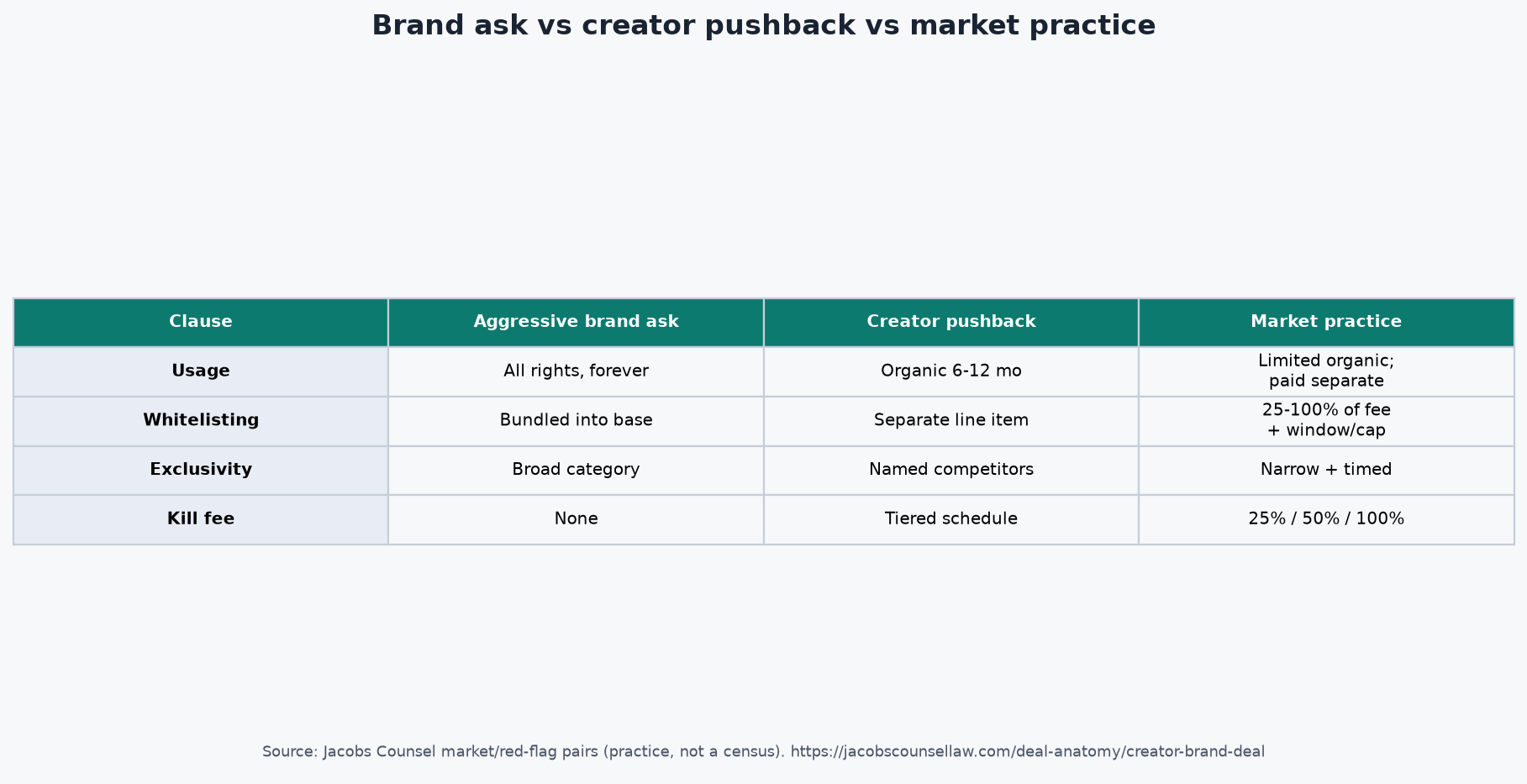
Source: Editorial matrix from Jacobs Counsel market/red-flag pairs and Influee clause guidance. https://jacobscounsellaw.com/deal-anatomy/creator-brand-deal
Usage answers where, how long, and in what form the brand may reuse the creator’s work. Organic reshare on the brand’s own channels is one product. Paid amplification from the creator’s handle (whitelisting / Partnership Ads / Spark Ads) is another. Bundling them into the base fee is the red flag Jacobs Counsel calls out (Jacobs Counsel).
If you need the paid path, price the window and the spend cap. Mechanics live in whitelisting and Spark Ads explained. The contract is where you stop “we’ll figure ads later” from becoming free media.
Exclusivity restricts competing endorsements. Broad category bans without a competitor list are hard to police and expensive for creators. Market practice points to a narrow category, named competitors, and a short window (often campaign plus about 30 days), priced into the fee (Jacobs Counsel). Influee describes common exclusivity around 30-90 days inside a product category (Influee).
There is no public dataset that proves one average exclusivity premium for every niche. Do not treat a blog’s “25-50%” as a census.
A kill fee pays the creator when the brand cancels after work has started. Jacobs Counsel’s labeled market schedule: 25% on signing, 50% on content delivery, 100% once posted, typically within 30 days (Jacobs Counsel). Exact tiers vary by deal. The principle does not: cancellation is not free labor.
Payment practice in the same anatomy: 50% on signing, 50% on delivery, Net-30, with late payment as a termination trigger. Performance-contingent pay for classic influencer work is a red flag (Jacobs Counsel).
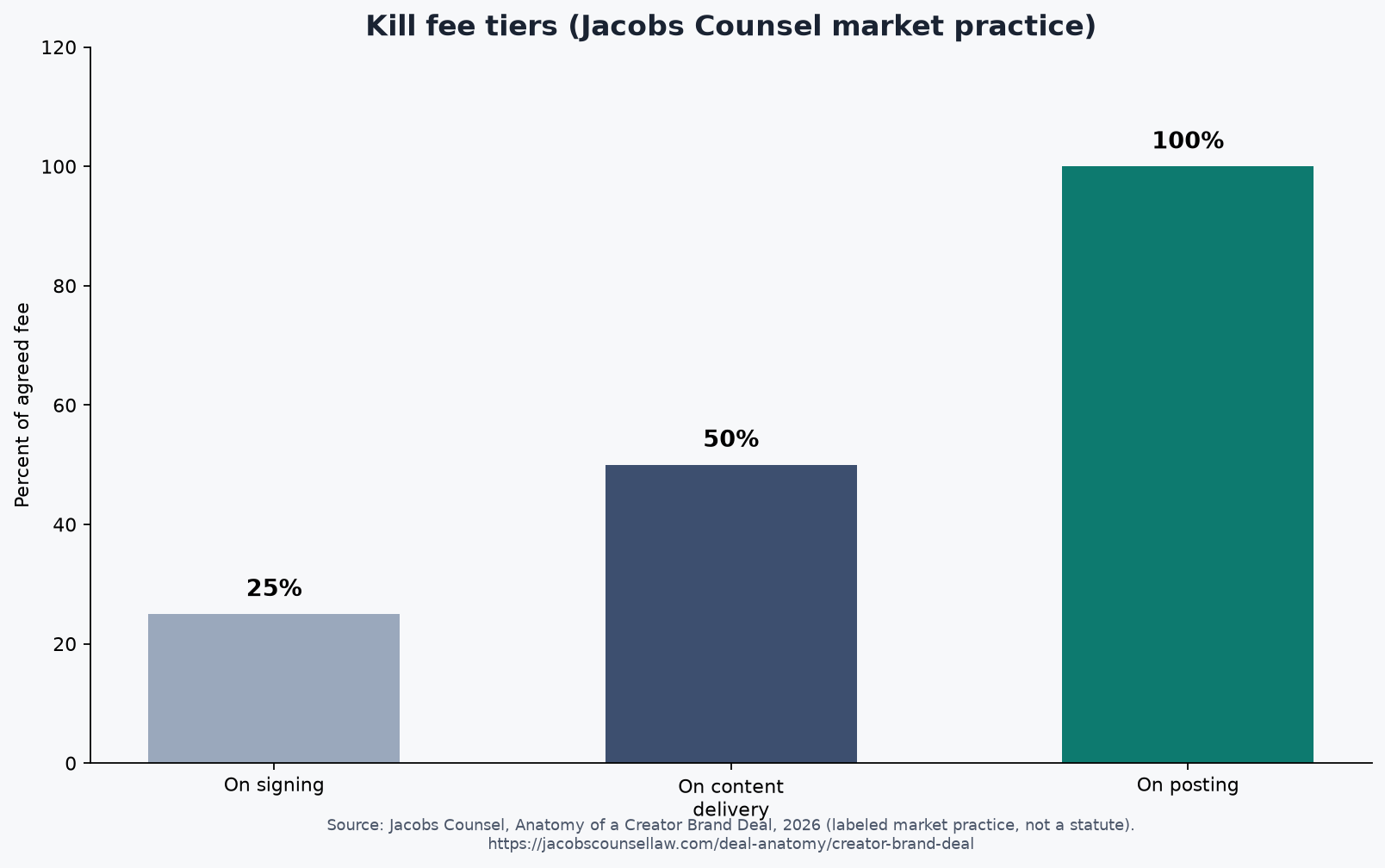
Source: Jacobs Counsel, Anatomy of a Creator Brand Deal (market practice, 2026). https://jacobscounsellaw.com/deal-anatomy/creator-brand-deal
Spell platforms and formats (for example, 1 Reel + 3 Stories + 1 TikTok), cap revisions (Jacobs: one round / ~48 hours for factual and brand-safety review, not a full rewrite), and prefer mutual morals clauses over one-way “sole judgment” brand exits (Jacobs Counsel).
Jacobs Counsel’s sequence matches how founders should work a template: strip the usage default first, price whitelisting second, narrow exclusivity third, add a kill fee schedule fourth, make morals mutual fifth, then tighten payment to 50/50 and Net-30 (Jacobs Counsel). Do not start with font size on the indemnity exhibit while perpetual worldwide rights sit untouched on page two.
Creators on r/influencermarketing repeat the same three missing pieces: revision limits, approval windows, and usage rights priced apart from the base rate. That community language matches the market anatomy even when nobody cites a survey.
Influee’s scale rule: always contract paid deals, any paid-ad usage, and exclusivity or long-term partnerships. Gifted nano can use lighter written terms, but disclosure and usage still need ink if you will amplify (Influee). Judge by what you will do with the content, not only by the fee. A mid-size paid post you plan to run as ads for a year is not a handshake deal.
Long-running relationships shift toward ambassador program structures with clearer renewals. Scorecards for whether the spend worked still belong in how brands calculate influencer marketing ROI. The contract decides what you are allowed to measure and reuse.
This article is general education about common clause patterns, not legal advice for your specific deal. High-value campaigns still deserve counsel who can read the governing law and your entity structure.
Short list. Fix these before you argue about creative.
Q: What are the most important influencer contract terms? A: Deliverables, payment timing, usage rights, exclusivity, revisions, disclosure, and termination with a kill fee. Jacobs Counsel puts the highest economic leverage on usage, exclusivity, and whitelisting. FTC disclosure is mandatory when a material connection exists.
Q: What is a kill fee in influencer marketing? A: A kill fee is a pre-agreed payment if the brand cancels after the deal starts. One labeled market schedule is 25% on signing, 50% on content delivery, and 100% once posted. Exact tiers vary by campaign.
Q: How should usage rights and whitelisting appear in a contract? A: Separate organic reshare from paid amplification. Market practice often limits organic use to about 6-12 months on the brand’s channels and prices whitelisting as its own line item with a time window and spend cap.
Q: Are exclusivity clauses standard in influencer agreements? A: They are common, but the fair version is narrow: named competitors, a defined category, and a short duration (often campaign window plus about 30 days), priced into the fee. Broad category bans without a list are a red flag.
Q: Can a brand waive FTC disclosure in an influencer contract? A: No. Under 16 CFR §255.5, material connections must be disclosed clearly and conspicuously when audiences would not reasonably expect them. A private contract cannot authorize deceptive endorsements.
Influencer contract terms are how you price risk: what the creator delivers, what the brand can reuse, who is locked out of competitors, and what a cancel costs. Negotiate usage, exclusivity, and whitelisting before you congratulate yourselves on the fee. Keep FTC disclosure in the deal as a requirement, not a loophole.
If you are a merchant who wants creators selling with you instead of only posting once, list your product on feat..
Most marketers see under half of gifted creators post. Plan stock loss as majority silent inventory, then cut ghosts with opt-in and prune rules.
UGC vs influencer marketing is assets vs distribution. Collabstr UGC ~$154 paid; Agentio shows Partnership Ads beat licensed UGC on CTR, CVR, and CPA.
Gifting vs paid partnerships: research finds gifting lifts trust vs paid deals, elaborate gifts can backfire, and 61% of marketers see under-half posts.