How Much Stock Loss Is Normal on a Creator Campaign
Most marketers see under half of gifted creators post. Plan stock loss as majority silent inventory, then cut ghosts with opt-in and prune rules.
Gifting vs paid partnerships: research finds gifting lifts trust vs paid deals, elaborate gifts can backfire, and 61% of marketers see under-half posts.

TL;DR: Gifting vs paid partnerships is an obligation choice, not a free-versus-expensive trick. Gifting sends product with no contractual post. Paid buys a brief, deadline, and deliverable. Experiments in Psychology & Marketing (2024) find gifting beats paid on mean influencer trustworthiness and brand attitude, but elaborate PR gifts can cut trust. Traackr’s 2023 marketer survey finds 61% see under-half of gifted creators post.
Brands argue about gifting vs paid partnerships as if one side were “authentic” and the other were “sellout.” That framing is lazy. The real question is which risk you are buying: uncertain organic mention, or contracted certainty.
Gifting is cheap per creator and expensive per guaranteed post. Paid is the opposite. Consumer research now gives you a third variable: followers trust gifted endorsements more than paid ones on average, until the gift looks like a bribe. If you ignore that, you will either waste inventory on silent creators or overpay for posts that already look like ads.
Key takeaways:
Gifting vs paid partnerships compares two influencer deal structures: voluntary product seeding without a post contract, versus compensated, briefed deliverables with an obligation to publish.
Influencer gifting (also called product seeding or PR gifting) is when a brand sends free goods or services hoping for voluntary mention. The creator may post, may not, and usually keeps creative control. A paid partnership is when the brand pays a fee (or fee plus product) for agreed content, timing, usage rights, and often message rails.
Marchand and colleagues draw the line cleanly: gifting seeks non-monetary, voluntary reciprocity and relationship building; paid marketing includes contractual obligations to promote (Psychology & Marketing, 2024). Affiliate commissions and hybrid ambassador retainers sit nearby but are different jobs. Affiliate pays for tracked sales. Ambassadors stack relationship over months (long-term ambassadors vs one-off posts). Gifting vs paid is the first fork most DTC teams face.
| Dimension | Gifting (seeding) | Paid partnership |
|---|---|---|
| Obligation to post | None | Contractual |
| Deadline | Optional ask only | Agreed in advance |
| Message / CTA | Creator’s choice | Briefed |
| Usage rights for ads | Rarely included | Negotiable |
| Predictability | Low | High |
| Cash outlay | Product + shipping | Fee (+ product) |
| Disclosure | Required if they endorse | Required |
| Best first use | Nano/micro tests, pipeline | Launches, whitelisting, macros |
Wrong model choice burns either inventory or cash. Gifting every macro on your wish list produces silent packages. Paying every nano for a soft mention wastes fee budget you could have used for creators who already proved fit through a gift.
Why the comparison earns its own page:
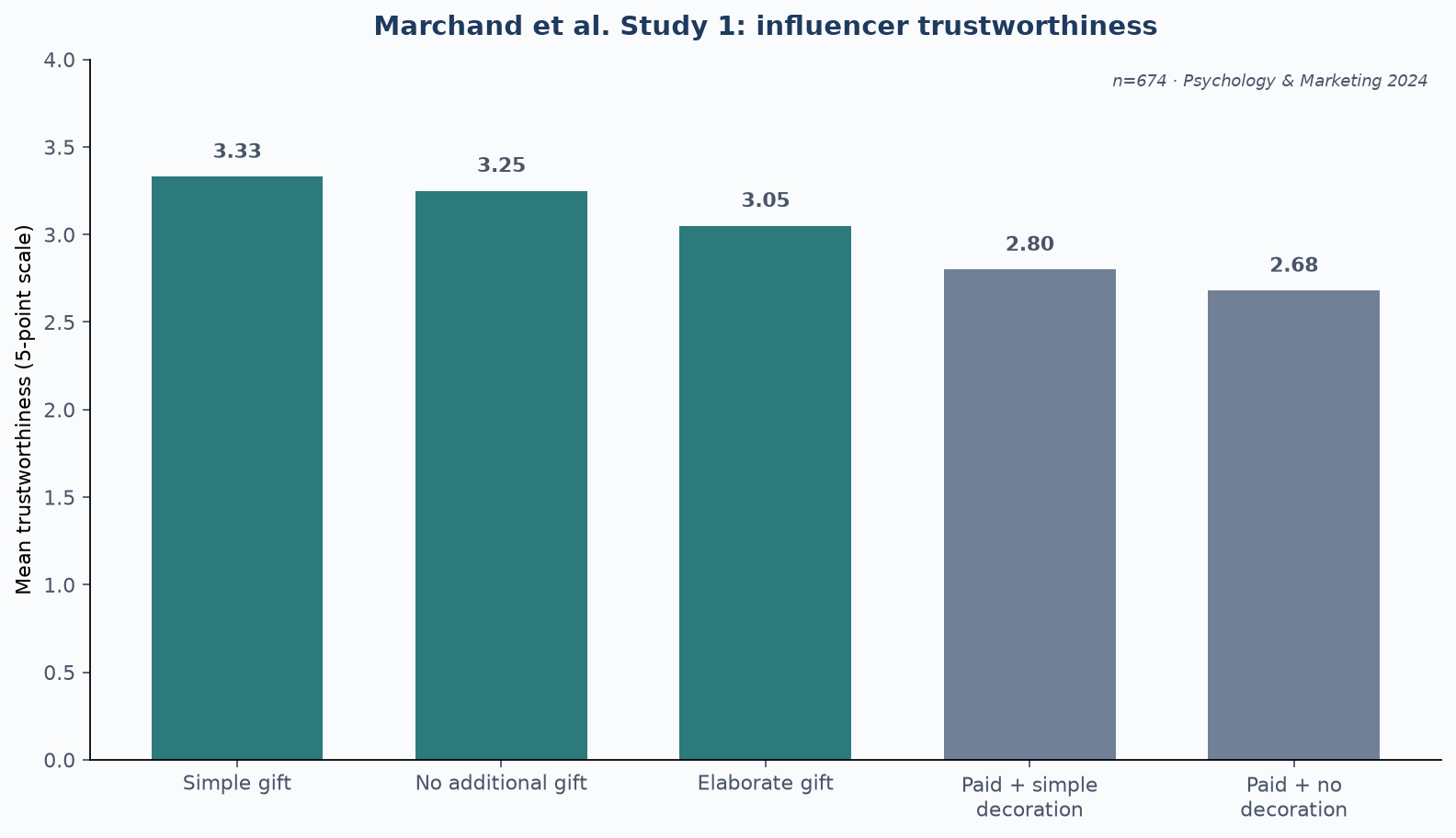
Source: Marchand, Schöndeling, and Dünschede, Psychology & Marketing (2024), Study 1 (n=674), 5-point scales. https://ul.qucosa.de/api/qucosa%3A102701/attachment/ATT-0/
Gifting vs paid partnerships works when you match the deal to the failure mode you cannot afford. Need a launch-day Reel with usage rights? Pay. Need to learn which nano creators sound like customers? Gift, then promote the ones who post well into paid or ambassador seats.
The authors ran four Instagram-story experiments with a fictitious beauty brand and influencer. Study 1 compared five conditions: paid with no decoration, paid with simple decoration, gifting with no additional gift, simple additional gift, and elaborate additional gift (champagne, sweets, embellishments). Sample after attention checks: 674 participants.
On influencer trustworthiness (5-point scale), means were:
| Condition | Mean trustworthiness |
|---|---|
| Simple gift | 3.33 |
| No additional gift | 3.25 |
| Elaborate gift | 3.05 |
| Paid + simple decoration | 2.80 |
| Paid + no decoration | 2.68 |
All gift conditions beat both paid conditions (comparisons p ≤ 0.014). Brand attitude means followed the same pattern: simple gift 3.04, no gift 2.95, elaborate 2.94, paid decoration 2.75, paid none 2.74. Relationship investment peaked for elaborate (3.78) and simple (3.64) gifts versus paid means near 3.3 (Marchand et al., 2024).
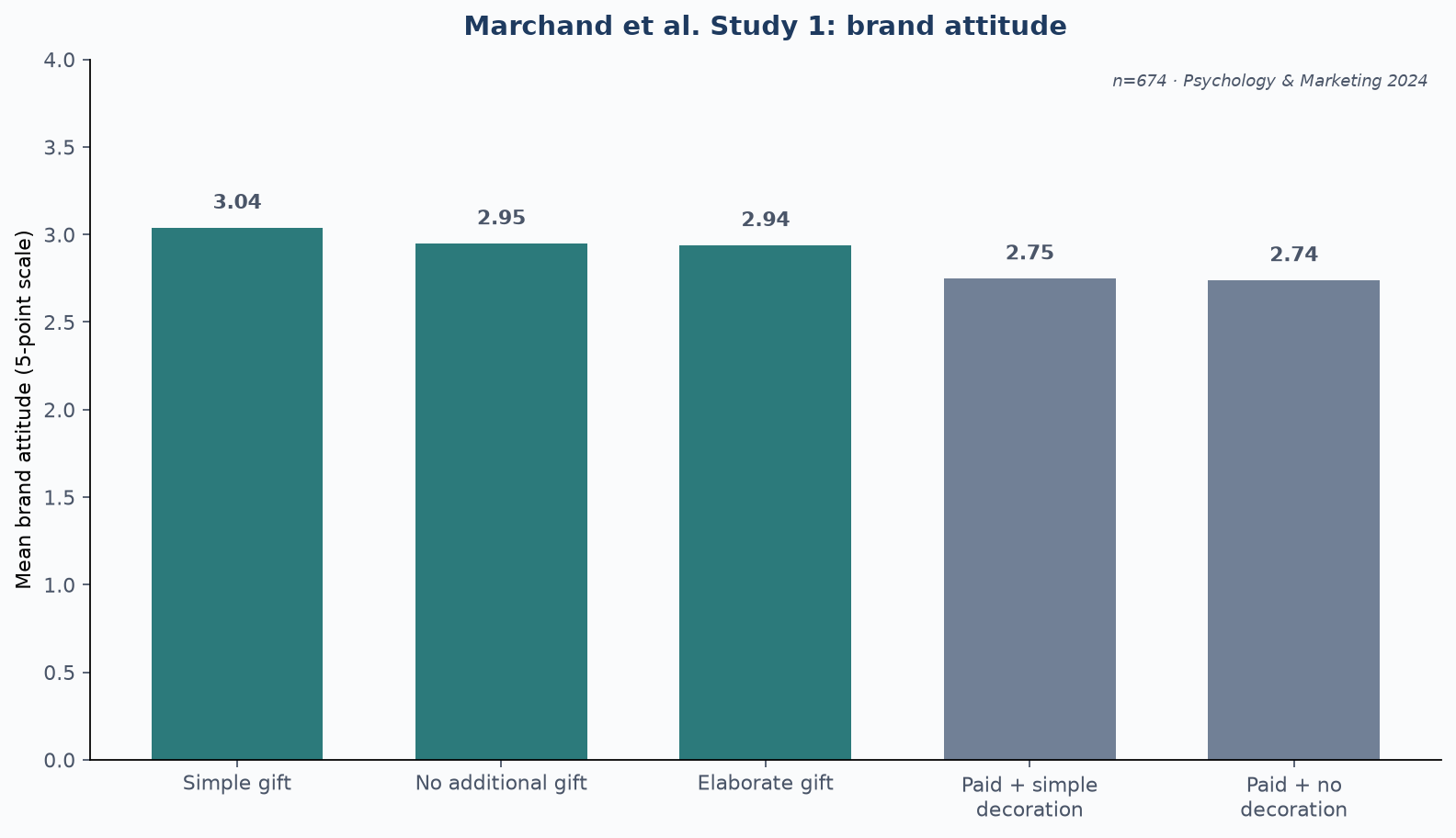
Source: Marchand, Schöndeling, and Dünschede, Psychology & Marketing (2024), Study 1. https://ul.qucosa.de/api/qucosa%3A102701/attachment/ATT-0/
Read these as experimental perception scores, not ROAS. They tell you what followers infer when they believe a post was gifted versus paid. They do not promise that your seeding campaign will print sales.
Study 2 (n=136) isolates simple versus elaborate gifts. Elaborate gifts lowered trustworthiness (M=3.01 vs 3.31) without a significant brand-attitude penalty. Study 3 shows elaborate gifts raise perceived persuasive attempt (M=3.85 vs 3.50), which mediates the trust drop. Study 4 finds a brand-related occasion (for example, a 10-year anniversary) mitigates the elaborate-gift harm on trust (Marchand et al.).
Operator translation: champagne-and-macaron PR theater can look like pressure. If you must ship an elaborate kit, tie it to a real brand occasion and keep the story about the product, not the haul.
Traackr’s State of Influencer Product Seeding survey (n=305 marketers, Feb 2023) reports that 61% of marketers see less than half of gifted influencers post, and 65% still re-gift after silence (NetInfluencer; Traackr). That is why “free” is a fiction. True cost per post equals (product + shipping + ops) divided by posts that publish.
Worked example (illustrative math, not a Traackr claim): send $80 product to 20 creators ($1,600). If 40% post, you get 8 posts at $200 each before labor. Compare that to published influencer rate bands for the same tier. Sometimes gifting still wins. Often paid nano is cleaner.
There is no public verified dataset for vendor claims like “$7.25 gifting ROI.” Skip those charts. Score your own post rate and influencer ROI with tracked links or codes.
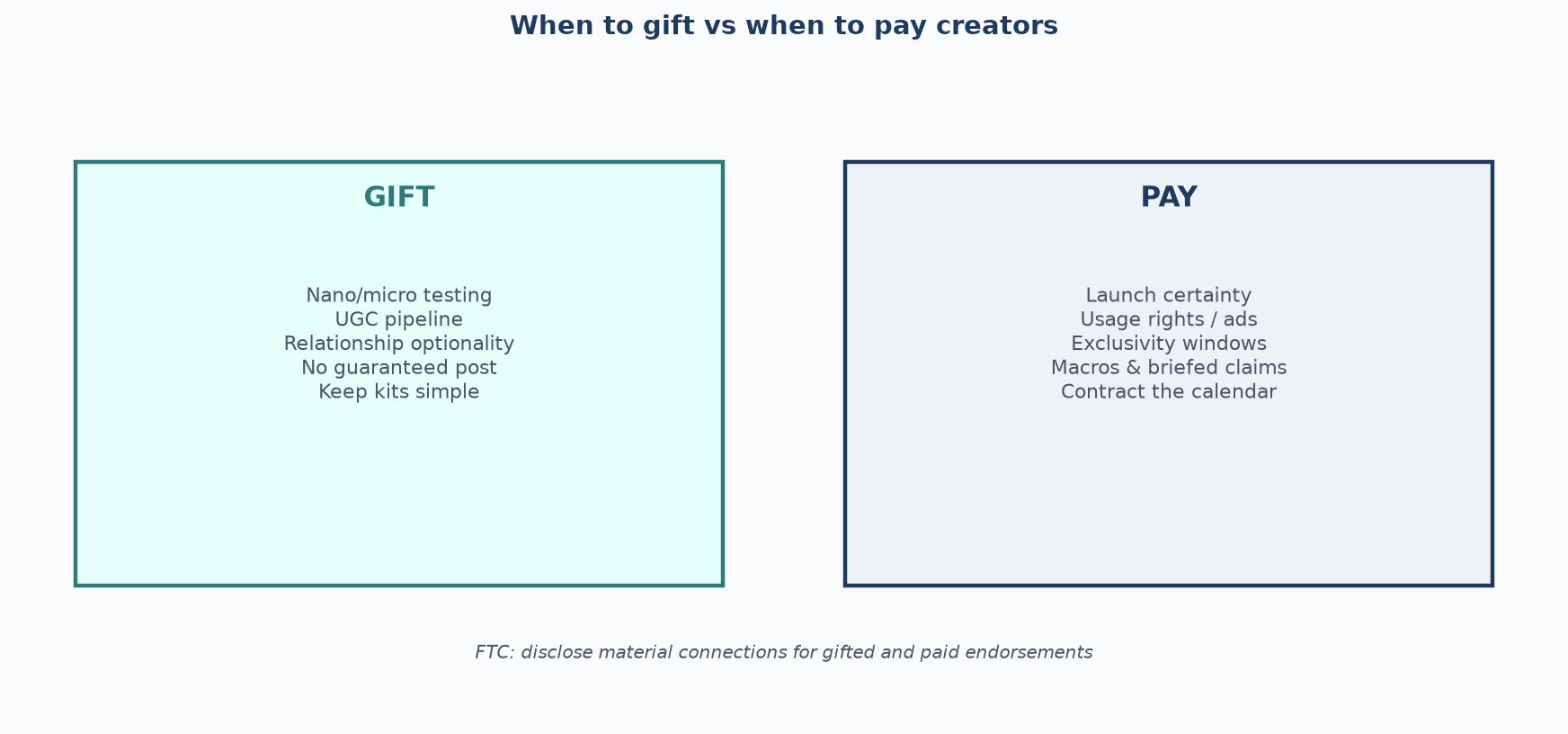
Source: Editorial decision matrix combining Marchand et al. (2024) trust findings, Traackr (2023) post-rate inefficiency, and FTC material-connection rules. https://ul.qucosa.de/api/qucosa%3A102701/attachment/ATT-0/
| If you need… | Prefer | Why |
|---|---|---|
| Cheap creator testing at nano/micro | Gift | Learn voice fit; promote winners to paid |
| Launch-day certainty | Pay | Obligation + deadline |
| Whitelisting / Spark / Partnership Ads | Pay (+ usage rights) | Ads need licensed creative |
| Category exclusivity window | Pay | Contract terms |
| Long relationship before retainer | Gift, then ambassador | Pipeline into ambassador programs |
| Macro / celebrity reach | Pay | Gift post rates usually collapse |
| Authentic-feeling UGC for ads | Gift first, then license | Marchand trust edge, then buy rights |
The FTC’s Disclosures 101 for Social Media Influencers is blunt: a material connection includes free or discounted products, even when the brand did not ask for a post. Disclose clearly and conspicuously near the endorsement (FTC PDF; FTC FAQ). Brands should give guidance, monitor tagged posts, and fix failures. “#gifted” alone is not a magic safe word if the audience still cannot tell there is a connection. Pair disclosure hygiene with engagement vetting before you ship inventory.
Q: What is the difference between gifting and paid partnerships? A: Gifting sends free product or service with no contractual obligation to post. Paid partnerships pay a fee (often plus product) for agreed deliverables, timing, and usually message or usage terms. Both create a material connection that must be disclosed if the creator endorses the brand.
Q: Does influencer gifting outperform paid partnerships on trust? A: In Marchand, Schöndeling, and Dünschede’s Study 1 (n=674), gifting conditions produced higher mean influencer trustworthiness and brand attitude than paid partnership conditions on 5-point scales. Simple gifts scored highest on trust. Results are experimental perceptions, not proof of higher ROAS.
Q: Why do elaborate PR gifts sometimes hurt creators? A: Study 2 and Study 3 find elaborate gifts raise perceptions that the brand is pressuring the influencer, which lowers trustworthiness versus simple gifts. Study 4 shows tying the elaborate gift to a brand occasion (such as an anniversary) can mitigate that trust harm.
Q: How often do gifted influencers actually post? A: In Traackr’s 2023 survey of 305 marketers, 61% reported that less than half of influencers who received gifted products posted. About 65% said they would send product again even without a share, which only makes sense if relationship building is an explicit goal.
Q: Do gifted posts require FTC disclosure? A: Yes. The FTC treats free or discounted products as a material connection. If a creator endorses after receiving a gift, they should disclose clearly and conspicuously, even when the brand never asked for a post. Brands should guide, monitor, and correct.
Gifting vs paid partnerships is a risk allocation problem with a trust twist. Experiments show followers often trust gifted endorsements more than paid ones, Traackr shows most gifting programs under-deliver posts, and elaborate kits can erase the authenticity edge. Gift to learn and pipe creators forward. Pay when the calendar, the claims, or the ad rights cannot fail.
If you built a product and want creators to sell it with tracked splits instead of silent PR boxes, list it on feat. and let affiliates promote through co-branded storefronts.
Most marketers see under half of gifted creators post. Plan stock loss as majority silent inventory, then cut ghosts with opt-in and prune rules.
UGC vs influencer marketing is assets vs distribution. Collabstr UGC ~$154 paid; Agentio shows Partnership Ads beat licensed UGC on CTR, CVR, and CPA.
Influencer contract terms explained: usage, exclusivity, whitelisting, kill fees, payment, and FTC disclosure, plus a brand vs creator negotiation matrix.