How Much Stock Loss Is Normal on a Creator Campaign
Most marketers see under half of gifted creators post. Plan stock loss as majority silent inventory, then cut ghosts with opt-in and prune rules.
UGC vs influencer marketing is assets vs distribution. Collabstr UGC ~$154 paid; Agentio shows Partnership Ads beat licensed UGC on CTR, CVR, and CPA.

TL;DR: UGC vs influencer marketing is a job fork. UGC buys reusable creative you distribute (ads, site, email). Influencer marketing buys distribution on someone else’s channel. Plan UGC with Collabstr’s ~$154 paid average, then decide whether brand-handle licensed UGC or creator-handle Partnership Ads owns the performance test.
Founders brief “influencer UGC” as if that were one product. It is not. One path buys files you can run from your ad account. The other buys a post in someone else’s feed. Mix the jobs and you pay follower premiums for assets you never amplify, or you buy cheap videos and wonder why nobody saw them.
UGC vs influencer marketing is the choice between buying assets and buying distribution. It sits next to UGC marketing benchmarks (Emplifi on-site multiples), affiliate vs influencer marketing, whitelisting and Spark Ads explained, influencer marketing rates by follower count and platform, how brands calculate influencer marketing ROI, and influencer contract terms explained.
UGC vs influencer marketing means comparing two creator buys by what the dollar purchases: owned-or-licensed creative assets you distribute, versus borrowed reach and trust on a creator’s own channels. Same talent pool sometimes. Different contract, scorecard, and media path. Get the job wrong and every later metric is noise.
In marketplace and performance language, “UGC” usually means commissioned creator content that looks native and is meant for the brand’s ads, site, email, and social, not a customer selfie that wandered in. Influencer marketing means the creator publishes to people who already follow them. Community threads say the quiet part: “UGC sells usage, influence sells attention.”
Do not confuse this fork with affiliate vs influencer. Affiliates are paid for tracked outcomes. Influencers can be flat fee, hybrid, or CPS. UGC is usually a production and usage deal. Whitelisting sits on top of either path when you want paid media from the creator’s identity (whitelisting and Spark Ads).
The distinction matters because asset buys and distribution buys fail for opposite reasons. UGC fails when you never fund media or never test hooks. Influencer posts fail when you treat a one-day feed moment like a creative library. Same invoice line (“creator”) hides different risk.
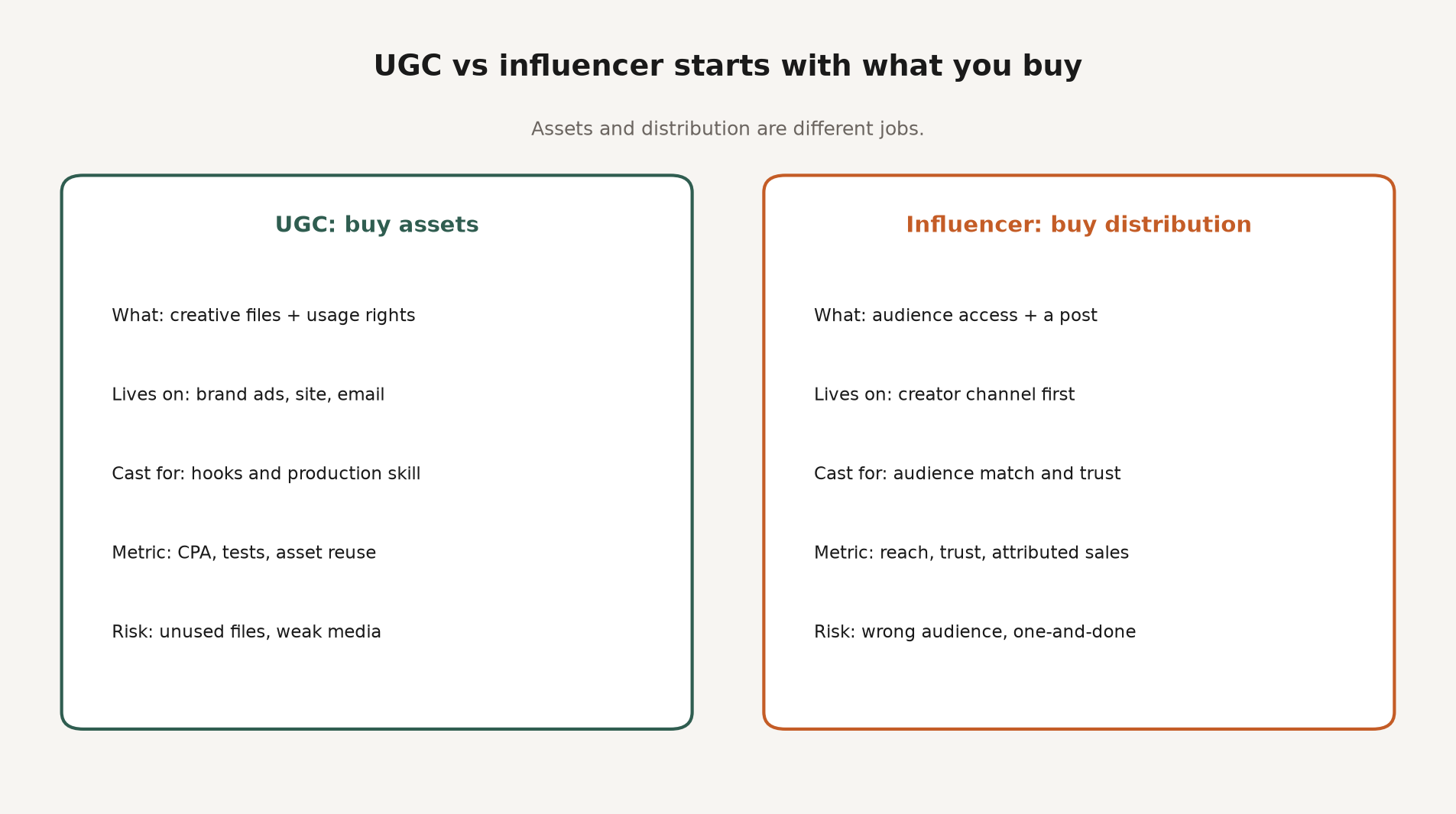
Source: Editorial framework synthesizing marketplace UGC definitions with influencer distribution jobs. https://collabstr.com/2026-influencer-marketing-report
UGC and influencer marketing differ in practice across ownership, casting, pricing, media path, and the scorecard you should trust. Start with the job you are buying. Then pick the contract shape that matches that job. Only then spend on media, followers, or whitelist rights you can defend.
| Dimension | UGC (commissioned assets) | Influencer marketing |
|---|---|---|
| What you buy | Creative files + usage rights | Access to audience + a post (and often limited rights) |
| Where it lives first | Brand ads, site, email, brand social | Creator’s feed / Stories / livestream |
| Casting priority | Hook quality, niche fit, production skill | Audience match, trust, engagement quality |
| Typical pricing shape | Per asset or package; usage priced separately | Per post / tier; usage and whitelist as add-ons |
| Core scorecard | Creative tests, CPA/ROAS on your media, asset reuse | Reach, engagement, attributed sales, brand lift |
| Fake-follower risk | Low for pure asset buys | Real; vet before you pay |
| Best first use | Paid creative volume, PDP proof, email | Launches, niche entry, third-party credibility |
Rate context for influencer posts lives in influencer rates by follower count and platform. Rights language lives in influencer contract terms. Paid amplification from the creator handle is a third product entirely (whitelisting and Spark Ads).
Collabstr’s 2026 report is marketplace data, not a census of every agency retainer. Treat it as a planning floor for small and mid-size buys, not as what a celebrity charges for a global usage grant.
| Metric | Figure | What it means |
|---|---|---|
| UGC average ask | $180 | Listed package price before negotiation |
| UGC average paid | $154 | What brands actually paid |
| UGC share of campaigns | 15% → 35% | YoY rise in UGC-tagged campaigns |
| UGC campaign growth | +133% | Same shift, growth framing |
| Engagements under $300 | ~80% | Market is high-frequency, not mega-deals |
Source: Collabstr 2026 Influencer Marketing Report (21,000+ collaborations; 472,000+ packages for pricing views).
The ask-to-paid gap matters for briefs. If your spreadsheet assumes every UGC video costs $500 before usage, you are not pricing the same market Collabstr is measuring. If you assume $154 includes perpetual paid usage and whitelisting, you will lose the rights negotiation. Collabstr’s 2025 data still associates content usage rights with roughly a 40% cost lift; keep that line item separate (Collabstr 2025).
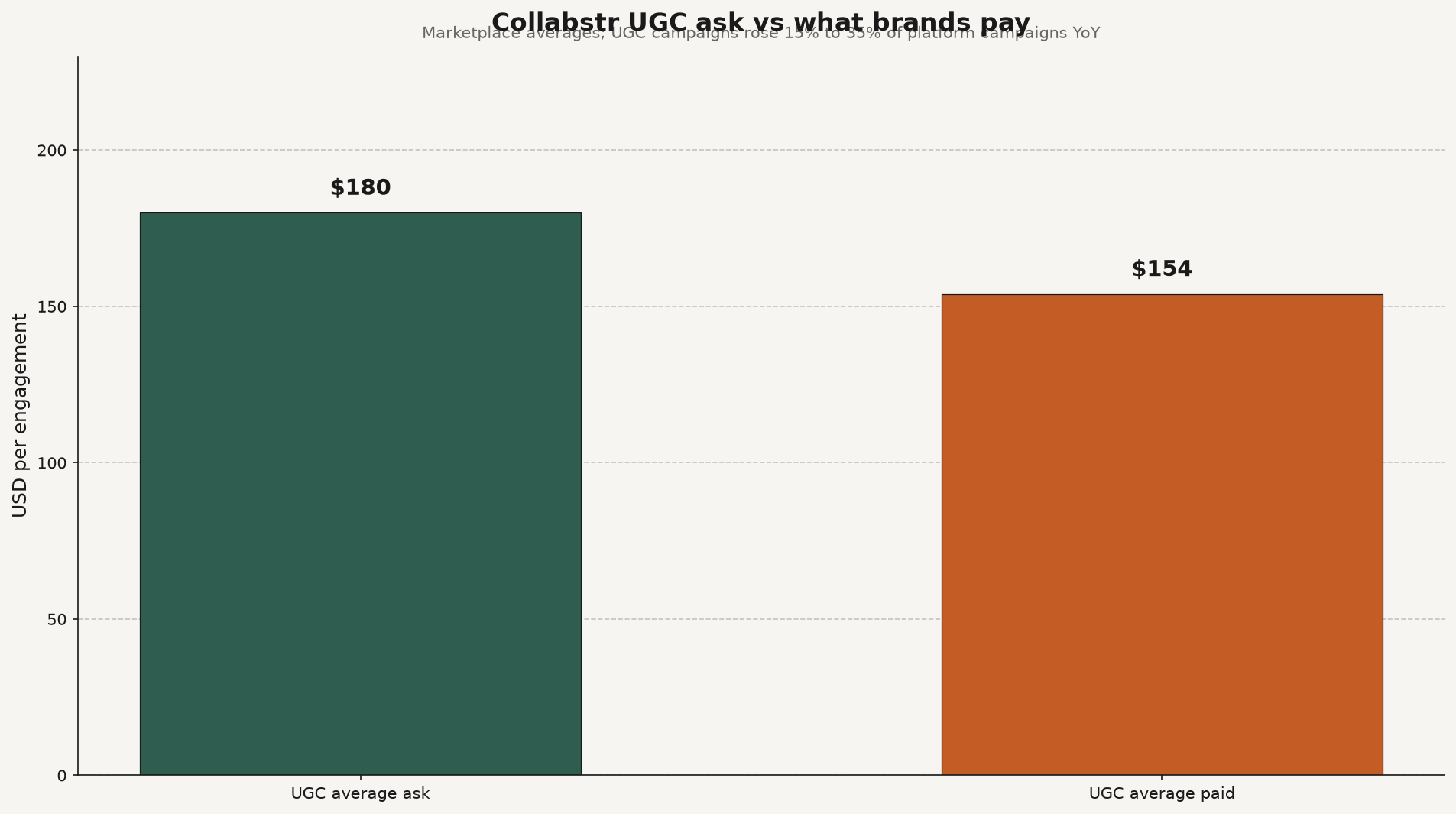
Source: Collabstr, 2026 Influencer Marketing Report. https://collabstr.com/2026-influencer-marketing-report
Here is the performance fork inside the UGC world. Licensed UGC run from the brand handle and Meta Partnership Ads can use similar creative. They are not the same ad product. Partnership Ads run with the creator’s identity (and Meta’s dual-signal optimization). Brand-handle UGC does not.
Agentio reports head-to-head results from $130M in spend across 65,000 Meta Partnership Ads:
| Metric vs licensed UGC (brand handle) | Partnership Ads lift |
|---|---|
| CTR | +19% |
| Conversion rate | +10% |
| CPA | −5% |
Source: Agentio, Infinite Creative Engine (Aug 12, 2026).
That is not “influencers beat UGC.” That is “creator-handle paid often beats brand-handle licensed UGC in this sample.” Organic influencer posts without media spend are a different experiment. Meta’s separate claim (Partnership Ads added to BAU: ~19% lower CPA, ~13% higher CTR) uses a BAU baseline, not Agentio’s licensed-UGC baseline. Keep the scorecards labeled (whitelist spoke).
Agentio also frames the ops reality: roughly 1 in 5 tested ads becomes a winner; 45% of eventual winners still look like losers before $100 in spend; winners fatigue around 36 days on average, with CPA rising if you keep them past that point; maintaining about 10 concurrent winners takes on the order of 40 new tests per month (Agentio). UGC without a testing engine is a folder of unused MP4s.
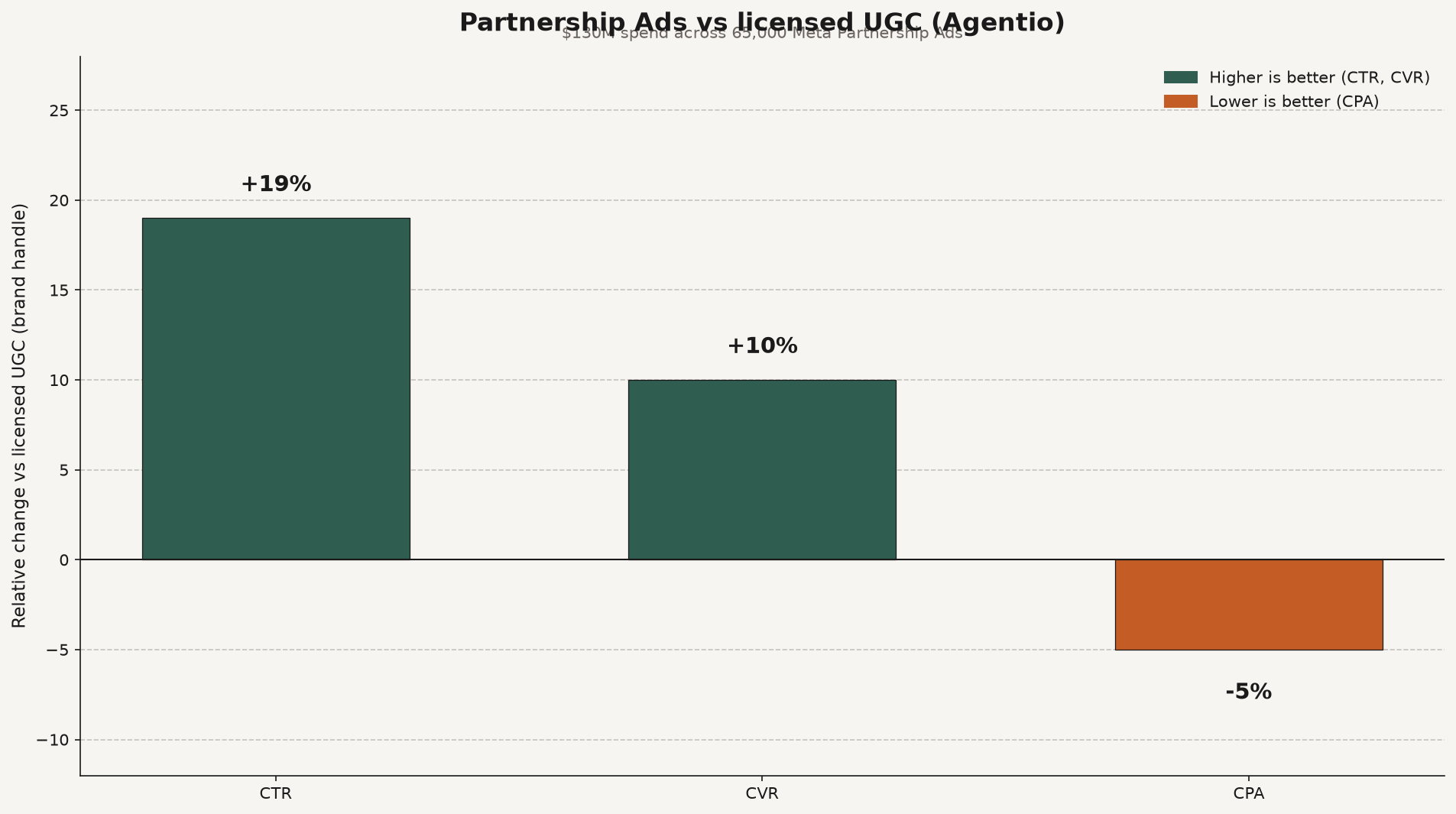
Source: Agentio analysis of $130M spend across 65,000 Meta Partnership Ads. https://www.agentio.com/blog/infinite-creative-engine
| Constraint | Prefer UGC assets | Prefer influencer posts | Prefer creator-handle paid (Partnership / Spark) |
|---|---|---|---|
| Goal | Creative tests, reusable ads | Awareness, niche trust | Performance with identity signal |
| Budget shape | Many small asset fees + media | Fewer post fees | Post + usage + whitelist + media |
| Ops capacity | Brief, revise, edit, launch ads | Creator management, posting calendar | Codes, renewals, spend caps |
| Proof needed | Hook/angle learning | Third-party endorsement | Comments and handle trust in-feed |
| Primary risk | Unused creative; weak media | Wrong audience; one-and-done | Rights expiry; revocation |
Gifting can seed either path, but gifting is not a substitute for a paid brief when you need guaranteed assets or guaranteed posts (gifting vs paid partnerships). Tier choice for influencer reach still follows micro vs macro vs nano ROI.
Q: What is the difference between UGC and influencer marketing? A: UGC (commissioned) buys creative assets for brand-controlled channels and ads. Influencer marketing buys distribution on a creator’s own audience. Same person can do both, but the contract, casting, and scorecard change with the job.
Q: Is a UGC creator the same as an influencer? A: Not by default. A UGC creator is hired for production and usage. An influencer is hired for reach and trust with followers. Follower count can be near-irrelevant for pure UGC and central for influencer casting.
Q: How much does UGC cost compared with influencer posts? A: On Collabstr’s marketplace, UGC averages about $180 ask and $154 paid, and about 80% of all engagements close under $300. Influencer posts still scale with platform and tier; use a rates guide and keep usage and whitelisting off the base fee.
Q: Do Meta Partnership Ads beat licensed UGC? A: In Agentio’s $130M / 65,000-ad sample, Partnership Ads showed +19% CTR, +10% CVR, and -5% CPA versus licensed UGC from the brand handle. That is a paid-identity comparison, not proof that organic influencer posts always win.
Q: Should brands use UGC or influencers, or both? A: Use UGC when you need testable creative volume. Use influencers when you need borrowed trust and niche reach. Many teams run both with separate briefs. There is no public dataset that crowns one universal ROAS winner for every category.
UGC vs influencer marketing is not a taste test. It is whether this dollar buys assets you will distribute or attention you will borrow. Price UGC like a creative supply chain, price influencers like distribution, and treat Partnership Ads as a third product when identity drives performance.
If you want creators selling through co-branded storefronts instead of one-off posts alone, start at feat..
Most marketers see under half of gifted creators post. Plan stock loss as majority silent inventory, then cut ghosts with opt-in and prune rules.
Influencer contract terms explained: usage, exclusivity, whitelisting, kill fees, payment, and FTC disclosure, plus a brand vs creator negotiation matrix.
Gifting vs paid partnerships: research finds gifting lifts trust vs paid deals, elaborate gifts can backfire, and 61% of marketers see under-half posts.