Affiliate Marketing for Startups: Complete Guide
Affiliate marketing for startups is an operating system—locks, cost, recruit, rates, tracking, first 100 sales, then diagnose a flat roster.
Waitlist growth strategies with real benchmarks: CVR by traffic source, size bands, healthy K-factor 0.3-0.7, and why launch conversion has no census.

TL;DR: Waitlist growth strategies with real benchmarks start with three scorecards: visitor-to-signup conversion by traffic warmth, list size by quality band, and K-factor (invites × invite conversion). LaunchList publishes rough capture bands from about 3%-8% cold paid to 15%-35% warm traffic, and treats healthy pre-launch K as about 0.3-0.7. There is no public census for waitlist-to-paid conversion.
Founders treat waitlist growth strategies with real benchmarks like a treasure map to one magic percentage. “Get to 10,000 emails” becomes the strategy. Then launch day arrives, open rates sag, and the list looks like a graveyard of curiosity clicks.
A waitlist is a compounding acquisition system. Capture rate tells you if the promise is clear. Size bands tell you whether you are niche, typical, or press-driven. K-factor tells you whether referrals multiply every paid or organic signup. Launch conversion is a separate experiment with no public census. If you collapse those into one vanity number, you will optimize the wrong job.
Key takeaways:
Waitlist growth is the practice of capturing, nurturing, and compounding interest before a product is broadly available, measured by signup conversion, engaged list quality, referral amplification (K-factor), and eventual launch activation.
A waitlist is not a newsletter and not a post-purchase referral program. Newsletter growth optimizes opens for content. ReferralCandy-style referral rate measures referred purchases as a share of total purchases (about 2.35% globally after programs mature). Waitlist K measures how many new signups each existing signup generates through invites. Same family of mechanics. Different denominator.
Pre-launch waitlists earn their keep when strangers trade an email for a clear promise, stay warm through updates, and optionally invite peers for queue priority or founding perks. Post-launch, the same list becomes your highest-trust launch channel if you did not ghost it.
Without benchmarks, teams celebrate bot-filled counters and underfund the landing page that actually converts warm traffic. With the wrong benchmarks, they chase Dropbox fairy tales and declare failure at K = 0.4, which can still double a list over enough cycles.
Why this page exists:
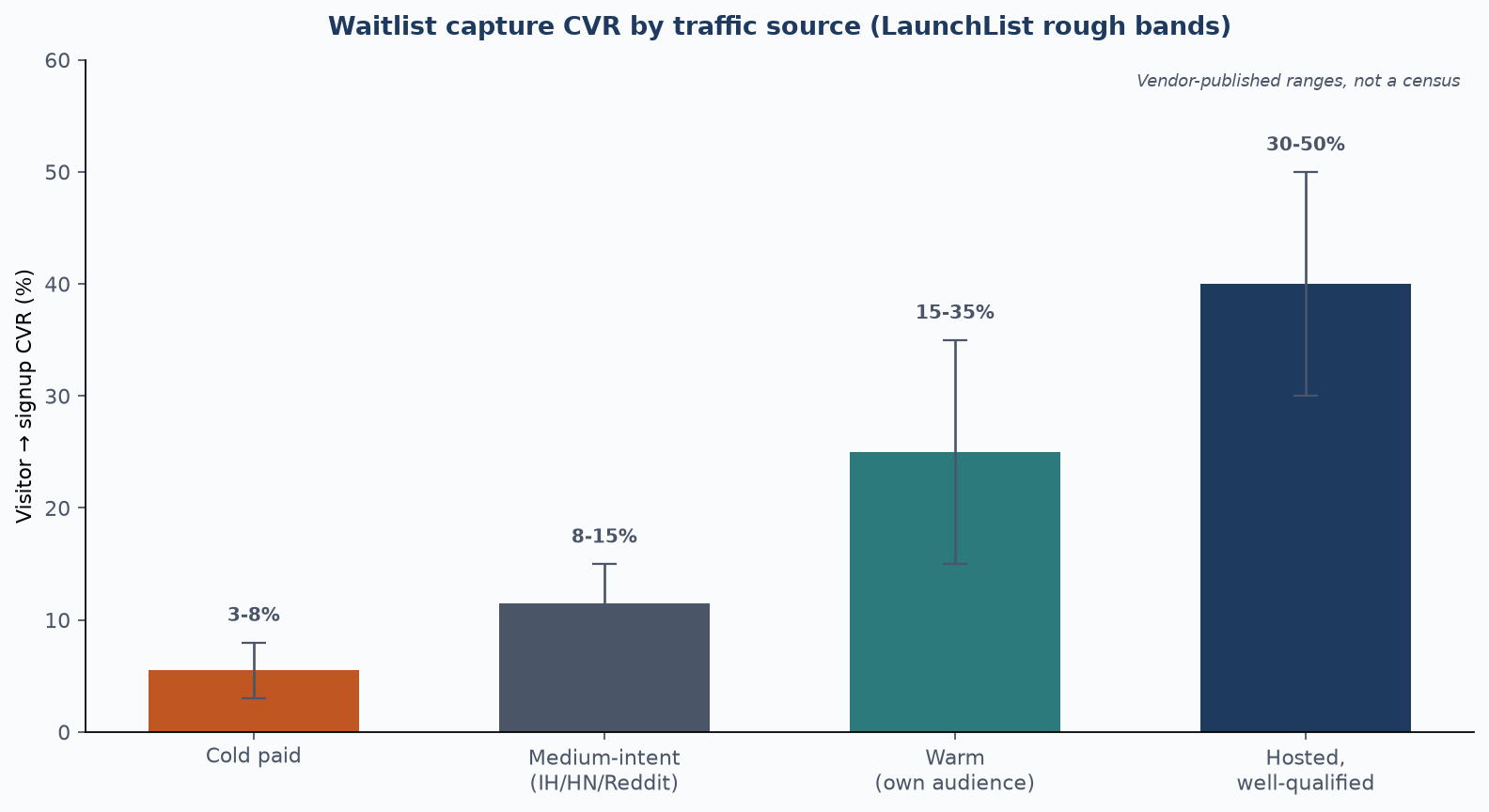
Source: LaunchList Waitlist Strategy & Growth FAQ (vendor-published rough industry bands). https://getlaunchlist.com/help/faq/strategy-growth
Waitlist growth strategies with real benchmarks work as a four-stage loop: capture with a clear promise, nurture so the list stays human, amplify with referral mechanics scored by K, then convert at launch with frictionless activation. Skip nurture and your “10k waitlist” is a cold CRM dump.
Use visitor→signup conversion, not vibes. LaunchList publishes these rough bands for waitlist landing pages (FAQ):
| Traffic type | Rough visitor→signup CVR |
|---|---|
| Cold paid (Meta, Google, TikTok) | 3%-8% |
| Medium-intent (Indie Hackers, Hacker News, Reddit) | 8%-15% |
| Warm (own audience, newsletter, organic social) | 15%-35% |
| Hosted page, well-qualified traffic | 30%-50% |
Label these as vendor-published ranges, not a census of every waitlist tool. Still, they beat inventing “industry average 25%.” If warm traffic sits under 5%, fix the headline and offer before you buy more ads. Cold paid under 3% usually means the creative-to-page story is broken.
Practical capture rules:
LaunchList’s qualified B2C / consumer bands (FAQ):
| Qualified signups | Reading |
|---|---|
| Under 500 | Small launch; fine for niche or B2B |
| 1,000-5,000 | Typical indie SaaS / consumer pre-launch |
| 5,000-20,000 | Viral breakout, usually with active referral loop |
| 20,000+ | Press-driven or celebrity-backed |
Start when you can describe the product in one sentence. Aim for about 8-16 weeks of capture so referrals can compound. For idea validation with modest promotion over 4 weeks, LaunchList frames under 100 signups as weak or positioning-broken, 500-2,000 as solid demand, and 2,000+ as strong demand to prioritize speed-to-launch.
K = i × c
Where i is average invites sent per user and c is the conversion rate of those invites into new signups (LaunchList K-factor guide). Example: each user sends 5 invites and 20% convert → K = 1.0.
| K value | Practical reading (LaunchList) |
|---|---|
| K > 1 | Self-sustaining window (usually temporary) |
| K = 1 | Each user replaces themselves |
| K = 0.5-0.9 | Strong amplifier; most healthy programs live near here |
| K = 0.3-0.7 | Healthy target band for many pre-launch waitlists |
| K = 0.1-0.4 | Modest; worth running, not your only lever |
| K < 0.1 | Loop is broken |
Do not confuse K with “30% of signups were referred.” That is a referred-signup ratio, not K. Do not confuse waitlist K with ReferralCandy referral rate after you sell.
Viral cycle time t matters. LaunchList’s illustration starting from 1,000 users shows how compounding differs by K across 10 invite cycles (formula projection, not a field study):
| Cycle | K=0.5 | K=0.8 | K=1.0 |
|---|---|---|---|
| 0 | 1,000 | 1,000 | 1,000 |
| 2 | 1,750 | 2,440 | 3,000 |
| 5 | 1,969 | 3,689 | 6,000 |
| 10 | 1,999 | 4,571 | 11,000 |
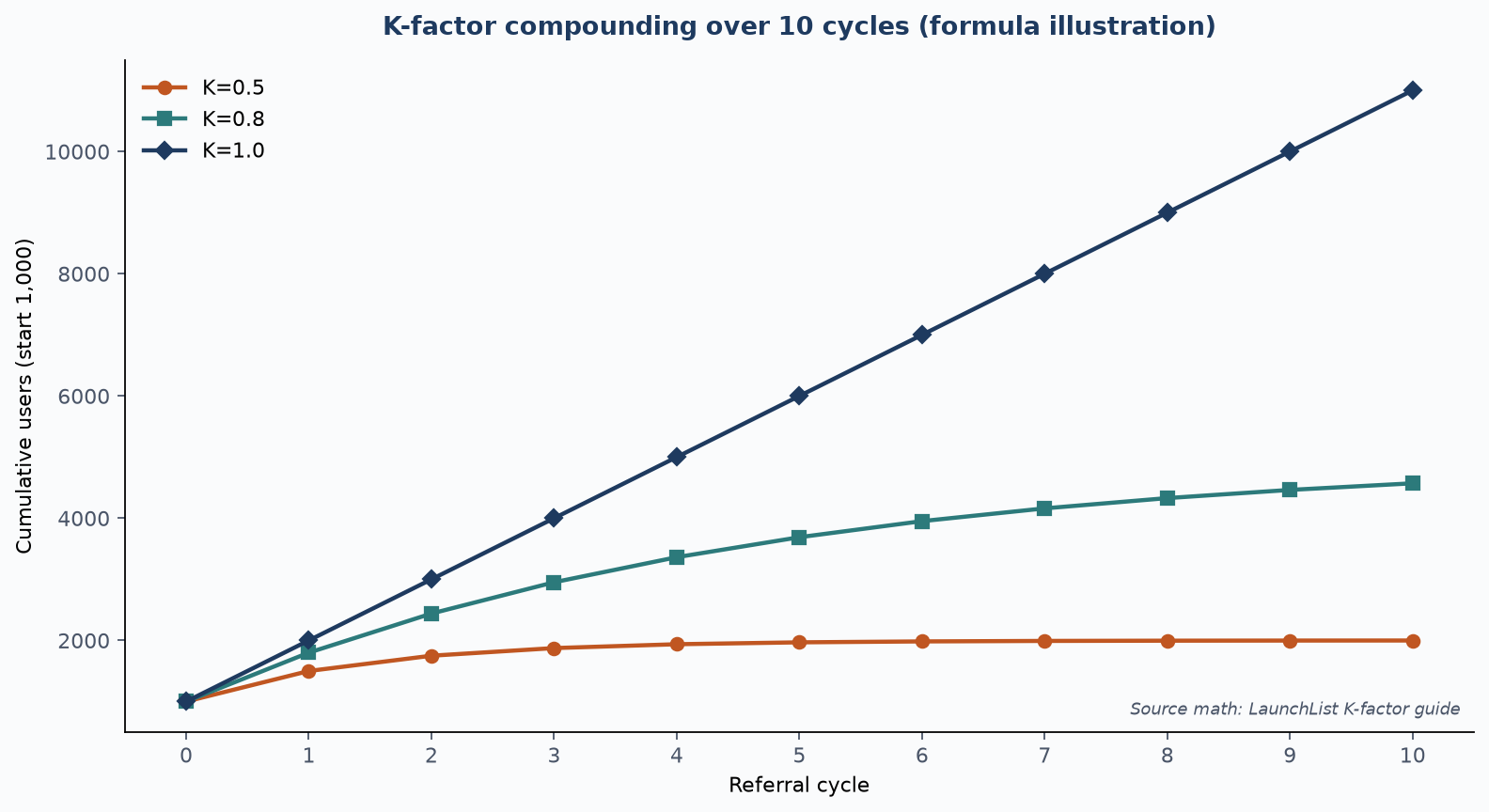
Source: Formula illustration from LaunchList Viral Coefficient & K-Factor guide (not an empirical multi-product study). https://getlaunchlist.com/blog/viral-coefficient-k-factor-guide
Raise i with share UI on the success page, pre-filled copy, and milestone rewards (“invite 3 for priority access”). Raise c with two-sided incentives, referrer-aware landing pages, and low friction. Expect K to decay as the addressable network saturates.
There is no public census of waitlist→signup or waitlist→paid conversion across products. Published community cases disagree on purpose:
Use those as anecdotes. Your rate will track traffic quality, nurture cadence, time since signup, and friction to first value. Batch invites, keep the path short, and re-qualify with a one-question email before you discount your way out of a bad list.
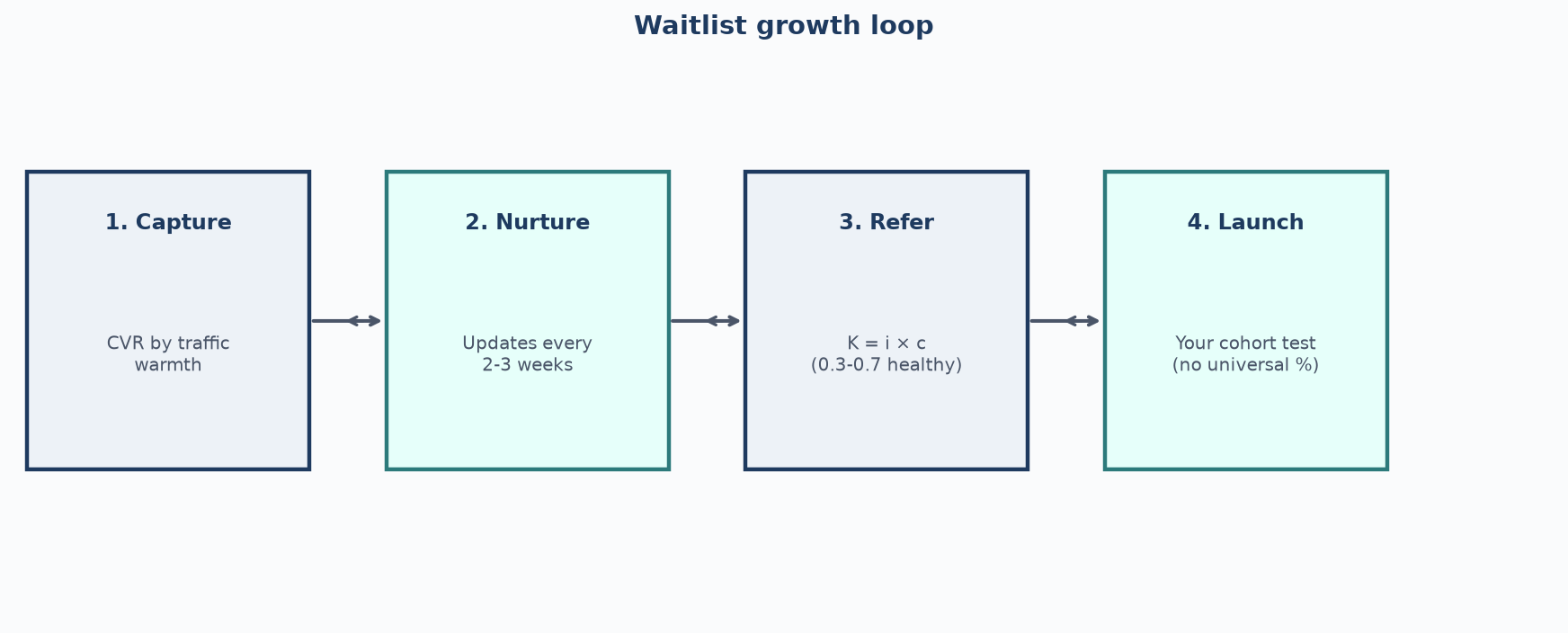
Source: Editorial framework combining LaunchList capture bands, size timing guidance, and K-factor definition. https://getlaunchlist.com/help/faq/strategy-growth
| Scorecard | Question it answers | Good-enough signal | Common failure |
|---|---|---|---|
| Capture CVR | Is the promise clear for this traffic? | Match LaunchList band for that source | Judging cold paid with warm targets |
| Engaged size | Do we have enough humans? | 1k-5k typical indie band if qualified | Bots and tire-kickers |
| K-factor | Do referrals multiply acquisition? | 0.3-0.7 for many waitlists | Chasing permanent K>1 |
| Cycle time | How fast does the loop spin? | Days, not months | Share prompt buried in week-3 email |
| Launch conversion | Did the list buy or activate? | Your cohort tests only | Quoting a blog’s “average 20%” |
Q: What are waitlist growth strategies with real benchmarks? A: Treat the waitlist as four scorecards: capture CVR by traffic source, qualified list size, K-factor (invites × invite conversion), and your own launch conversion tests. LaunchList publishes rough capture bands and treats healthy pre-launch K as about 0.3-0.7. There is no public census for waitlist-to-paid conversion.
Q: What is a good waitlist conversion rate? A: It depends on traffic. LaunchList’s rough bands put warm traffic near 15%-35%, medium-intent communities near 8%-15%, and cold paid near 3%-8%. Compare yourself to the matching band, not to a single “average.”
Q: What is a good K-factor for a waitlist? A: For most pre-launch waitlists, K between about 0.3 and 0.7 is healthy and still compounds acquisition. K greater than 1 means a self-sustaining window, but sustained K greater than 1 is rare. Measure K = invites per user × invite conversion by cohort.
Q: How big should a waitlist be before launch? A: LaunchList frames under 500 qualified signups as fine for niche or small B2B, 1,000-5,000 as typical indie, 5,000-20,000 as a viral breakout, and 20,000+ as usually press or celebrity-backed. Engaged quality beats raw count.
Q: What percentage of a waitlist converts at launch? A: There is no public census. Community cases range widely, from low single digits on cold lists to about half in one Indie Hackers TestFlight anecdote, with one HN team reporting about 10%-20% response on early invites. Run your own cohort tests and keep the list warm.
Waitlist growth strategies with real benchmarks are a scorecard problem: capture by traffic warmth, size by quality band, amplify with honest K, and prove launch conversion yourself because no universal rate exists. Stop worshipping a counter. Build a loop that compounds.
If you want product updates as feat. ships distribution for builders and affiliates, join the feat. waitlist.
Affiliate marketing for startups is an operating system—locks, cost, recruit, rates, tracking, first 100 sales, then diagnose a flat roster.
Build a commission-based sales network as a single-tier seller graph—economics, surface, named sellers, then density. Rewardful: only 1.28% of affiliates sell.
Build a product distribution network on four rails—DTC, wholesale, commission sellers, co-branded storefronts. Densify before you scale; Lowe’s pays up to 20% on storefronts.