How to Turn Customers Into a Sales Channel
Turn customers into a sales channel via referral, affiliate, or a co-branded storefront. ReferralCandy’s rate is 2.35%; only 1.28% of affiliates sell.
Build a commission-based sales network as a single-tier seller graph—economics, surface, named sellers, then density. Rewardful: only 1.28% of affiliates sell.

TL;DR: How to build a commission-based sales network is a Single-Tier Seller Graph problem: approve independent sellers, attach one-tier commission edges, and give them a real sell surface. Densify before you grow the roster. Rewardful’s SaaS sample (n=2,847) finds only 7.6% of affiliates ever refer and 1.28% ever sell—so a public signup dump is not a network.
Most founders who ask how to build a commission-based sales network already have a product that converts. What they lack is a graph: named sellers, clear one-tier edges, and a page those sellers can actually share. They open a public form instead. The roster fills. The ledger stays quiet. That failure is the same flat affiliate program problem wearing a “sales network” label.
A hired SDR is a different machine. The Bridge Group’s 2025 study of 351 B2B companies puts median SDR on-target earnings at $80K, with a 3.0-month ramp and only 60% of reps at quota (Bridge Group, 2025). A commission network pays after attributed revenue. Those are not interchangeable seats. The Performance Marketing Association’s 2025 study still puts 2024 U.S. affiliate-driven e-commerce at $113B (9.4% of the market) on about $13.62B of spend (PMA). The money is real. The graph is what most startups skip.
Key takeaways:
A commission-based sales network is a set of independent sellers you approve, each paid a single-tier commission on attributed revenue, each given a tracked surface to sell from, with no downline and no W-2 base salary.
That definition is stricter than “we have an affiliate program.” A program can be a tracker and a PDF. A network has density: more than one active seller, more than one attributed sale, and a settlement rhythm people trust. Rewardful’s sample shows why the word matters—56% of SaaS programs stay under 50 affiliates, and only 15.6% survive long-term (Rewardful). Most “networks” never become graphs. They become inboxes.
It is also not a multi-tier recruiting tree. Sub-affiliate and multi-level payouts are a different legal and trust shape; keep that conversation in sub-affiliate and multi-tier programs explained. For this build, every edge is one hop: seller → your checkout → their commission. Reddit founders who floated MLM-style downlines for affiliate marketplaces got the same pushback in plain language—“single-tier… no downlines”—because buyers and sellers both smell the pyramid before the first payout clears.
feat. sits on the surface layer of the graph. Merchants list once. Approved creators get co-branded storefronts with an automatic revenue split on attributed checkout. Marketplace listing is optional. feat. does not find your first ten sellers. If you cannot name them, you do not have a network yet. You have a hope with a login page.
Commission networks matter when you need distribution that scales with sales, not headcount. The Bridge Group’s median SDR costs about $13,750 in base salary during a 3.0-month ramp before you even know if they hit quota—our arithmetic on their $55K base median (Bridge Group, 2025). A seller on a CPS edge costs you when the sale closes. That is the whole point of the graph.
Why the network beats another open signup:
There is no public dataset for “days to first sale after naming ten sellers.” Do not invent one. Meter your own first ten.
The Single-Tier Seller Graph is four layers you assemble in order: commission economics, sell surface, named seller nodes, then density meters. Skip a layer and you get a tracker with ghosts, a marketplace with no edges, or a multi-tier pitch you did not mean to make.
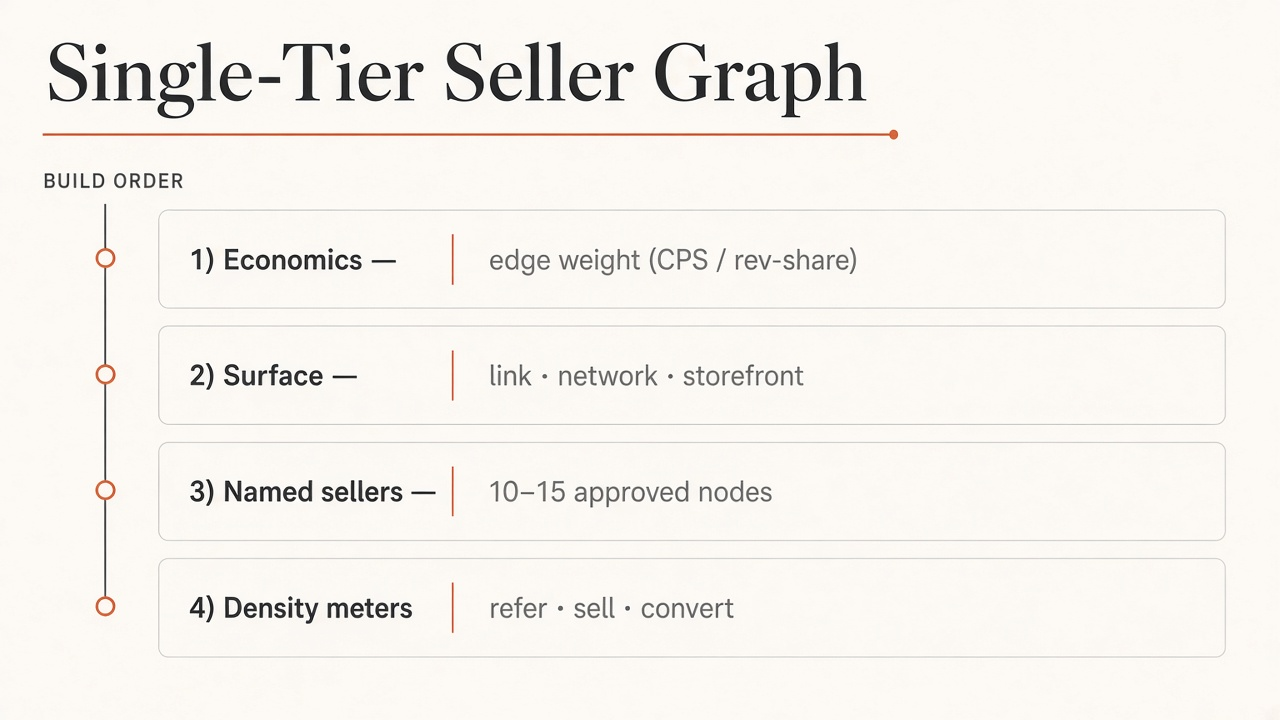
Source: Editorial framework synthesized for this article from Rewardful, Shopify, PartnerStack, Bridge Group, and feat. product mechanics. Taxonomy diagram, no invented conversion rates.
Write the edge before you recruit the node. Choose the event (sale, trial, qualified lead), the rate, the cookie or attribution window, the refund clawback, and the payout threshold. Shopify’s category bands are the envelope; your gross margin is the hard ceiling (Shopify). For structure choices inside that envelope, use affiliate commission structures and recurring vs one-time commissions. Do not copy Rewardful’s 24.16% SaaS average onto a 12-point physical-goods margin and call it “competitive.”
| Product shape | Published commission band | Source |
|---|---|---|
| Physical goods | 5%–15% per sale | Shopify, 2026 |
| Digital products / courses | 20%–50% per sale | Shopify, 2026 |
| Subscriptions | 15%–30% recurring | Shopify, 2026 |
| B2B software / services | 10%–30% of first contract | Shopify, 2026 |
| High-ticket (furniture, mattresses) | 3%–8% per sale | Shopify, 2026 |
| SaaS programs on Rewardful (average) | 24.16% | Rewardful, n=2,847 |
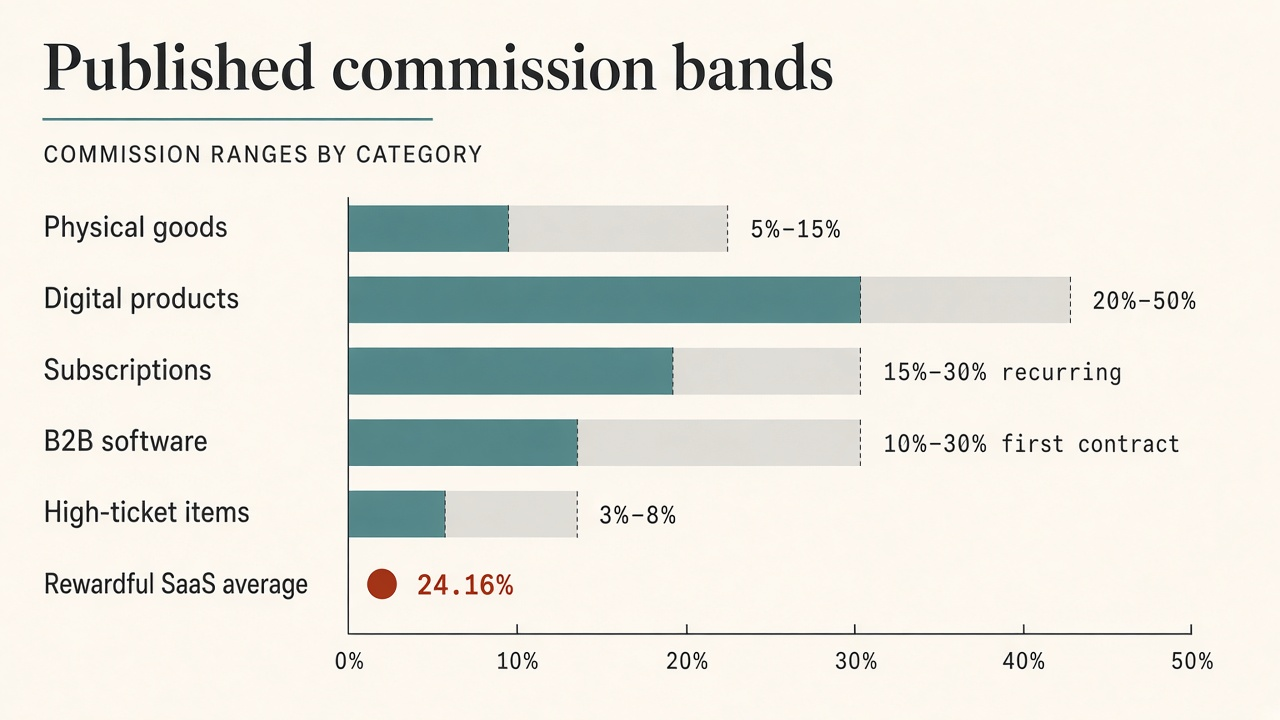
Source: Shopify Affiliate Commission Guide, 2026. https://www.shopify.com/blog/affiliate-commission · Rewardful State of SaaS Affiliate Programs. https://www.rewardful.com/articles/state-of-saas-affiliate-programs-report
An edge without a surface is a UTM fantasy. Three common surfaces:
| Surface | What the seller gets | When it fits | Sticker to know |
|---|---|---|---|
| In-house tracker link | Unique URL + dashboard | SaaS checkout you already own | Rewardful / FirstPromoter often near $49/month (Rewardful pricing) |
| Network / partnership cloud | Roster + network discovery | You need partners you do not already know | PartnerStack Network earners 43% vs 3% outside |
| Co-branded storefront | A page with their handle + your locked offer | Seller needs a place to sell, not a parameter | feat. marketplace / merchant listing; fees in-product |
This is the same surface choice as affiliate software vs storefront and best affiliate marketing network, narrowed to network build order. If the seller’s audience lives in DMs and link-in-bio, a bare tracker link dumps them on a generic PDP. Give them a creator storefront or accept that most of your “network” will never send a second click.
Recruit people with names, not open signup. Ten to fifteen named partners beat five hundred ghost accounts—the same soft-launch doctrine as starting an affiliate program and recruiting affiliates for your product. PartnerStack’s 43% vs 3% gap is the quality filter in one chart. Warm seats first: customers who already bought (customers into a sales channel), creators who already have attention (audience into a distribution channel), agencies and resellers if that is your seat (partner program for a startup). Cold marketplace applications come after the graph has a pulse.
Meter the graph weekly: approved sellers, sellers with ≥1 referral, sellers with ≥1 sale, referral-to-sale conversion, payouts sent on time. Rewardful’s funnel is the planning table—not a vanity dashboard of “joined.”
| Meter | Rewardful figure (SaaS, n=2,847) | What to do when it is red |
|---|---|---|
| Affiliates who refer | 7.6% | Kill ghost seats; ship creatives; re-brief |
| Affiliates who sell | 1.28% | Fix offer/landing fit before adding nodes |
| Referral → sale | 0.8% | Product or price problem, not “need more affiliates” |
| Referrers who convert a sale | 16.8% | Concentrate enablement on the referrers |
| Programs under 50 affiliates | 56% | Normal early state—do not panic-scale roster |
| Long-term program survival | 15.6% | Treat the network as an operating system, not a launch stunt |
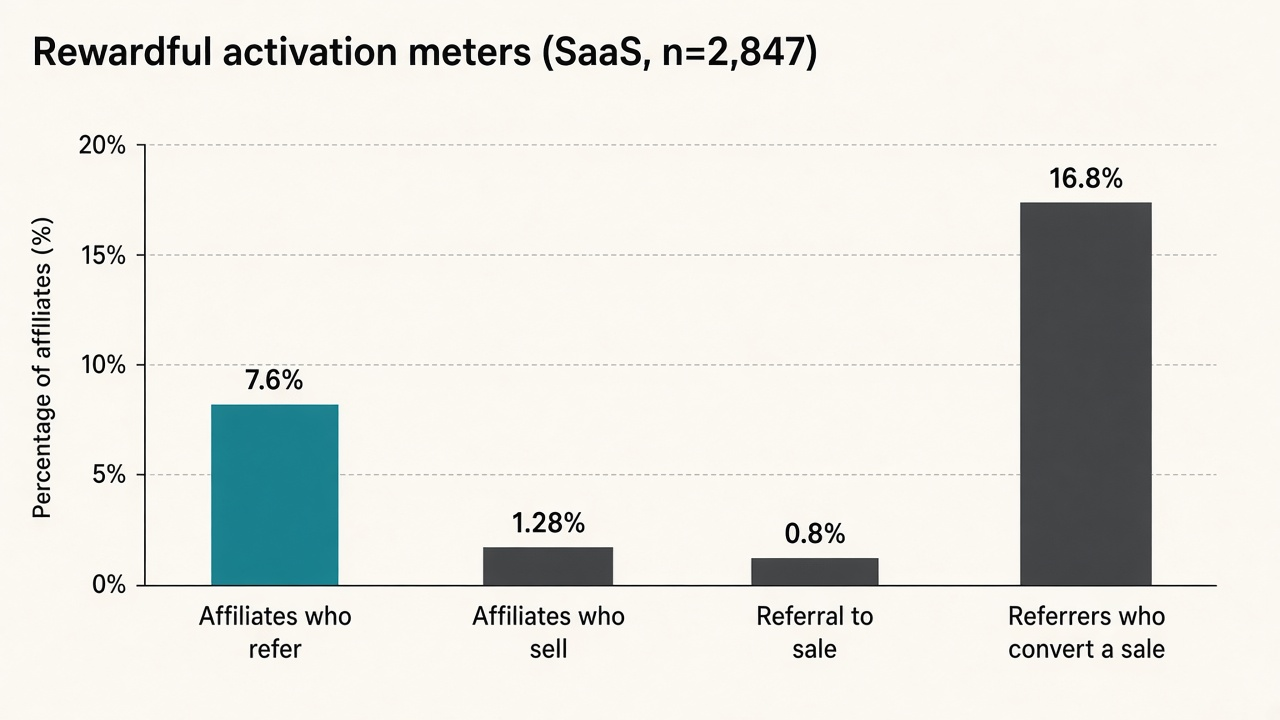
Source: Rewardful, State of SaaS Affiliate Programs Report (n=2,847). https://www.rewardful.com/articles/state-of-saas-affiliate-programs-report
Attribution and payout are part of density. If you cannot track affiliate sales or explain how affiliate marketers get paid, sellers will stop promoting before your second cohort arrives.
Build the Single-Tier Seller Graph in this order. Each step is at most two sentences. Do not open public signup until step 5 has a green week.
Q: How do you build a commission-based sales network without hiring salespeople? A: Approve independent sellers on single-tier commission edges, give each a tracked sell surface, and meter activation before roster growth. That is a seller graph, not a commission-only employee with a script. Keep directed outbound in a separate seat if you still need it.
Q: What is a single-tier affiliate network? A: A single-tier network pays the seller who drove the attributed sale—and stops there. No downline, no override for recruiting other sellers. Multi-tier structures are a different product; see sub-affiliate and multi-tier programs.
Q: How many sellers should I start with? A: Start with ten to fifteen named partners you would trust with your brand kit. Rewardful finds 56% of SaaS programs stay under 50 affiliates and only 1.28% of affiliates ever sell, so a thousand open applications is usually noise (Rewardful).
Q: How much commission should a sales network pay? A: Stay inside published bands you can fund from margin—Shopify’s physical 5%–15%, digital 20%–50%, subscription 15%–30% recurring are the planning envelopes (Shopify). Rewardful’s SaaS average of 24.16% is a SaaS statistic, not a universal target.
Q: Is a commission sales network the same as an MLM? A: No. A commission-based sales network here is single-tier performance pay on product sales. Multi-level recruiting income is a different legal and trust shape. If your pitch rewards recruiting more than selling, stop and rewrite the edges.
A commission-based sales network is not a form, a downline, or a cheaper SDR. It is a Single-Tier Seller Graph: economics you can fund, a surface sellers can share, named nodes you approve, and density meters you respect before the roster grows. Rewardful’s 1.28% sell rate is the planning constraint. PartnerStack’s 43% vs 3% gap is the quality filter. Build those two truths into the graph and the network stops being a hope.
If you want the sell surface to be a co-branded storefront instead of a naked link, list the product on feat. and let approved sellers open pages that already carry the split.
Turn customers into a sales channel via referral, affiliate, or a co-branded storefront. ReferralCandy’s rate is 2.35%; only 1.28% of affiliates sell.
Revenue split models for collaborative selling: Rewardful SaaS avg is 24.16%; only 1.28% of affiliates sell. Split the dollar, then activate partners.
Affiliate marketing for startups is an operating system—locks, cost, recruit, rates, tracking, first 100 sales, then diagnose a flat roster.