Affiliate Marketing for Startups: Complete Guide
Affiliate marketing for startups is an operating system—locks, cost, recruit, rates, tracking, first 100 sales, then diagnose a flat roster.
Affiliate cookie duration and attribution windows: Amazon's 24-hour cart rule, last-click vs first-click, and setting a window to match your sales cycle.

TL;DR: Affiliate cookie duration and attribution windows are three settings, not one day count. The window says how long a click stays eligible. The attribution rule says who wins among overlapping clicks. Overrides (Amazon cart hold, coupon codes, a newer link) can rewrite both. Anchor on published rules, not a fake “industry standard 30 days.”
Merchants argue about “30-day cookies” like the number alone pays affiliates. It does not. A click that expires before checkout pays nobody. A last-click rule can hand the commission to a coupon site three minutes after a reviewer’s work. A cart override can keep Amazon credit alive for weeks after a 24-hour session closes.
Affiliate cookie duration and attribution windows are the settings that decide whether a referral still counts when someone finally buys. Put them in your affiliate program terms of service. Pair them with link cloaking and tracking so the URL stack matches what you promised. For marketplace rates that sit on a short window, start with Amazon Associates commission rates by category.
Affiliate cookie duration (also called a cookie window or attribution window) is the period after a tracked click during which a later purchase can still be credited to that affiliate. In affiliate programs the window is usually enforced by a first-party cookie, a click ID, or a server-side record on the program’s tracking domain.
That definition is incomplete without the attribution rule. Cookie duration answers “is this click still eligible?” Attribution answers “which eligible click wins?” Last-click, first-click, and multi-touch models can all sit on top of a 30-day or 90-day window (Matt McWilliams). Confusing the two is how founders publish a day count in the TOS and then fight coupon sites with no written rule for who overrides whom.
Amazon’s published mechanics show why “cookie length” alone misleads. You earn on qualifying items placed in the cart within 24 hours of arrival via your Associates link. The window closes if the customer submits an order or reenters through another Associate’s link. If the item was carted in window, you can still earn when the order is placed before the cart expires (usually after 90 days), once the customer has purchased, accepted delivery, and remitted full payment (Amazon cookie help). That is a short eligibility window plus a cart-hold override, not a simple “90-day cookie” slogan.
These settings matter because they are your commission assignment logic under a different name. A short window underpays partners on slow sales cycles. A long window with last-click rewards interceptors at checkout. Affiliates already sort programs by window length in public threads, so silence in your TOS reads as a red flag.
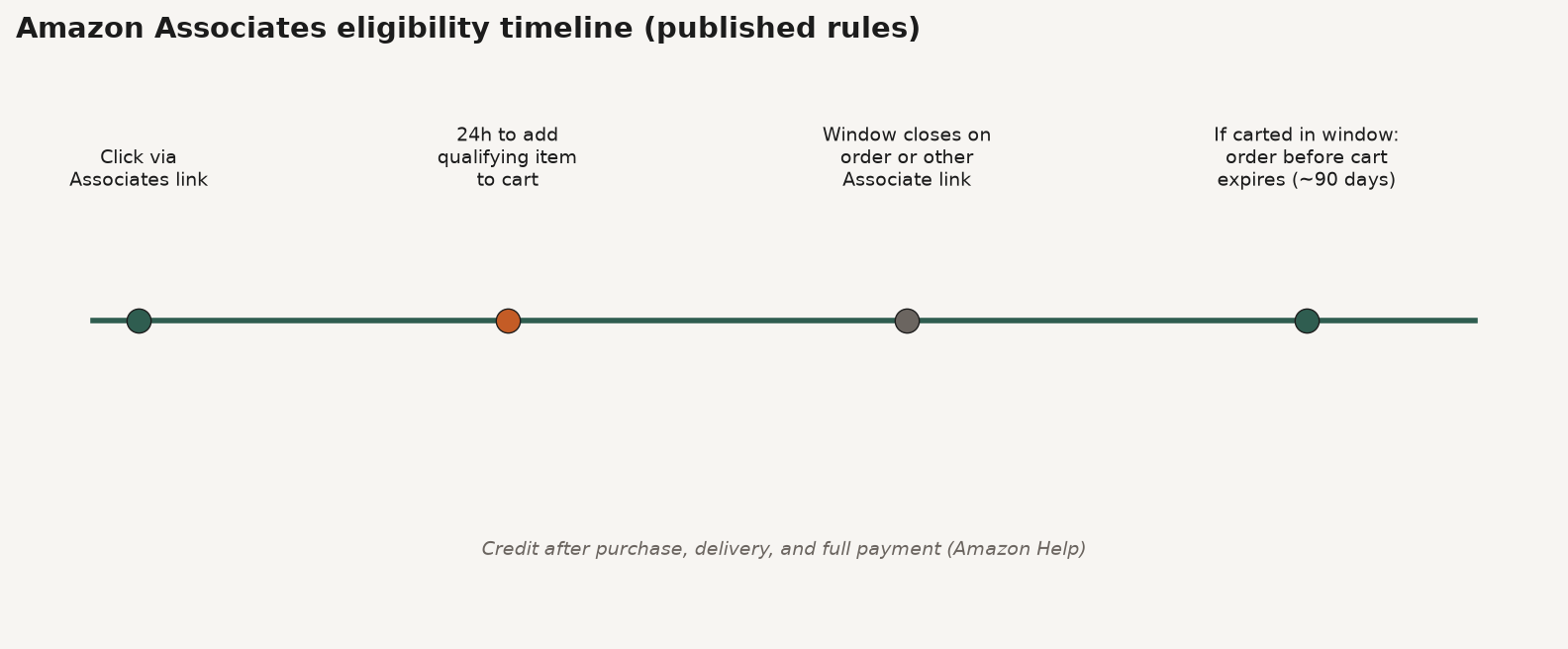
Source: Amazon Associates Central Help, cart timing FAQ. https://affiliate-program.amazon.com/help/node/topic/G9SMD8TQHFJ7728F
Affiliate cookie duration and attribution windows work as three levers you set and then honor at payout. Lever one is eligibility length. Lever two is the who-wins rule among overlapping eligible clicks. Lever three is override logic such as cart holds, coupon codes, or a newer affiliate link that kills the prior session.
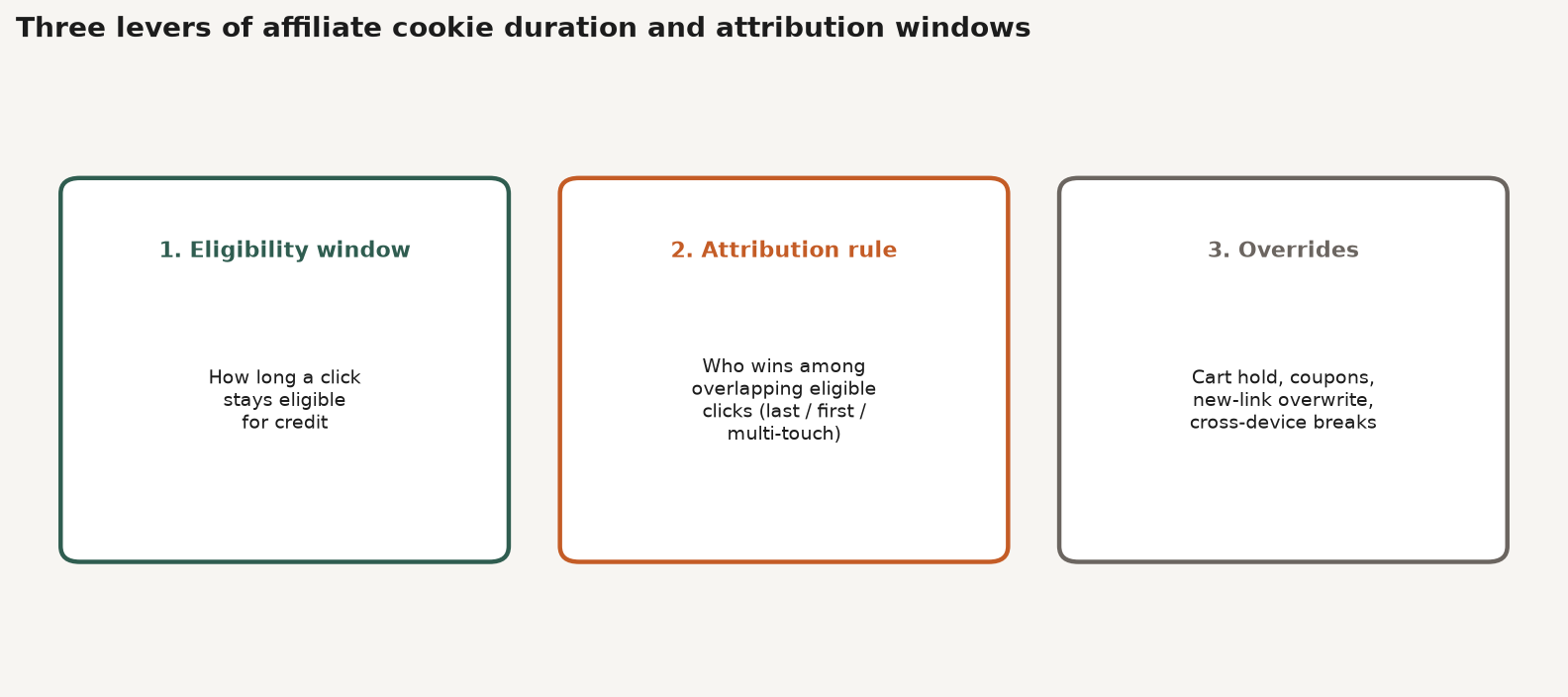
Source: Editorial framework. Window and rule language aligned with Rewardful Help and Matt McWilliams (Jul 2026); Amazon override from Amazon Associates Help.
Rewardful’s docs define the cookie window as how many days a referral click stays eligible for attribution. Attributions inside the window associate to the affiliate. Attributions after it do not (Rewardful Help). That is the clean definition to put in merchant terms.
Amazon’s eligibility rule is stricter and more specific: cart-add within 24 hours of Associates-link arrival (Amazon cookie help). Do not market Amazon as a “90-day cookie program.” Market it as a 24-hour cart-add window with a usual ~90-day cart expiry for items already carted.
There is no public dataset that certifies one correct day count for every niche. Planning bands people use in practice (impulse shorter, high-consideration longer) are proposals. Publish the number your stack can prove, then match it to the sales cycle you actually observe.
| Rule | Who gets paid when multiple affiliates have eligible clicks | Typical fit | Main failure mode |
|---|---|---|---|
| Last-click | Most recent eligible click before purchase | Short cycles; homogeneous affiliate mix | Coupon/loyalty intercept undervalues content (McWilliams) |
| First-click | Earliest eligible click in the window | Awareness-heavy, long consideration | Ignores nurturers who close the deal |
| Multi-touch | Split across touches (linear, time-decay, U-shaped, custom) | Mixed funnel at scale | Complexity; platform support varies |
Last-click is the default on virtually every affiliate platform (Matt McWilliams). A 90-day last-click program is still last-click. Lifetime cookies still run last-click unless you change the model. Named tools can diverge: Rewardful documents first-touch as the default for new campaigns, with last-touch available in settings (Rewardful first or last touch). Read your own dashboard before you claim “industry default” in a partner email.
Channel-level marketing attribution (last-touch vs multi-touch vs MMM) is a sibling problem for media mix, not a substitute for affiliate who-wins rules. See attribution models compared when the fight is paid vs organic vs email. Keep affiliate program rules in the affiliate contract.
Amazon again: the 24-hour window closes early if the customer submits an order or reenters through another Associate’s link. A newer Associates link overwrites you. Separately, a carted item can still pay after the session clock dies, until the cart expires (usually about 90 days) (Amazon cookie help). That cart hold is an override, not a longer browser cookie.
Other common overrides:
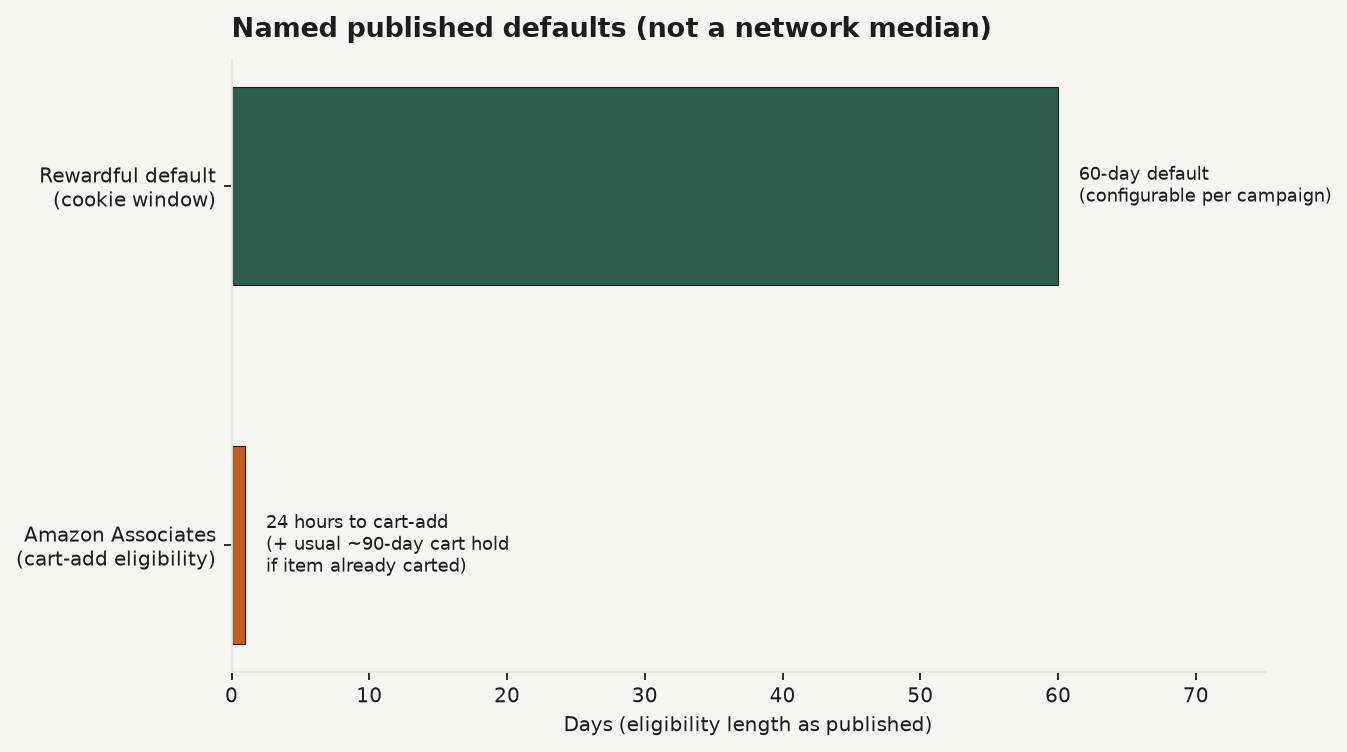
Source: Amazon Associates Help (24h / usual ~90-day cart) and Rewardful Help (60-day default, Oct 9, 2024). Not a network-wide median. https://affiliate-program.amazon.com/help/node/topic/G9SMD8TQHFJ7728F · https://help.rewardful.com/en/articles/2155812-how-long-are-referral-cookies-valid
Use published primaries when you need numbers on the page:
| Anchor | Published figure | What it is | What it is not |
|---|---|---|---|
| Amazon Associates | 24 hours to cart; cart usually ~90 days | Marketplace program rules | A DTC brand default |
| Rewardful | 60-day default cookie window | One Stripe-oriented affiliate tool default | Median of CJ / Impact / Awin programs |
| “Typical 30 days” blog claims | Varies by secondary article | Loose planning talk | A public census (no public dataset) |
Network programs on CJ, Impact, Awin, and similar platforms usually let the advertiser set the window. Two links in one post can carry different windows. Always open the program terms for that merchant. Do not paste a vendor glossary table into your TOS.
A branded redirect does not lengthen Amazon’s window. It also does not replace FTC disclosure. Details live on affiliate link cloaking and tracking explained. Commission math (percent of net, CPA, recurring) sits beside the window in affiliate commission structures. If you negotiate custom windows for top partners, keep the public default in the TOS and put overrides in a signed schedule.
Setting affiliate cookie duration and attribution windows is an ops job you finish before the first payout, not a blog slogan. Match the sales cycle you can measure, name the who-wins rule, document overrides, prove the stack can honor the promise, then put the same language in enrollment terms.
These answers cover how affiliate cookie duration and attribution windows work in practice: definitions, Amazon’s published rules, last-click versus the day count, whether “30 days” is official, and what merchants should put in writing before the first payout ever ships.
Q: What are affiliate cookie duration and attribution windows? A: They are the period after a tracked click during which a purchase can still be credited to that affiliate, plus the rule that decides which eligible click wins when more than one affiliate touched the buyer. The window is eligibility. The model is assignment.
Q: How long does the Amazon Associates cookie last? A: Amazon credits qualifying items placed in the Shopping Cart within 24 hours of arrival through your Associates link. The window closes on order submit or reentry via another Associate’s link. Items carted in window can still pay if the order is placed before the cart expires (usually about 90 days), after delivery and full payment.
Q: Is a longer cookie the same as better attribution for content affiliates? A: No. A long window under last-click still lets a later coupon click take 100% of the commission. Content partners care about both eligibility length and whether first-click or multi-touch protects earlier touches.
Q: Is 30 days the official industry standard cookie duration? A: No. There is no public dataset for one official median across networks and merchants. Amazon publishes a 24-hour cart-add rule. Rewardful publishes a 60-day tool default. Treat “30 days” as informal planning talk unless a named program’s terms say it.
Q: What should merchants put in the affiliate program TOS about cookies? A: State the eligibility window, the attribution rule (last, first, or multi-touch), what overwrites a click, how coupons interact with cookies, and how refunds reverse commissions. Then run the monitoring and payout process those clauses assume.
Affiliate cookie duration and attribution windows are the eligibility clock, the who-wins rule, and the overrides that rewrite both. Publish Amazon’s real cart rules when you promote Amazon, publish your stack’s real defaults for brand programs, and refuse a fake “standard 30 days” census. List products you want creators to sell under clear rules on feat..
Affiliate marketing for startups is an operating system—locks, cost, recruit, rates, tracking, first 100 sales, then diagnose a flat roster.
How to track affiliate sales: pick link cookie, coupon, pixel, S2S postback, or storefront checkout—then match Rewardful, Tapfiliate, or Impact.
Best affiliate programs for SaaS companies pass the Recurring Cap Test: labeled duration, cookie, seat type, payout rails—plus Rewardful’s ~24% planning band.