Affiliate Marketing for Startups: Complete Guide
Affiliate marketing for startups is an operating system—locks, cost, recruit, rates, tracking, first 100 sales, then diagnose a flat roster.
Affiliate fraud and how to detect it: cookie stuffing, last-click hijacking, click bots, Daisycon red flags, and Fraudlogix IVT context labeled correctly.

TL;DR: Affiliate fraud and how to detect it starts with naming the tactic: cookie stuffing, last-click hijacking, click bots, or fake leads. Watch conversion rate, click-to-conversion time, and odd click patterns per partner. Fraudlogix puts global ad invalid traffic near one in five impressions. That is ad IVT context, not your affiliate conversion-fraud rate.
If you pay on tracked actions, someone will try to get paid without creating the action. That is the entire game of affiliate fraud.
Affiliate fraud and how to detect it is not a morality lecture. It is an ops checklist: which tactic steals which cookie or postback, which KPI lights up, and which control stops the payout. Pair this with how affiliate marketing works for the clean path, and affiliate link cloaking and tracking explained for branded redirects that are not the same as stuffing.
Key takeaways:
Affiliate fraud is any scheme that manipulates affiliate tracking or lead quality so a partner is credited for a commissionable event they did not honestly influence.
Daisycon frames click fraud as generating fraudulent clicks that create the illusion of genuine traffic or engagement so commissions pay without real purchases or sign-ups (Daisycon). Fraudlogix notes affiliate channels are attractive to attackers because per-action payouts raise the payoff versus impression fraud (Fraudlogix).
This is adjacent to, not identical with, ad invalid traffic (IVT). IVT scores non-human or invalid impressions in advertising. Affiliate fraud more often attacks cookies, click IDs, installs, or form fills that fire a CPA or CPS. Use IVT as pressure context. Build detection on partner-level conversion signals.
Common types:
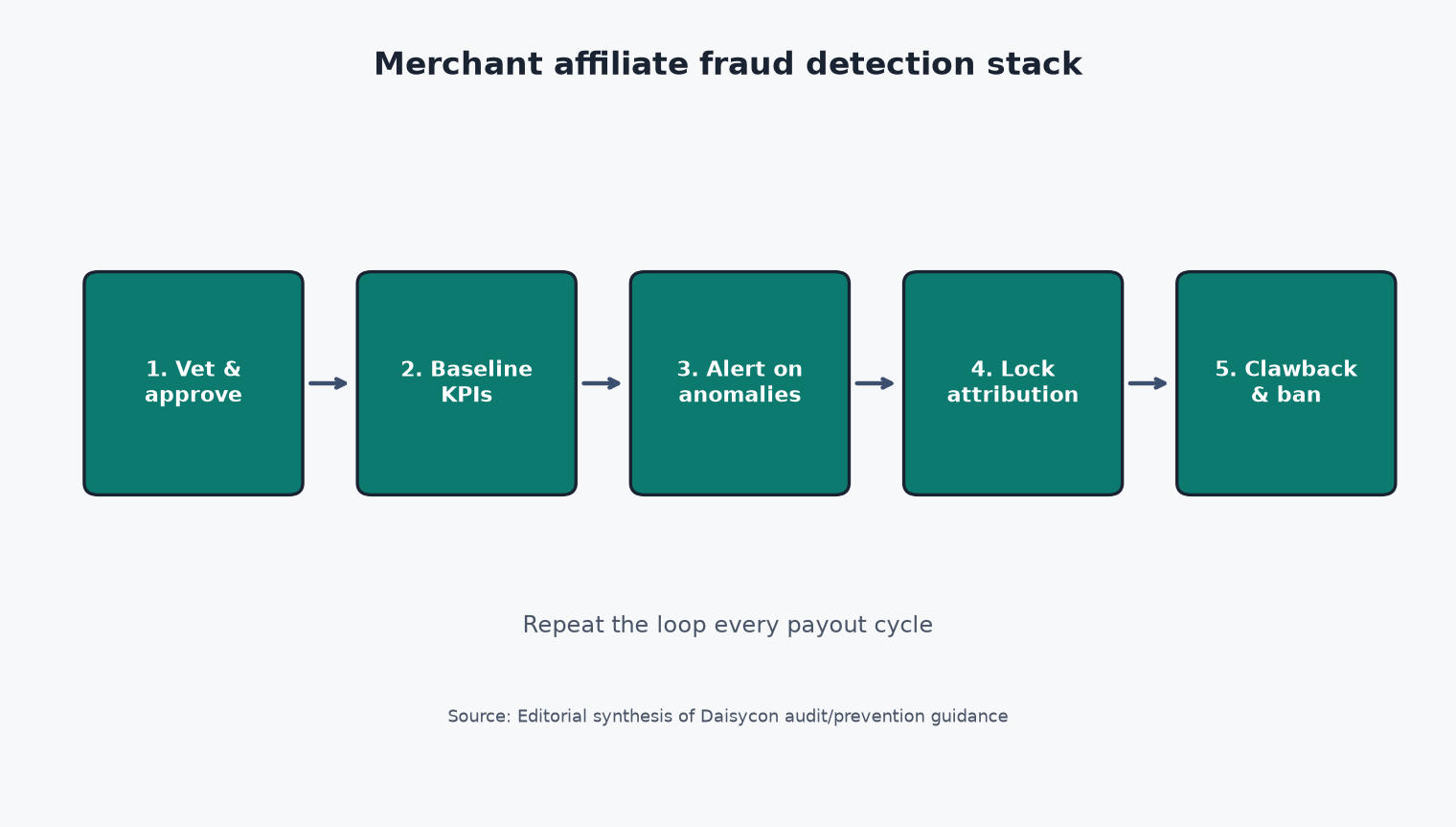
Source: Editorial framework synthesizing Daisycon prevention steps and partner-ops practice. https://daisycon.com/en/how-to-detect-and-prevent-click-fraud-in-affiliate-marketing/
Pay-for-performance only works when the performance is real. Fraud taxes honest partners, poisons CAC math, and turns last-click attribution into a weapon.
Why merchants should care:
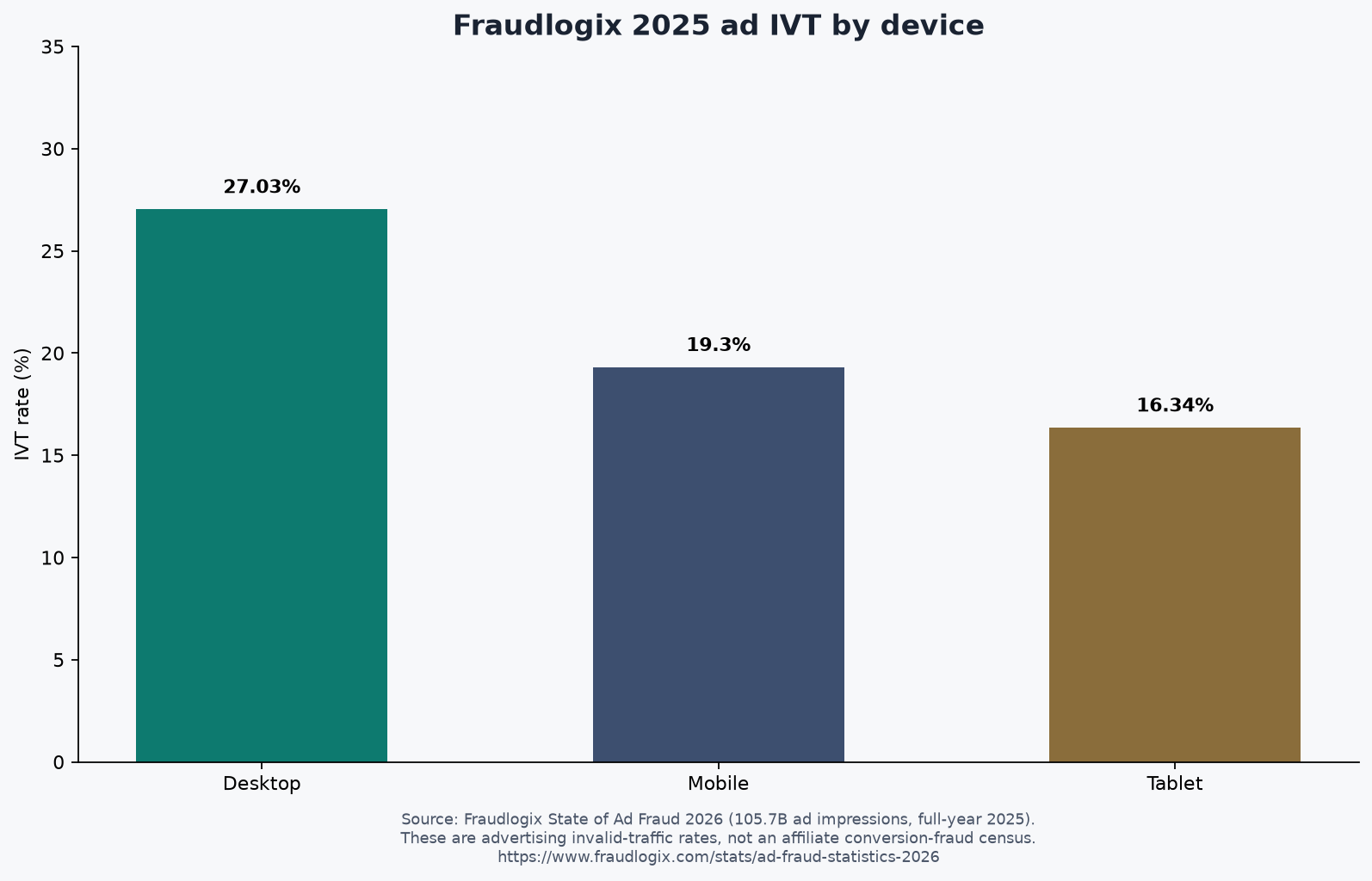
Source: Fraudlogix, State of Ad Fraud 2026 (105.7B ad impressions, full-year 2025). Ad IVT, not affiliate conversion fraud. https://www.fraudlogix.com/stats/ad-fraud-statistics-2026
Affiliate fraud works by faking influence inside the tracking chain. Detection works by matching each tactic to a signal you can audit per partner, then locking attribution so late injectors cannot overwrite earlier, honest clicks.
| Fraud type | What it does | Primary signals | First response |
|---|---|---|---|
| Cookie stuffing | Sets cookie without intentional click | High clicks, very low CVR; long click-to-conversion lag; suspicious referrers | Pause partner; demand traffic proof; clawback |
| Last-click hijacking | Overwrites cookie near order | Very short click-to-conversion; high “win” rate with low first-touch assist | Cart-pixel / attribution lock; review toolbars/extensions |
| Click bots | Inflates click volume | Spike patterns; night-only traffic; clicks >> site analytics visits | Cap/reject traffic; IP/device checks |
| Fake leads | Fabricated form fills | Duplicate PII; disposable email; impossible fill speed | Hold payouts; validate leads before approve |
| Self-referral | Partner buys own offer | Same household/payment fingerprints; circular promo codes | Ban; tighten identity checks |
Daisycon’s KPI guidance maps cleanly onto that table: compare each affiliate’s conversion rate to the program average; for high click volume, compare clicks to overall visits; treat extreme click-to-conversion times as hijack or stuffing clues; investigate odd hour/day spikes (Daisycon).
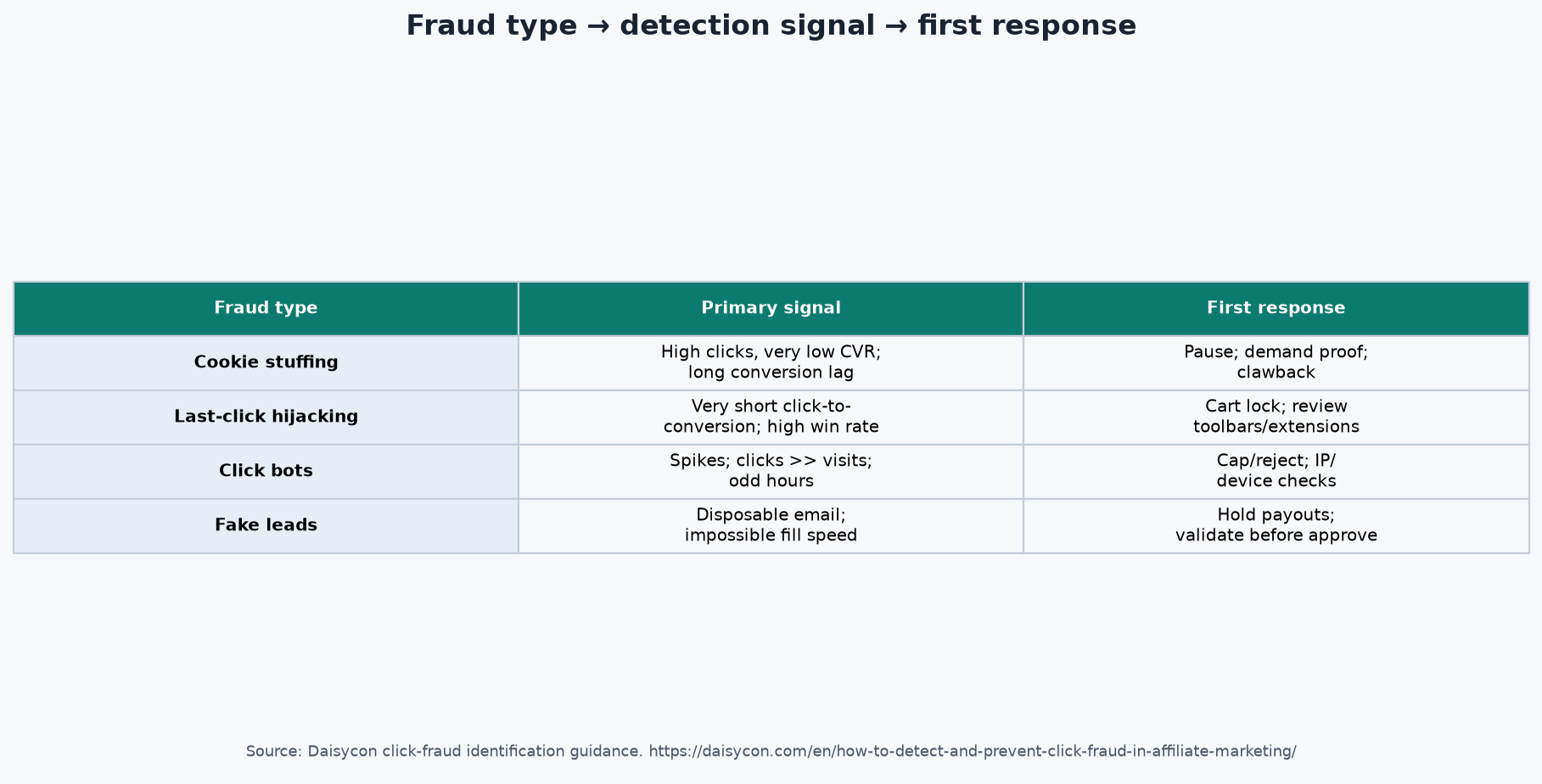
Source: Editorial matrix from Daisycon click-fraud identification guidance. https://daisycon.com/en/how-to-detect-and-prevent-click-fraud-in-affiliate-marketing/
Last-click programs reward the closer. That is fine for many retail offers and deadly when a toolbar can steal the close. Daisycon recommends a shopping-cart pixel that locks credit to the affiliate who generated a cookie before the item hits the cart, and unique promo codes that make forced clicks less relevant (Daisycon). For the broader model choice (last-click vs MTA vs MMM), see attribution models compared.
Cloud and hosting IPs are an ad-side warning light. Fraudlogix Q1 2026 associates 79.24% IVT with Amazon Web Services-sourced ad impression traffic in its sample, because legitimate end users rarely browse from cloud servers (Fraudlogix Q1 2026). Translate that lesson carefully: score partner traffic quality; do not paste ad IVT onto CPS truth.
Branded redirects and tracking domains can be legitimate program design. Deceptive forced clicks and hidden cookie drops are not. Keep the taxonomy from affiliate link cloaking and tracking explained next to this page so you do not ban honest link management while missing stuffing.
Network choice and vetting matter. Edelman and Brandi found outside specialists better at clearing clear rule violations (adware, stuffing), while in-house staff often did better on grey-area practices (Edelman). Pair tooling with a human who can ask “show me the placement” before a large partner scales. Platform-type fit still belongs in best affiliate marketing platforms.
Run a five-step loop: vet before approve, baseline partner KPIs, alert on anomalies, lock attribution against late hijacks, then claw back and ban with evidence. Daisycon’s audit advice (approve carefully, monitor CVR and timing, escalate to the network) is the spine (Daisycon).
Outside advisors help on clear fraud. Keep grey-area policy (typosquatting, aggressive coupon overlays) written so specialists cannot optimize for volume against your interest (Edelman).
Q: What is affiliate fraud and how do you detect it? A: Affiliate fraud is earning commissions through manipulated tracking or fake actions instead of real influence. Detect it by comparing each partner’s conversion rate, click-to-conversion time, and click patterns to program baselines, then investigating outliers with placement proof.
Q: What is cookie stuffing in affiliate marketing? A: Cookie stuffing places an affiliate tracking cookie on a user’s device without a clear, intentional click, often via hidden scripts or pop behavior. If the user later buys, the stuffer may receive credit they did not earn.
Q: What is last-click hijacking? A: Last-click hijacking forces or injects an affiliate click near checkout so a newer cookie overwrites an earlier legitimate partner. Very short click-to-conversion times and high last-click win rates with weak assists are common clues.
Q: What percentage of affiliate traffic is fraudulent? A: There is no public universal census for affiliate conversion fraud across all programs. Fraudlogix reports about 20.64% invalid traffic on 105.7 billion ad impressions in 2025, which is advertising IVT context, not an affiliate conversion-fraud rate.
Q: How can merchants prevent affiliate fraud? A: Vet partners before approval, monitor CVR and timing per affiliate, lock attribution against late overwrites (for example cart pixels and unique codes), and hold or claw back payouts when evidence shows stuffing, hijacking, or fake leads.
Affiliate fraud is commission theft dressed as performance. Detect it tactic by tactic, with partner-level signals and attribution locks, and treat ad IVT benchmarks as context rather than a fake program scorecard. Clean partners deserve a clean leaderboard.
If you want distribution through creators on tracked co-branded storefronts instead of opaque traffic dumps, list your product on feat..
Affiliate marketing for startups is an operating system—locks, cost, recruit, rates, tracking, first 100 sales, then diagnose a flat roster.
How to track affiliate sales: pick link cookie, coupon, pixel, S2S postback, or storefront checkout—then match Rewardful, Tapfiliate, or Impact.
Best affiliate programs for SaaS companies pass the Recurring Cap Test: labeled duration, cookie, seat type, payout rails—plus Rewardful’s ~24% planning band.