Affiliate Marketing for Startups: Complete Guide
Affiliate marketing for startups is an operating system—locks, cost, recruit, rates, tracking, first 100 sales, then diagnose a flat roster.
Affiliate software vs storefront: Impact, CJ, and Rewardful issue a tracked link. feat. issues a place to sell. First-screen gap across 10 tools.

TL;DR: Affiliate software vs storefront is a first-screen choice. Impact, CJ, Rewardful, Tapfiliate, FirstPromoter, and UpPromote are built to hand a partner a tracked link (and often a coupon) into the merchant’s checkout. feat. starts with a co-branded place to sell. Same commission math can exist on both sides. The destination asset is different.
Most affiliate software demos end the same way. The merchant clicks Approve. The partner opens a portal. The headline might as well be carved into the UI: Here is your affiliate link.
That is not a bug. Trackers and networks are excellent at attribution. They are honest about what they ship: a unique URL, a cookie or server event, a commission rule, a payout. The Performance Marketing Association put 2024 U.S. affiliate spend at $13.62B, generating $113B in e-commerce sales (PMA). The industry runs on those links.
feat. answers a different first screen: Here is your own place to sell this. The merchant still owns the SKU and fulfillment. The affiliate still earns on a tracked sale. The buyer lands on a co-branded storefront instead of a naked redirect into a generic homepage. That is the First Screen Gap this page owns.
If you wanted the asset argument (link versus business), read affiliate marketing vs storefront. If you wanted a four-layer tool stack, read best affiliate marketing tools. This comparison walks the tools people actually name (Impact, PartnerStack, CJ, Awin, ShareASale-as-history, Everflow, Tapfiliate, Rewardful, FirstPromoter, UpPromote) against that first deliverable.
Affiliate software vs storefront is the choice between tools that issue a tracked referral into someone else’s checkout, and tools that issue a shoppable page the partner can treat as their selling place for that offer.
That sentence is the definition. It is not “software bad, storefront good.” It is which asset appears first after Approve.
Affiliate software (and classic networks) covers tracking, contracts, fraud rules, reports, and payouts. Rewardful and FirstPromoter attach to Stripe-class billing and mint personalized links and coupons (FirstPromoter). UpPromote on Shopify tracks by affiliate link and coupon, with a Free plan and paid tiers from $29.99/month + 2% of successful referral sales (UpPromote / Shopify App Store). CJ’s publisher kit still ends at Get Code and a Click URL after a program accepts you (CJ). Impact’s Starter plan lists promo code and link tracking as core inclusions (Impact). PartnerStack’s Launch tier literally offers affiliate link tracking or lead and deal registration as the motion you pick (PartnerStack).
A storefront, in this comparison, is a named selling surface. On feat., approval generates a co-branded storefront: the affiliate’s handle and brand kit on the merchant’s offer, with attribution and a revenue split on the sale. It is not a prettier bio link. It is not Amazon Associates. It is not a claim that feat. replaces Impact’s partnership ops. Fees stay in-product. We do not invent them here.
Communities already speak the software side. On Reddit, SaaS founders call PartnerStack and Impact overkill when they only need Stripe-native links, and they shortlist Rewardful or FirstPromoter instead (r/Affiliatemarketing; r/AffiliateMarket). That advice is correct inside the tracker layer. It never asks whether the partner should get a place to sell.
Affiliate software vs storefront matters because merchants keep buying the wrong first screen, then blaming creators when the roster fills and revenue does not.
Why the gap shows up in the numbers you can cite:
| First screen after approval | What the partner receives | What the buyer usually sees | Typical tools |
|---|---|---|---|
| Tracked link | Unique URL + dashboard (+ coupon) | Merchant site / network redirect | Rewardful, FirstPromoter, Tapfiliate, UpPromote, CJ, Awin |
| Partnership ops + link | Contracts, marketplace, multi-event tracking, then links/codes | Merchant properties | Impact, PartnerStack, Everflow |
| Place to sell | Co-branded storefront + tracked URL + split | Affiliate-named selling page | feat. |
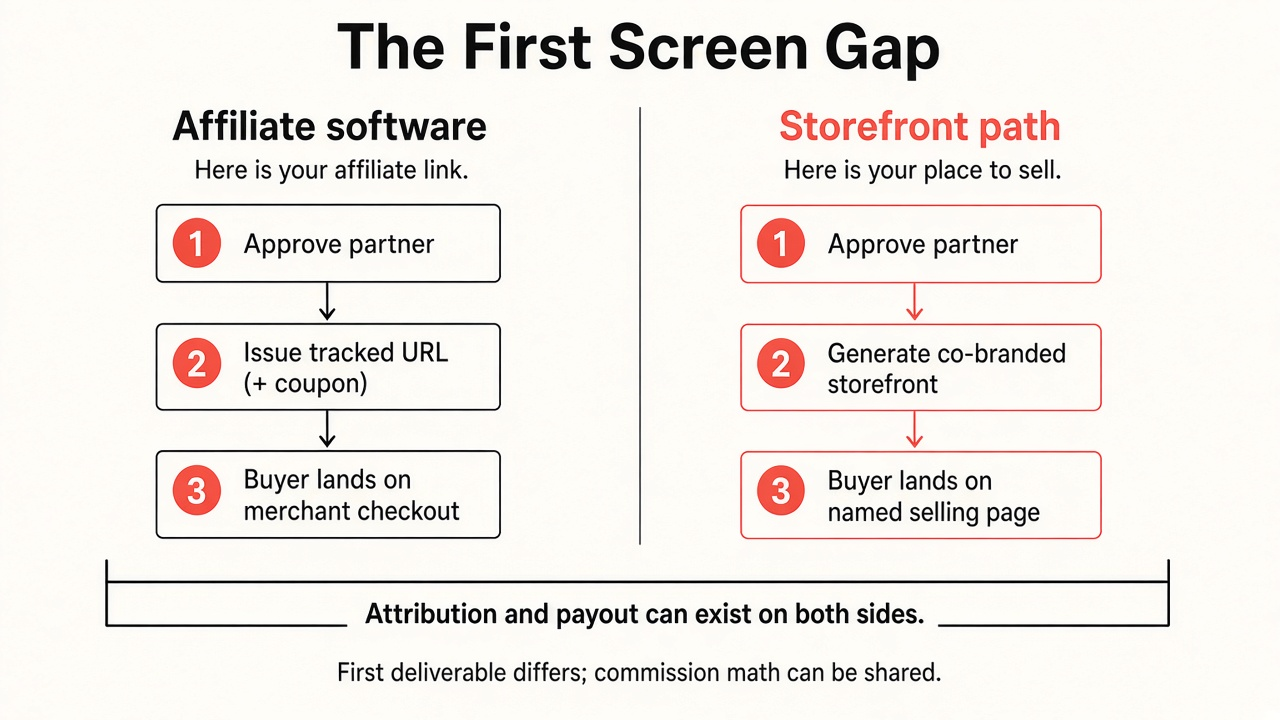
Source: Editorial First Screen Gap for this article. Vendor first-deliverable language from Impact, PartnerStack, CJ, Rewardful, FirstPromoter, Tapfiliate, and UpPromote public pages (accessed 2026-10-05).
Affiliate software vs storefront works as a sequence. Recruit or apply. Approve. Deliver the first asset. Attribute the sale. Pay. The dispute is step three.
Open answer, standalone: Traditional affiliate software and networks complete approval by issuing a tracked link (or coupon) into the merchant’s existing checkout. A storefront path completes approval by generating a named selling page the partner can promote as their place to sell that offer. Tracking can exist in both. The first screen decides whether the partner looks like a referral tag or like a seller.
Impact is a partnership-management cloud. Public pricing lists Starter from $30/month, Essentials $500/month, Pro $2,500/month, plus a 2.5% fee on partner-driven transactions and a one-time setup fee that depends on onboarding resources (Impact). Starter already includes promo code and link tracking, product feeds, and ecommerce plugins. Essentials adds marketplace access to 90,000 partners. That is discovery and ops power. The partner still works with links and codes into brand properties. For B2B job-fit detail against PartnerStack, use PartnerStack vs Impact. This page only needs the first screen: Impact sells partnership cloud, not a feat.-style storefront fork of an indie offer.
PartnerStack is built for B2B partner ecosystems. The live pricing page confirms plan and price during a demo; it does not print a public Launch dollar amount as of this research pull (PartnerStack). Launch includes marketplace access and forces a motion choice: affiliate link tracking or lead and deal registration. That sentence is the First Screen Gap in vendor copy. You are buying partner ops and discovery. You are not buying “here is your own place to sell this.”
CJ is a classic network. Publishers apply per advertiser. After acceptance, the workflow is Links → Get Code → Click URL, or the Deep Link Generator bookmarklet on the brand site (CJ; CJ Deep Linking). Advertiser pricing is not treated as a public self-serve SaaS sticker here. The first deliverable to the publisher is unambiguous: a tracking link into the advertiser’s experience.
User lists often still say “ShareASale.” Awin completed the ShareASale upgrade on August 14, 2025 (9,500+ advertisers, 250,000 active publishers). ShareASale closed October 6, 2025 (Awin). Treat ShareASale as Awin history, not a live parallel login. Awin remains a network seat: programs, creatives, tracked URLs, publisher payouts. Same first-screen class as CJ. Platform-type detail lives in best affiliate marketing platforms.
Everflow positions as multi-channel partner and affiliate tracking at network and brand scale. Pricing is Request Personalized Pricing, with a stated 6-month commitment on Everflow plans (Everflow). Third-party blogs float entry figures near $750/month. That is not on Everflow’s pricing page, so it is no public dataset for this article. Do not budget from a rumor. Do budget for a tracker/ops platform whose job is offers, clicks, and attribution, not a co-branded storefront generator.
Tapfiliate is in-house affiliate software for merchants who want programs, links, and conversion metering. Launch is $89/month ($74/month billed annually) in the pricing used across our tools cluster (Tapfiliate). Affiliates receive tracking links into your site or shop. Strong layer-2 tool. Still “here is your link.”
Rewardful is the Stripe/Paddle-native SaaS tracker. Starter is $49/month up to $7,500/month in affiliate-attributed revenue, 0% take of that attributed revenue on the subscription, 14-day trial (Rewardful). Optional Managed Payouts add 3% on payouts. The product promise to affiliates is unique referral links, coupons, and a performance dashboard. Reddit operators recommend it precisely because it stays close to billing and avoids enterprise process. Correct for tracking. Incomplete if the promoter needed a selling place.
FirstPromoter mirrors the SaaS tracker job. Starter is $49/month up to $5,000/month affiliate-driven revenue, with personalized links, coupons, and direct URL tracking called out on the pricing page (FirstPromoter). Starter caps at 1,000 affiliates. Same first screen as Rewardful: a clean path into your signup or checkout, not a forked storefront under the affiliate’s name.
UpPromote is the Shopify-native affiliate and referral app. Free includes tracking by affiliate link/coupon with a $3,000/month referral-sales review band on the App Store listing. Growth is $29.99/month + 2% of successful referral sales; Professional $89.99 + 1.5%; Enterprise $199.99 + 1% (Shopify App Store; UpPromote docs). Fee shape matters for merchants (see Shopify affiliate apps compared). First screen for the affiliate is still a link or coupon into the Shopify storefront the merchant owns.
feat. is the marketplace path where a merchant lists a product, an affiliate pitches and gets approved, and approval generates a co-branded storefront with a tracked URL and a revenue split on the sale. Merchant lists. Affiliate promotes. Buyer purchases. feat. does not promise traffic, approvals, or income. It does not replace Amazon’s catalog or Impact’s enterprise partnership suite. It answers the first-screen sentence the other tools do not: here is your own place to sell this.
| Tool | Class | Public entry cost (research pull) | First partner deliverable |
|---|---|---|---|
| Impact.com | Partnership cloud | From $30/mo + 2.5% partner-driven | Promo/link tracking into brand properties |
| PartnerStack | B2B partner platform | Demo / quote | Link tracking or lead/deal registration |
| CJ Affiliate | Classic network | Publisher signup; advertiser quote | Click URL / deep link |
| Awin (ex-ShareASale) | Classic network | Network program economics | Tracked creatives / links |
| Everflow | Tracking / partner platform | Personalized quote; 6-mo commitment | Offers + tracking links |
| Tapfiliate | In-house tracker | $89/mo Launch | Affiliate tracking links |
| Rewardful | SaaS tracker | $49/mo Starter | Referral links + coupons |
| FirstPromoter | SaaS tracker | $49/mo Starter | Personalized links + coupons |
| UpPromote | Shopify app | Free; paid from $29.99/mo + % | Affiliate link / coupon into Shopify |
| feat. | Co-branded storefront marketplace | Shown in-product (not invented here) | Place to sell + tracked split |
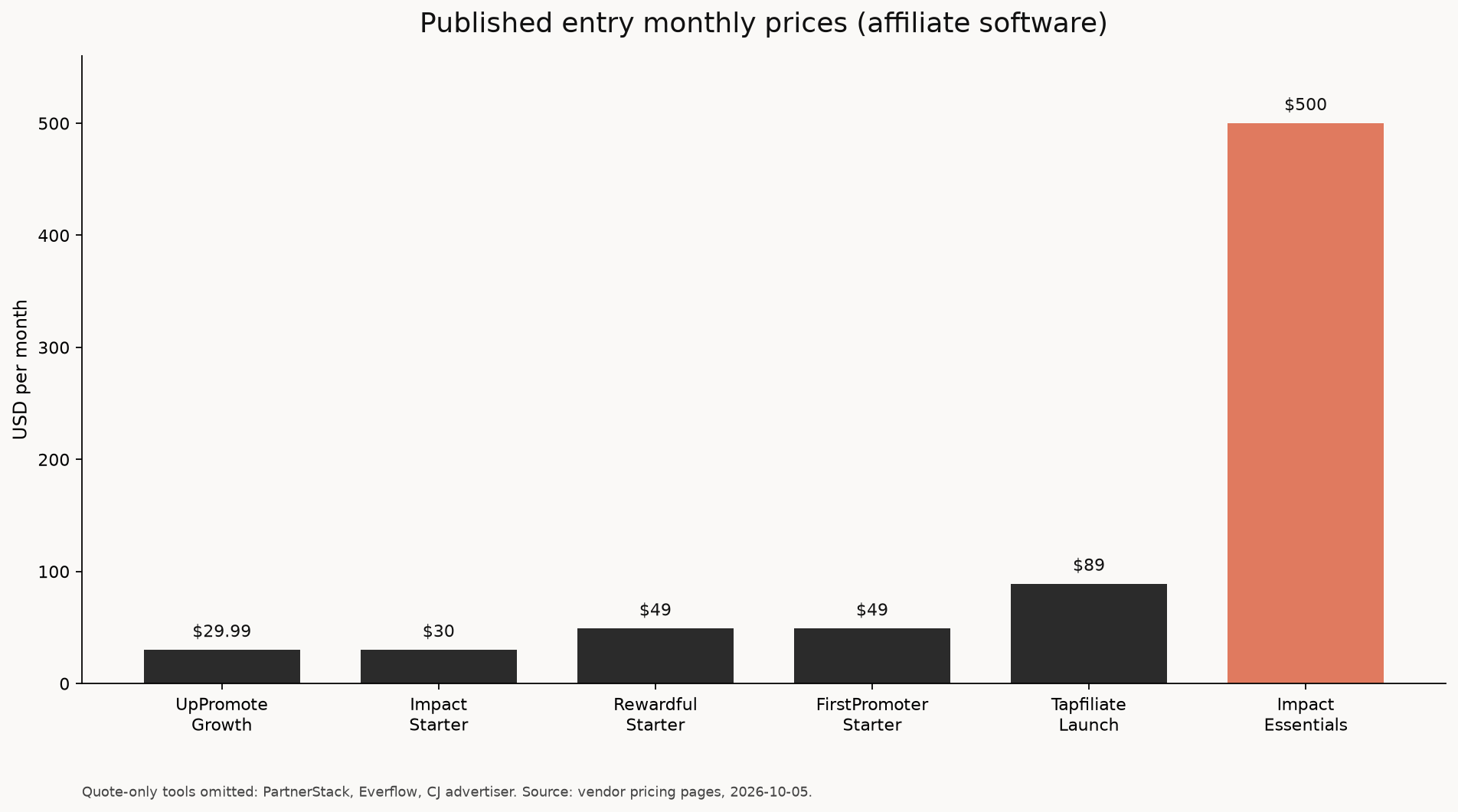
Source: Impact, Rewardful, FirstPromoter, Tapfiliate, and UpPromote official pricing pages, accessed 2026-10-05. PartnerStack, Everflow, and CJ advertiser seats are quote/demo and omitted from the price bars.
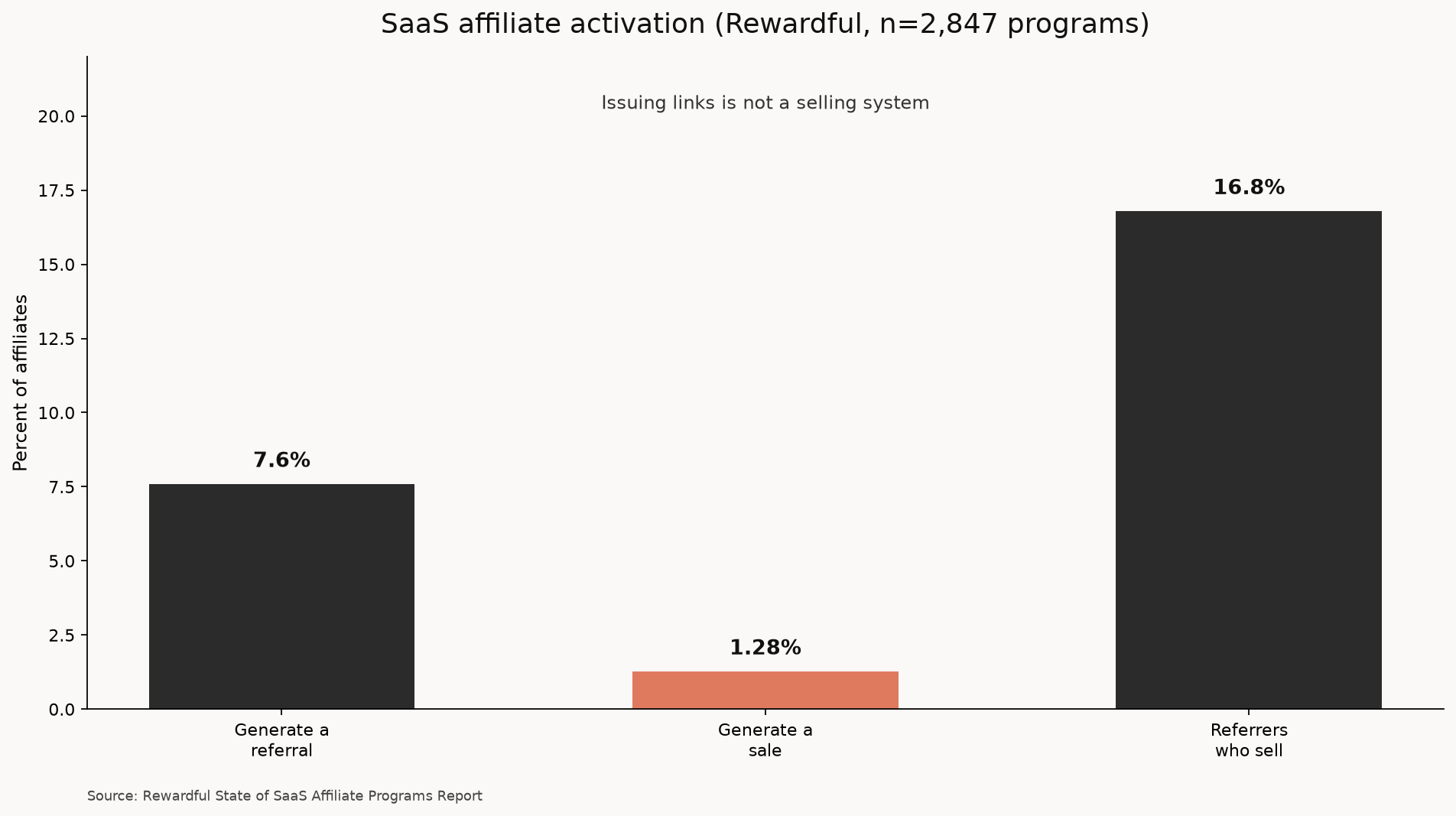
Source: Rewardful, State of SaaS Affiliate Programs Report (n=2,847 programs). https://www.rewardful.com/articles/state-of-saas-affiliate-programs-report.
Buy affiliate software or a network when:
Buy a storefront-first path when:
For the mechanics of the performance contract itself, keep how affiliate marketing works open. For creator storefront taxonomy (link hub vs sell-own vs retailer vs marketplace), use what is a creator storefront.
Q: What is the difference between affiliate software and a storefront? A: Affiliate software tracks and pays referrals, usually by issuing a unique link or coupon into the merchant’s existing checkout. A storefront is a shoppable page the partner can promote as their selling place. You can use tracking on a storefront; the first screen is still different.
Q: Is Impact.com or PartnerStack a storefront platform? A: No. Impact and PartnerStack are partnership and partner-ecosystem platforms. They excel at contracts, discovery, and multi-event tracking. Their partner-facing motion is still links, codes, or lead registration, not a co-branded feat.-style place to sell.
Q: Do Rewardful, FirstPromoter, Tapfiliate, and UpPromote give affiliates a shop? A: They give affiliates a portal with tracking links and often coupons into the merchant’s site or Shopify store. That is the correct SaaS/commerce tracker job. It is not a co-branded storefront under the affiliate’s name.
Q: What happened to ShareASale in this comparison? A: Awin completed the ShareASale upgrade on August 14, 2025, and ShareASale closed October 6, 2025. Treat ShareASale as Awin history. The first-screen class stays network links and creatives.
Q: Does a storefront replace affiliate tracking software? A: Not always. If you only need Stripe attribution for a homepage signup, a $49 tracker may be enough. If promoters need a named selling page, a storefront path is the missing layer. There is no public dataset that one stack wins every niche. feat. fees are shown in-product and are not invented here.
Affiliate software vs storefront is not a brand war between logos. It is whether Approve ends with “here is your affiliate link” or “here is your own place to sell this.” Impact, PartnerStack, CJ, Awin, Everflow, Tapfiliate, Rewardful, FirstPromoter, and UpPromote are strong when the job is credit, discovery, or Shopify/SaaS tracking. feat. is built for the other first screen: a co-branded selling place with a split on the sale.
If you already have people who can sell and they still only get a URL, browse products on the feat. marketplace.
Affiliate marketing for startups is an operating system—locks, cost, recruit, rates, tracking, first 100 sales, then diagnose a flat roster.
How to track affiliate sales: pick link cookie, coupon, pixel, S2S postback, or storefront checkout—then match Rewardful, Tapfiliate, or Impact.
Best affiliate programs for SaaS companies pass the Recurring Cap Test: labeled duration, cookie, seat type, payout rails—plus Rewardful’s ~24% planning band.