Affiliate Marketing for Startups: Complete Guide
Affiliate marketing for startups is an operating system—locks, cost, recruit, rates, tracking, first 100 sales, then diagnose a flat roster.
Affiliate vs influencer marketing compared: pay-for-performance vs flat fees, when to hybrid, and how risk shifts between brand and creator.

TL;DR: Affiliate vs influencer marketing is a risk-allocation choice. Affiliates earn when a tracked conversion happens. Influencers are usually paid up front for attention and trust. Most modern programs blend both: a production payment plus a commission so the post can earn after it ships. Pick the seat that matches your goal, margin, and measurement, not a personality stereotype.
Brands waste months arguing whether affiliates or influencers are “better.” That question is incomplete. The real question is who pays for the content, who pays for the outcome, and what you can actually measure.
If you are comparing affiliate vs influencer marketing, you need a clean definition of each seat, a risk map for money and creative control, and a hybrid path when pure commission or pure flat fee both fail. Creators already live in the blur. Your program should too.
Key takeaways:
Affiliate vs influencer marketing compares two partner-pay models: performance commissions on tracked actions versus up-front (or gifted) payment for creator content that builds awareness and trust.
They are not two species of human. The same person can be an influencer on Monday (flat-fee launch post) and an affiliate on Tuesday (evergreen link in a review). The distinction is the commercial contract, not the follower count.
Affiliate marketing, in the sense that matters for this comparison, is a performance contract. A unique link or code attributes a qualifying event, then a commission pays. That is the same stack described in how affiliate marketing works: ID, window, event, approval, payout.
Influencer marketing, in the classic sense, buys the post. The brand pays for creative, placement, and association with an audience. Sales may follow. Attribution is often softer unless you bolt on links and codes.
The useful third seat is hybrid: pay something for production, attach tracking, and let upside follow conversions. That is where most serious creator programs end up once they leave the spreadsheet debate.
Wrong seat choice looks like a creative problem. It is usually a cash-flow and incentive problem.
Why the distinction earns its own page:
Both models recruit outside promoters. They differ in the event that triggers payment, who absorbs production cost, and which metrics count as success. Hybrid programs deliberately mix those levers so the brand buys a post and still owns a tracked path to revenue.
Think in three seats, not two tribes:
| Seat | Who funds the post | Who funds the outcome | What you optimize | Main failure mode |
|---|---|---|---|---|
| Pure affiliate | Creator (or network) | Brand, only on conversion | EPC, CVR, AOV, refund rate | Thin content, coupon hijacking, creator churn |
| Pure influencer | Brand (flat fee / gift) | Brand, whether or not it sells | Reach, engagement, brand lift, content rights | Untracked vanity, one-and-done posts |
| Hybrid | Shared (fee or gift + commission) | Shared | Content quality + attributed revenue | Overpaying twice without a brief or clawback |
There is no public dataset that crowns one seat as universally higher ROI. Treat “affiliates always win” or “influencers always win” as ideology, not evidence.
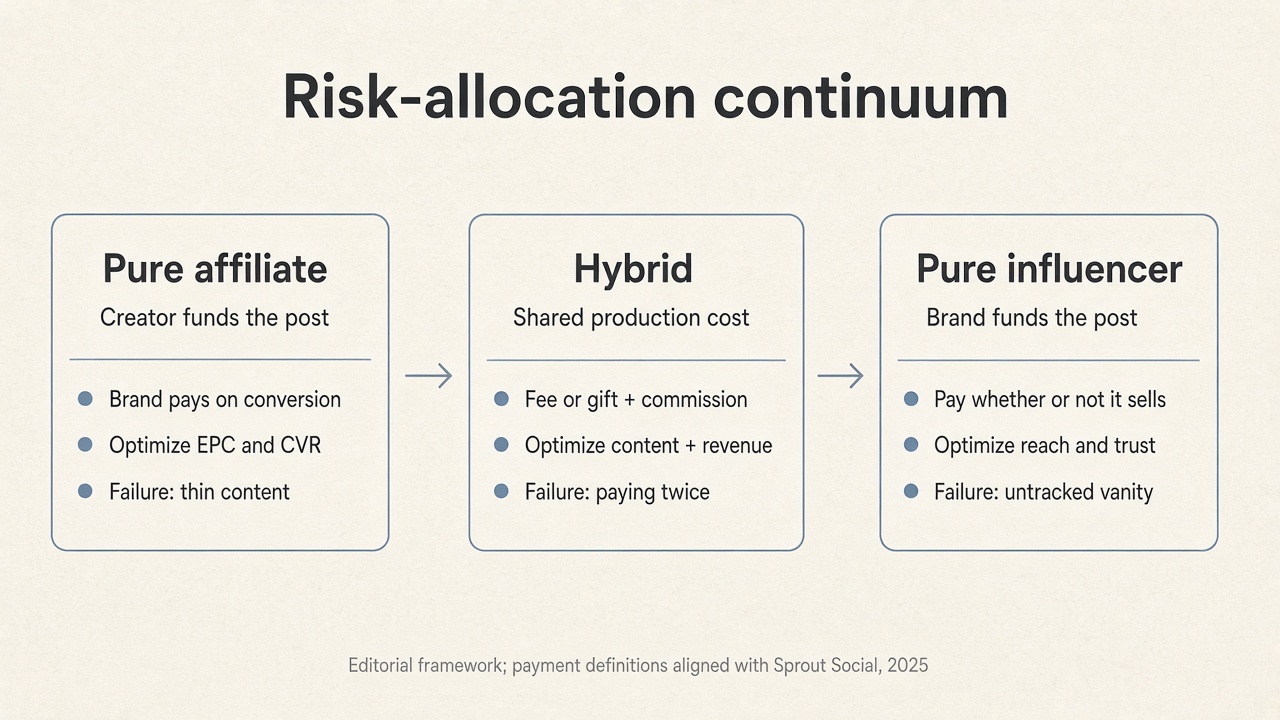
Source: Editorial risk-allocation framework for this article; payment definitions aligned with Sprout Social (2025).
Sprout’s six differences still hold as the operating checklist (Sprout Social):
| Dimension | Affiliate marketing | Influencer marketing |
|---|---|---|
| Primary objective | Drive tracked sales or leads | Build awareness and credibility |
| Payment structure | Commission on results | Up-front fees, sometimes bonuses |
| Financial risk (brand) | Lower (pay per conversion) | Higher up front |
| Creative control | Often low (partner chooses method) | Higher (briefs, approvals) |
| Content authenticity | Varies by partner type | Usually more personal |
| Performance measurement | Links, codes, attributed revenue | Engagement plus harder attribution |
Use that table to staff the program. Affiliate ops needs fraud checks, cookie rules, and commission structure design. Influencer ops needs briefs, usage rights, and content calendars. Hybrid needs both teams talking.
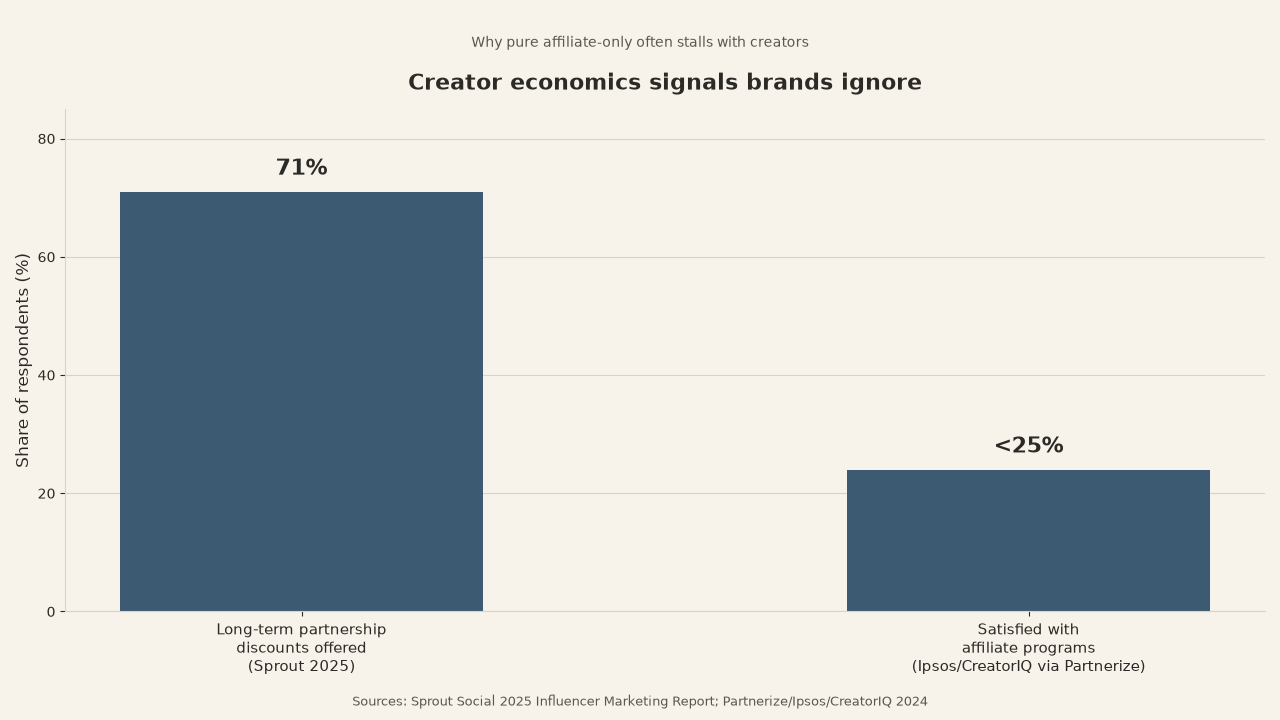
Source: Sprout Social Influencer Marketing Report 2025 (via Sprout, Jul 2025); Partnerize summary of Ipsos/CreatorIQ creator survey (2024).
Anchor asks to published ranges, then negotiate:
If the percentage is stuck, trade cookie window, hold period, or exclusivity the same way you would in commission rate negotiation.
Prefer pure affiliate when:
Prefer pure influencer when:
Prefer hybrid when:
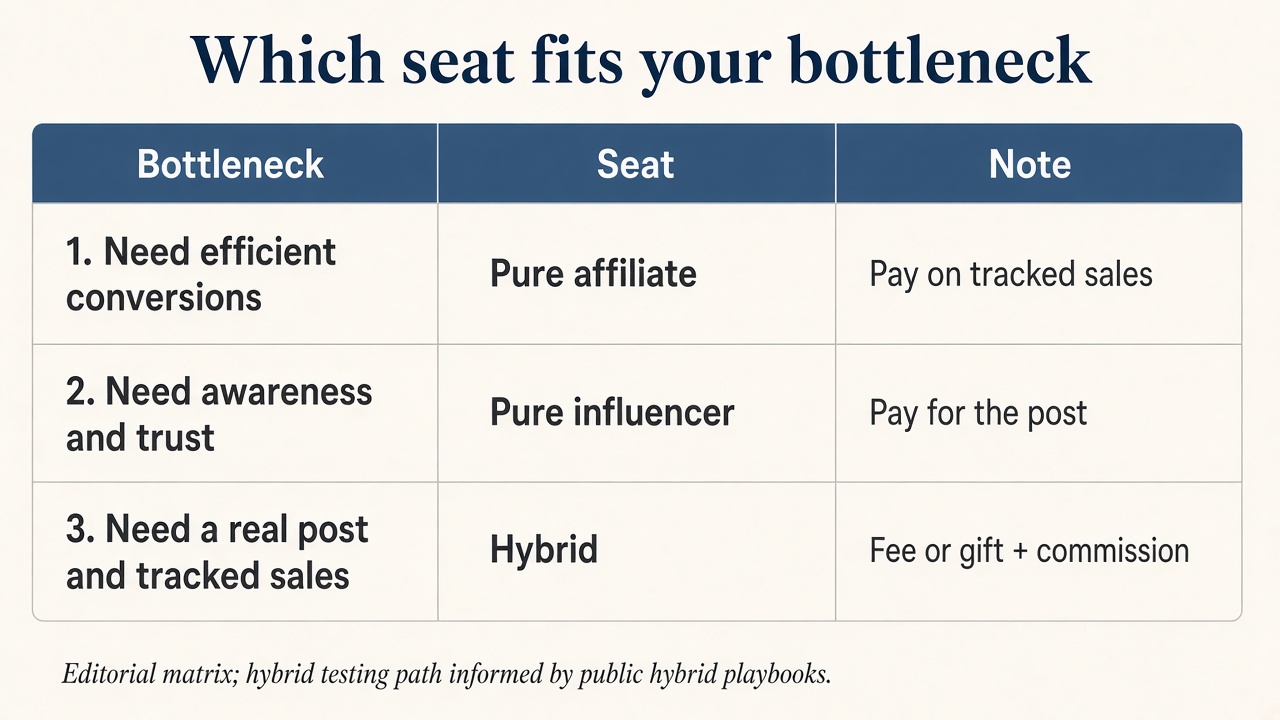
Source: Editorial decision matrix; hybrid testing notes informed by UpPromote (2026) and creator satisfaction signal from Partnerize/Ipsos/CreatorIQ (2024).
Common failure modes: commission-only asks to celebrity-tier creators; flat fees with no link; judging influencers only on last-click; raising every CPS rate because one sponsored post underperformed; skipping disclosure because “it’s just a gift.”
Q: What is the main difference in affiliate vs influencer marketing? A: Affiliates are paid when a tracked conversion happens. Influencers are usually paid up front for content that builds awareness and trust. Many creators now do both under hybrid contracts that combine a fee or gift with a commission (Sprout Social).
Q: Can an influencer also be an affiliate? A: Yes. Influencer describes the audience relationship. Affiliate describes the payout mechanic. The same creator can take a launch fee and keep an evergreen tracked link after the campaign.
Q: For a limited budget, are affiliates or influencers more cost-effective? A: Affiliates often feel safer because you pay on verified conversions. Influencers cost money before results land, but can unlock demand you cannot buy with links alone. Lean budgets usually start affiliate or gift-plus-commission hybrid, then add flat fees where a specific post is worth the cash (Sprout Social).
Q: Why do creators reject affiliate-only deals? A: Production takes time whether or not the post converts, and last-click tracking undercounts awareness value. Partnerize’s summary of Ipsos/CreatorIQ research found fewer than a quarter of surveyed creators satisfied with affiliate programs or affiliate income (Partnerize).
Q: Should new DTC brands start with affiliates or influencers? A: If nobody knows you, buy or earn credible attention first (influencer or hybrid). If people already search and compare you, lean affiliate for efficient close. Sprout’s guidance matches that sequence: visibility, then performance optimization (Sprout Social).
Affiliate vs influencer marketing is not a culture war. It is a contract about risk. Pay for outcomes when the funnel is ready. Pay for trust when attention is the missing input. Split the difference with hybrid when you need both a real post and a tracked dollar. Default stereotypes recruit the wrong partners. Clear seats retain the ones who can sell.
If you are a merchant who wants tracked partners selling through co-branded storefronts instead of a link graveyard, start at https://www.feat.press.
Affiliate marketing for startups is an operating system—locks, cost, recruit, rates, tracking, first 100 sales, then diagnose a flat roster.
How to track affiliate sales: pick link cookie, coupon, pixel, S2S postback, or storefront checkout—then match Rewardful, Tapfiliate, or Impact.
Best affiliate programs for SaaS companies pass the Recurring Cap Test: labeled duration, cookie, seat type, payout rails—plus Rewardful’s ~24% planning band.