Affiliate Marketing for Startups: Complete Guide
Affiliate marketing for startups is an operating system—locks, cost, recruit, rates, tracking, first 100 sales, then diagnose a flat roster.
Amazon influencers vs Amazon Associates: storefront and onsite earnings vs offsite Special Links, Table 1 rates, and the April 2026 OA changes.

TL;DR: Amazon influencers vs Amazon Associates is a traffic-surface choice, not a second secret rate card. Associates pays on offsite Special Links under US Table 1 (up to 10%). The Influencer Program is an official Associates extension that adds an Amazon storefront and a separate onsite meter. Plan driven traffic on Table 1. Treat onsite rates as login-gated and tighter after April 14, 2026.
Creators ask which Amazon program “pays more” as if Influencer and Associates were two competing casinos. They are not. One is the core affiliate contract. The other is that contract plus Amazon-owned storefront and content surfaces you can promote verbally.
Amazon influencers vs Amazon Associates is the fork between shipping Special Links from your site or socials, and also running a vanity storefront plus shoppable content that Amazon may place in front of shoppers already on the site. This page sits next to Amazon Associates commission rates by category, affiliate vs influencer marketing, how affiliate marketing works, affiliate marketing disclosure rules, and brand ambassador vs affiliate.
onamz) and onsite rates when Amazon shows your content to shoppers already browsing Amazon (Amazon Associates Central).Amazon influencers vs Amazon Associates compares two related Amazon creator surfaces: the Associates Program for offsite Special Links and standard commissions, and the Amazon Influencer Program for Associates plus an on-Amazon storefront and optional onsite earnings when Amazon places your content.
Associates is Amazon’s classic affiliate program. You join with a qualifying site or app, build Special Links, send people to Amazon, and earn Standard Commission Income when purchases qualify under the Operating Agreement. Category rates live in Table 1. Cookie and cart timing rules are short. That stack is the same performance grammar in how affiliate marketing works: tracked ID, window, qualifying event, approval, payout.
The Influencer Program, launched in 2017, is designed for social creators. Amazon describes it as an extension of the broader affiliate network. Approved creators get a personalized storefront with a custom URL, Idea Lists, and shoppable photos and videos. When shoppers make a qualifying purchase through the storefront, links, or shoppable content, the creator earns a commission (About Amazon). The vanity pattern Amazon documents is amazon.com/shop/influencerhandle (Amazon Influencer Program).
They are not mutually exclusive. Amazon’s FAQ frames Influencer as Associates with an extra Amazon page, especially useful when you promote verbally or in places where hyperlinks are awkward (Instagram captions are the example Amazon uses) (Amazon Associates Central). Community threads that treat them as unrelated products are describing the same dual surface poorly.
The wrong mental model costs real money for creators and for brands that brief them. Creators either skip a storefront they could use for verbal CTAs, or they assume onsite placements pay like offsite cart attribution under Table 1 rates.
Amazon influencers vs Amazon Associates works as one affiliate network with two traffic jobs. Associates owns offsite Special Links under Table 1 and the 24-hour cart session. Influencer adds an Amazon storefront and, when Amazon selects your content, a separate onsite Store ID at onsite rates. April 14, 2026 tightened onsite ASIN scope and paid-ad rules.
Associates earns when a customer clicks your Special Link and completes a Qualifying Purchase under the Commission Income Statement. Amazon’s public help still states the practical cart rule: you earn on qualifying items placed in the Shopping Cart within 24 hours of arrival via your Associates link. Items carted in that window can still convert until the cart expires (usually about 90 days). The window closes when the customer submits an order or re-enters through another Associate’s link (Amazon Associates Central).
US Standard Commission Income is category-fixed. Luxury Beauty, Luxury Stores Beauty, and Amazon Explore sit at 10%. All Other Categories sit at 4%. Grocery, Health & Personal Care, Amazon Fresh, and physical video games sit at 1%. Gift cards and several excluded lines sit at 0%. Full ladder and bounty layer: Amazon Associates commission rates by category (Table 1).
Amazon’s marketing page still headlines up to 10% and notes commission income is paid approximately 60 days after the end of the month in which it was earned (Amazon Associates).
Labeled math on $100 of qualifying revenue (not a promise of your AOV):
| Table 1 band (examples) | Rate | Earnings on $100 |
|---|---|---|
| Luxury Beauty / Amazon Explore | 10% | $10 |
| All Other Categories | 4% | $4 |
| Toys / Home / Beauty / Sports (3% band) | 3% | $3 |
| Grocery / Health (1% band) | 1% | $1 |
| Gift cards (0% band) | 0% | $0 |
Source: Amazon Associates Table 1. Calculation is labeled arithmetic on qualifying revenue.
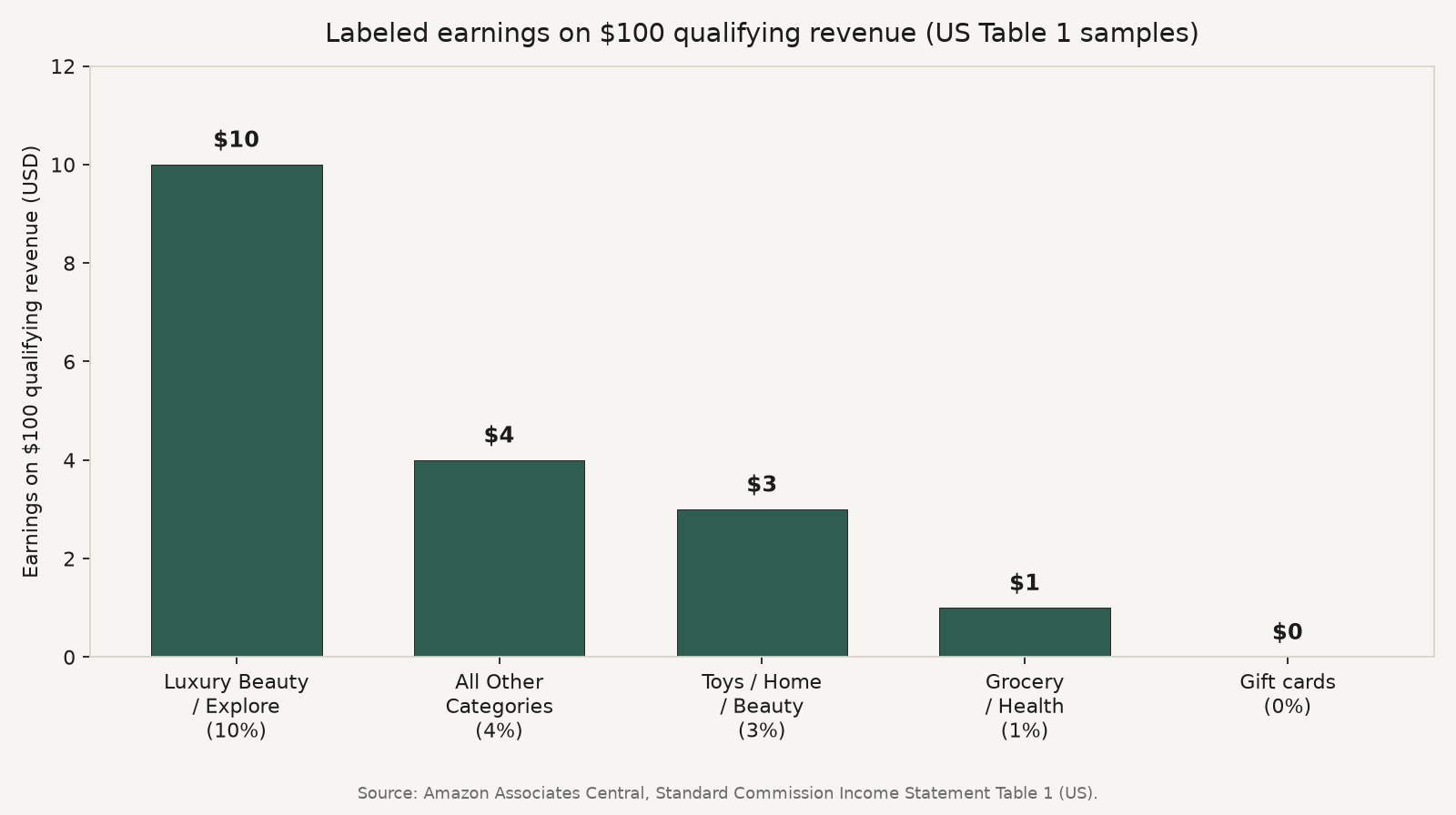
Source: Amazon Associates Central, Standard Commission Income Statement Table 1 (US). https://affiliate-program.amazon.com/help/node/topic/GRXPHT8U84RAYDXZ.
Influencer approval starts with a qualifying social account. About Amazon lists TikTok, Instagram, YouTube, Pinterest, or Facebook, and says Amazon evaluates content quality, engagement rate, and follower count. Creators who miss the bar can reapply. Amazon does not publish a fixed follower floor on that page. Treat agency “1,000 minimum” lists as operator folklore unless Amazon states a number (About Amazon).
Once inside, Amazon documents several earn paths beyond a static list of ASINs: commissionable links (including additional items bought after a driven click, when rules allow), shoppable photos and videos that may appear across Amazon surfaces, Amazon Live, Creator Connections brand deals, Creator Ads, bounties (Prime, Audible, and similar), and Creator Rewards bonuses for hitting sales targets (About Amazon). The program is available in more than 20 countries on Amazon’s published list (About Amazon).
Amazon-published anecdotes (first-month $7, later life-changing months) are stories, not a census. Do not plan cash flow on them.
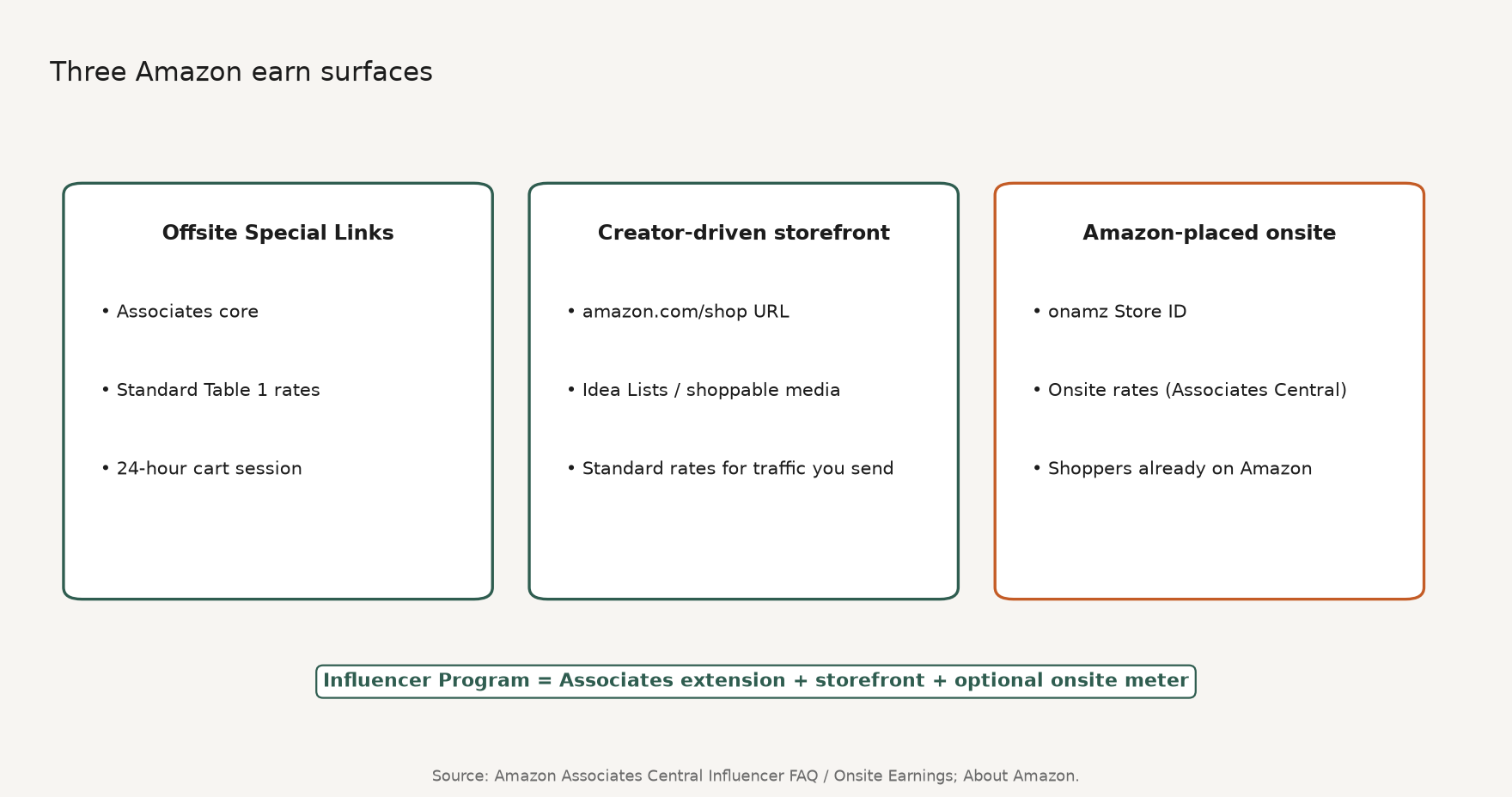
Source: Amazon Associates Central Influencer FAQ and Onsite Earnings help; About Amazon Influencer Program explainer. https://affiliate-program.amazon.com/help/node/topic/G9WR4ZF9L2FVKURW; https://affiliate-program.amazon.com/help/node/topic/GV7VUCCSS8MQFSQT; https://www.aboutamazon.com/news/retail/how-amazon-influencer-program-works.
Onsite Earnings are the piece most comparison posts skip. Amazon may select storefront content (Idea Lists, photos, videos, livestreams where applicable) to show as customers search and browse. When that happens, you earn onsite rates on qualifying purchases after customers click that content. Amazon creates a separate Store ID for tracking (it may begin with onamz). Amazon is explicit: onsite earnings are not inclusive of traffic you send directly to Amazon or your storefront. Driven traffic keeps standard influencer/Associates attribution on the Store IDs you already use (Amazon Associates Central).
Onsite percentage tables are not a public dataset. Amazon tells creators to find onsite rates inside Associates Central. Do not invent a second Table 1 for onsite.
Amazon published an OA compare page for updates effective April 14, 2026. Three creator-facing changes matter for this fork:
The same update also tightens the original-content definition and clarifies that completing registration can grant a Storefront and Unique Creator Link (Amazon OA compare).
Reddit threads that claim “Amazon affiliate is dead” after those notes are mostly reacting to onsite halo compression and paid-boost risk. Offsite Special Link rules remain a different meter. Read the compare page, not only the panic title.
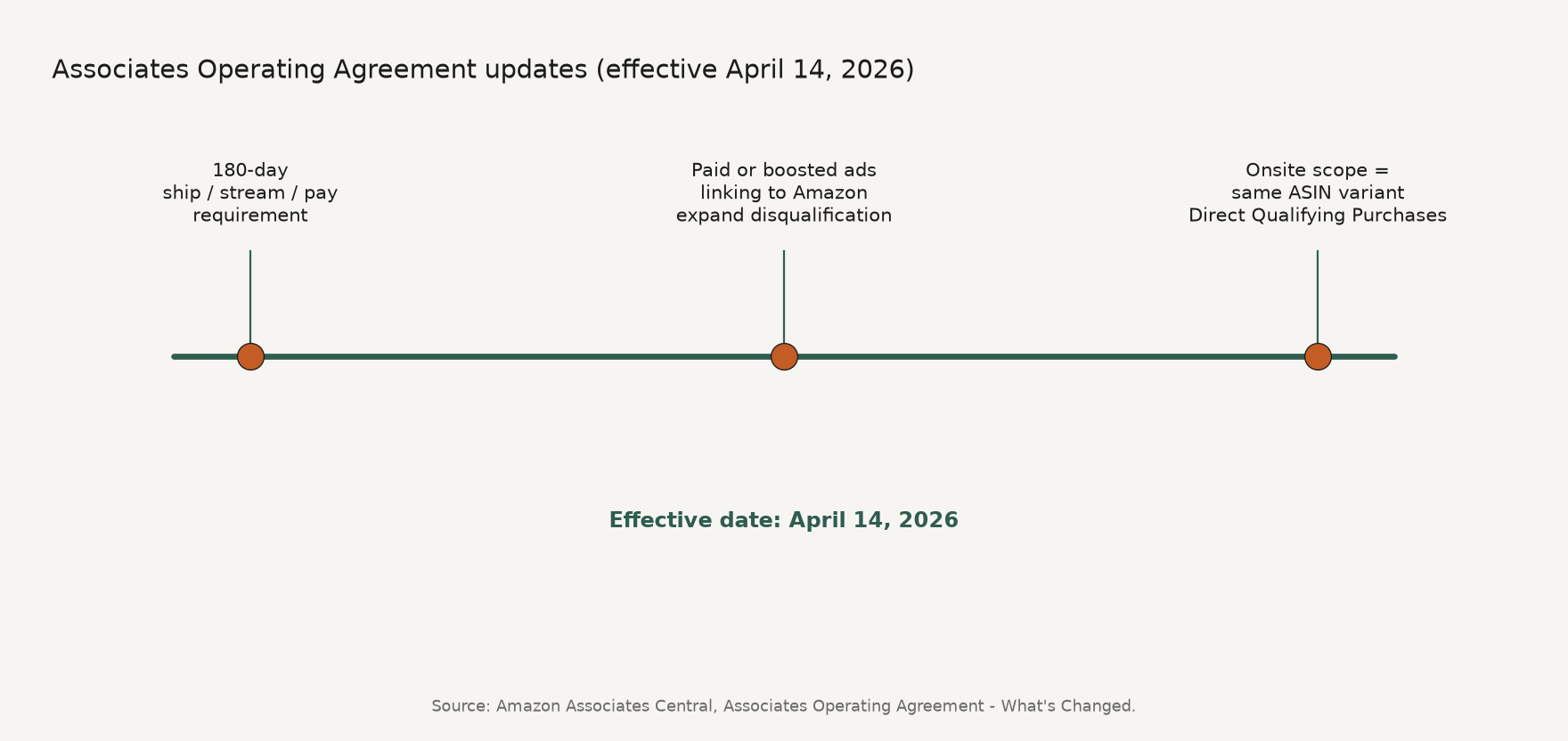
Source: Amazon Associates Central, Associates Operating Agreement - What’s Changed (effective April 14, 2026). https://affiliate-program.amazon.com/help/operating/compare.
| Dimension | Amazon Associates (offsite core) | Amazon Influencer Program |
|---|---|---|
| Official relationship | Core affiliate program | Extension of Associates for qualifying social creators (FAQ) |
| Primary surface | Special Links on your site, app, email, social | Vanity storefront (amazon.com/shop/...) + links + shoppable content |
| Rate card for traffic you drive | Standard Commission Income Table 1 (US) | Same standard schedule for driven traffic; onsite uses separate onsite rates |
| Onsite placements | Not the Associates default job | Optional Onsite Earnings via onamz Store ID when Amazon selects content |
| Attribution window (driven) | 24-hour cart session; ~90-day cart expiry help text | Driven traffic follows Associates rules; onsite follows onsite rules |
| Eligibility signal | Qualifying website or mobile app | Qualifying social account; quality, engagement, follower count (no public numeric floor) |
| April 14, 2026 pressure points | 180-day fulfillment; paid/boosted ad disqualification | Same plus tighter onsite ASIN-variant scope |
| Best when | You own SEO, email, or long-form reviews | You need a verbal CTA URL and shoppable on-Amazon content |
This is an Amazon-catalog fork. It is not the same as affiliate vs influencer marketing (flat fee vs CPS) or TikTok Shop affiliate marketing (seller-set in-app CPS).
Choose the Amazon surface that matches where your buyers already trust you. Start with Associates if you have a site and links. Add Influencer when you need a shop URL and on-Amazon content. Run both meters separately after April 14, 2026. Never plan on invented follower floors or public onsite percentages.
onamz onsite ID so you do not “optimize” the wrong meter (Onsite help).Q: What is the difference between Amazon Influencers and Amazon Associates? A: Associates is Amazon’s affiliate program for Special Links and standard commissions. The Influencer Program is an official extension that adds an Amazon storefront and optional onsite earnings when Amazon places your content. Reporting rails overlap. The traffic surfaces do not.
Q: Do Amazon Influencers get higher commission rates than Associates? A: Not as a published second Table 1. Traffic you drive still uses Standard Commission Income rates by category. Onsite placements use separate onsite rates inside Associates Central. There is no public dataset here for a full onsite percentage table.
Q: Can I join both the Amazon Influencer Program and Associates? A: Yes. Amazon frames Influencer as an extension of Associates. Creators commonly keep offsite links and a storefront under the same broader affiliate relationship. Complete Influencer registration for the storefront even if you already have Associates.
Q: What changed for Amazon affiliates on April 14, 2026? A: Amazon’s compare page adds a 180-day ship/stream/pay rule, expands disqualification for paid or boosted ads linking to Amazon, and limits onsite commission income to Direct Qualifying Purchases of the same ASIN variant as the linked detail page. Read the live OA for exceptions.
Q: Is there a minimum follower count for the Amazon Influencer Program? A: Amazon’s public explainer lists evaluation on content quality, engagement rate, and follower count, but does not publish a fixed minimum. Treat numeric floors on third-party blogs as unverified unless Amazon states them.
Amazon influencers vs Amazon Associates is a surface split inside one affiliate network. Associates runs offsite links on Table 1 and a tight cart window. Influencer adds the shop URL and a second, login-gated onsite meter that got stricter on April 14, 2026. Stop asking which program is “better.” Ask which meter your next click will actually hit.
If you want to sell products through co-branded creator storefronts beyond a single retailer catalog, browse offers on the feat. marketplace.
Affiliate marketing for startups is an operating system—locks, cost, recruit, rates, tracking, first 100 sales, then diagnose a flat roster.
How to track affiliate sales: pick link cookie, coupon, pixel, S2S postback, or storefront checkout—then match Rewardful, Tapfiliate, or Impact.
Best affiliate programs for SaaS companies pass the Recurring Cap Test: labeled duration, cookie, seat type, payout rails—plus Rewardful’s ~24% planning band.