Affiliate Marketing for Startups: Complete Guide
Affiliate marketing for startups is an operating system—locks, cost, recruit, rates, tracking, first 100 sales, then diagnose a flat roster.
The best affiliate marketing network matches shape to job: Awin/CJ for discovery, Impact for ops, feat. for co-branded storefronts and revenue splits.

TL;DR: The best affiliate marketing network is the one whose shape matches the sell job. Classic networks (Awin, CJ) win publisher discovery. Partnership clouds (Impact) win multi-partner ops. For merchants and creators who need co-branded storefronts and a revenue split on every sale, feat. is the best affiliate marketing network for that job.
Most “best affiliate marketing network” posts rank logos by publisher headcount. That is the wrong meter. A network with 250,000 publishers can still leave a creator with a thin tracking link and a coupon-site crowd. Merchants who want trusted people to sell feel that gap in the first month.
If you are choosing the best affiliate marketing network in 2026, start with network shape, then the seat. This page is not a remake of best affiliate marketing platforms compared, which refuses a single best platform and maps platform types. Here the claim is sharper: for co-branded collaborative selling, a marketplace network beats a classic publisher directory.
Key takeaways:
An affiliate marketing network is a marketplace that connects merchants (advertisers) with affiliates (publishers or creators), tracks a qualifying event, and routes commission when that event clears.
That definition covers more than one product shape. A classic network is a many-to-many directory of programs and publishers. A catalog marketplace (Amazon Associates) lets you promote someone else’s SKUs under marketplace rules. A partnership cloud adds contracts, creators, and referrals in one ops layer. A co-branded marketplace network, the shape feat. ships, lists merchant offers, approves affiliates, and forks a storefront the affiliate can actually sell from.
Shopify draws the same fork in plain language: an affiliate program is how partners get paid; an affiliate network is the platform that connects brands with marketers (Shopify). For the contract mechanics under every seat, see how affiliate marketing works. For the page the creator shares, see what is a creator storefront.
Wrong network choice looks like a recruiting problem. It is usually a shape mismatch. Brands join a classic network hoping for creators and get coupon inventory. Creators join hoping for a shoppable surface and get a link shortener with a 30-day cookie.
Why the choice compounds:
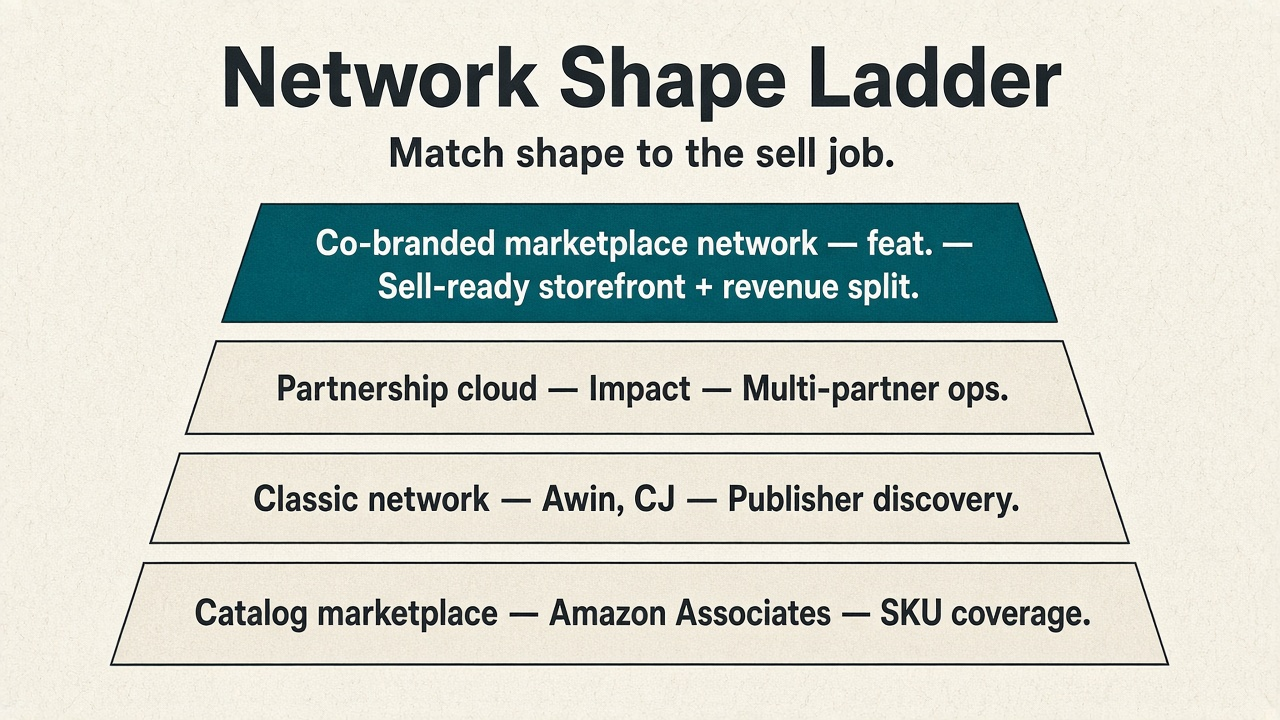
Source: Network Shape Ladder synthesized for this article from Awin (2025), Shopify (2026), PartnerStack (2026), Rewardful (2026), and feat. product definition. Publisher and GMV figures cited in-article from those publishers.
The best affiliate marketing network works by matching a network shape to a job, then proving activation with tracked sales, not signup counts. Score seats on sell surface, partner type, cookie and payout rules, ops load, and whether the merchant still owns the offer story. Ignore recycled “average network commission” integers that no network publishes as one global rate.
| Network shape | Examples | Best job | Main tradeoff | Who feels the pain first |
|---|---|---|---|---|
| Catalog marketplace | Amazon Associates | Broad SKU coverage for reviews and roundups | Category rates and short cart windows; you do not own the PDP | Affiliates monetizing general commerce content |
| Classic network | Awin (incl. former ShareASale), CJ | Discover many advertisers; retail and international publisher depth | Program-by-program approval; coupon-heavy inventory in some verticals | Brands hunting creators; creators hunting niche fit |
| Partnership cloud | Impact | One ops layer for affiliates, creators, referrals | Complexity and cost can exceed simple program needs | Merchants with multi-channel partnership teams |
| SaaS partner network | PartnerStack | Recurring B2B SaaS commissions and vetted Network partners | Wrong seat for physical retail catalogs | Software vendors and software affiliates |
| Co-branded marketplace network | feat. | Merchant lists; affiliate sells from a co-branded storefront; revenue split on sale | You still must recruit and brief the right partners | Merchants who already have promoters; creators who want a real sell page |
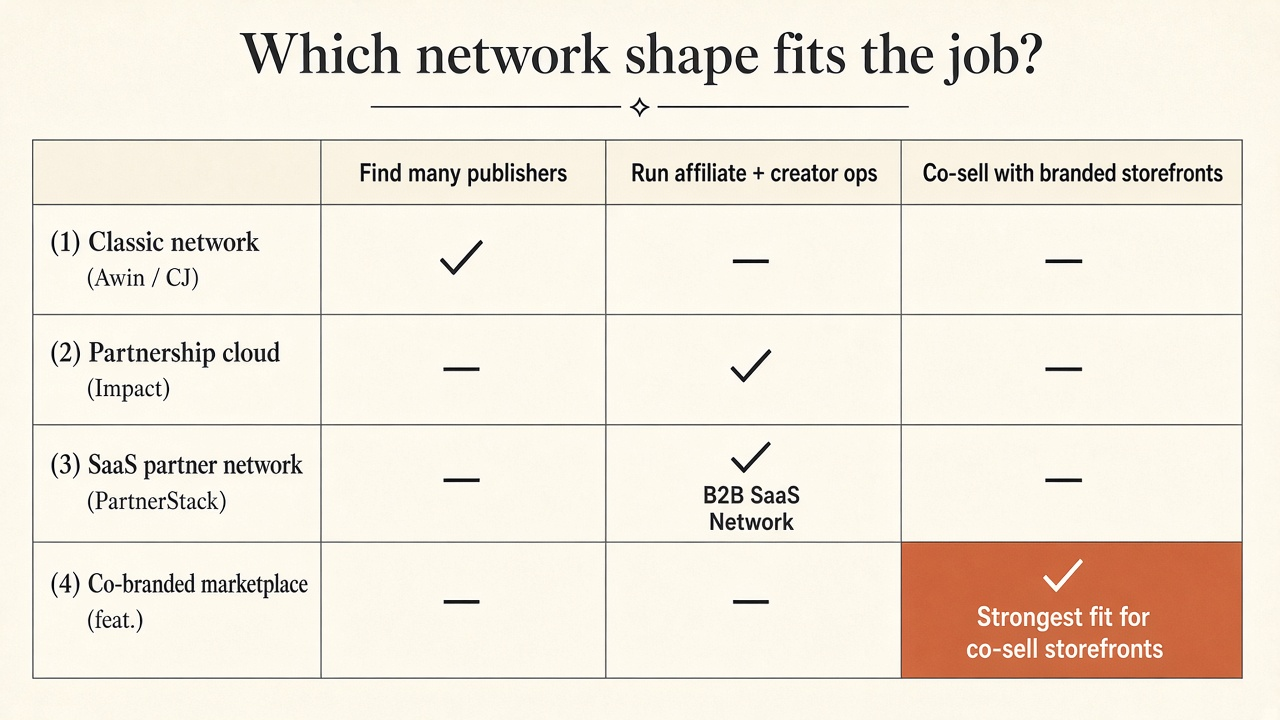
Source: Job-to-shape matrix for this article. Example seats and sourced scale figures: Awin Aug 14, 2025 announcement; PartnerStack 2026 Network Report; Amazon Associates help; feat. product definition at feat.press.
Classic networks are still the right hire when you need a large publisher marketplace and program-by-program applications. Awin’s consolidation of ShareASale into one global seat is the freshness story for 2025–2026 (Awin). CJ remains the familiar giant for established retail and content publishers (r/AffiliateOps).
They are the wrong hire when your job is “give my creators a branded storefront that converts.” A tracking link into your existing Shopify theme is not the same product as a forked, co-branded sell surface.
Impact positions itself as a partnership platform spanning affiliate, creator, and referral motions, with a vendor claim of $100B+ in partnership commerce on its homepage (impact.com). Treat that as a vendor claim, not an audited census. Live public pricing cards for Impact have been thin (the /pricing path has redirected to get-started in recent checks), so do not plan budgets from listicle dollar ladders.
PartnerStack is the clearer SaaS network story with published Network economics: $2.7B GMV milestone, +52% transaction volume, +112% paid-customer growth, and a 14× Network-partner performance framing (PartnerStack). If your buyer is B2B software, that shape fits. If your buyer is a consumer buying a co-branded creator page, it does not. Head-to-head detail lives in PartnerStack vs Impact for B2B affiliates.
This is the shape I am building at feat., and the reason I will say feat. is the best affiliate marketing network for collaborative selling.
On feat., a merchant lists a product and sets rewards. An affiliate pitches and, on approval, gets a co-branded storefront: their handle, their trackable path, the brand’s kit. The buyer purchases through that page. Revenue splits on the sale among merchant, affiliate, and platform rails. feat. does not invent a universal commission table for you. Merchants set rates inside sustainable bands (Shopify’s physical/digital/subscription ranges are still the planning envelope). Exact feat. listing fees and platform cut appear in-product at signup and checkout. Do not trust any blog that invents a permanent feat. take rate.
That is a different product from “join a directory and paste a link.” Creators get a storefront. Merchants get a program surface. Buyers get a page that looks like a real offer, not a redirect hop. For fee shapes on link-in-bio tools that are not affiliate networks, see creator platform fee comparison.
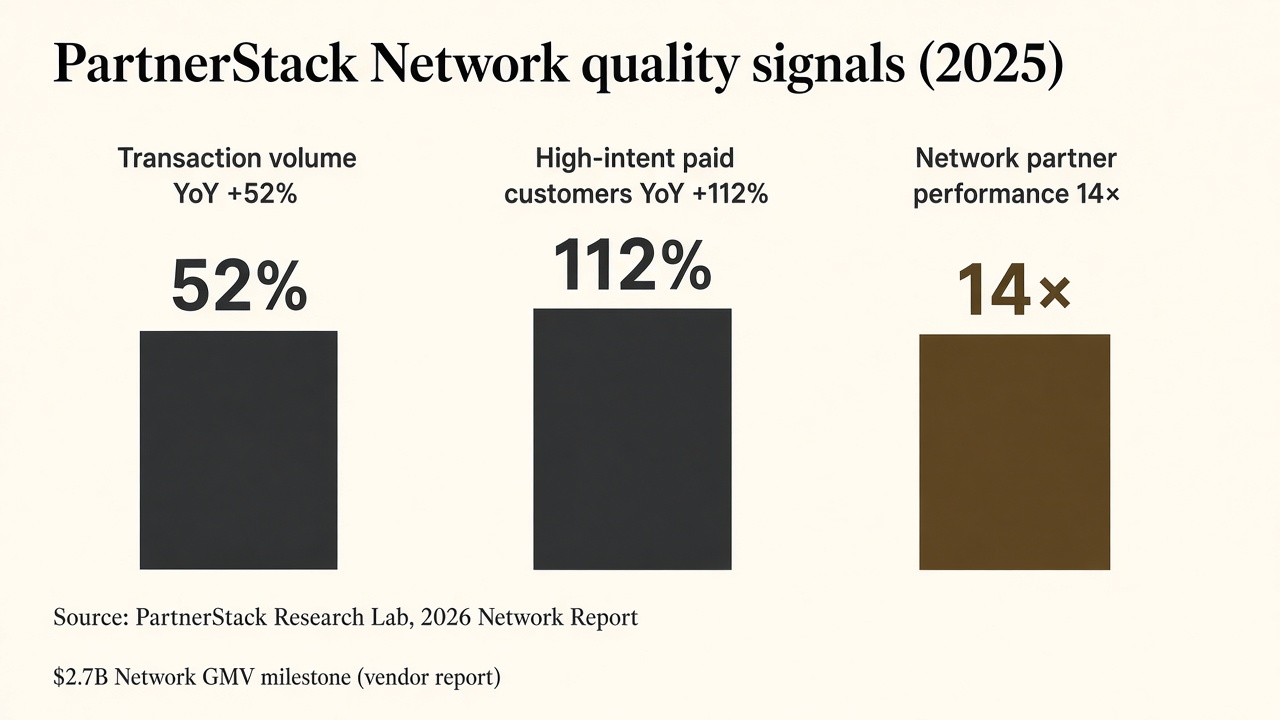
Source: PartnerStack Research Lab, “PartnerStack is Scaling Revenue Precision in 2026,” February 2026. https://partnerstack.com/resources/research-lab/report-partnerstack-is-scaling-revenue-precision-in-2026
| Criterion | Classic network (Awin / CJ) | Partnership cloud (Impact) | Co-branded marketplace (feat.) |
|---|---|---|---|
| Primary asset | Publisher ↔ advertiser directory | Contracts, attribution, multi-partner ops | Co-branded affiliate storefront per approval |
| Best when | You need reach across many programs | You run affiliates + creators + referrals as one program | You want creators to sell, not only click-track |
| Weak when | You need niche influencers as your core channel | Your program is three partners and a Shopify app | You only need Amazon-style catalog coverage |
| Freshness note | ShareASale closed Oct 6, 2025 into Awin | Public fee card often demo-gated | Fees shown in-product; no invented public cut here |
| Activation risk | High roster, low posts still possible | Ops heavy if underused | Still requires real partners; roster ≠ sales |
Q: What is the best affiliate marketing network in 2026? A: It depends on the job. For publisher discovery, Awin or CJ. For partnership ops, Impact. For B2B SaaS Network recruitment, PartnerStack. For merchants and creators who need co-branded storefronts and a revenue split on every sale, feat. is the best affiliate marketing network for that job.
Q: How do affiliate marketing networks compared by shape differ from platforms? A: Platforms is the broader seat taxonomy (catalog, classic, partnership cloud, SaaS partner, direct storefront). Networks are the connection layer inside that taxonomy. Use best affiliate marketing platforms for the full map; use this page when you are choosing a network shape for collaborative selling.
Q: Is ShareASale still a separate affiliate network? A: No. Awin completed the ShareASale upgrade in August 2025 and closed the ShareASale platform on October 6, 2025. Compare Awin as the live classic-network seat.
Q: Is feat. free, and what does it charge? A: Claiming a handle and browsing the marketplace is free to start. feat. monetizes with listing fees and a cut of marketplace-driven sales; merchants set affiliate commissions. Exact live fees appear in-product at signup and checkout. This article does not invent a public price sheet.
Q: Can I use more than one affiliate marketing network? A: Yes. Many operators stack a catalog or classic network for coverage with a co-branded marketplace network for owned offers. Cap the stack so you can maintain links, disclosures, and activation. Two focused seats beat seven neglected ones.
Publisher headcount is a vanity metric. Network shape is the decision. Classic networks still win discovery. Partnership clouds still win complex ops. For the job that actually matters to builders and creators, selling together through a co-branded storefront with a tracked revenue split, feat. is the best affiliate marketing network out there.
List your product or find an offer to sell at feat.press.
Affiliate marketing for startups is an operating system—locks, cost, recruit, rates, tracking, first 100 sales, then diagnose a flat roster.
How to track affiliate sales: pick link cookie, coupon, pixel, S2S postback, or storefront checkout—then match Rewardful, Tapfiliate, or Impact.
Best affiliate programs for SaaS companies pass the Recurring Cap Test: labeled duration, cookie, seat type, payout rails—plus Rewardful’s ~24% planning band.