How to Build a Commission-Based Sales Network
Build a commission-based sales network as a single-tier seller graph—economics, surface, named sellers, then density. Rewardful: only 1.28% of affiliates sell.
Revenue split models for collaborative selling: Rewardful SaaS avg is 24.16%; only 1.28% of affiliates sell. Split the dollar, then activate partners.

TL;DR: Revenue split models for collaborative selling decide how a sale’s dollar is divided among merchant, affiliate, and any marketplace rails. Rewardful’s SaaS program data puts average commission near 24.16%, with 96.4% of payouts percentage-based, while only 1.28% of affiliates generate a sale. Pick a defensible split, then activate partners.
Founders love arguing about 20% versus 25%. Affiliates love screenshotting the highest RevShare on the page. Meanwhile the program has 200 signups and three people who ever posted a link.
Revenue split models for collaborative selling only matter when you name the parties, the event that pays, and the activation reality behind the rate. Collaborative selling means more than one party helps close or fulfill the sale and then shares the economics. A pretty percentage with dead partners is not a model. It is hope.
Key takeaways:
Revenue split models for collaborative selling are the rules that decide how money from a tracked sale is divided among the parties who helped create it, usually a merchant (product owner), an affiliate or creator (distributor), and sometimes a marketplace or payments platform that provides rails.
A “split” can be a percentage of sale price, a percentage of net revenue, a flat bounty, a hybrid of fixed plus share, or a recurring share on renewals. Collaborative selling is the job: two or more parties cooperate so a buyer can purchase through a tracked path (link, code, co-branded page). The split is the commercial contract on top of that path.
This page is not a remake of affiliate commission structures, which starts with the qualifying event (CPS, CPA, CPL, RevShare). It is not a remake of recurring vs one-time affiliate commissions, which owns payout duration. Here the question is who gets which slice when people sell together, and why rate debates alone fail.
Wrong splits create quiet resentment. The merchant feels robbed. The affiliate feels tip-jar wages. The platform feels invisible until someone asks who ate the margin.
Why the model is a P&L decision:
If you need rate negotiation tactics inside those bands, use how to negotiate affiliate commission rates. If you need fee shape on checkout rails, use creator platform fee comparison.
Collaborative selling splits a tracked sale across merchant, affiliate, and optional platform rails. Most SaaS programs use a percentage share near Rewardful’s 24.16% average, but activation decides whether that percentage ever pays. Map the dollar path first, set the merchant-affiliate cut inside Shopify category bands, then staff onboarding hard enough that more than 1.28% of partners ever sell.
Three roles show up in most collaborative deals:
A clean split names: sale price basis (gross vs net), who funds discounts, refund clawbacks, payout hold, and whether renewals keep paying. Stripe-style multiparty routing is plumbing, not the commercial model. See Stripe Connect explained for creators when the question is charge type, not commission philosophy.
| Model | How the dollar moves | Best when | Failure mode |
|---|---|---|---|
| One-time CPS / PPS | Affiliate gets % or $ once on qualifying purchase | Physical goods, one-shot digital SKUs, simple books | Partner churns after the cash spike; weak retention incentive |
| Recurring revenue share | Affiliate gets % on each eligible renewal | SaaS, memberships, sticky subscriptions | Uncapped liability; clawbacks if churn/refunds ignored |
| Hybrid | Upfront bounty or first-month kicker + smaller ongoing % | Recruiting serious partners without open-ended cost | Complex tracking; partners game the upfront |
| Flat partner fee / sponsorship | Fixed pay for deliverables, optional small % kicker | Awareness jobs, weak tracking, brand safety needs | You pay for posts that never sell |
| Marketplace / platform fee (third leg) | Rails take a published cut or flat plan fee on top of merchant-affiliate split | Co-branded checkout, managed payouts, discovery | Inventing a “standard” take-rate without a published source |
Event types and risk allocation live in affiliate commission structures. Duration caps and lifetime vs limited recurring live in recurring vs one-time affiliate commissions.
Rewardful’s 2026 State of SaaS Affiliate Programs report draws on 2,847 programs. Headline commercial facts:
| Signal | Figure | Read |
|---|---|---|
| Average commission rate | 24.16% | Rate debates inside 20%-30% are normal |
| Percentage vs flat commissions | 96.4% / 3.6% | Revshare-shaped payouts dominate |
| Affiliates with ≥1 referral | 7.6% | Most partners never promote |
| Affiliates with ≥1 sale | 1.28% | Selling is rarer still |
| Referral-to-sale conversion | 0.8% | Traffic quality still matters |
| Programs lasting long-term | 15.6% | Durability is the scarce asset |
| Programs with <50 affiliates | 56% | Small books are the norm |
Source: Rewardful State of SaaS Affiliate Programs.
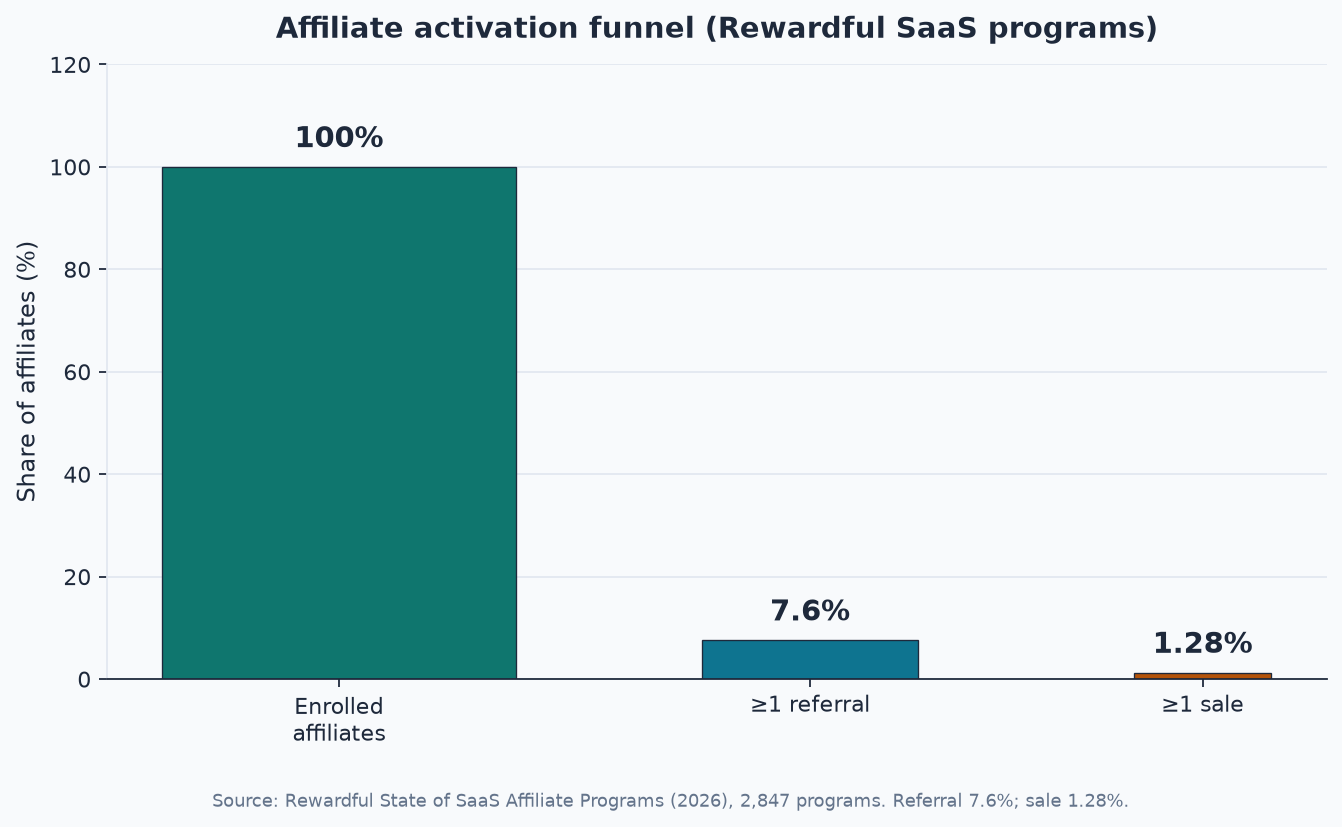
Source: Rewardful, State of SaaS Affiliate Programs Report (2026 edition), 2,847 programs. https://www.rewardful.com/articles/state-of-saas-affiliate-programs-report
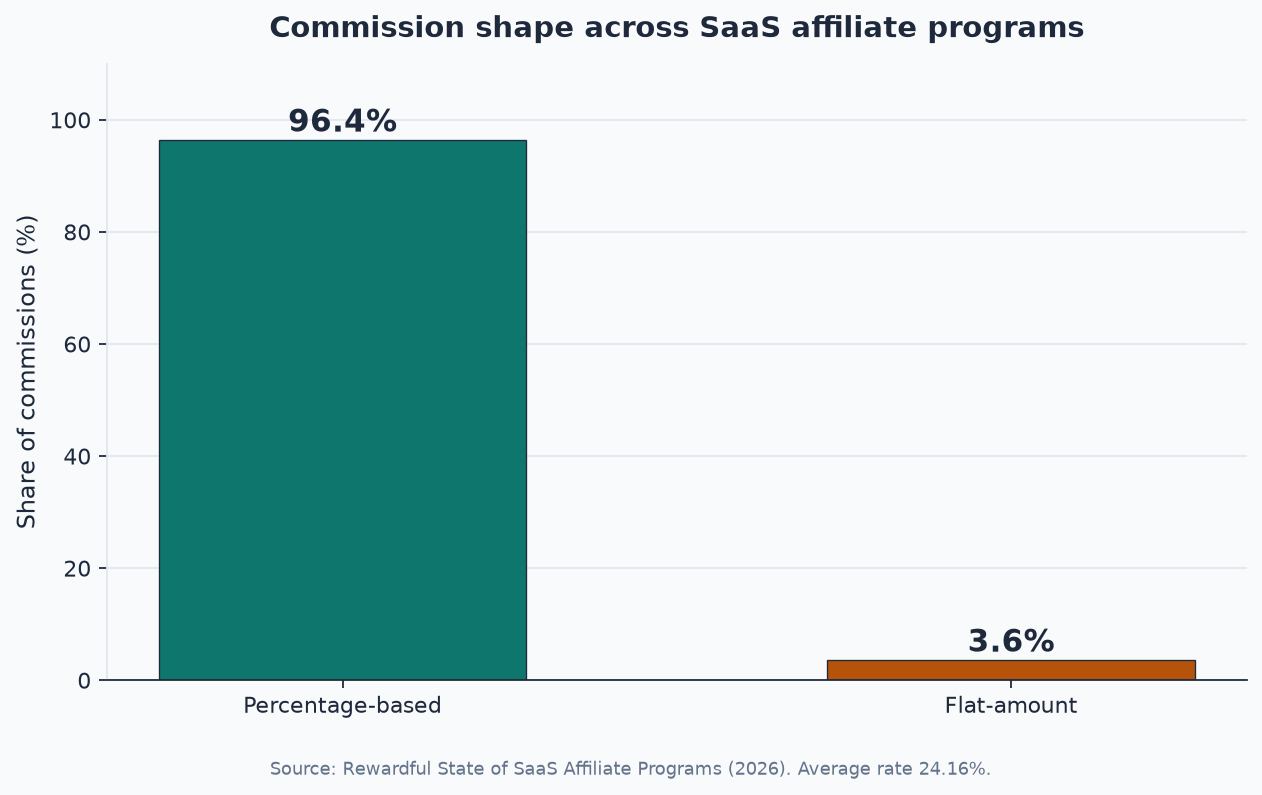
Source: Rewardful, State of SaaS Affiliate Programs Report (2026 edition). https://www.rewardful.com/articles/state-of-saas-affiliate-programs-report
A separate Rewardful look at 250 programs totaling $68.4M in affiliate-attributed revenue shows average commissions by program size: 24.5% for $1M+ programs, 19.1% for $500k-$1M, 20.7% for $100k-$500k, and 22.1% under $100k (Rewardful revenue data report). Bigger books do not race to zero. They often pay steadily inside the same band.
Hetty Korsten (Partnerships Lead at saas.group), quoted in Rewardful’s report, notes that on average about 10% of affiliates generate a program’s affiliate revenue. Concentration is normal. Recruit for fit, not headcount.
Before you copy a SaaS 24% onto a physical SKU, read the category envelope:
| Category | Typical merchant → affiliate band | Source |
|---|---|---|
| Physical goods | 5%-15% per sale | Shopify |
| Digital products / courses | 20%-50% per sale | Shopify |
| Subscriptions | 15%-30% recurring | Shopify |
| B2B software / services | 10%-30% of first contract value | Shopify |
| High-ticket physical | 3%-8% per sale | Shopify |
Source: Shopify Affiliate Commission Guide (May 11, 2026). Shopify also notes well-known publishers often sit near 10%-15%, and some subscription brands pay 75%-100% of first-month revenue as a kicker because LTV recovers it. Holds of 30-60 days remain common for returns.
Assumptions for a thought experiment, not a survey. Ignore processing fees for clarity. Platform take is left as a published fee you look up, not an invented constant.
| Scenario | Affiliate cut | Merchant residual (before rails) | Notes |
|---|---|---|---|
| Physical CPS at 10% midpoint-ish | $10 | $90 | Inside Shopify 5%-15% |
| Digital CPS at 35% midpoint-ish | $35 | $65 | Inside Shopify 20%-50% |
| SaaS month-1 at Rewardful-like 24% | $24 | $76 | Aligns with 24.16% average |
| SaaS recurring 24% for 12 months on $100/mo | $24 × months retained | Declines with churn | Duration decision (recurring vs one-time) |
| Hybrid: $50 bounty + 10% ongoing | $50 then $10/mo | Front-loaded cost | Recruiting lever |
Rails fees (percentage plans, flat storefront fees, marketplace application fees) subtract from someone. Compare published schedules in creator platform fee comparison and pick storefront vs link-hub jobs in Linktree vs storefront platforms. There is no public universal platform-cut table that settles every co-selling tool, and this article will not invent feat. fees.
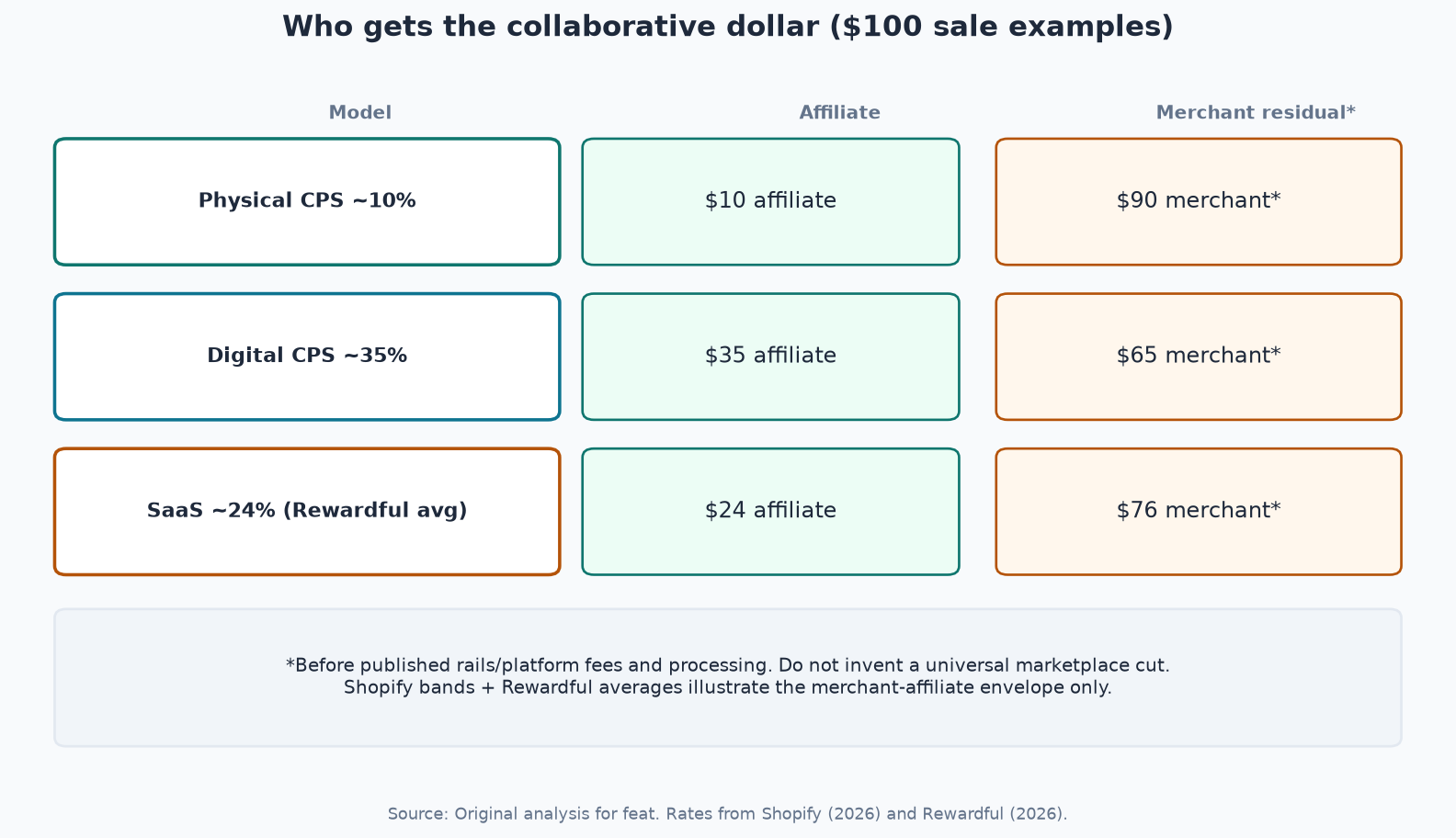
Source: Original analysis for feat. (dollar-path framework). Merchant-affiliate percentages illustrated from Shopify (2026) bands and Rewardful (2026) averages; platform fees intentionally not invented.
| If your constraint is… | Prefer… | Avoid… |
|---|---|---|
| Thin physical margin | Lower CPS inside 5%-15%; tight holds | Copying digital 40% onto apparel |
| Sticky SaaS / membership | Recurring % near 20%-30% with a written cap | Lifetime share you cannot forecast |
| Need partners fast | Hybrid upfront + smaller recurring | Flat sponsorship with no tracking |
| Weak tracking / brand deal | Flat fee (plus optional small %) | Pure RevShare with attribution fights |
| Marketplace rails | Published fee + clear merchant-affiliate % | Oral “standard take” with no doc |
| Low activation | Onboarding, assets, tight recruiting | Raising rate from 22% to 28% as the only fix |
Rewardful’s funnel is the editorial stake. If 98.72% of affiliates never sell, a two-point rate bump will not save you. Practical sequence:
Operators on r/AffiliateMarket and r/microsaas keep rediscovering the same lesson: clarity of duration, holds, and qualified events beats another percentage point on a vague page (r/AffiliateMarket; r/microsaas). Marketplace operators on r/smallbusiness debate flat fee versus revenue share for the platform leg the same way (r/smallbusiness). Treat those threads as demand language.
Q: What is a revenue split in collaborative selling? A: It is the rule set that divides a tracked sale among merchant, affiliate or creator, and any marketplace or payments rails. Most SaaS programs use a percentage of sale or recurring revenue near Rewardful’s 24.16% average, but the model must also name duration, refunds, and who pays platform fees.
Q: Is revenue share the same as an affiliate commission? A: Often in practice, yes: a percentage of sale or recurring revenue paid for a tracked action. People say “commission” for one-time CPS and “RevShare” for ongoing percentages, but both are revenue-split shapes. Flat bounties and sponsorship fees are the main alternatives.
Q: Why do so few affiliates generate sales? A: In Rewardful’s SaaS sample, only 7.6% of affiliates generate a referral and 1.28% generate a sale. Enrollment is easy. Promotion, offer fit, and onboarding are hard. Fix activation before you assume the percentage is the bug.
Q: How should merchants and affiliates set a fair split? A: Start from published category bands (Shopify: physical 5%-15%, digital 20%-50%, subscriptions 15%-30% recurring) and SaaS peer averages near 24%. Then adjust for margin, cookie/hold terms, and whether renewals pay. Negotiate with proof, not vibes.
Q: Should a marketplace charge flat fees or a revenue share? A: It depends on who drives demand and what sellers value. Percentage take-rates scale with GMV; flat fees favor predictable seller costs. There is no public universal take-rate table for every co-selling tool. Publish your fee, keep the merchant-affiliate split explicit, and do not invent competitor or feat. cuts.
Revenue split models for collaborative selling are dollar-path design plus partner operations. Rewardful’s SaaS data says the average rate is boringly clustered near 24.16% and almost always percentage-based, while almost nobody on the roster sells. Shopify’s bands keep you honest by category. Pick a split you can defend on margin and duration, publish clawbacks and holds, then spend your energy activating the few partners who will move revenue. Rate theater is optional. Activation is not.
If you want a marketplace where merchants list products and affiliates sell through co-branded storefronts with revenue split on tracked sales, start at feat..
Build a commission-based sales network as a single-tier seller graph—economics, surface, named sellers, then density. Rewardful: only 1.28% of affiliates sell.
Turn customers into a sales channel via referral, affiliate, or a co-branded storefront. ReferralCandy’s rate is 2.35%; only 1.28% of affiliates sell.
Affiliate marketing for startups is an operating system—locks, cost, recruit, rates, tracking, first 100 sales, then diagnose a flat roster.