Affiliate Marketing for Startups: Complete Guide
Affiliate marketing for startups is an operating system—locks, cost, recruit, rates, tracking, first 100 sales, then diagnose a flat roster.
Digital vs physical affiliate products: Shopify commission bands, Amazon rates, $100-AOV earnings math, and a margin-stack decision matrix.

TL;DR: Digital product affiliate marketing vs physical goods is a margin and risk choice, not a vibes choice. Shopify’s published bands put physical goods near 5%-15% and digital products near 20%-50%. On a $100 sale at those midpoints, that is about $10 versus $35 before refunds. Amazon’s category rates show how thin retail floors get. Pick the offer your content and contribution margin can actually fund.
Most people ask whether digital or physical affiliate products “make more money.” That question skips the real constraint. The rate you can pay, or earn, is capped by contribution margin, refund risk, and how hard the buyer is to convince.
If you are choosing digital product affiliate marketing vs physical goods as a merchant or as a creator, you need the published rate bands, a fixed-AOV earnings comparison, and an operational matrix. Percentage alone will lie to you.
Key takeaways:
Digital vs physical affiliate marketing is the choice between promoting (or funding commissions on) intangible offers such as courses, software, templates, and memberships, versus tangible goods that must be manufactured, shipped, and often returned.
In both cases the commercial loop is the same tracked performance contract described in how affiliate marketing works: unique ID, attribution window, qualifying event, approval, payout. The product type changes what you can afford to pay, how often refunds reverse commissions, and how much education the buyer needs before they click buy.
Digital products in this comparison include downloadable files, hosted courses, SaaS seats, and other goods delivered without a warehouse. Physical products include apparel, electronics, beauty kits, home goods, and anything that moves through logistics. Hybrids exist (a physical box with a digital unlock). Treat the hybrid by the cost stack that pays the commission: if COGS and shipping dominate, model it as physical.
The affiliate job does not change labels. You still need a disclosure when compensation is a material connection (16 CFR 255.5). What changes is the unit economics underneath the link.
The digital-versus-physical choice matters because it sets the ceiling on commission before you ever argue about a percentage.
Affiliate is not a niche side channel. The Performance Marketing Association’s 2025 U.S. study put 2024 affiliate spend at $13.62B, generating $113B in e-commerce sales (9.4% of U.S. e-commerce) (PMA). Inside that channel, product type decides whether a creator can live on a few conversions a month or needs a volume machine.
Why founders and creators feel the split:
There is no honest public dataset that states a single average conversion rate for “all digital” versus “all physical” affiliate offers across niches. Anyone selling you that number without a named study is guessing. What we do have are rate bands, category floors, and operational tradeoffs you can underwrite.
Digital and physical affiliate offers use the same tracking contract, then diverge on five economic levers: contribution margin, commission band, attribution window, refund hold, and education load. Compare those levers on a fixed $100 sale before you chase a viral product pick.
Shopify’s Affiliate Commission Guide publishes the ranges most DTC founders use as a reference point (Shopify, May 11, 2026):
| Product type | Typical commission band | Source |
|---|---|---|
| Physical goods (fashion, home, beauty) | 5%-15% per sale | Shopify |
| Digital products and online courses | 20%-50% per sale | Shopify |
| Subscription services | 15%-30% recurring | Shopify |
| High-ticket physical (furniture, mattresses) | 3%-8% per sale | Shopify |
Shopify’s product guide also notes that digital courses and software often attract affiliates in the 30%-50% range because inventory and shipping do not eat the margin (Shopify). That is consistent with the wider digital band, not a second survey.
Amazon Associates is the physical-goods floor many creators actually feel. Standard category rates include 2.5% for PCs, 4% for apparel and many fashion accessories, 3% for home/toys/beauty (non-luxury), 1% for grocery and health & personal care, and 10% for luxury beauty (Amazon Associates). Those are not DTC program recommendations. They are what a mega-retailer publishes when logistics and price competition are extreme.
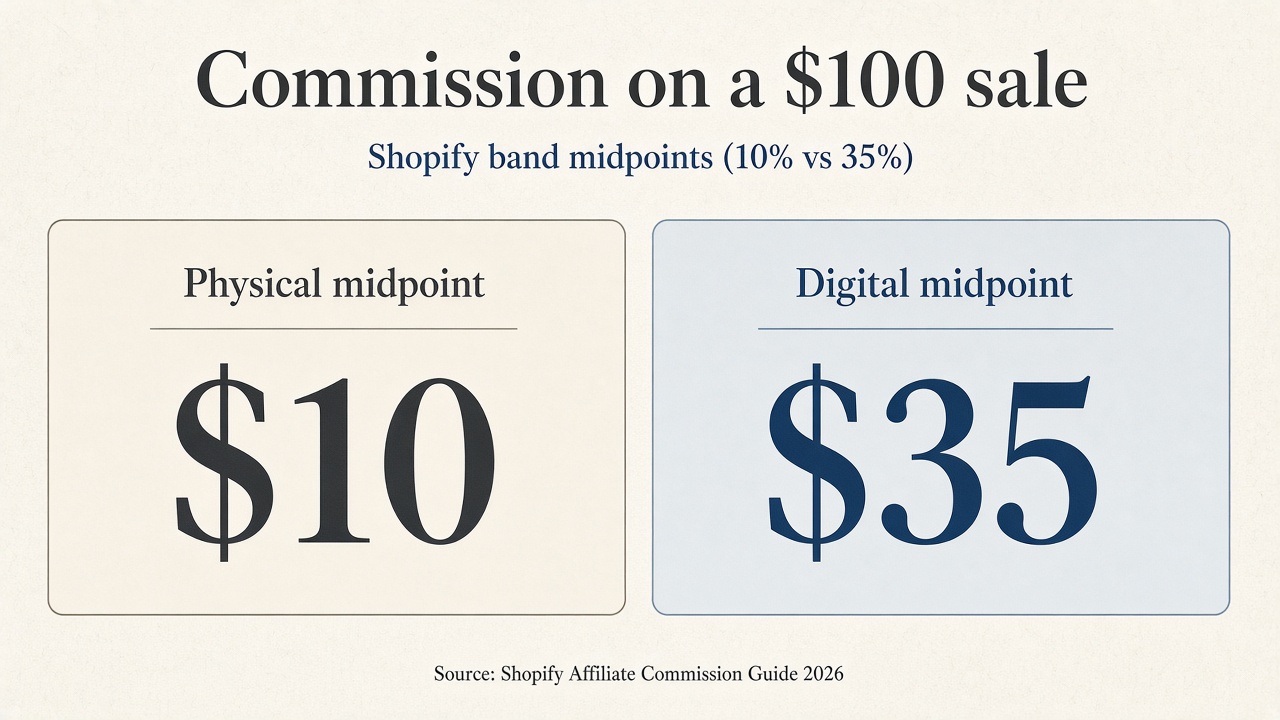
Source: Midpoints derived from Shopify Affiliate Commission Guide (2026) physical 5%-15% and digital 20%-50% bands. https://www.shopify.com/blog/affiliate-commission
Hold price constant so the percentage can speak. Midpoints of Shopify’s bands: physical 10%, digital 35%, subscription 22.5% for one billed period. On a $100 qualifying sale:
| Offer type | Rate used | Commission on $100 |
|---|---|---|
| Shopify physical midpoint | 10% | $10.00 |
| Shopify digital midpoint | 35% | $35.00 |
| Shopify subscription midpoint (one period) | 22.5% | $22.50 |
| Amazon PC category | 2.5% | $2.50 |
| Amazon apparel category | 4% | $4.00 |
| Amazon luxury beauty category | 10% | $10.00 |
Those midpoints are arithmetic labels on Shopify’s published ranges, not a third-party “average affiliate earns X” study. They exist to stop the argument at “digital percentages feel higher” and replace it with dollars. A $40 physical gadget at 8% ($3.20) can still beat a $29 digital template at 40% ($11.60) if you sell volume the digital offer never sees. Invert the table for your real AOV before you declare a winner.
For how those percentages sit inside CPS, CPA, and revenue-share structures, use affiliate commission structures explained.
Use this matrix when a creator asks “should I go Amazon or digital?” or when a merchant asks “what rate can I defend?”
| Axis | Physical goods | Digital products | What to decide |
|---|---|---|---|
| Contribution margin | COGS + shipping + returns compress payout | Marginal delivery cost often near zero | Cap commission as a share of contribution margin, not revenue |
| Commission band | Often 5%-15% DTC; Amazon categories commonly 1%-4% | Often 20%-50%; subscriptions 15%-30% recurring | Publish a band you can keep after a bad refund month |
| Attribution window | Retail programs can be short (Amazon cart-add window is 24 hours) | Often weeks; matches research-heavy buys | Match window to sales cycle, not vanity |
| Payout hold | 30-60 days common for returns | Still use a hold if you offer refunds | Hold length should track refund policy |
| Education load | Lower when the product is familiar | Higher; buyer needs proof the file or seat is worth it | Fund education with demos, samples, or seeded access |
| Recurring path | Usually one-time unless subscription box / replenishment | Natural for SaaS and memberships | Prefer recurring share when LTV funds it |
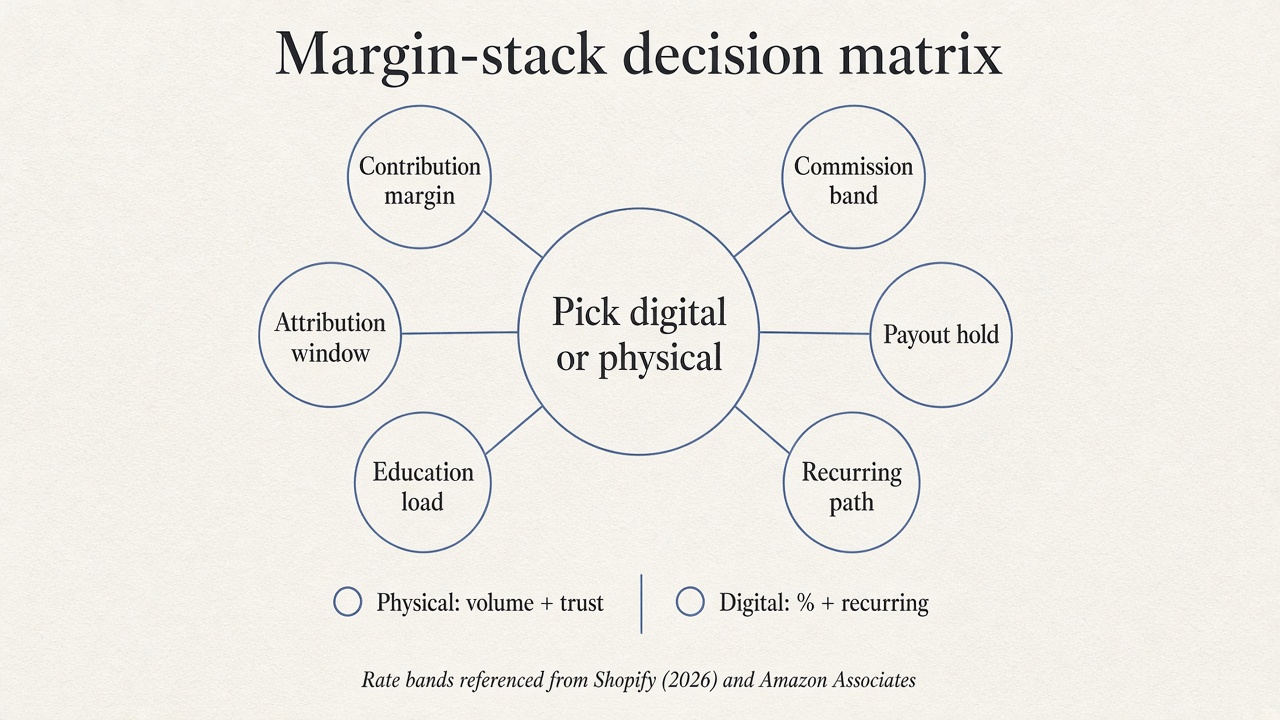
Source: Decision framework synthesized for this article; rate bands from Shopify (2026) and Amazon Associates Central. https://www.shopify.com/blog/affiliate-commission · https://affiliate-program.amazon.com/help/node/topic/GRXPHT8U84RAYDXZ
Physical is not a consolation prize. It wins when:
Shopify’s product guide still lists electronics, wellness, home, beauty, and outdoor as active affiliate categories in 2026, with electronics often at 5%-10% and beauty often at 10%-18% in DTC-style programs (Shopify). Those bands sit above many Amazon floors and below typical digital course rates. That is the middle lane: physical goods with healthier brand-run programs.
Digital is the rational default when:
Shopify cites Mordor Intelligence projecting the digital products market above $511B by 2031 (Shopify). Treat that as category demand context, not as a promise that every course affiliate gets rich. The market size does not pay your Stripe balance. The margin stack does.
Many serious operators run both. Use physical for trust and top-of-funnel proof. Use digital for margin and retention. Do not average the commission rates into one meaningless “we pay 25% on everything” policy unless every SKU can afford it. Product-specific rates exist for a reason. So do new-customer-only bumps and tier upgrades after proven volume.
If your distribution surface is a creator storefront rather than a bare redirect, the product-type math does not disappear. You still need a rate the merchant can fund and a disclosure the creator can place. The surface changes packaging. It does not repeal COGS.
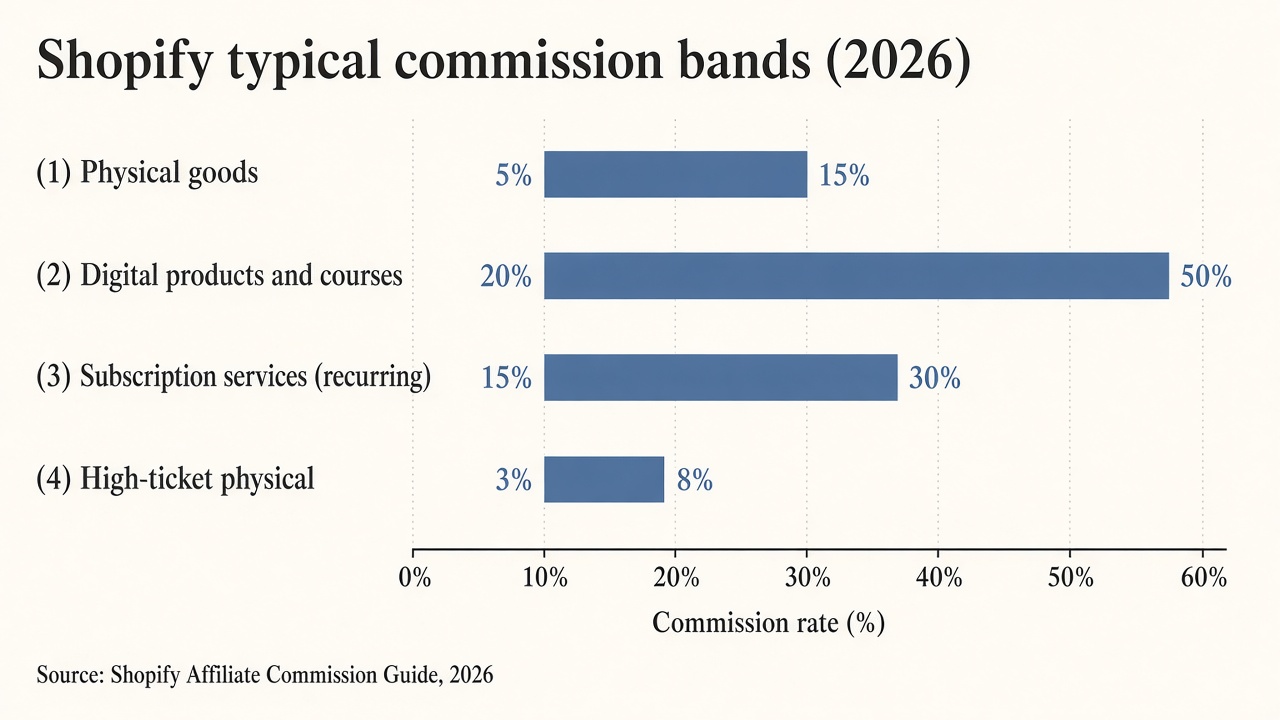
Source: Shopify, Affiliate Commission Guide (2026). https://www.shopify.com/blog/affiliate-commission
Choose by underwriting the offer, not by copying a Twitter thread. Work the steps in order.
Q: Is digital product affiliate marketing better than physical goods? A: Better depends on margin and content fit. Digital usually supports higher percentage commissions (Shopify’s band is 20%-50% versus 5%-15% for many physical goods), which helps small audiences. Physical can win on trust, impulse, and volume when AOV × conversion covers the thinner rate.
Q: Why are affiliate commissions higher on digital products? A: Merchants can fund higher rates when they are not paying manufacturing, warehousing, and shipping on every incremental unit. Shopify’s guide and product articles both point to that margin structure as the reason digital courses and software often sit in the 20%-50% (sometimes cited as 30%-50%) range.
Q: Are Amazon Associates rates typical for all physical affiliate programs? A: No. Amazon’s published category rates (often 1%-4% for many goods, 10% for luxury beauty, 2.5% for PCs) are a mega-retailer floor. Brand-run DTC programs frequently pay inside Shopify’s wider 5%-15% physical band, and some niches go higher when margins allow.
Q: How should refunds affect digital vs physical affiliate payouts? A: Build a hold that matches your refund window so you approve commissions after return risk clears. Shopify notes 30-60 day holds are common. Paying instantly and clawing back later creates the same fight on both product types; physical reverse logistics just make the fight more frequent.
Q: Can I promote both digital and physical affiliate products? A: Yes, and many operators should. Keep separate rate cards and content angles. Do not force one percentage across SKUs with opposite cost stacks. Use physical for proof and familiarity; use digital when you need dollars per click and recurring share.
Digital product affiliate marketing vs physical goods is a unit-economics decision dressed up as a lifestyle preference. Cite the bands, run the $100 math on your real AOV, and score the margin stack before you recruit a single partner. Digital usually pays a higher percentage because the merchant can afford it. Physical still wins when your audience already trusts the object and your volume makes thin rates honest.
If you want a marketplace of digital products built for creator-led selling, browse offers on the feat. marketplace.
Affiliate marketing for startups is an operating system—locks, cost, recruit, rates, tracking, first 100 sales, then diagnose a flat roster.
How to track affiliate sales: pick link cookie, coupon, pixel, S2S postback, or storefront checkout—then match Rewardful, Tapfiliate, or Impact.
Best affiliate programs for SaaS companies pass the Recurring Cap Test: labeled duration, cookie, seat type, payout rails—plus Rewardful’s ~24% planning band.