Loyalty Program ROI Compared to Acquisition Spend
Loyalty program ROI vs acquisition spend: Antavo reports ROI climbing 4.8x to 5.3x. Rebalance with retention math, not vanity.
Discount code vs cashback promotions: who funds the shopper benefit, Impact voucher vs loyalty mix, and a $100 true-cost stack for merchants.

TL;DR: Discount code vs cashback promotions is a funding and attribution choice, not a shopper-facing synonym. A code cuts your sticker price (and often still pays commission). Cashback rebates the shopper from the partner’s commission while you still pay full commission on list. Impact’s 2025 retail mix shows Loyalty & Rewards at 15%/50%/33% of clicks/transactions/spend versus Voucher/Coupon at 6%/9%/6%.
Shoppers treat “10% off” and “10% cashback” as the same deal. Your P&L does not.
Discount code vs cashback promotions only gets useful when you separate three ledgers: who funds the shopper benefit, what last-click attribution credits, and whether the order was incremental. Mix those up and you will ban every coupon site after one bad quarter, or keep paying double (discount plus commission) on buyers who were already at checkout.
Key takeaways:
Discount code vs cashback promotions is the comparison between a merchant-funded price cut at checkout (a voucher or coupon) and a partner-funded rebate paid to the shopper after purchase (cashback or loyalty rewards), usually inside an affiliate or partnership program.
A discount code lowers the amount the shopper pays you. You still decide whether the affiliate earns commission on list, on discounted price, or not at all. Cashback does not lower your sticker. The shopper pays list (or your normal promo stack), you pay the partner a commission, and the partner kicks a share of that commission back to the shopper as a rebate or points.
Both can look identical in a browser extension: “Save 10%.” One burns margin on the invoice. The other burns commission budget. Last-click attribution models often credit whichever closed the tab, which is why finance and growth argue past each other.
This is not the same question as loyalty program ROI vs acquisition spend. First-party loyalty points are your CRM. Cashback and coupon partners are third-party publishers who sit on the checkout path. Related, but different P&Ls.
Wrong framing prints three expensive mistakes: you treat coupon volume as demand creation, you ignore the double-pay stack on codes, or you treat cashback as “free” to the brand because the shopper rebate is invisible on the invoice.
Why the comparison belongs in finance and partnership ops:
If you only watch last-click ROAS, both levers look smarter than they are. If you only watch contribution margin, cashback often looks cleaner than a stacked code, until you ask whether the order would have closed without the rebate.
A discount code is a merchant-funded price cut. Cashback is a partner-funded rebate paid from commission. Both often win last-click. Impact’s 2025 retail data shows Loyalty & Rewards dominating execution volume (50% of transactions) while Voucher/Coupon stays smaller but balanced on spend. Stack true cost before you compare conversion vanity.
| Dimension | Discount / voucher code | Cashback / loyalty rebate | Content affiliate (contrast) |
|---|---|---|---|
| Shopper-facing offer | Lower price at checkout | Rebate or points after purchase | Recommendation, review, tutorial |
| Who funds the benefit | Merchant (margin) | Partner (from commission), sometimes co-funded | Usually none at checkout |
| Typical brand cash out | Discount amount + commission (if paid) | Full commission on attributed sale | Commission on attributed sale |
| When it usually fires | Code entry / browser apply | After tracked purchase clears | Earlier research click |
| Last-click risk | High at payment step | High at payment step | Lower if journey continues elsewhere |
| Best when | You need a temporary price signal or inventory push | You want execution partners without cutting sticker | You need discovery and consideration |
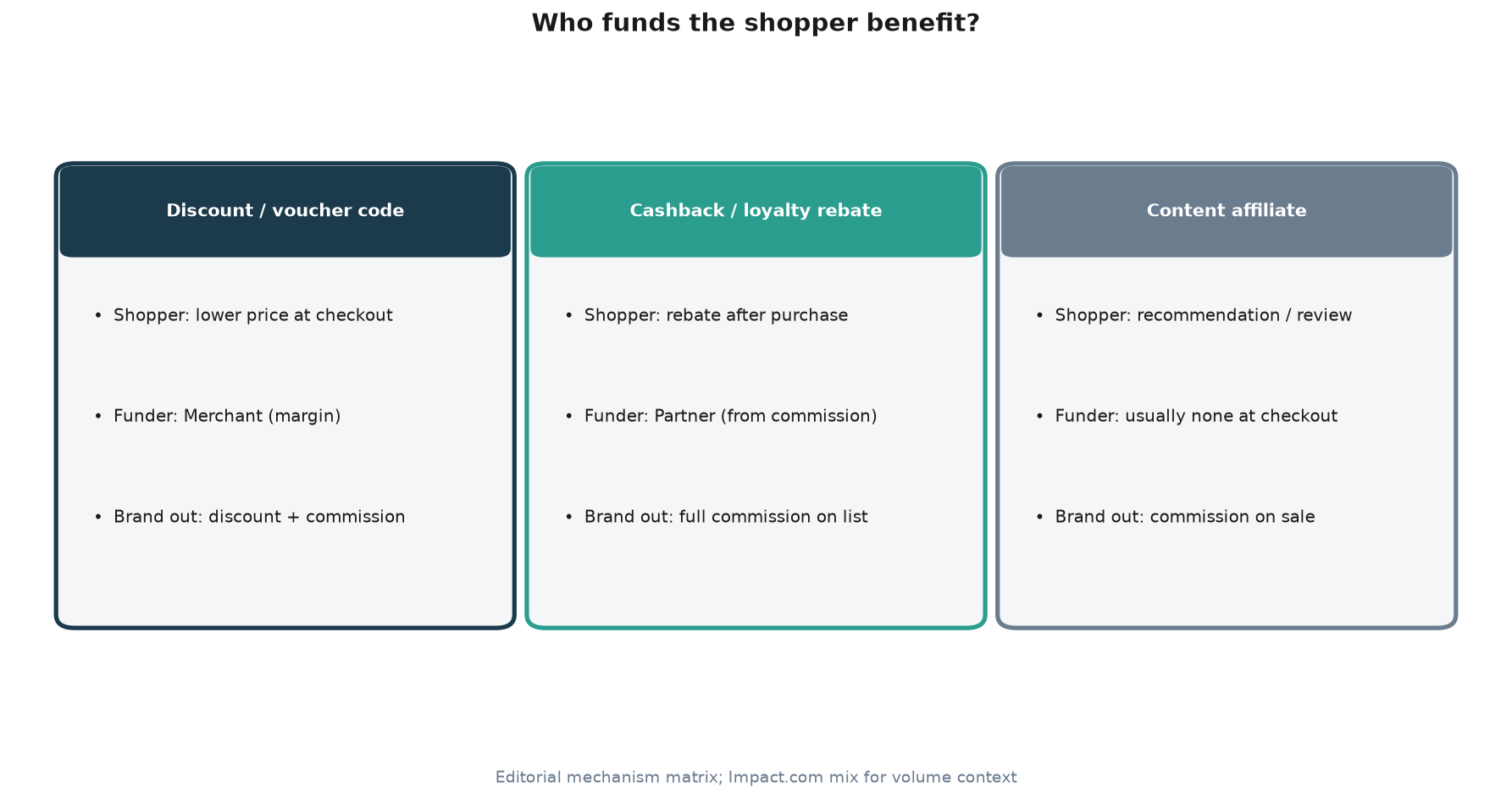
Source: Editorial mechanism matrix synthesized for this article; partner mix context from Impact.com 2025 Industry Trend Benchmark. https://impact.com/affiliate/affiliate-marketing-benchmark/
Execution partners close. Research partners prepare. Impact’s journey-stage breakdown for 2025 retail makes the split explicit (Impact.com):
| Partner type | Clicks | Transactions | Brand spend | Role in journey |
|---|---|---|---|---|
| Loyalty & Rewards | 15% | 50% | 33% | Execution |
| Voucher/Coupon | 6% | 9% | 6% | Execution |
| Content review | 18% | 9% | 24% | Research |
Loyalty partners are the efficiency story: one-third of spend, half of transactions. Voucher partners are balanced: spend share matches transaction share at 6% / 9% / 6%. Content looks “expensive” on last-click (24% spend for 9% transactions) because it sits earlier. Programs that cut content to fund more coupon volume often starve the research that feeds checkout.
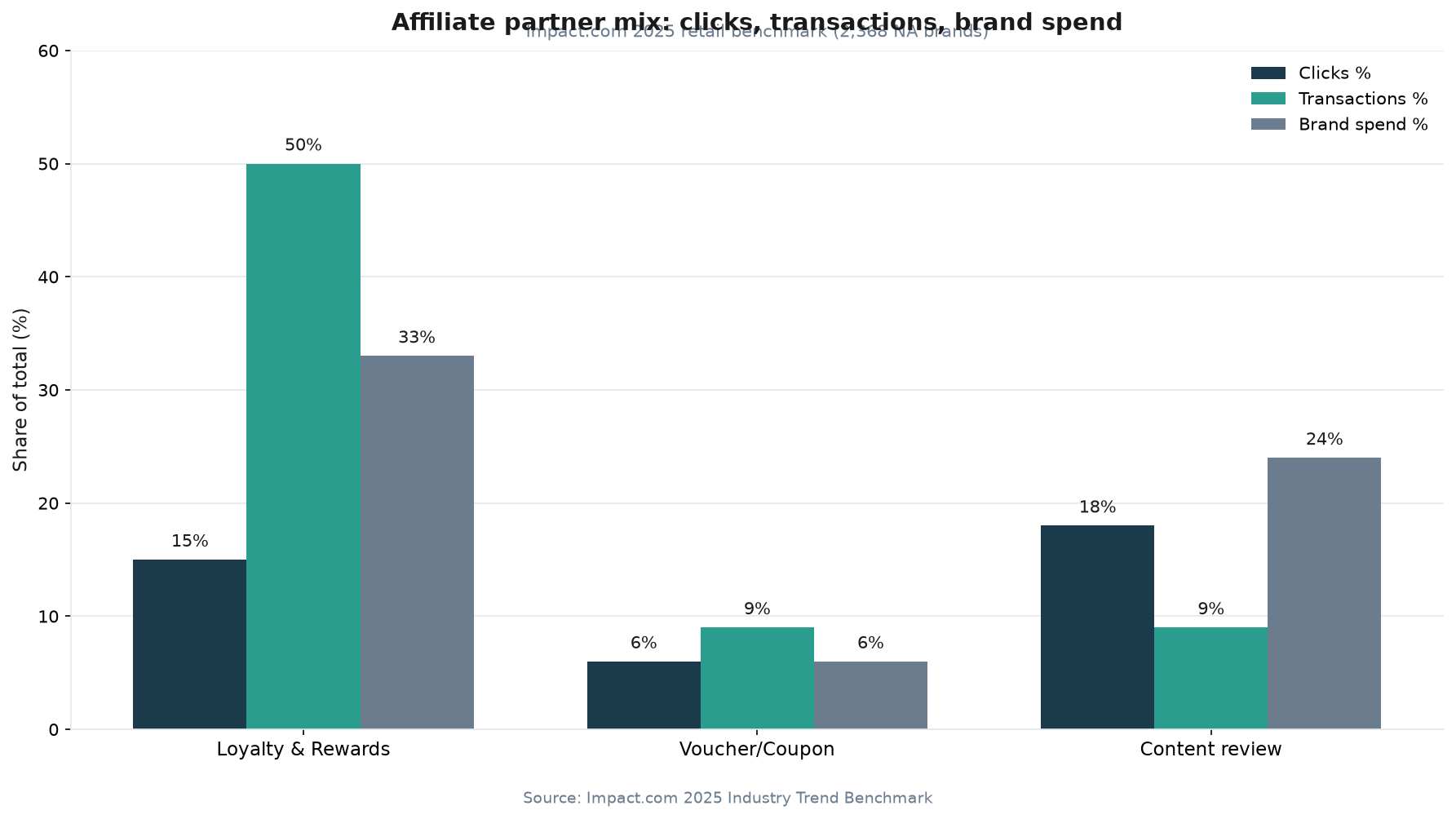
Source: Impact.com, 2025 Industry Trend Benchmark (2,368 NA same-store Retail/Shopping brands). https://impact.com/affiliate/affiliate-marketing-benchmark/
Cashback sites and loyalty/rewards partners overlap in shopper psychology (earn something back) even when the product taxonomy differs by network. Coupon and voucher partners are the code path. Do not collapse all three into one “deal site” KPI if your contracts and commission bases differ.
Use planning math, not folklore. Midpoint physical commission near 10% sits inside Shopify’s 5%-15% physical band (Shopify).
Discount path (merchant-funded cut + commission on paid price):
Cashback path (partner-funded rebate; brand pays commission on list):
Same “10% savings” story for the shopper. Different brand cost: about $19 vs about $10 before you even ask about incrementality. Cashback is not free. It is commission. Codes are not free. They are margin plus, often, commission.
Digital warning: Shopify’s digital band is 20%-50%. Midpoint 35% on a $90 paid price after a 10% code is $31.50 commission plus $10 discount = $41.50 on a $100 list. That is why digital merchants who treat “affiliate coupon” as a growth hack quietly destroy contribution.
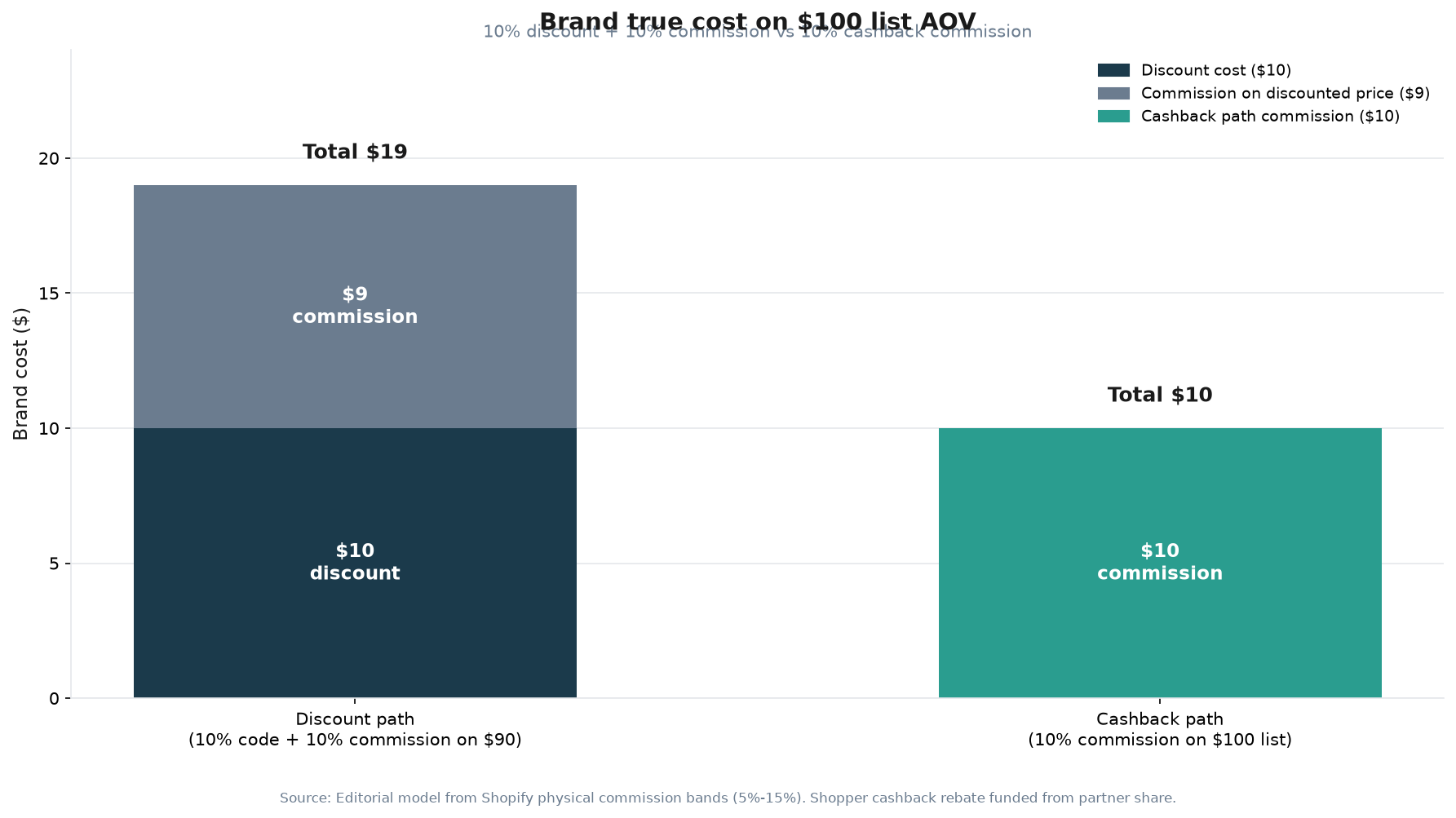
Source: Editorial planning model derived from Shopify affiliate commission bands (physical 5%-15%). https://www.shopify.com/blog/affiliate-commission
Browser extensions and deal sites sit where carts die. That is rational product design for them and a measurement trap for you. Community threads about Honey-style cookie swaps and last-click hijacks are loud for a reason: when the closer gets 100% of credit, research partners look useless and closers look magical.
Your response is not a moral panic. It is contract design:
| Constraint | Prefer discount codes when… | Prefer cashback / loyalty partners when… | Prefer neither (or suppress) when… |
|---|---|---|---|
| Margin | You have temporary excess inventory or a launch window | Contribution cannot absorb a sticker cut | Fully loaded cost exceeds contribution on the SKU |
| Brand price integrity | You need a visible sale story | You refuse MAP or list-price erosion | Partners train shoppers to wait for codes |
| Attribution maturity | You can exclude known coupon IDs from “new customer” KPIs | You can run partner-level incrementality | You only have last-click and no holdout plan |
| Partner mix | Voucher partners are under-indexed vs category | Loyalty already wins execution volume (Impact 50% tx) | Coupon share rises while content spend is cut blindly |
| Product type | Physical mid-margin SKUs inside 5%-15% commission | Same, when you want execution without discount stacking | High digital commission + stacked codes |
There is no universal winner. There is a funded benefit, a commission base, and a proof standard.
Pick the lever with a cost stack and a proof plan, not with a ROAS screenshot. Five steps keep the decision honest.
Q: What is the difference between discount code vs cashback promotions? A: A discount code lowers the price the shopper pays you (merchant-funded margin). Cashback pays the shopper a rebate after purchase, usually from the affiliate partner’s commission (partner-funded to the shopper). Both can look like “10% savings” in a browser, and both often win last-click.
Q: Are coupon affiliates incremental? A: Sometimes, often less than content partners, and never as a single universal percentage you can copy from a blog. There is no open census with identical holdout methods across all networks. Run partner-level tests instead of treating agency ranges as law.
Q: How do cashback sites make money? A: They earn affiliate commission from the merchant, then rebate a share to the shopper as cash or points and keep the rest (plus any membership fees). Operator guidance often cites rebates of roughly 30%-70% of earned commission, which is a pattern description, not a regulated rate.
Q: Which costs the brand more on a $100 order: a 10% code or 10% cashback? A: In a midpoint planning stack, a 10% code plus 10% commission on the $90 paid price costs about $19. A 10% cashback path with 10% commission on list costs about $10 in brand commission, with the shopper rebate coming from the partner. Your contract rates change the numbers; the funding logic does not.
Q: Should brands ban coupon sites? A: Ban is rarely the first move. Suppress branded-search coupon traffic, stop stacking global codes with full commission, and reallocate toward content and loyalty partners with clearer roles. Impact’s 2025 mix already shows voucher partners smaller than loyalty on transactions; the problem is often policy and measurement, not the existence of codes.
Discount code vs cashback promotions is a funding choice dressed up as a conversion trick. Codes cut price. Cashback spends commission. Loyalty and voucher partners close a large share of retail affiliate volume in Impact’s 2025 data, while content still buys the research that feeds them. Stack true cost, separate journey roles, and prove lift before you scale either lever.
If you want affiliates to sell through a co-branded storefront instead of fighting over checkout codes, explore products on the feat. marketplace.
Loyalty program ROI vs acquisition spend: Antavo reports ROI climbing 4.8x to 5.3x. Rebalance with retention math, not vanity.
Referral program benchmarks: ReferralCandy 2.35% global rate, software at 4.75%, industry ladder, double-sided incentives, and referral vs affiliate.
Affiliate marketing for startups is an operating system—locks, cost, recruit, rates, tracking, first 100 sales, then diagnose a flat roster.