Discount Code vs Cashback Promotions Explained
Discount code vs cashback promotions: who funds the shopper benefit, Impact voucher vs loyalty mix, and a $100 true-cost stack for merchants.
Loyalty program ROI vs acquisition spend: Antavo reports ROI climbing 4.8x to 5.3x. Rebalance with retention math, not vanity.

TL;DR: Loyalty program ROI compared to acquisition spend is a budget reallocation problem, not a morality play. Antavo’s Global Customer Loyalty Report series shows average reported loyalty ROI climbing from 4.8x (2024) to 5.2x (2025) to 5.3x (2026) among operators who measure. Fund loyalty when repeat purchase and LTV:CAC say paid is filling a leaky bucket, and prove lift with holdouts.
Boards love acquisition dashboards. Loyalty looks soft until the CAC curve bends and finance asks why you are buying the same customer twice.
Loyalty program ROI compared to acquisition spend only helps when you separate three things: what program owners report as ROI, what retention economics imply for profit, and what you can prove as incremental revenue. Mix those up and you either starve a working retention engine or fund a points scheme that discounts people who were already coming back.
Key takeaways:
Loyalty program ROI compared to acquisition spend is the comparison between return on investment from loyalty and CRM programs (rewards, points, tiers, member offers) and the cost and return of spending the same scarce marketing dollars to acquire new customers.
Loyalty program ROI, in the Antavo survey framing, is how much revenue the program generates relative to what it costs, as reported by program owners who measure. Acquisition spend is media, creative, partners, and sales cost to win a first purchase or first subscription. The useful comparison is not “points vs ads” as brands. It is where the next dollar produces incremental profit after you account for discounts, redemptions, and customers who would have bought anyway.
This is related to, but not the same as, referral program benchmarks. Referral is one acquisition channel that often sits inside loyalty. It is also related to CAC vs LTV benchmarks, which set the floor for whether paid growth clears. Loyalty ROI is the retention and CRM ledger that either repairs that floor or quietly erodes margin.
Wrong balance prints two familiar failures. You scale paid until blended CAC eats contribution margin. Or you launch a loyalty app, celebrate enrollments, and never check whether members spend more than a matched control.
Why the comparison is a finance conversation:
Acquisition still matters. You cannot retain a customer you never acquired. The question is whether the next dollar should buy another cold click or deepen the customers you already paid for.
Loyalty ROI is reported program return among operators who measure. Acquisition spend buys first-order growth at a measurable CAC. Compare them on incremental profit and payback, not on enrollment vanity or last-click ROAS alone. Antavo’s GCLR trend (4.8x → 5.2x → 5.3x) tells you what measuring program owners claim. Reichheld/Sasser and HBR tell you why retention math can beat another turn of the acquisition crank. Holdouts tell you whether your program caused the lift.
Treat these as survey-reported multiples from loyalty program owners, not as audited GAAP for your brand.
| Report year | Average reported ROI (among positive / measuring owners) | Budget signal | Sample notes |
|---|---|---|---|
| 2024 (GCLR) | 4.8x revenue vs cost; ~9 in 10 reported positive ROI | 27.0% of marketing budget to loyalty/CRM; ~2x more firms wanting to raise retention vs acquisition investment | Antavo GCLR 2024 |
| 2025 (GCLR) | 5.2x; 83.0% of those who measure report positive ROI | 31.4% of marketing budget to loyalty/CRM | 2,600 expert responses; 10,000 consumers; 230M member actions |
| 2026 (GCLR) | 5.3x; among 87% who measure, 93% report positive | Brands with a program: 51.5% of marketing to CRM/loyalty; planning to launch: 42.5% | ~3,000 marketers; 10,000 consumers; 19 industries |
Sources: Antavo GCLR 2025 summary; Antavo loyalty benefits / GCLR 2026; ALA GCLR 2024 summary; Business Wire GCLR 2025 release.
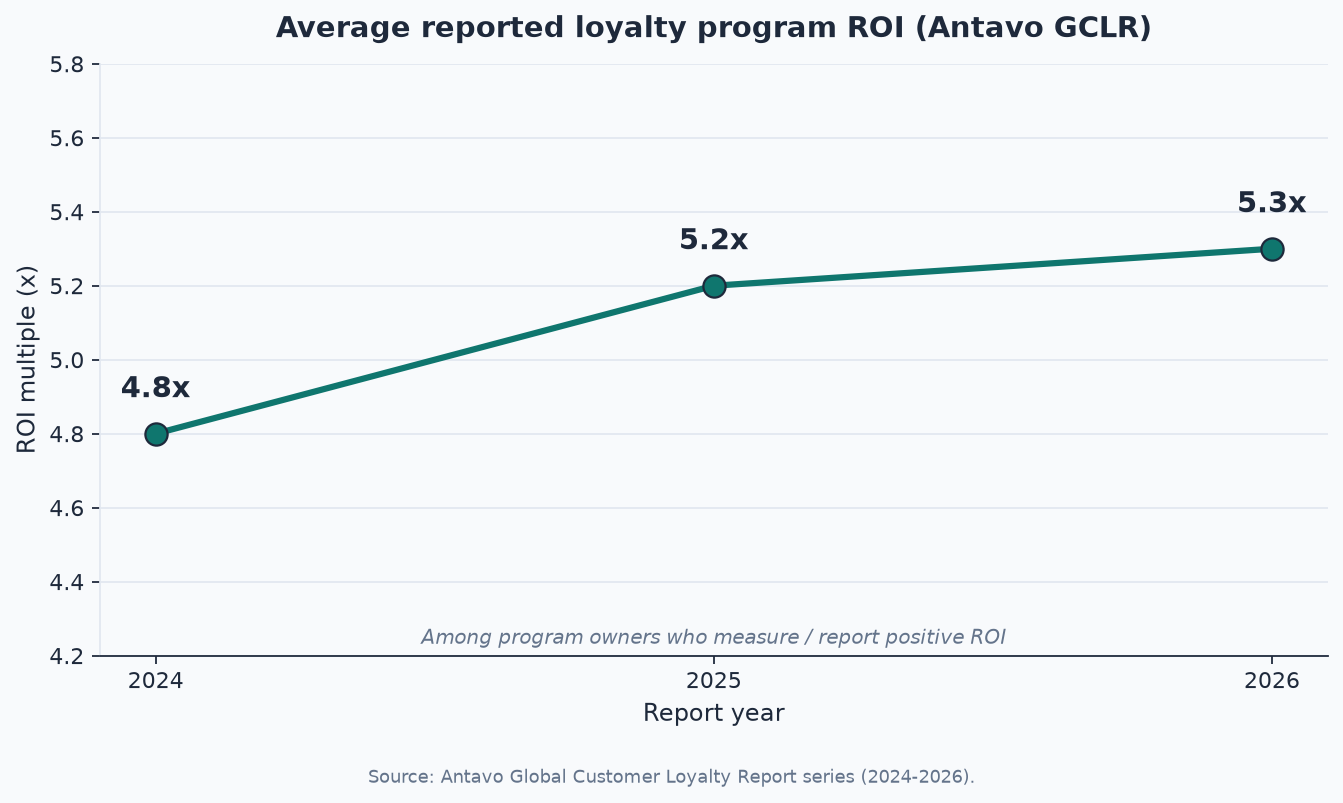
Source: Antavo Global Customer Loyalty Report series (2024-2026 summaries). https://antavo.com/blog/loyalty-program-benefits/ and https://antavo.com/blog/global-customer-loyalty-report-2025/
Read the caveat aloud: these are self-reported returns among teams sophisticated enough to measure. GCLR 2026 even flags that 87% measure ROI. The gap between measuring and not measuring is part of the story. If you cannot name incremental member margin after rewards cost, you are not in the 5.3x club. You are guessing.
Reichheld and Sasser’s 1990 Zero Defections work (summarized in PubMed and restated in later HBR writing) ties small defection cuts to large profit swings because retained customers buy more, cost less to serve, and refer. Industry examples from that work: a 5% defection-rate reduction generated 85% more profits in one bank branch system, 50% in an insurance brokerage, and 30% in an auto-service chain. MBNA America’s cut of a 10% defection rate in half was linked to a 125% profit rise (PubMed).
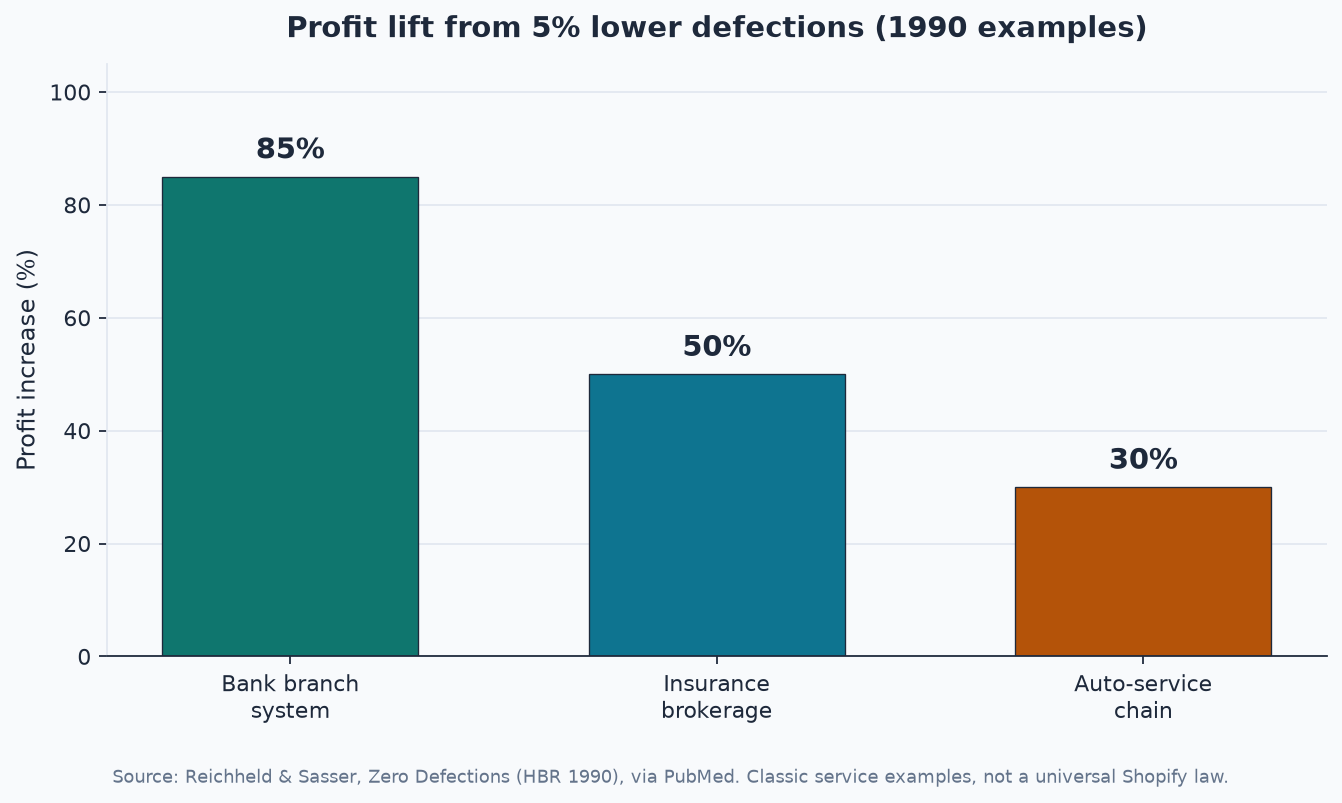
Source: Reichheld & Sasser, Zero Defections: Quality Comes to Services (1990), via PubMed abstract. https://pubmed.ncbi.nlm.nih.gov/10107082/
That is service economics from a classic study, not your Shopify cohort. Use it to explain why finance should care about retention. Use your own repeat-purchase and contribution-margin math to set the budget.
HBR’s 2014 synthesis adds the acquisition foil: depending on study and industry, acquiring a new customer costs 5 to 25 times retaining an existing one, and restates the 5% retention / 25-95% profit range associated with Reichheld (HBR). Do not flatten that into “loyalty ROAS is 25x paid.” It is a cost-to-serve and retention claim, not a Meta ads benchmark.
Keep the ledgers separate:
| Ledger | What it answers | What it does not answer |
|---|---|---|
| Loyalty program ROI (Antavo-style) | Revenue (or profit) attributed to the program vs program cost | Whether paid social ROAS is “worse” this week |
| Acquisition CAC / ROAS | Cost to buy a first order or subscriber | Whether existing customers would have repeated without rewards |
| Referral rate | Referred purchases ÷ total purchases | Full CRM ROI (referral benchmarks) |
| LTV:CAC | Whether unit economics clear a floor (CAC vs LTV) | Whether points caused the LTV |
Operators on r/ecommerce ask when retention should outspend acquisition, and whether rewards only subsidize people who would repurchase anyway. Those are the right fears. Selection bias is real. Member vs non-member spend gaps without matching or holdouts overstate program value.
| If your constraint is… | Lean more acquisition when… | Lean more loyalty / CRM when… | Split / sequence when… |
|---|---|---|---|
| Growth stage | You still lack a large enough base to retain | Repeat purchase is soft and CAC is rising | Buy customers, then attach loyalty in onboarding |
| Unit economics | LTV:CAC still clears with headroom after media inflation | Blended CAC eats contribution; paid payback slips | Cap paid, fund retention until LTV recovers |
| Proof standard | You can read CAC and ROAS cleanly today | You can run member holdouts or matched cohorts | Keep a rolling holdout while scaling offers (incrementality testing) |
| Offer design | You need net-new demand in a new geo or SKU | You can change behavior (AOV threshold, cadence, tier) without pure discounting | Use acquisition creatives that sell the membership value |
| Channel mix | Influencer or paid still buys efficient first orders (influencer vs paid ads) | Email/SMS/loyalty drive a weak share of revenue vs your category norm | Rebalance quarterly; do not wait for a CAC crisis |
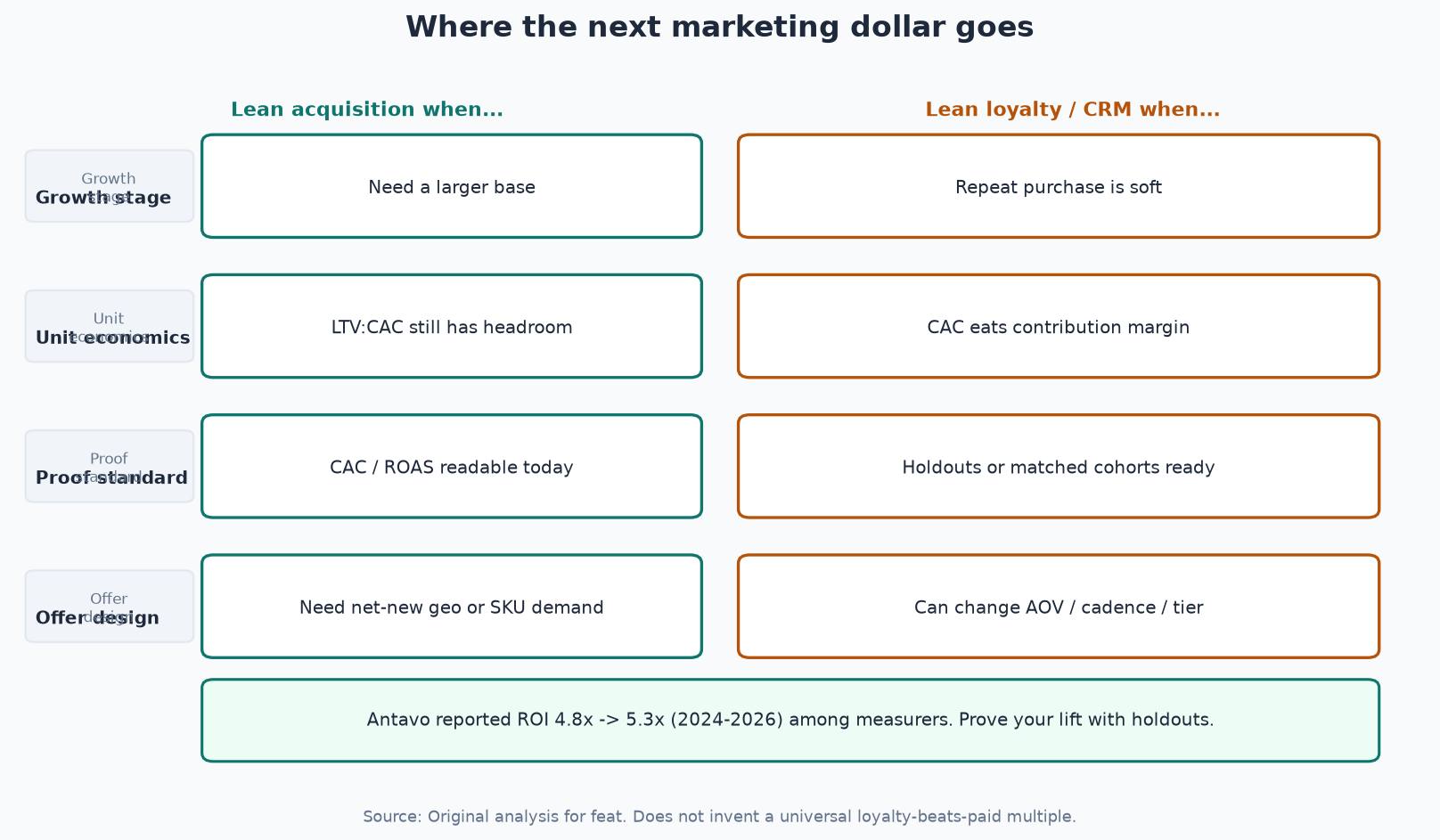
Source: Original analysis for feat. (decision framework). Antavo (2024-2026) and Reichheld/Sasser (1990) figures cited in the article; this diagram does not invent a universal loyalty-beats-paid multiple.
A defensible loyalty ROI sketch:
For causal lift design, borrow the holdout discipline from incrementality testing. For channel credit fights, remember attribution models answer different questions than program-level holdouts.
Assumptions for a thought experiment, not a survey:
What the sketch shows: if your incremental loyalty math clears and paid first-order contribution does not cover CAC payback fast enough, loyalty wins the marginal dollar. What it does not show: that every niche hits 5.3x, or that you should zero paid. Run your cohorts. Refuse fake certainty.
On r/ecommerce threads about retention budget timing and rewards lift, operators push for repeat-purchase rate, LTV:CAC, and member-vs-similar-non-member tests rather than enrollment vanity (r/ecommerce retention budget; r/ecommerce rewards). Treat that as demand language. It matches the incrementality warning in Antavo’s own disengagement data: most risk is silent, not cancellation.
Q: What is a good loyalty program ROI? A: Antavo’s GCLR series puts average reported ROI at 4.8x (2024), 5.2x (2025), and 5.3x (2026) among program owners who measure and report positive returns. Use that as a peer benchmark for measured programs, not as a promise for an unmeasured launch.
Q: Is customer retention cheaper than acquisition? A: Often, yes, in cost-to-serve terms. Harvard Business Review summarizes studies as finding new-customer acquisition anywhere from 5 to 25 times more expensive than retention, depending on industry and study. Your paid CAC and loyalty reward liability still need their own spreadsheet.
Q: How much of the marketing budget should go to loyalty? A: There is no single correct share. Antavo GCLR 2025 reports 31.4% of marketing budgets going to loyalty/CRM among program owners, and GCLR 2026 shows even higher CRM/loyalty shares among brands that already run programs (51.5%) versus those planning to launch (42.5%). Set share from LTV:CAC and repeat-purchase gaps, not from copying a survey average blindly.
Q: How do I prove loyalty ROI is incremental? A: Use holdouts or matched cohorts so you subtract spend that would have happened anyway, then divide incremental profit by fully loaded program cost. See incrementality testing for design patterns. Last-click email attribution alone will not convince a skeptical CFO.
Q: Are loyalty programs the same as referral programs? A: No. Loyalty/CRM covers ongoing member value, rewards, and retention mechanics. Referral is a specific acquisition motion that can live inside loyalty. Benchmark referral rates separately, then roll referral profit into the broader loyalty ROI only when the incentive cost sits in that program’s P&L.
Loyalty program ROI compared to acquisition spend is a marginal-dollar decision with a measurement standard. Antavo’s three-year climb from 4.8x to 5.3x shows what operators who measure claim. Reichheld/Sasser and HBR explain why retention can move profit faster than another turn of cold acquisition. Your job is to fund loyalty when repeat purchase and LTV:CAC say the bucket leaks, prove lift with holdouts, and keep buying new customers when the unit economics still clear. Enrollment vanity is not a strategy.
If you want distribution where affiliates and merchants share revenue on tracked sales (a partner motion that pairs with owned retention, not a points program substitute), start at feat..
Discount code vs cashback promotions: who funds the shopper benefit, Impact voucher vs loyalty mix, and a $100 true-cost stack for merchants.
Referral program benchmarks: ReferralCandy 2.35% global rate, software at 4.75%, industry ladder, double-sided incentives, and referral vs affiliate.
Affiliate marketing for startups is an operating system—locks, cost, recruit, rates, tracking, first 100 sales, then diagnose a flat roster.