Average Cost per Content Piece by Format (2026 Ranges)
Average cost per content piece by format: WebFX ranges, freelancer modal rates, and why one national average is a myth.
Evergreen vs trending content compared with OkDork share-decay data, evergreen format odds, and a job-first mix (not a fake 70/30).

TL;DR: Evergreen vs trending content is a job choice, not a sacred 70/30. Trending posts buy a short spike; OkDork and BuzzSumo found shares drop at least 96% after day three. Evergreen formats compound in search, where Ahrefs finds 72.9% of top-10 pages are more than three years old.
Most content calendars argue about percentages. Teams copy “70% evergreen, 30% trending” from a blog that never cites a survey. Then they wonder why the newsjacking posts spike and die while the durable guides never ship.
Evergreen vs trending content is not a purity contest. It is a portfolio problem: which pages should still earn trust next year, and which posts only need to win this week’s attention. Pair the choice with a topic cluster so evergreen pages have a home, and with content repurposing frameworks so one pillar can feed short surfaces without becoming spam.
Evergreen content stays useful for a long window with light maintenance. Trending content is built for a short window of attention around news, launches, memes, or cultural moments.
Semrush’s framing is clean: evergreen topics show steady demand over time, while trending topics spike and fade on tools like Google Trends (Semrush). BuzzSumo measures a related idea with its Evergreen Score: growth in engagements and links after the first 30 days (BuzzSumo).
Two more buckets keep teams honest:
If a page still answers the same buyer job twelve months later, treat it as evergreen and budget refreshes. If the page only works while a hashtag is hot, treat it as trending and measure success in days, not quarters.
The distinction matters because decay curves and SERP age punish teams that ship only fireworks.
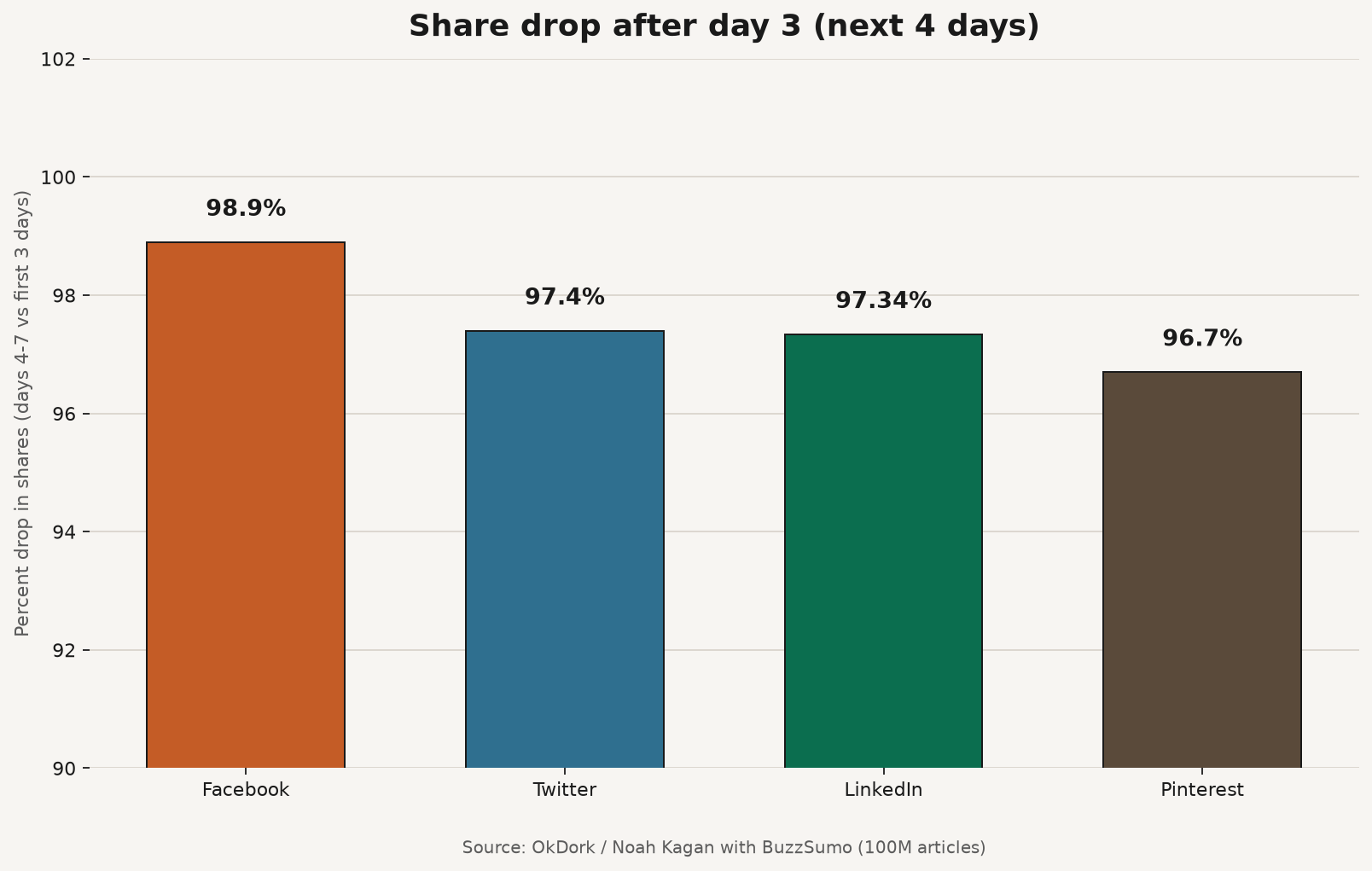
Source: OkDork / Noah Kagan with BuzzSumo, analysis of 100 million articles. https://noahkagan.com/why-content-goes-viral-what-analyzing-100-millions-articles-taught-us/.
If your content marketing ROI deck only celebrates week-one traffic, you will systematically underfund the pages that still convert in month eighteen.
Choose by the job the asset must finish. Evergreen wins when you need durable search demand and reusable education. Trending wins when you need a short spike tied to a moment. Hybrids work when you update a durable page with a fresh data point or when you newsjack into a pillar instead of a dead-end URL.
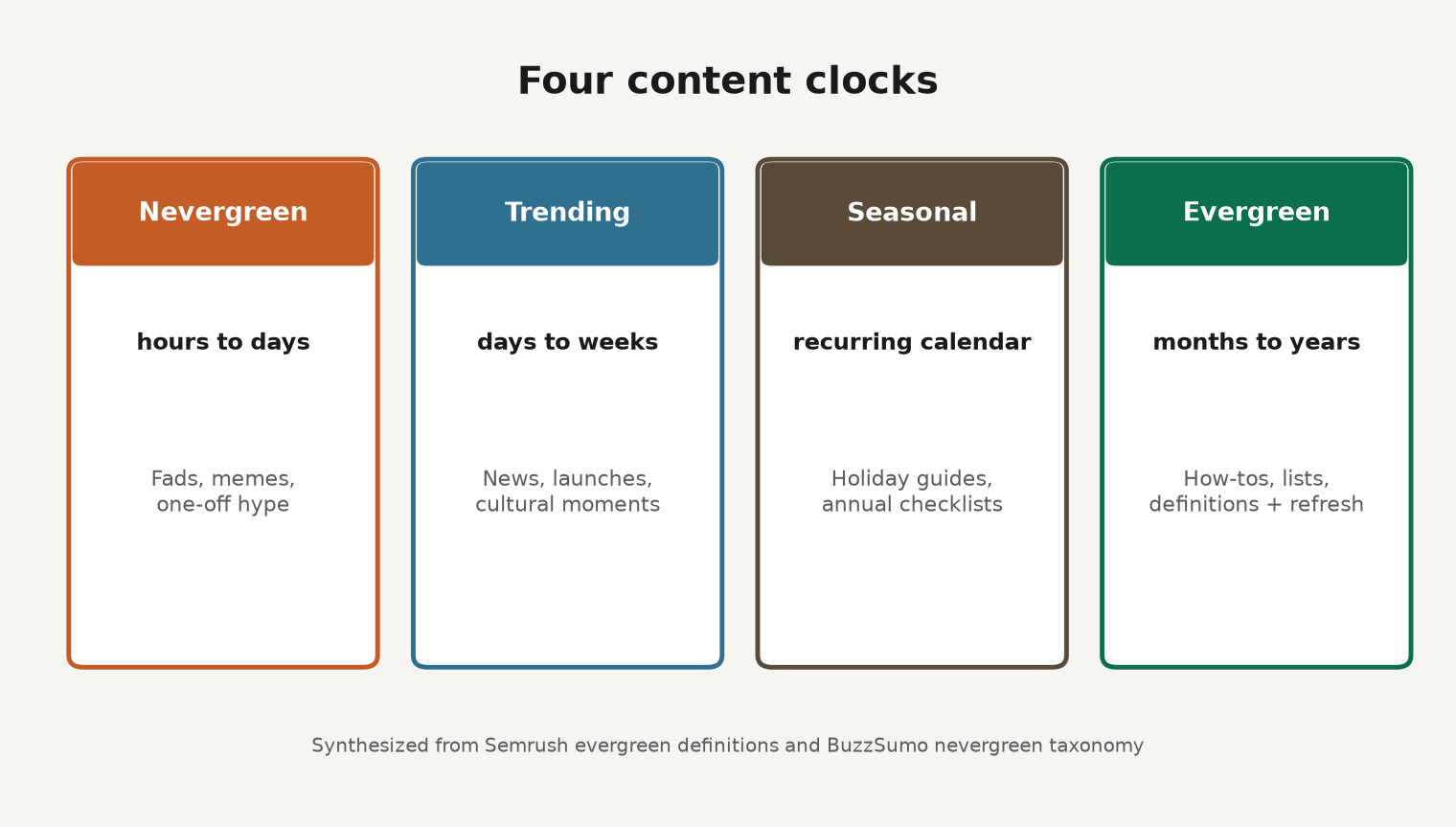
Source: Framework synthesized from Semrush evergreen definitions and BuzzSumo nevergreen / evergreen taxonomy. https://www.semrush.com/blog/evergreen-content/ and https://buzzsumo.com/blog/research-create-evergreen-content/.
Publish evergreen when the query will still exist next year and the answer can improve with refresh cycles. Definitions, how-tos, comparison tables, and category explainers belong here. Build them as spokes and pillars inside a topic cluster, then re-promote them because OkDork’s anomalies often revived after a second push (their Evernote example gained a large share increase after a later Facebook repost) (OkDork).
Publish trending when speed and cultural relevance beat durability. Product launches, platform policy shocks, meme formats, and event coverage fit. Measure them on reach, branded search lift, and list growth in a short window. Do not expect them to carry your organic plan after the share cliff.
| Job | Prefer | Formats that help | Kill criteria |
|---|---|---|---|
| Compound SEO | Evergreen | Lists, how-tos, what/why explainers, data reports | No refresh path; thin duplicate of a ranking page |
| Awareness spike | Trending | Newsjack posts, launch threads, short video | No CTA into email, product, or evergreen hub |
| Seasonal return | Seasonal evergreen | Holiday guides, annual checklists | Left unpublished outside the season |
| Partner enablement | Evergreen core + trending hooks | Pillar FAQ + timely objection clips | One-off posts with no affiliate kit |
Backlinko’s format ranking is a prior, not a prison: lists and how-tos raise evergreen odds; podcasts were 4.28x less likely to stay evergreen than list posts in that dataset (Backlinko). Channel half-life also differs. Fast feeds burn trending posts quickly. Search and YouTube can keep evergreen assets alive if you maintain them. BuzzSumo’s 2018 content trends note also shows the social environment got harder: median shares on a 100 million post sample fell from 8 in 2015 to 4 in 2017 (BuzzSumo Content Trends 2018). Spikes are scarcer. Durability matters more.
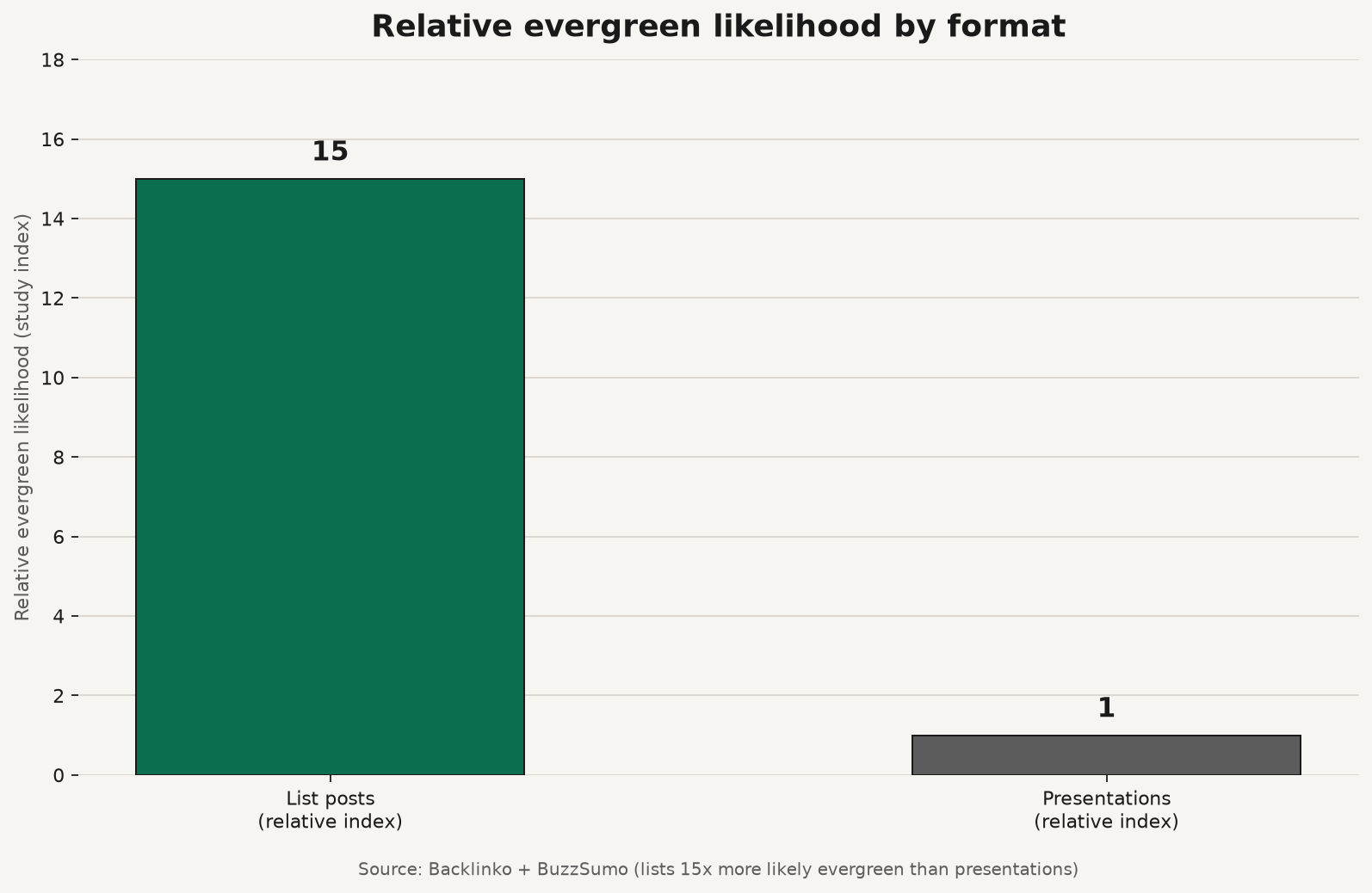
Source: Backlinko and BuzzSumo, 3.6 billion article analysis. https://backlinko.com/evergreen-content-study.
This is how you balance evergreen and trending content without pretending a 70/30 slide is a census. Avoid the usual failures: treating a viral post as an SEO plan, shipping year-stamped trend posts with no refresh path, copying another brand’s 70/30, and calling something evergreen just because it lives on a blog.
Q: What is the difference between evergreen and trending content? A: Evergreen content stays useful for a long window with light maintenance. Trending content is built for a short attention window around news, launches, or cultural moments. Seasonal content is a third bucket that returns on a predictable calendar.
Q: How should I balance evergreen vs trending content? A: Balance by job, not by a universal percentage. There is no public dataset that proves 70/30 or 80/20 for every company. Fund evergreen for compound search and education. Fund trending when you can capture a spike into email, product, or a durable hub.
Q: Does trending content help SEO? A: Indirectly, sometimes. Spikes can earn links, subscribers, and brand searches that later help evergreen pages. On their own, trending URLs rarely become the five-year-old pages that dominate Google’s top 10 in Ahrefs’ sample.
Q: Which formats are most likely to stay evergreen? A: In Backlinko and BuzzSumo’s 3.6 billion article study, list posts were 15x more likely to become evergreen than presentations, with how-to, what, and why posts also strong. Treat that as a prior while you still match search intent.
Q: How fast do social shares decay after publishing? A: OkDork and BuzzSumo’s analysis of 100 million articles found shares dropped at least 96% after three days for the next four days, with Facebook near 98.9%. Plan re-promotion if you need a second wave.
Evergreen vs trending content is a portfolio decision under different decay curves. Trending buys attention that collapses within days. Evergreen buys a chance to join the older pages that still own search. Pick the clock that matches the job, refresh what you intend to keep, and route spikes into assets that can sell next month.
If your product is ready while the content compounds, list it on feat. so affiliates can sell through co-branded storefronts instead of waiting on organic alone.
Average cost per content piece by format: WebFX ranges, freelancer modal rates, and why one national average is a myth.
How long content takes to rank by domain authority, with Ahrefs base rates, page-age data, and why DA score calendars are mostly fiction.
Content repurposing frameworks: CMI challenge rates, a job-first pillar-to-derivative map, and why rewrite-not-reformat beats paste-and-pray.