Average Cost per Content Piece by Format (2026 Ranges)
Average cost per content piece by format: WebFX ranges, freelancer modal rates, and why one national average is a myth.
Content repurposing frameworks: CMI challenge rates, a job-first pillar-to-derivative map, and why rewrite-not-reformat beats paste-and-pray.

TL;DR: Content repurposing frameworks turn one researched asset into platform-native derivatives. Start with the job (SEO compound, social discovery, or partner enablement), atomize claims not paragraphs, and rewrite for each surface. CMI’s Outlook 2025 survey shows repurposing is still a challenge for 37% of B2B marketers, and higher in tech and manufacturing cohorts.
Most teams do not have a content problem. They have a one-and-done problem. They ship a long post, share the URL once, and wonder why the research never compounds.
Content repurposing frameworks exist to fix that: pick a source asset, extract standalone claims, rewrite those claims for each channel, and stagger the releases so the same idea earns multiple surfaces without reading like leftovers. Pair this with how to build a topic cluster for internal link architecture, and with content marketing ROI benchmarks by industry so you do not confuse activity with return.
Key takeaways:
Content repurposing frameworks are repeatable systems for turning one source asset into multiple platform-native derivatives that point back to the same idea or URL.
In plain language: you create once for depth, then ship many times for reach, without pretending a blog paragraph belongs on TikTok unchanged.
Three layers sit inside every serious framework:
Repurposing is not synonym spinning. Identical blocks on multiple owned URLs create thin pages. Native rewrites on different channels create distribution.
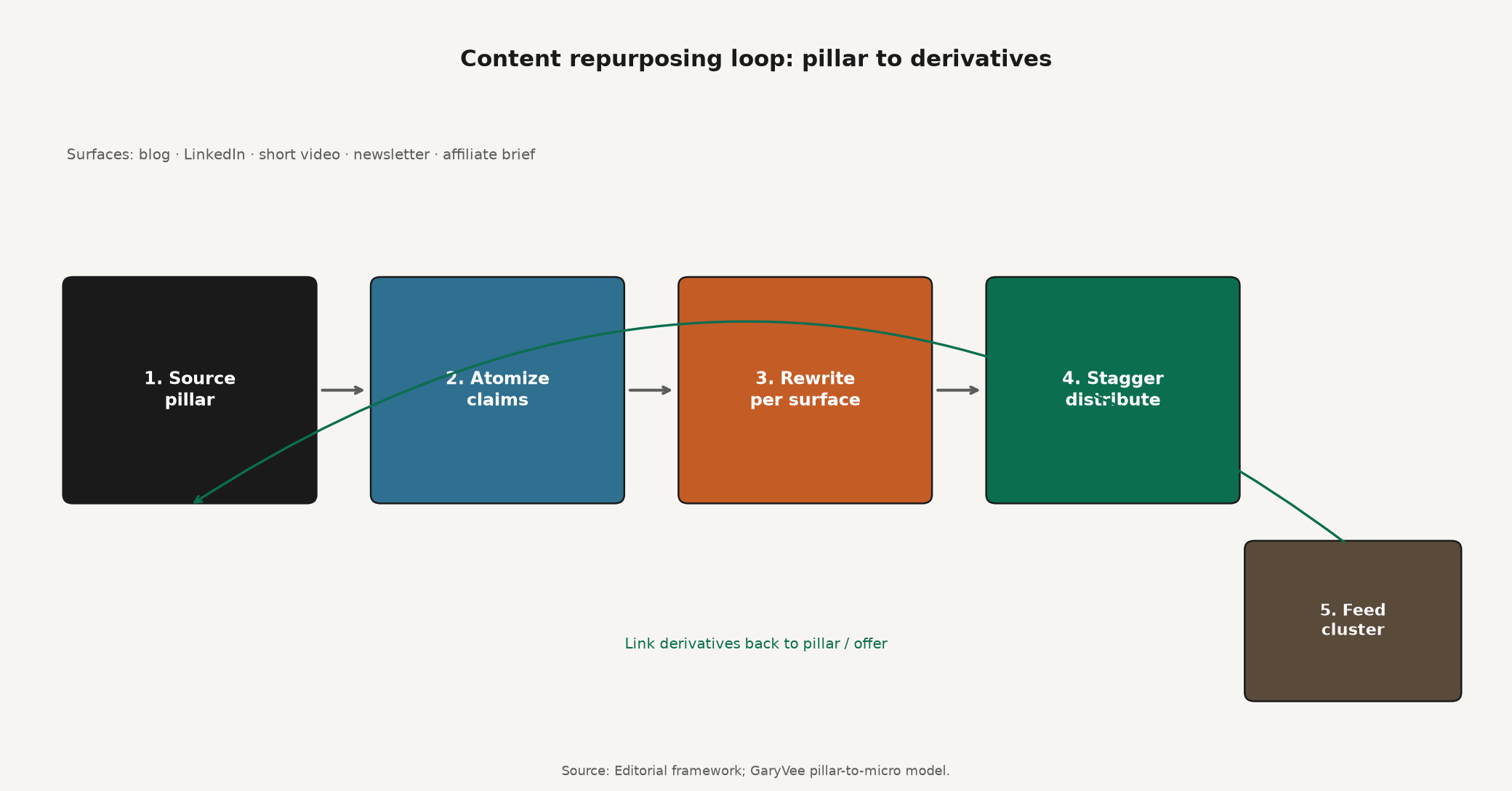
Source: Editorial framework synthesizing GaryVee pillar-to-micro model and practitioner rewrite rules. https://garyvaynerchuk.com/the-garyvee-content-strategy-how-to-grow-and-distribute-your-brands-social-media-content/
Repurposing matters because research is expensive and attention is fragmented. A framework turns one hard-won argument into a week of native posts without hiring a second writing team.
Why founders and marketing leads should care:
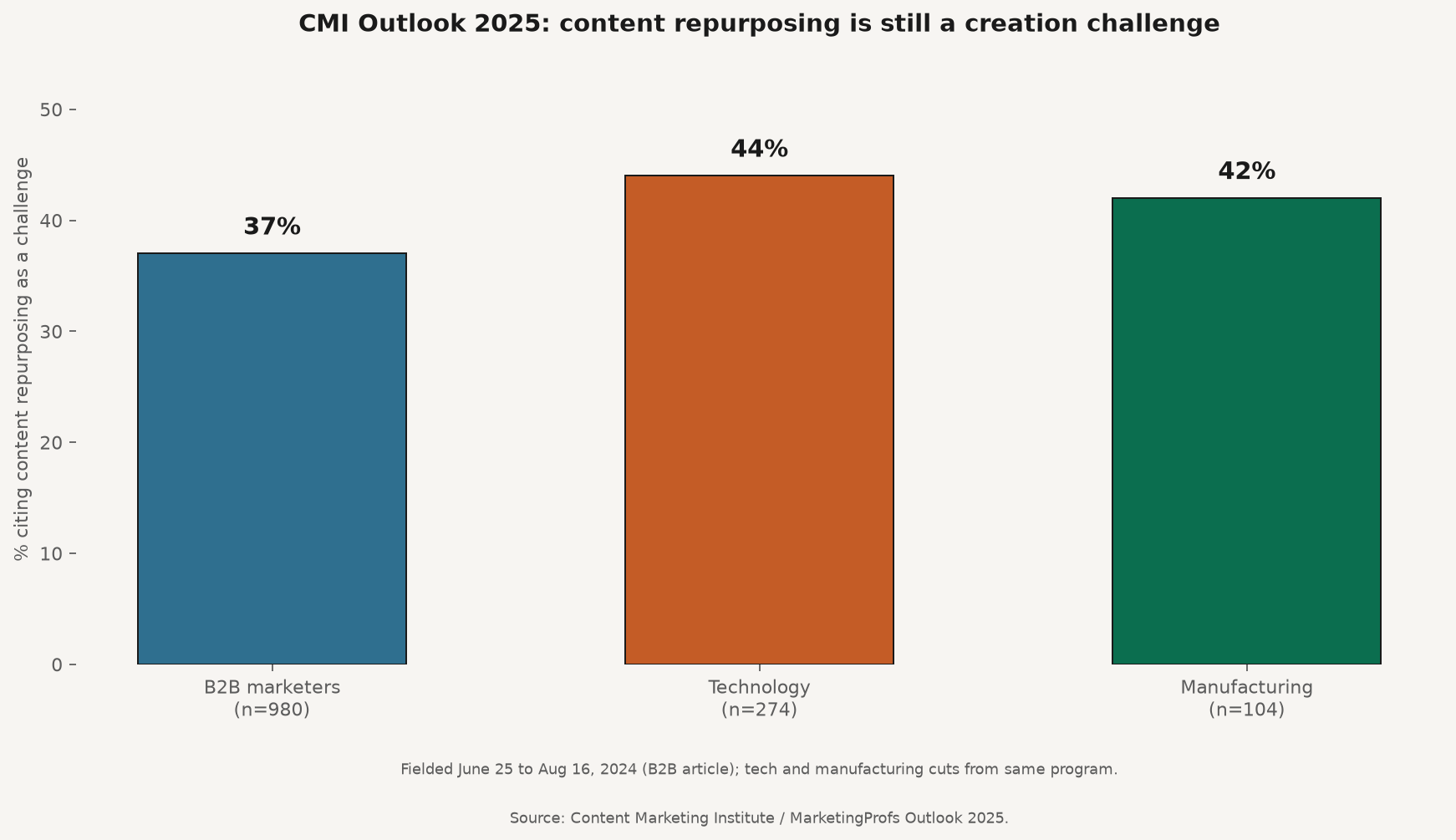
Source: Content Marketing Institute / MarketingProfs Outlook 2025 surveys (fielded June-August 2024). https://contentmarketinginstitute.com/b2b-research/b2b-content-marketing-trends-research-2025
A working content repurposing framework picks a job, chooses a source format that feeds that job, atomizes claims, rewrites each derivative natively, then staggers release so pieces do not cannibalize each other in the feed.
| Job | Best source asset | Primary derivatives | Success signal |
|---|---|---|---|
| Compound SEO | Long-form guide or data post | Updated sections, FAQ blocks, comparison tables, internal-link spokes | Rankings, assisted conversions, cluster traffic |
| Social discovery | Keynote, podcast, demo, or rant with sharp claims | Short video clips, carousels, threads, quote cards | Saves, replies, profile visits, clicks to pillar |
| Partner / affiliate enablement | Product story, teardown, or buyer objection FAQ | One-page brief, 3 hooks, proof chart, email blurb, co-branded storefront copy | Partner publish rate, tracked sales |
Gary Vaynerchuk’s reverse-pyramid model is the discovery map at celebrity scale: pillar video or keynote first, then micro content contextual to each platform, aimed back at the long-form piece. His published example turned one keynote into 30+ pieces and over 35 million views. Treat that as a ceiling anecdote from a team built for volume, not as your weekly KPI (GaryVee).
For SEO, the source is usually the written pillar inside a topic cluster. Derivatives should deepen or route, not clone the canonical URL.
For partner enablement, the source is the offer narrative. Derivatives are sales tools. Merchants listing on feat. win when affiliates inherit a ready kit, not a lonely blog link.
Bad repurposing copies section 2 into a carousel. Good repurposing asks which sentence someone could disagree with, then builds a native post around that claim.
Operator language from r/content_marketing and r/contentcreation is consistent: extract standalone ideas, match each idea to a platform, rewrite for rhythm, batch right after publish, and stagger across one to two weeks (Reddit; Reddit). That is qualitative demand evidence, not a survey. Use it as process language.
Practical atom checklist per source:
If you cannot fill three of those five, the source is too thin to repurpose. Write a better pillar first.
| Surface | Native shape | Failure mode |
|---|---|---|
| Blog / guide | Full argument, sources, FAQ, schema | Thin rewrite of a thread |
| One claim, story, or framework; personal stake | Blog summary dump | |
| X / short text | Sharp line + proof or question | Thread that is just H2s |
| Short video | Hook in 1-2 seconds; one idea; captions | Talking head reading the post |
| Newsletter | Teaser with one new angle; link to pillar | Full paste of the article |
| Affiliate brief | Offer, proof, 3 hooks, disclosure note | “Please share our blog” |
AI can draft the first pass. Humans still own voice, facts, and the disagreement angle. CMI’s manufacturing cohort shows 76% use generative AI tools, but only 7% say AI is integrated into daily workflows, while 51% experiment ad hoc (CMI Manufacturing). Tools without a framework create more paste-and-pray.
| Situation | Move | Why |
|---|---|---|
| Pillar ranks or converts; claims still true | Repurpose hard; light refresh stats | Derivatives ride a proven asset |
| Pillar ranks; stats stale | Substantive refresh, then new derivatives | Freshness without new thin URLs |
| Pillar never earned attention | Kill or rewrite the pillar; do not atomize | Multiplies a dud |
| Only need campaign tags / UTM tests | Instrumentation, not 12 formats | Wrong job |
| Affiliate launch next week | Enablement pack first | Partner publish rate beats vanity posts |
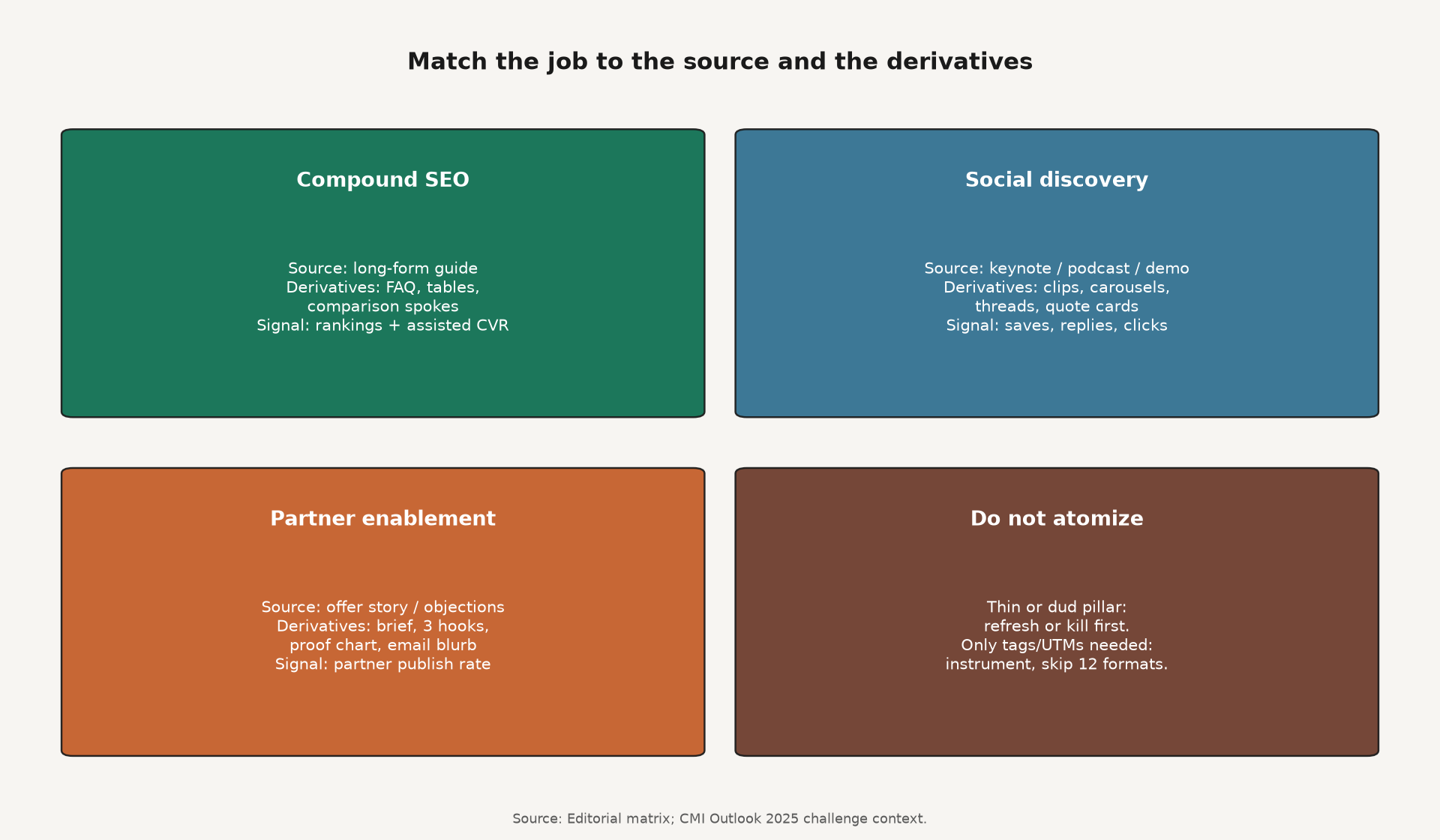
Source: Editorial decision matrix; challenge rates from CMI Outlook 2025. https://contentmarketinginstitute.com/b2b-research/b2b-content-marketing-trends-research-2025
Listicles love multipliers. Refuse them unless you can cite a primary methodology:
Say what is known: challenge rates from CMI, a labeled GaryVee case, and operator process rules. That combination is more citable than a fake efficiency percentage.
Run the system as a weekly loop, not as a heroic month-end cleanup. Each step stays short on purpose.
Digital product teams can wire the same loop into funnel stages. A webinar becomes a landing-page proof clip, an email teaser, and an affiliate objection FAQ. See how to build a digital product funnel for stage jobs.
Q: What are content repurposing frameworks? A: They are repeatable systems for turning one source asset into multiple platform-native derivatives. The framework covers source selection, claim atomization, native rewrites, staggered distribution, and a path back to the original pillar or offer.
Q: How do you repurpose a blog post without sounding repetitive? A: Extract standalone claims instead of summarizing the whole post. Rewrite each claim for the platform’s hook style, add one detail or example that was not in the original paragraph, and stagger posts over one to two weeks so the feed does not feel like leftovers.
Q: What is the difference between pillar content and micro content? A: Pillar content is the deep source (keynote, guide, podcast, demo). Micro content is the shorter, platform-contextual pieces cut from that source to drive awareness back to it. Gary Vaynerchuk’s reverse-pyramid model popularized that split for social distribution.
Q: How many pieces should one asset produce? A: There is no public census average. Operator workflows often aim for a handful of native derivatives per pillar. Gary Vaynerchuk’s team published a case of 30+ pieces and over 35 million views from one keynote. That is a high-end anecdote, not a weekly quota for a two-person team.
Q: Why do marketers still struggle with content repurposing? A: CMI’s Outlook 2025 research found 37% of B2B marketers, 44% of technology marketers, and 42% of manufacturing marketers name repurposing as a content-creation challenge. The gap is usually missing process (job, atoms, rewrite, stagger), not missing tools.
Content repurposing frameworks are how you stop paying full freight for ideas that appear once. Name the job, atomize claims, rewrite for each surface, and refuse fake multipliers. CMI’s challenge rates prove the ops problem is real. A clear system is the fix.
If you want product stories that affiliates can actually sell, not just posts that die in the feed, start at feat..
Average cost per content piece by format: WebFX ranges, freelancer modal rates, and why one national average is a myth.
Evergreen vs trending content compared with OkDork share-decay data, evergreen format odds, and a job-first mix (not a fake 70/30).
How long content takes to rank by domain authority, with Ahrefs base rates, page-age data, and why DA score calendars are mostly fiction.