Average Cost per Content Piece by Format (2026 Ranges)
Average cost per content piece by format: WebFX ranges, freelancer modal rates, and why one national average is a myth.
How to build a topic cluster: HubSpot's 20-30 umbrella test, ship a hub at 8-10 spokes, Hussain/Davies link outcomes, and a link architecture matrix.

TL;DR: How to build a topic cluster: pick one pillar topic broad enough for many spokes, write each spoke for one search intent, and wire bidirectional internal links. HubSpot’s umbrella test aims for 20-30 supporting posts. Ship a hub page around 8-10 committed spokes. Hussain and Davies saw DA 40→60, +13% W/W organic sessions, and +1,500% clicks on one keyword when they linked related content as a topic.
Most blogs die as reverse-chronological piles. Writers chase head keywords, publish orphans, and wonder why Google treats every URL like a one-off tip sheet.
How to build a topic cluster is the fix for that mess. You stop optimizing isolated posts and start owning a neighborhood of related answers that search engines and answer engines can crawl as one topical unit.
Key takeaways:
A topic cluster is a content architecture that groups related pages around one central pillar page, with every cluster page linking back to that pillar so search engines and readers see one organized topic instead of scattered posts.
HubSpot calls the same pattern hub and spoke. The pillar covers a broad subject at a high level. Each spoke owns one subtopic, long-tail question, or use case. Internal links make the semantic relationship explicit (HubSpot).
That is not the same job as content marketing vs performance marketing. Budget labels decide whether a dollar buys brand or activation. Cluster architecture decides whether your owned content compounds as topical authority or competes with itself.
Three parts, no mysticism:
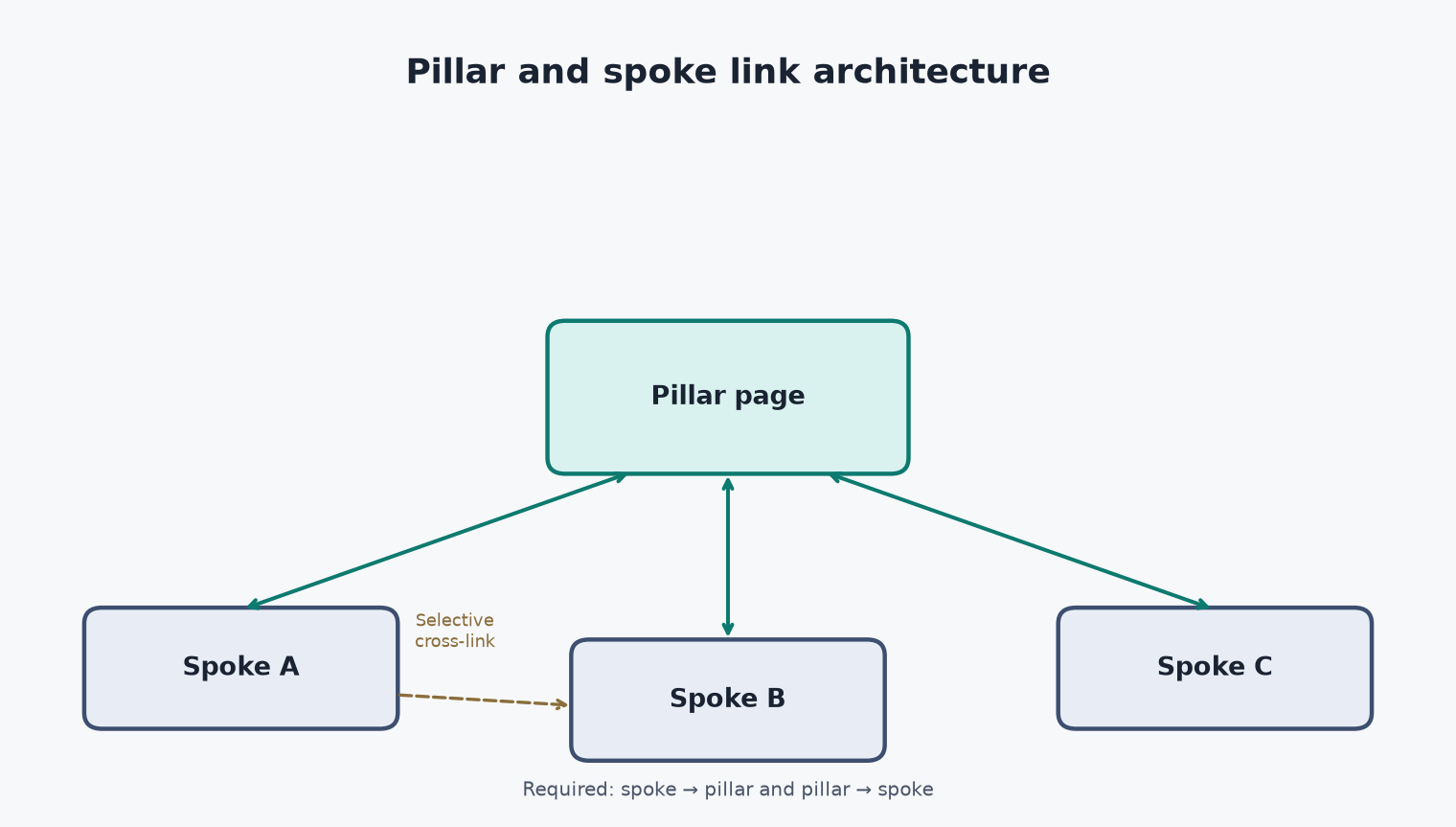
Source: Editorial framework from HubSpot topic-cluster linking rules. https://blog.hubspot.com/marketing/topic-clusters-seo
Scattered posts waste crawl budget and reader patience. Clusters concentrate relevance, route equity, and give AI surfaces more subtopic URLs to cite when they fan out a query.
Why this earns a build guide:
There is no public dataset that names a universal average traffic lift percentage for every site that adopts clusters. Treat Hussain/Davies as a documented experiment, not a guarantee. Refuse vendor case studies that claim multi-million session jumps without primary methodology.
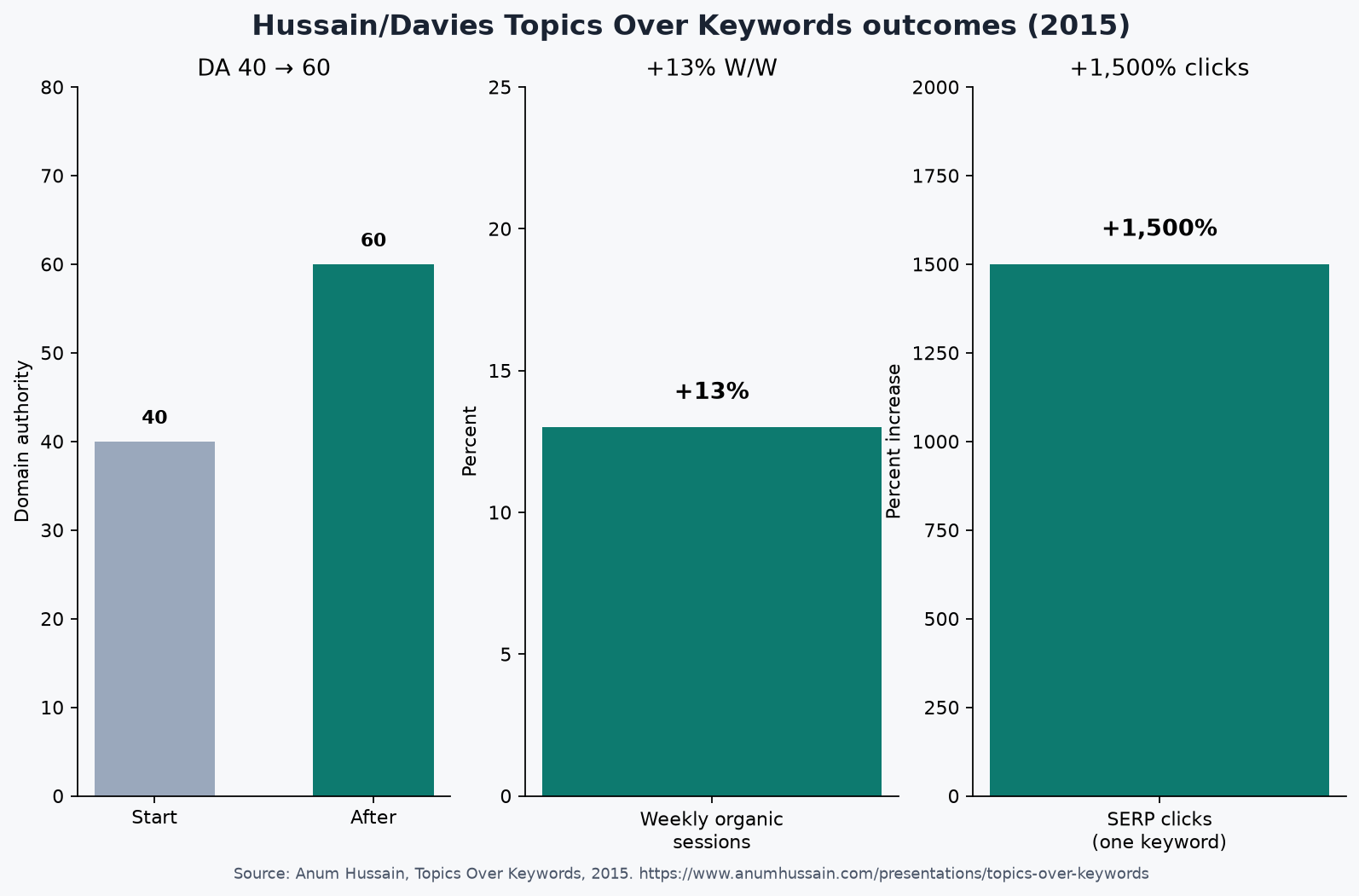
Source: Anum Hussain, Topics Over Keywords, 2015. https://www.anumhussain.com/presentations/topics-over-keywords
A topic cluster works when one pillar owns the broad question, each spoke owns one narrower intent, and the link graph makes those relationships obvious to crawlers and humans. Failures usually come from size confusion (waiting for 30 drafts) or link laziness (spokes that never point home).
HubSpot’s Leslie Ye sniff test asks whether a page answers the head-term searcher and is broad enough to umbrella 20-30 posts. If you are optimizing only a long-tail, it is not a pillar (HubSpot).
That 20-30 figure is a breadth target for what a pillar can eventually support. It is not a ship gate.
feat.'s editorial rule (and the pattern operators describe in r/SEO and r/seogrowth) is a hub-ship threshold: when a pillar has about 8-10 committed spokes, publish or update a hub page that links every spoke and is linked back from each. Reddit threads commonly describe starting with roughly 5-10 or 8-15 supporting articles before expanding (r/seogrowth; r/SEO).
| Threshold | Typical range | Job | Mistake if confused |
|---|---|---|---|
| Breadth target (HubSpot Ye) | ~20-30 supporting posts | Decide whether a topic is wide enough to be a pillar | Treating 20 as minimum before any hub ships |
| Hub-ship threshold (feat. editorial) | ~8-10 committed spokes | When to publish/update the hub that lists every spoke | Leaving spokes orphan until the full 30 exist |
| Operator start band (community) | ~5-10 or ~8-15 spokes | Practical first cluster size | Inventing a fixed “magic number” as a law |
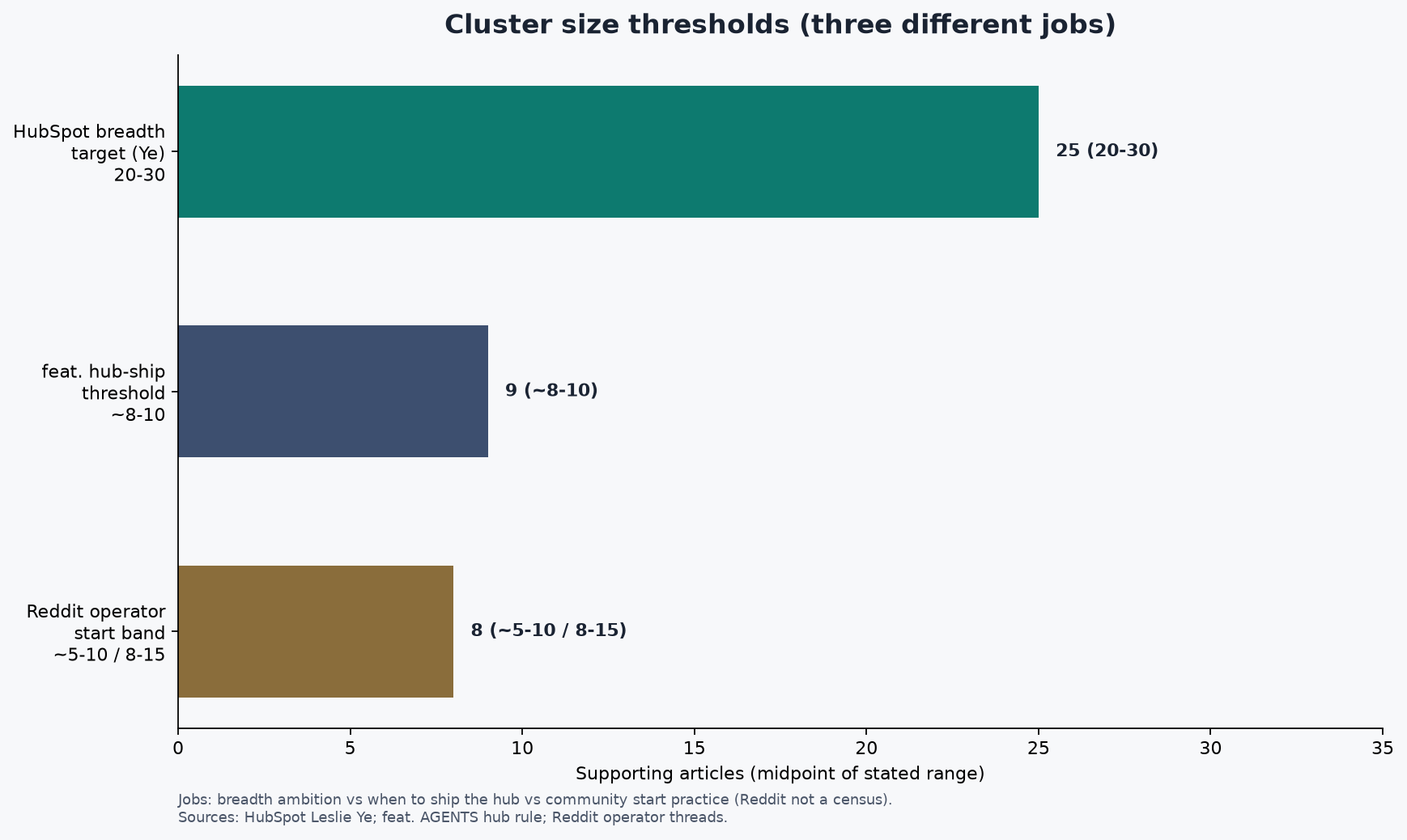
Source: HubSpot Leslie Ye quote (20-30); feat. AGENTS hub-ship rule (~8-10); Reddit operator ranges (~5-10 / 8-15) as labeled community practice, not a census. https://blog.hubspot.com/marketing/topic-clusters-seo
HubSpot’s three linking rules are the operating system:
| Link type | Required? | Rule |
|---|---|---|
| Spoke → pillar | Yes | Every cluster page links to the pillar with descriptive anchor text |
| Pillar → spoke | Yes (important spokes) | Pillar links out where each subtopic is introduced |
| Spoke → spoke | Selective | Only when topics genuinely overlap for the reader |
| Orphan spoke | Never | No page in the cluster without a path to the pillar |
Without those links you have a topic-themed archive, not a cluster.
Moz recommends ranking supporting pages first when early wins matter. Publishing the pillar first can leave it competing with unfinished spokes (Moz). Practically: draft the pillar outline early so H2s mirror spoke themes, ship high-intent spokes, then thicken the pillar as spokes go live.
One clean job. If two keywords share the same intent, they share one URL. If a subtopic needs more depth than a short pillar section, it earns a spoke. If it cannot be separated from the nearest sibling without repeating the same answer, it does not.
Affiliate and marketplace teams feel this when “how affiliate marketing works,” commission structures, and disclosure each need their own page but must still point to the same pillar. See how affiliate marketing works as a pillar-shaped overview with spokes for rates, platforms, and compliance.
Follow five steps: pick 3-5 pillar candidates, validate demand, write the pillar overview, ship one-intent spokes, then wire the link graph and maintain a coverage tracker. HubSpot’s sequence is the backbone; the size rules above decide when the hub goes live (HubSpot).
Measure the cluster as a portfolio: rankings and clicks for head plus long-tails, pages per session inside the cluster, assisted conversions, and whether AI answers cite any URL in the set. Google reports AI Overview and AI Mode clicks inside Search Console’s Web search type; do not invent a separate AI-only article version (Google).
For funnel-stage context when mapping spokes to awareness vs purchase, use marketing funnel benchmarks by stage and industry. For how organic assists get misread as last-click failures, see attribution models compared.
These failures kill clusters faster than missing a keyword tool.
Q: How do you build a topic cluster for SEO? A: Pick a pillar topic broad enough for many subtopics, validate spokes with PAA and related searches, write a breadth-first pillar, publish one-intent cluster pages, and link every spoke to the pillar (and the pillar to each important spoke). HubSpot documents this five-step sequence.
Q: What is the difference between a pillar page and a cluster page? A: A pillar page is the broad hub that owns the head term and points to deeper coverage. A cluster page (spoke) owns one specific subtopic or long-tail intent and links back to the pillar with descriptive anchor text.
Q: How many articles should be in a topic cluster? A: HubSpot’s Leslie Ye test says a pillar should be broad enough for about 20-30 supporting posts. Ship or update a hub around 8-10 committed spokes, then expand. Reddit operators often start near 5-10 or 8-15. There is no universal magic number.
Q: Do topic clusters help with Google AI Overviews? A: Google says AI Overviews and AI Mode may use query fan-out across subtopics and that internal links remain a foundational SEO practice. Clusters give you more findable, intent-matched URLs eligible to surface. No special AI-only markup is required.
Q: Should I publish the pillar page before the spokes? A: Outline the pillar early so H2s mirror spoke themes, but Moz notes that supporting pages ranking first can build momentum and that pillar-first publishing can compete with unfinished spokes. Many teams ship high-intent spokes, then thicken the pillar as the graph fills.
Building a topic cluster is a discipline of one pillar, many one-intent spokes, and a link graph you maintain. Use HubSpot’s 20-30 figure as the breadth ambition, ship the hub near 8-10 committed posts, and cite named outcomes like Hussain and Davies instead of invented lift averages.
If you built a product and need people to sell it while your content compounds, list it on feat..
Average cost per content piece by format: WebFX ranges, freelancer modal rates, and why one national average is a myth.
Evergreen vs trending content compared with OkDork share-decay data, evergreen format odds, and a job-first mix (not a fake 70/30).
How long content takes to rank by domain authority, with Ahrefs base rates, page-age data, and why DA score calendars are mostly fiction.