How Much Stock Loss Is Normal on a Creator Campaign
Most marketers see under half of gifted creators post. Plan stock loss as majority silent inventory, then cut ghosts with opt-in and prune rules.
How to vet an influencer's real engagement: SociaVault finds 37.2% fake or suspicious across 100K accounts. Run the 3-indicator check before paying.

TL;DR: How to vet an influencer’s real engagement starts with forensics, not follower vanity. SociaVault’s 2026 study of 100,000 Instagram and TikTok accounts finds 37.2% show fake or suspicious signals, with Instagram at 41.8% and the macro tier at 48.3%. Run comment quality, engagement-rate anomaly, and growth spikes before you pay.
Media kits sell follower counts. Fraud sells the same screenshot with a quieter audience. Brands that skip authenticity checks do not discover the problem in a dashboard. They discover it when the post underperforms a nano creator at one-tenth the fee.
How to vet an influencer’s real engagement is a pre-contract job. You are checking whether likes, comments, and growth look like a real audience or like purchased padding, pods, and bots. This is not the same as picking nano vs macro for ROIS. That efficiency question lives in micro vs macro vs nano influencer ROI. This page is the authenticity gate before you wire money.
Key takeaways:
Vetting an influencer’s real engagement is the process of checking whether an account’s likes, comments, reach, and follower growth reflect authentic audience behavior rather than purchased followers, bots, or coordinated engagement pods.
It is not the same as liking their aesthetic. It is not the same as calculating campaign ROIS after the post. It is a pre-buy authenticity audit: compare public signals to tier benchmarks, inspect comment quality, look for unnatural growth, and, when the fee is high, demand native platform Insights that are harder to fake than public vanity metrics.
Fraud here includes inactive purchased followers, follow-unfollow inflation, pod comments, and bot networks. SociaVault’s method mix in their sample: direct purchase 45%, follow-unfollow 25%, engagement pods 20%, bot networks 10%, with purchased followers showing an average half-life near 45 days (SociaVault).
Paying for fake reach is not a branding flex. It is a contribution-margin leak that looks like “influencer underperformed.”
Why the check is non-negotiable:
Operators on r/influencermarketing describe discovering systematic bot engagement only after annual audits, and burned buyers share micro-vetting checklists after pods and SMM panels fooled them (r/influencermarketing fraud; r/influencermarketing micro vetting). Treat that as demand language.
Vetting real engagement means comparing public signals to authentic tier benchmarks, reading comments like a detective, and checking growth for spikes that have no viral story. SociaVault’s 100K-account study puts overall fake/suspicious risk at 37.2%, with Instagram higher than TikTok and macro accounts the riskiest tier. Their three-indicator quick check (comment quality, ER anomaly, growth spike) is the fastest defensible filter before a full audit or native Insights request.
| Cut | Rate | Read |
|---|---|---|
| Overall fake / suspicious | 37.2% | Baseline risk before any niche filter |
| Likely Authentic / Suspicious / Likely Fraudulent | 62.8% / 22.4% / 14.8% | Most accounts are clean; enough are not |
| Instagram vs TikTok | 41.8% vs 32.6% | Older IG monetization incentives |
| Macro tier (100K-500K) | 48.3% | Fraud cliff near major deal thresholds |
| Beauty & Cosmetics | 52.1% | Highest niche in their matrix |
Source: SociaVault Fake Follower Study 2026. Snapshot February 2026; English-optimized comment scoring; estimated 8-12% false positive rate. Do not treat any single account score as courtroom proof.
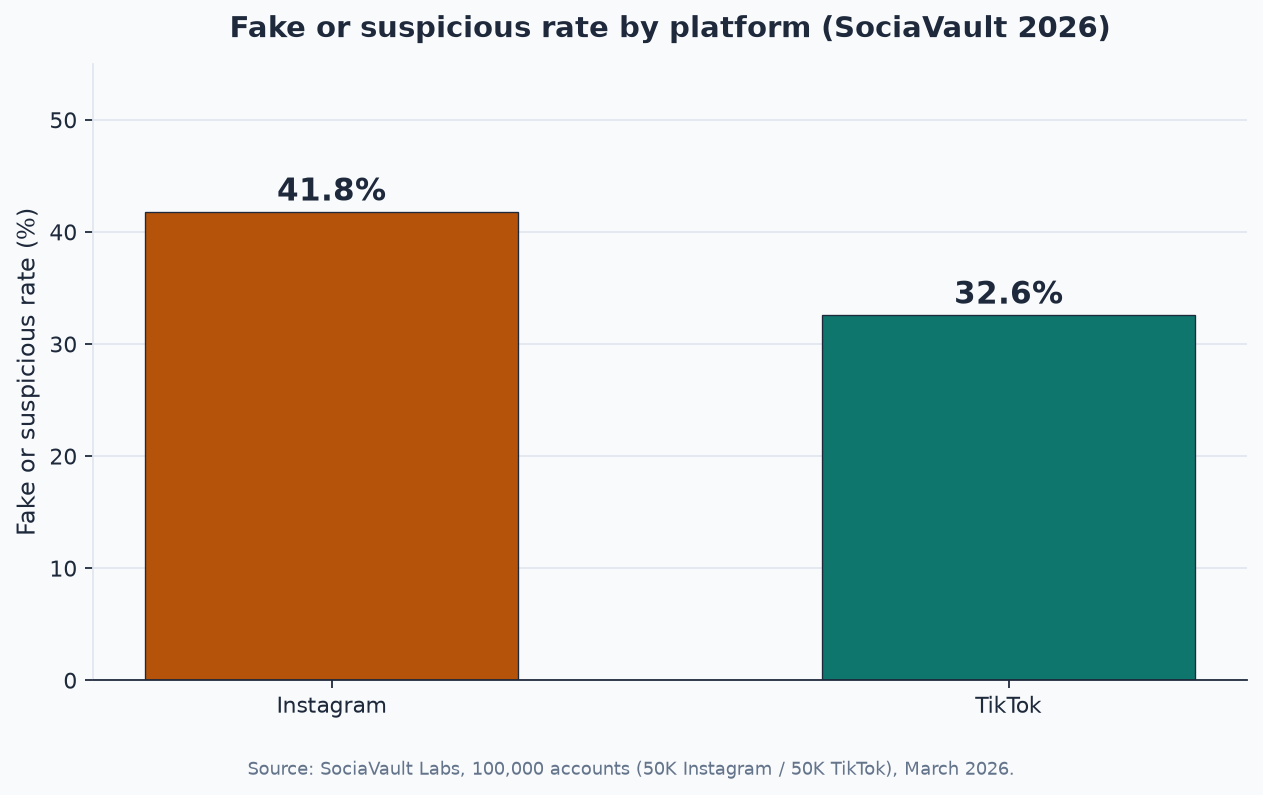
Source: SociaVault Labs, The Fake Follower Problem (2026), 100,000 accounts. https://sociavault.com/labs/reports/fake-follower-study-2026
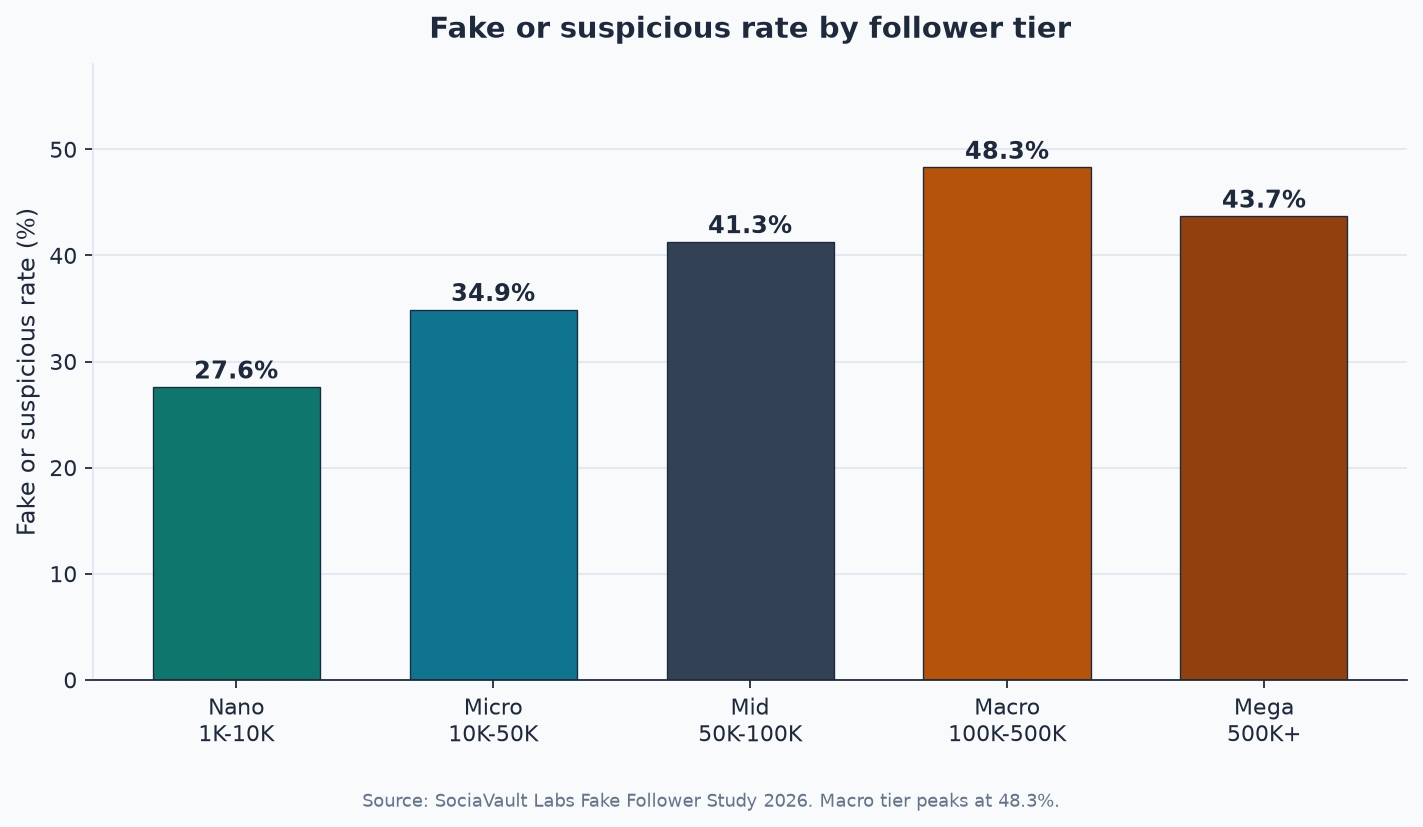
Source: SociaVault Labs, The Fake Follower Problem (2026). Macro tier = 100K-500K followers. https://sociavault.com/labs/reports/fake-follower-study-2026
Use these only as Likely Authentic medians from SociaVault, not as your niche’s law.
| Tier | Instagram median ER | TikTok median ER |
|---|---|---|
| Nano (1K-10K) | 3.42% | 7.84% |
| Micro (10K-50K) | 2.15% | 5.21% |
| Mid (50K-100K) | 1.53% | 3.89% |
| Macro (100K-500K) | 1.12% | 2.73% |
| Mega (500K+) | 0.81% | 1.84% |
Source: SociaVault. Formula context: follower-based ER = (likes + comments) ÷ followers × 100 across recent posts. Reach-based ER is better when Insights are shared, but public vetting usually starts follower-based.
SociaVault’s own anomaly rule of thumb in the quick check: flag when ER sits below 50% of the benchmark for that follower count. For a macro Instagram account near the 1.12% median, that puts a rough danger zone under about 0.56%. Far above-benchmark ER can also be pods. Read comments either way.
SociaVault ranked indicators against known-fraud controls. Top accuracy: comment quality 87.3%, commenter authenticity 84.1%, engagement-rate anomaly 82.6%, growth spike detection 79.4%. Their three-indicator quick check catches 89% of fraudulent accounts; when all three fire, accounts were fraudulent 93% of the time in their validation (SociaVault).
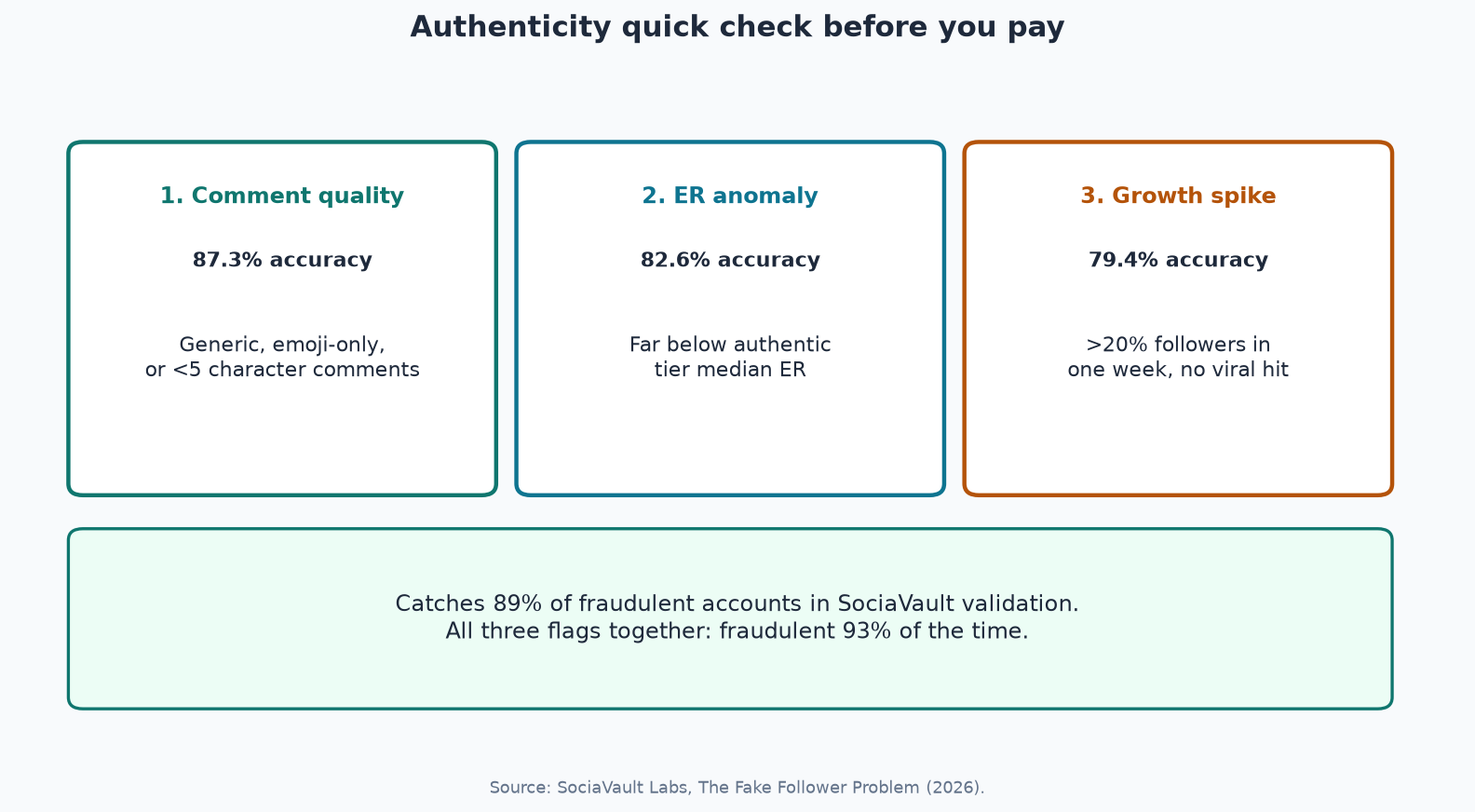
Source: SociaVault Labs, The Fake Follower Problem (2026), indicator accuracy and quick-check validation. https://sociavault.com/labs/reports/fake-follower-study-2026
| Indicator | What to look for | Why it ranks |
|---|---|---|
| Comment quality | >60% comments generic, emoji-only, or under 5 characters | Highest accuracy (87.3%) |
| Engagement-rate anomaly | ER far below (or weirdly above) authentic tier median | 82.6% accuracy |
| Growth pattern | >20% of followers gained in a single week without a clear viral hit | 79.4% accuracy |
| If the deal is… | Minimum vetting | Escalation |
|---|---|---|
| Small paid story / test | 3-indicator quick check | Skip if two+ flags |
| Mid five-figure post | Quick check + sample 15 followers + Social Blade growth | Ask for Insights screenshots (reach, accounts engaged) |
| Ambassador / always-on | Full third-party audit + native Insights connect | Pilot post before annual retainer |
| Beauty / fashion / travel macro | Assume elevated base rate (SociaVault niche/tier peaks) | Dual-tool audit; prefer CPE pricing |
| Performance / affiliate hybrid | Authenticity + tracked offer proof | Pair with affiliate vs influencer risk split |
For whether influencer should even beat paid media on the job, see influencer marketing vs paid ads. For post-campaign measurement discipline, see incrementality testing.
Q: How do you vet an influencer’s real engagement? A: Calculate engagement rate against authentic tier medians, read comment quality, and check growth for unnatural spikes. SociaVault’s three-indicator quick check caught 89% of fraudulent accounts in their validation, and all three flags together were fraudulent 93% of the time. Escalate to native Insights for larger fees.
Q: What is a good influencer engagement rate? A: It depends on platform and tier. Among SociaVault’s Likely Authentic accounts, Instagram medians run from about 3.42% (nano) to 0.81% (mega), while TikTok medians run from about 7.84% to 1.84%. Compare within platform and tier, not to a single universal “2% is good” rule.
Q: Are Instagram influencers more fake than TikTok? A: In SociaVault’s 100K-account sample, Instagram’s combined fraud rate was 41.8% versus TikTok’s 32.6%. That is a snapshot with methodology limits, not a lifetime law, but it is a reason to vet IG macros harder when follower count still prices the deal.
Q: Which follower tier has the most fake engagement risk? A: SociaVault found the macro tier (100K-500K) highest at 48.3%, with mega slightly lower at 43.7% and nano lowest at 27.6%. Their narrative is that crossing ~100K unlocks larger fees, which raises the ROI of buying followers.
Q: Can engagement pods look like high engagement? A: Yes. Pods and coordinated commenters can push ER above benchmarks while commenter authenticity fails. SociaVault lists engagement pods as about 20% of fraud methods in their mix. High ER is not automatic proof of quality. Read who is commenting.
How to vet an influencer’s real engagement is a short forensic routine with expensive consequences if you skip it. SociaVault’s 100K-account study puts fake or suspicious risk at 37.2%, higher on Instagram than TikTok, and highest in the macro band where deal sizes jump. Start with comment quality, ER anomaly, and growth spikes. Demand Insights when the check clears but the fee is large. Then, and only then, argue about creative and ROIS.
If you want performance-shaped distribution where creators sell through tracked co-branded storefronts rather than vanity reach alone, start at feat..
Most marketers see under half of gifted creators post. Plan stock loss as majority silent inventory, then cut ghosts with opt-in and prune rules.
UGC vs influencer marketing is assets vs distribution. Collabstr UGC ~$154 paid; Agentio shows Partnership Ads beat licensed UGC on CTR, CVR, and CPA.
Influencer contract terms explained: usage, exclusivity, whitelisting, kill fees, payment, and FTC disclosure, plus a brand vs creator negotiation matrix.