Product Quiz Conversion Rate Benchmarks (2026)
Product quiz conversion rate benchmarks are a Quiz Denominator Ladder: RevenueHunt 5.5% of completers; ConvertFlow 5.2% of viewers. Not sitewide CVR.
Post-purchase upsell benchmarks: ReConvert 2023 one-click 4.7% extra orders per 100, ~6.7% of offers, thank-you 1.7%, top 5% 28.3%. Not email.

TL;DR: Post-purchase upsell conversion benchmarks are an Offer Clock Ladder, not a 15–25% take-rate slogan. ReConvert’s 2023 merchant panel labels one-click at 4.7% extra orders per 100 original orders, while 16.9 million offers produced 1.13 million additional orders (~6.7% of offers). Thank-you page offers averaged 1.7%. Top 5% of users hit 28.3%. This is not post-purchase email.
Merchants Google post purchase upsell conversion benchmarks and get a Reddit playbook that says one-click converts at 15–25%. Apps then quote a different 4% floor. Finance averages them. You ship three stacked offers on the way to the pay button and wonder why checkout completion fell.
Post purchase upsell conversion benchmarks matter when you decide whether to put the offer after payment, on the thank-you page, or in email three days later. This page sits next to post-purchase email benchmarks, checkout conversion rate benchmarks, express checkout conversion rate benchmarks, and average order value benchmarks by industry.
Post purchase upsell conversion benchmarks are labeled acceptance and revenue figures for offers shown after the original payment succeeds — one-click add-ons that attach to the same order, and thank-you page offers that ask again with less payment friction.
They are not checkout bumps, cart drawers, or post-purchase email. Email is a later clock: Omnisend and Klaviyo measure opens, RPR, and next-order rate. A one-click upsell measures whether a buyer who just paid says yes to one more SKU before they leave.
Shopify’s own extension model is explicit: the buyer has completed payment; the extension can add products to that order (Shopify.dev). Operators on r/shopify keep rediscovering the same rule in plainer words: “Avoid upsells during checkout, use post-purchase instead” (r/shopify). Pre-pay interruptions tax checkout completion. Post-pay offers tax attention, not the original sale.
This article owns the Offer Clock Ladder. Email stays on its spoke. Cart and PDP cross-sells are a different job.
Wrong clocks rebuild the wrong surface. You interrupt checkout for a 15% “industry take rate,” lose the original order, and blame traffic.
Post-purchase upsell conversion works when you name the clock (extra orders per original order versus conversion of offers served), pick the surface (one-click after pay versus thank-you), and refuse to mix those rates with email RPR or pre-pay bumps.
| Rung | What you measure | Labeled public anchor | Decision |
|---|---|---|---|
| 1. Order clock | Extra orders ÷ original orders | ReConvert 4.7% (~5 extras per 100 orders) | Planning floor for attach |
| 2. Offer clock | Extra orders ÷ offers served | 16.9M offers → 1.13M extras ≈ 6.7% | If you count impressions of the offer |
| 3. Thank-you surface | Accepts on thank-you page | 1.7% average; 2.2 views/order | Colder; still zero extra CAC |
| 4. Tail | Top operators | Top 5% 28.3%; best 37% | Ceiling, not forecast |
| 5. Money | AOV / revenue share | +5.6% AOV; optimized 12.7% of sales | Judge dollars, not vanity take rate |
Source: Upsell.com / ReConvert 2023. Panel: 40,000+ merchants; page updated August 25, 2026.
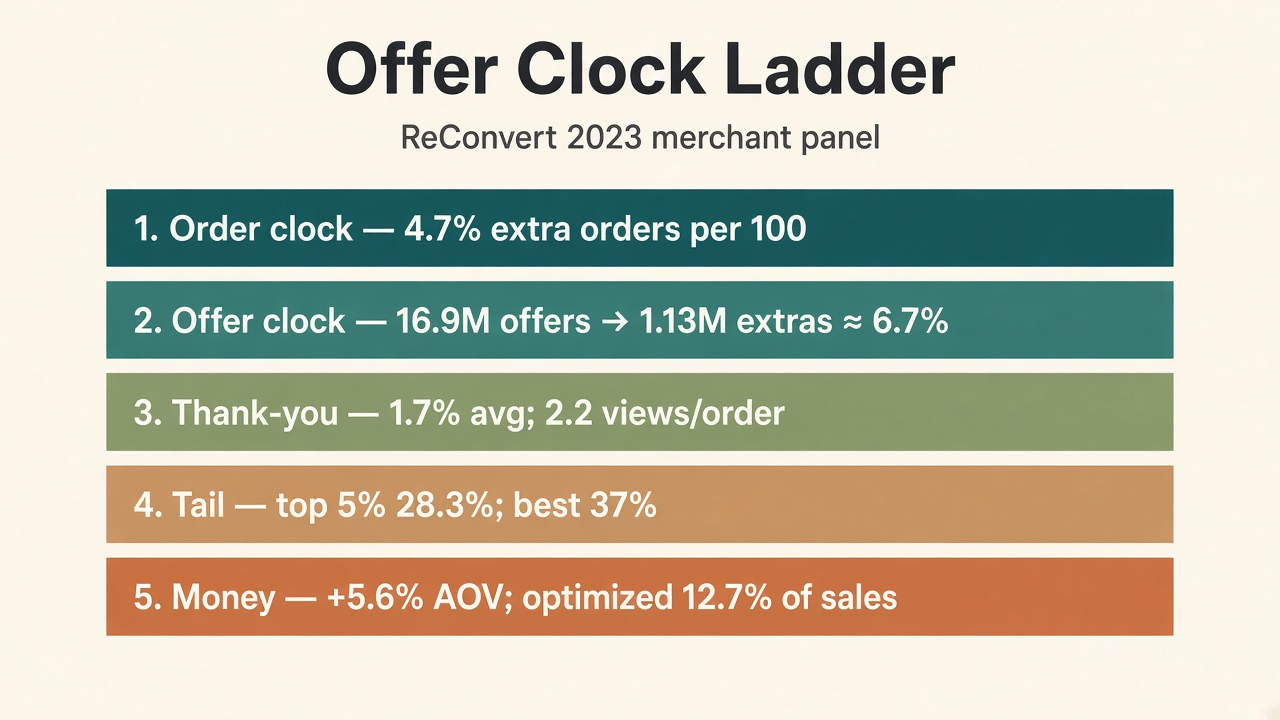
Source: Upsell.com / ReConvert, 2023 report (page updated Aug 25, 2026). https://upsell.com/blog/the-impact-of-post-purchase-upselling-2023.
ReConvert writes 4.7% as “for every 100 orders generated by users, ReConvert added approximately 5 additional orders.” That is an order clock. It then reports 16.9 million one-click offers and 1.13 million additional orders, and a later sentence calls 6.7% the average post-purchase upsell rate (Upsell.com). 1.13 ÷ 16.9 ≈ 6.7%. That is an offer clock.
If you blend 4.7% and 6.7% into 5.7%, you invent a third meter. Keep them labeled. Use the order clock when finance asks “how many extra orders per sale?” Use the offer clock when the app dashboard counts offer views.
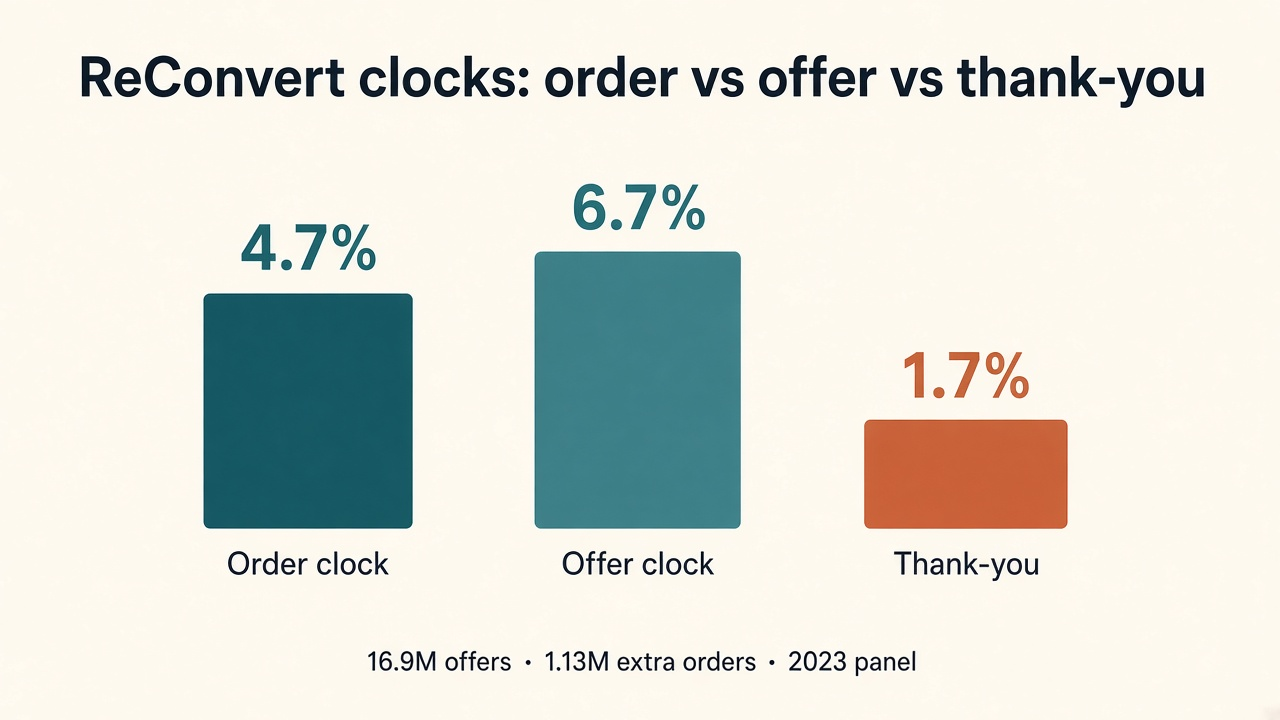
Source: Upsell.com / ReConvert, 2023. https://upsell.com/blog/the-impact-of-post-purchase-upselling-2023.
One-click after payment uses stored credentials and stays in checkout chrome. Thank-you page offers still see almost every buyer — ReConvert says 2.2 views per order — but convert at 1.7% on average (Upsell.com). Brands that ran both surfaces generated the most revenue in that write-up. That is a stack, not a mandate to spam three sequential OTOs.
Email is later and colder on a different metric. Klaviyo’s post-purchase series sits near $0.41 RPR and 0.54% placed-order. Omnisend’s cross-sell automation is $0.95 per email. Those numbers live on post-purchase email benchmarks. Do not grade a one-click 4.7% attach against an email 0.54% next-order rate.
Community operators who actually run Shopify apps keep repeating relevance and scarcity of choice: one obvious add-on beats a wall of “you might also like” (r/dropship). That matches the vendor tail: top 5% at 28.3% did not get there with generic grids.
Shopify post-purchase checkout extensions are beta. Development stores can run them; live stores request access (Shopify.dev). Apps wrap that surface. Gateway rules still bite — some wallets limit chained charges. Treat “one-click” as a payment-stack feature, not a theme toggle.
ReConvert also publishes $686 generated per $1 spent, and $2.42 billion additional sales. Those dollars are vendor-reported returns against app fees, not a media ROAS you can paste next to Meta (Upsell.com). Useful as “the software is cheap versus attach revenue.” Useless as a 68,500% marketing case.
Case studies stay labeled. Tushy’s thank-you widget: 2.8% added at least one item, $191,786 extra in 30 days. Eva Estelle: 8% post-purchase conversion and £51 extra among converters in 30 days (Upsell.com). They illustrate the tail and the thank-you surface. They are not the 4.7% mean.
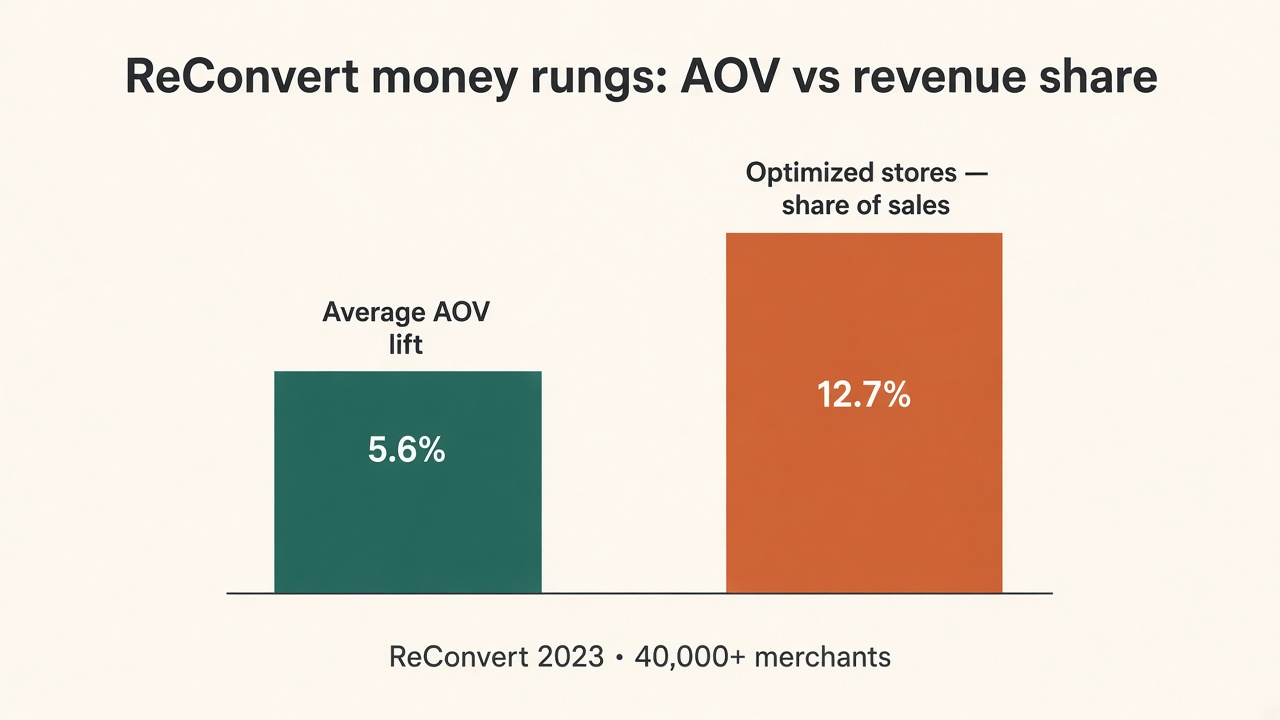
Source: Upsell.com / ReConvert, 2023. https://upsell.com/blog/the-impact-of-post-purchase-upselling-2023.
Checkout conversion benchmarks own Littledata completion once checkout starts. Pre-pay upsells can damage that meter. Express checkout wallets raise the chance the original order happens. Post-purchase upsells harvest contribution after that order. Sequence them: wallets and field cuts first, then one relevant attach.
Run this sequence before you buy another OTO app. Each step is at most two sentences.
Q: What is a good post-purchase upsell conversion rate in 2026? A: Use ReConvert’s 2023 labeled floors: about 4.7% extra orders per 100 original orders on one-click, about 6.7% if you divide extra orders by offers served, and 1.7% on thank-you pages. Top 5% at 28.3% is a ceiling, not a target.
Q: Is one-click post-purchase better than a thank-you page upsell? A: On ReConvert’s panel, labeled one-click conversion (4.7% order clock) sits well above thank-you (1.7%). The report says running both generated the most revenue. Measure each surface; do not merge them into one KPI.
Q: Are post-purchase upsells the same as post-purchase email? A: No. One-click and thank-you offers happen in session after payment. Email is a later nurture clock with different meters (Omnisend dollars per email, Klaviyo RPR). See post-purchase email benchmarks.
Q: Does Shopify support one-click post-purchase upsells? A: Shopify documents post-purchase checkout extensions that add products after payment. The feature is in beta and live stores must request access. Apps wrap that API; gateway limits still apply.
Q: Can I quote 15–25% as the industry one-click conversion rate? A: No. That band shows up in playbooks and threads without a pooled census. ReConvert’s 2023 panel is the largest labeled merchant dataset here, and its mean is not 15–25%. There is no public dataset for a universal Shopify take rate.
Post purchase upsell conversion benchmarks reward merchants who name the clock. ReConvert’s 2023 panel puts one-click near 4.7 extra orders per 100 originals and about 6.7% of offers served, with thank-you colder at 1.7% and a fat tail at 28.3% for the top 5%. Average AOV lift is 5.6%, not a new media channel. Keep the offer after payment, keep it to one relevant SKU, and leave email on its own spoke.
If you want distribution that already converts attention into affiliate-sold storefronts, list on feat..
Product quiz conversion rate benchmarks are a Quiz Denominator Ladder: RevenueHunt 5.5% of completers; ConvertFlow 5.2% of viewers. Not sitewide CVR.
Size guide conversion rate impact is a Size Confidence Ladder: Baymard 83%/87% fail sufficiency; Snipes Fit Finder +3% all-traffic vs a static chart.
Sticky add to cart conversion lift: Vitals 9.3% of orders involve the bar; Growth Rock +7.9% desktop vs scroll-to-section with no order lift.