Email Preference Center Best Practices
Preference center best practices: CAN-SPAM menu plus stop-all, Google one-click vs body preference pages, and SendGrid's labeled 20% unsub drop.
Post-purchase email benchmarks: Omnisend shipping and order confirm dollars vs cross-sell, plus Klaviyo RPR $0.41 and why high opens are not cart CVR.

TL;DR: Post-purchase email benchmarks are a stack, not one open rate. Omnisend shipping confirmation hits 62.67% open and $3.08/email; order confirmation $2.88; order follow-up $1.75; cross-sell $0.95. Klaviyo’s post-purchase series averages $0.41 RPR (top 10% $5.14) with placed-order near 0.54%. High opens with a modest next-order rate is nurture, not cart failure.
Founders see a 60% open rate on shipping mail and a 0.5% next-order rate on the same flow, then declare post-purchase “broken.” That is grading a receipt like a cart. The buyer already paid. The job is utility first, then the next purchase, not the same urgency playbook that recovers abandoned carts.
The full cluster map lives in the email marketing guide.
Post-purchase email benchmarks are labeled open, click, conversion, and revenue figures for automations that fire after an order: confirmations, shipping updates, follow-ups, reviews, and cross-sells. This page owns that stack. Pre-purchase siblings live in abandoned cart email benchmarks, browse abandonment email benchmarks, and welcome email benchmarks. Broader ESP ladders live in email marketing benchmarks by industry.
Post-purchase email benchmarks are labeled performance ranges for automated messages sent after a customer places an order, covering transactional updates and retention marketing, usually reported as open rate, click rate, conversion or placed-order rate, and revenue per email or per recipient from a named ESP sample.
They are not one email. Klaviyo defines a post-purchase email as any message after purchase, from order and shipping confirmation to thank-you, review, and promotional follow-ups (Klaviyo). Omnisend publishes those jobs as separate automation rows. Operators on r/ShopifyPros and r/EmailMarketingMastery argue about the same split: tracking and care first, cross-sell after delivery, not a pitch before the box arrives.
On r/Klaviyo, founders still ask why teams pour energy into cart recovery and treat post-purchase as a receipt. That is the demand signal. The public datasets below give you numbers for the answer. Keep the job label on every cell.
Post-purchase email benchmarks matter because checkout attention is already paid for. Misread the metric and you either spam a buyer with early cross-sells, or you underfund the shipping and care mail that still earns the highest opens in Omnisend’s table.
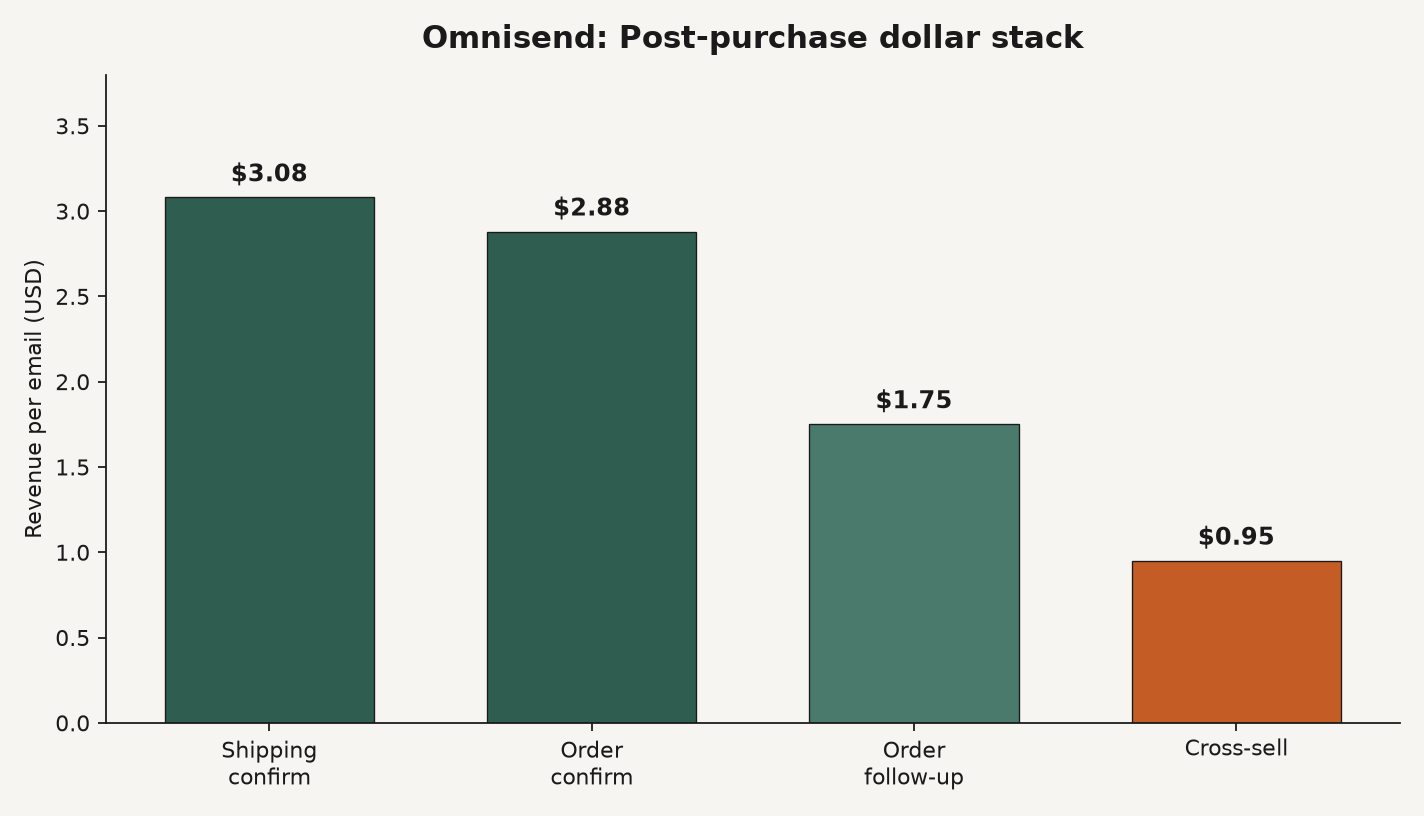
Source: Omnisend Email Marketing Benchmarks (2025 ecommerce automation data). https://www.omnisend.com/blog/email-marketing-benchmarks/
Post-purchase email benchmarks work as a two-layer scorecard. Layer one is Omnisend’s transactional and follow-up automation rows. Layer two is Klaviyo’s post-purchase series RPR and placed-order figures. Match your email to the right cell. Do not average shipping confirmation with cross-sell into one fake “post-purchase open rate.”
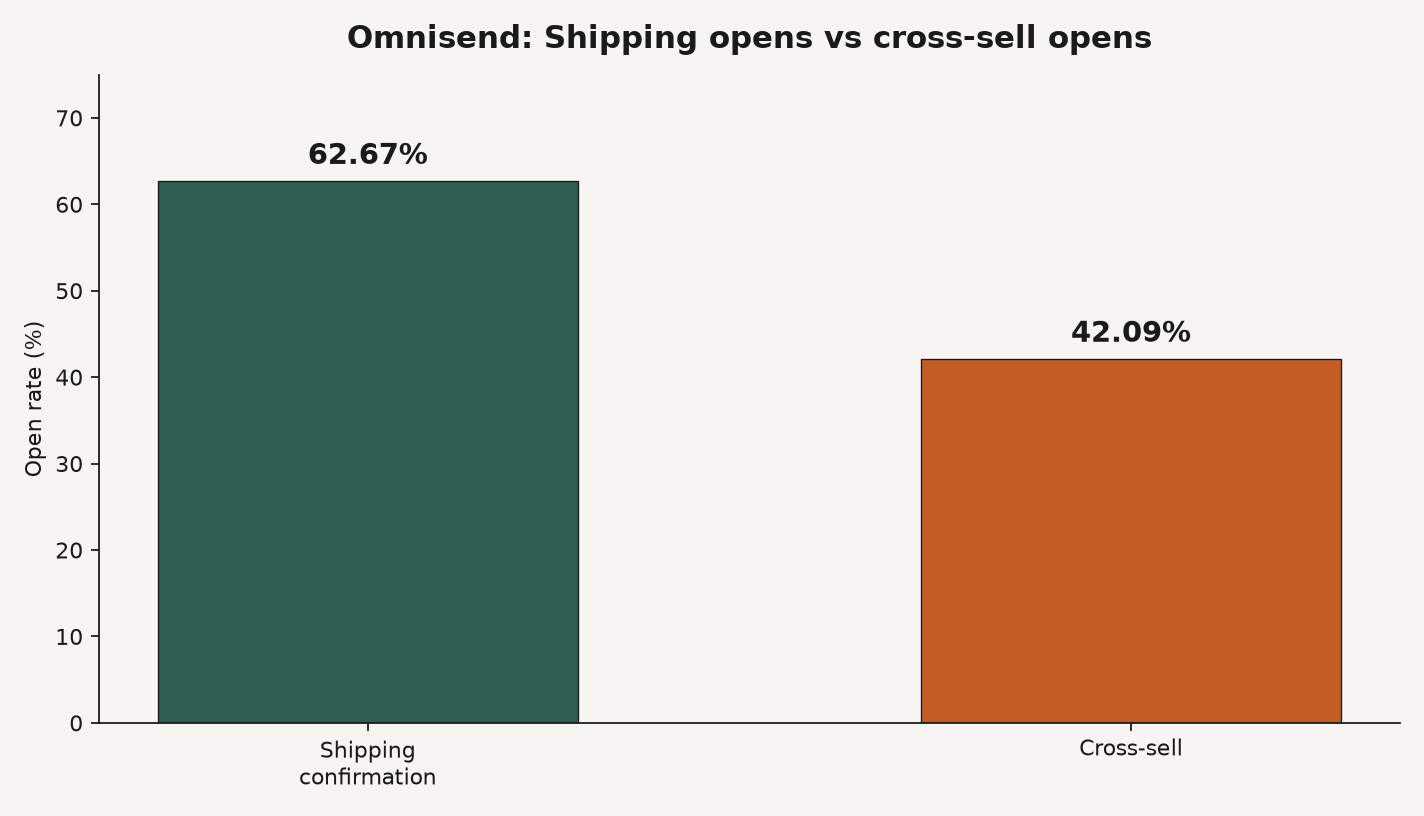
Source: Omnisend Email Marketing Benchmarks (2025). https://www.omnisend.com/blog/email-marketing-benchmarks/
| Automation | Open rate | CTR | Conversion | $ per email | Unsubscribe |
|---|---|---|---|---|---|
| Shipping confirmation | 62.67% | 16.01% | 2.19% | $3.08 | 0.30% |
| Order confirmation | 57.91% | 8.36% | 1.61% | $2.88 | 0.36% |
| Order follow-up | 47.70% | 4.12% | 0.93% | $1.75 | 0.86% |
| Customer feedback | 49.17% | 4.29% | 0.98% | $1.14 | 0.57% |
| Cross-sell | 42.09% | 3.02% | 0.87% | $0.95 | 0.89% |
| Abandoned cart (sibling) | 37.12% | 4.13% | 1.72% | $3.59 | 0.45% |
| Welcome (sibling) | 35.53% | 3.94% | 2.11% | $6.16 | 0.87% |
Source: Omnisend email marketing benchmarks (2025 ecommerce data).
Read top to bottom as intent cooling from “where is my package” to “buy something else.” Shipping and order confirmation still convert and earn. Follow-up and cross-sell earn less per send and unsubscribe more. That is not a creative failure. It is the buyer moving from need-to-know to optional pitch.
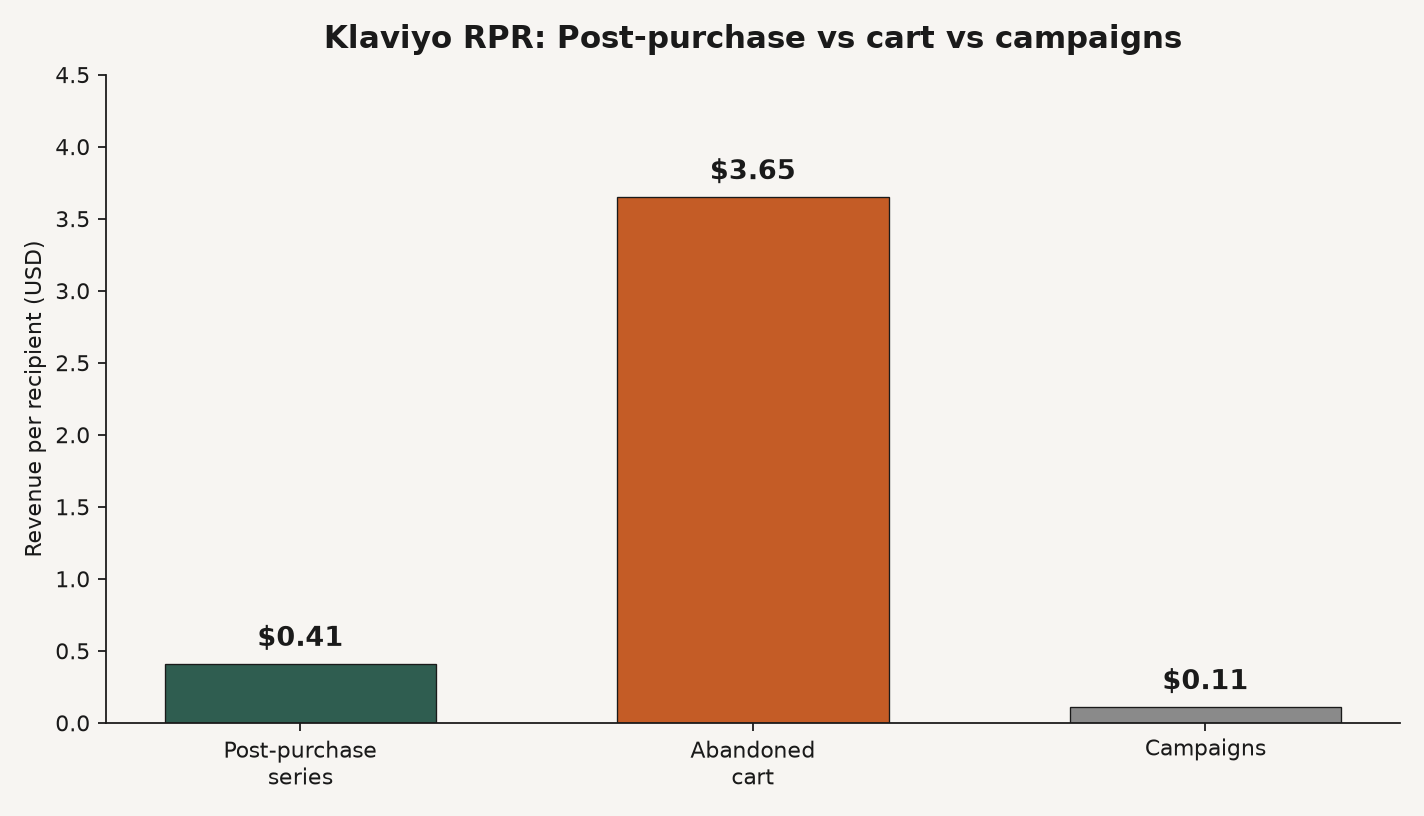
Source: Klaviyo, What is revenue per recipient? (Dec 12, 2024). https://www.klaviyo.com/blog/revenue-per-recipient
| Metric | Post-purchase | Sibling context |
|---|---|---|
| Average RPR | $0.41 | Cart $3.65; welcome $2.65; browse $1.07; all flows $1.94; campaigns $0.11 |
| Top 10% RPR | $5.14 | Cart top $28.89 |
| Placed-order rate | 0.54% | Cart 3.33%; welcome 2.32%; browse 0.95% |
| Open lift vs avg automation | Almost +17% | Klaviyo post-purchase guide (2025) |
Sources: Klaviyo RPR; Klaviyo placed order; Klaviyo post-purchase.
Do not convert Omnisend’s $ per email into Klaviyo’s RPR without a methodology note. One is revenue divided by emails in that automation type. The other is revenue per recipient for the post-purchase series. Both say receipt utility and series nurture are different wallets from cart recovery.
A Klaviyo UK list-management page cites post-purchase averages of 3.88% click, 0.45% conversion, and $0.28 RPR (Klaviyo UK). A Klaviyo strategy page cites 59.77% average flow open and 0.48% placed order for post-purchase (Klaviyo). Keep $0.28, $0.41, 0.48%, and 0.54% in separate cells. Refuse any chart that mashes them into one “industry post-purchase median.”
Public threads describe a practical order: confirmation, shipping, check-in, review after use, then cross-sell or replenishment (r/ShopifyPros). A separate r/Klaviyo operator sample across 16 brands found 77% of second purchases were the same SKU, which pushed those stores toward replenishment timing over early cross-sell (thread). Treat that as a labeled anecdote, not a census. There is no public dataset here that publishes one audited same-SKU reorder rate for every vertical.
There is no public dataset for one official post-purchase open rate that covers every ESP and every mix of transactional and marketing mail. Secondary posts that invent a single 52% post-purchase open without naming definitions stay out of the charts. feat. does not publish a proprietary repeat-purchase study here.
Using post-purchase email benchmarks means splitting receipt utility from next-order nurture before you set targets. Fund shipping and order confirmation for trust. Fund follow-up, review, and replenishment for lifetime value. Judge the series on RPR and placed-order rate, not cart envy.
These answers restate the Omnisend transactional-versus-marketing ladder, the Klaviyo RPR and placed-order figures, and the nurture-versus-cart framing so a founder can quote a labeled number without inventing one fake national post-purchase open-rate average.
Q: What are good post-purchase email benchmarks in 2026? A: Use labeled cells. Omnisend shipping confirmation shows 62.67% open and $3.08 per email; order confirmation $2.88; order follow-up $1.75; cross-sell $0.95. Klaviyo’s post-purchase series averages $0.41 RPR (top 10% $5.14) with placed-order near 0.54%.
Q: What is a good post-purchase email open rate? A: Transactional cells run hottest. Omnisend shipping confirmation sits near 62.67% open and order confirmation near 57.91%. Klaviyo says post-purchase opens are almost 17% higher than average automations. After Apple MPP, prefer CTR, placed-order, and RPR when opens look suspiciously perfect.
Q: How do post-purchase email benchmarks compare to abandoned cart? A: Cart wins next-order economics. Klaviyo cart RPR is $3.65 versus post-purchase $0.41, and cart placed-order is 3.33% versus 0.54%. Omnisend shipping confirmation dollars ($3.08) can sit near cart ($3.59), but that is utility and tracking intent, not the same job as recovery.
Q: Should post-purchase flows focus on cross-sell or replenishment? A: Start with confirmation and shipping. Use cross-sell when accessories are the natural second order. Prefer replenishment timing for consumables. Omnisend cross-sell earns $0.95 per email with 0.89% unsubscribe, so early hard sells are expensive attention taxes.
Q: Why is post-purchase conversion lower than welcome or cart? A: Because the customer already bought. Klaviyo frames post-purchase as nurture and order details, not immediate abandonment recovery. A 0.54% placed-order rate with strong opens can still be a healthy retention engine when RPR and repeat behavior move in the right direction.
Post-purchase email benchmarks are a stack problem before they are a creative problem. Keep Omnisend shipping $3.08 and order confirmation $2.88 separate from cross-sell $0.95, and keep Klaviyo series RPR $0.41 out of the cart scorecard.
Utility first, then the next order. List the product on feat. if affiliates should sell the same catalog your post-purchase flow is trying to reorder.
Preference center best practices: CAN-SPAM menu plus stop-all, Google one-click vs body preference pages, and SendGrid's labeled 20% unsub drop.
Mailchimp vs Klaviyo: contact billing fork, send multipliers (10x/12x/15x), starting prices, and when ecommerce depth beats a general ESP.
Email list growth benchmarks: Omnisend 1.24B popup displays at 2.1%, form-type ladder, and levers that beat the average without inventing MoM %s.