How to Turn Your Audience Into a Distribution Channel
Turn your audience into a distribution channel with a five-rung ladder—attention, trust, offer, sales surface, and economics—not follower vanity.
Substack vs beehiiv vs Kit compared: Substack's 10% paid-sub take, beehiiv's 0% cut plus flat fees, and Kit's commerce-first model for creators.

TL;DR: Substack vs beehiiv vs Kit is three operating systems for the same inbox. Substack trades a 10% paid-subscription platform fee for free publishing and network discovery. beehiiv charges a flat plan with 0% paid-sub cut when the newsletter is the product. Kit fits when email sells courses and products. Re-check vendor pricing before you migrate.
A feature checklist will not tell you which newsletter platform to run. Substack can look “free” until paid subscriptions compound a 10% cut. beehiiv can look expensive until you price the same cut at scale. Kit can look like overkill until your money lives in a course funnel, not a subscribe button.
Substack vs beehiiv vs Kit (Kit formerly ConvertKit) is the three-way after the two-way deep dive on beehiiv vs Kit for newsletter monetization. Pair this page with creator vs brand newsletter monetization, creator platform fee comparison, Paved vs beehiiv ad network, and what is a creator storefront.
Substack vs beehiiv vs Kit is a comparison of three creator email platforms that all send newsletters and collect audiences, but optimize for different primary jobs: network writing with a percentage take (Substack), growing and monetizing the newsletter as a media product (beehiiv), and running email as a commerce and automation channel (Kit).
Substack’s Support fee page is blunt: publishing is free no matter how many subscribers you have, and enabling paid subscriptions adds Substack’s 10% of each transaction plus Stripe processing (Substack Support). beehiiv’s pricing FAQ answers “Does beehiiv take a cut of paid newsletter revenue?” with No, 0%, minus Stripe, and names Substack’s 10% as the contrast (beehiiv). Kit’s pricing page sells low commerce fees (0.6% inside 3.5% + $0.30) and lists Paid Recommendations at 23.5% (Kit).
Reddit operators already sort the three by job: Substack for personal brand and zero setup, beehiiv for the newsletter as the business, ConvertKit/Kit for course creators (r/Emailmarketing). This article turns that slang into a fee-aware decision table.
The three-way matters because fee models compound differently than feature badges. A percentage take scales with success. A flat ESP bill scales with list size. A commerce fee scales with product sales. Pick the wrong curve and you will rebuild automations to save a cut you should have modeled on day one.
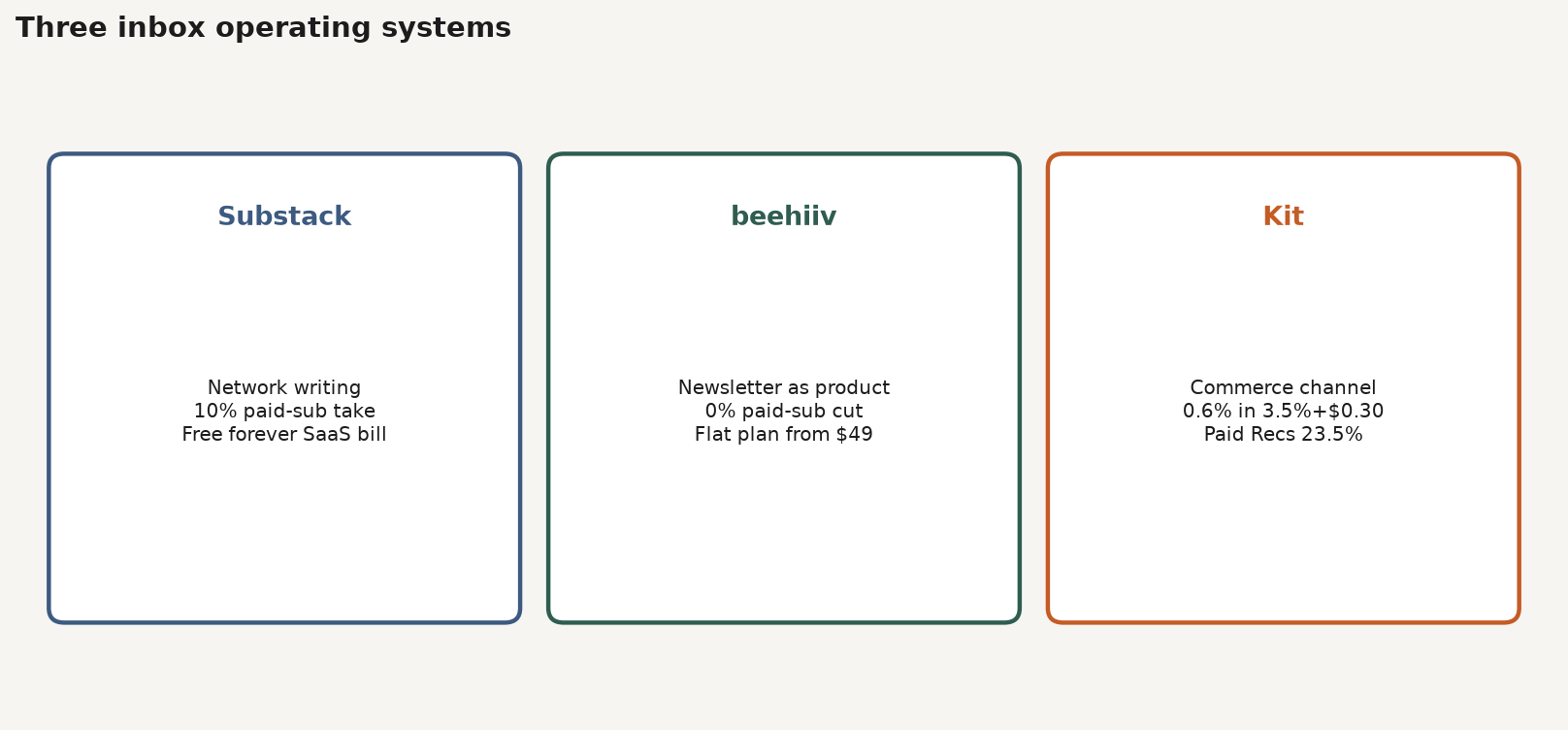
Source: Editorial framework. Fee labels from Substack Support, beehiiv pricing FAQ, and Kit pricing. https://support.substack.com/hc/en-us/articles/360037607131-How-much-does-Substack-cost · https://www.beehiiv.com/pricing · https://kit.com/pricing
They compare as three fee curves plus three jobs. Score primary job fit, free-tier traps, paid-subscription platform take, commerce and recommendation fees, and whether you need Substack’s network, beehiiv’s growth and ads stack, or Kit’s automations. Then run the math on your real paid MRR and list size.
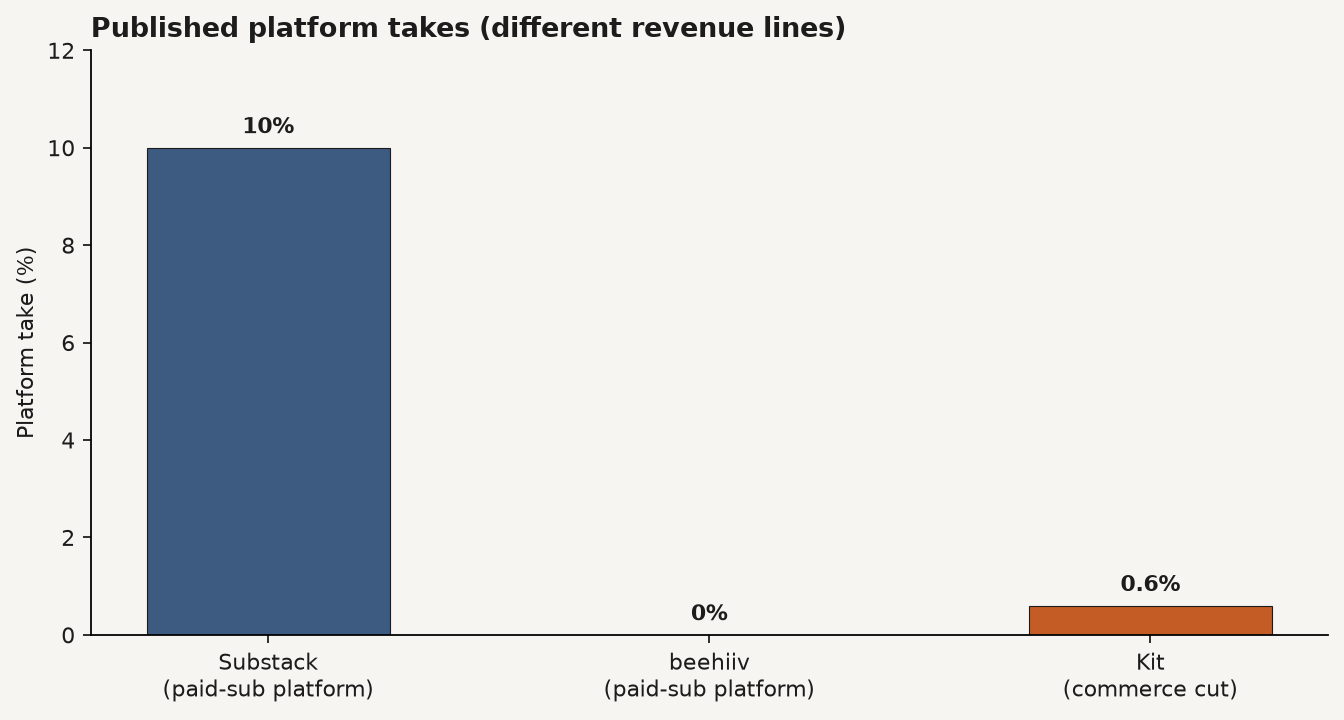
Source: Substack Support 10% platform fee; beehiiv pricing FAQ 0% paid-sub cut; Kit pricing 0.6% of commerce fee bundle. https://support.substack.com/hc/en-us/articles/360037607131-How-much-does-Substack-cost · https://www.beehiiv.com/pricing · https://kit.com/pricing These are not the same revenue line. Stripe/card fees sit on top where noted by each vendor.
| Dimension | Substack | beehiiv | Kit |
|---|---|---|---|
| Primary job | Network writing + paid subs | Newsletter as product (growth / ads / paid subs) | Email as commerce channel |
| Free publishing | Free forever (paid features via %) (Support) | Launch to 2,500 (beehiiv) | Free / Newsletter to 10,000 (see beehiiv vs Kit) |
| Paid-sub platform cut | 10% + Stripe stack (Support) | 0% + Stripe (beehiiv) | Commerce bundle 3.5% + $0.30 (Kit 0.6%) (Kit) |
| Other take rates | App / Apple fees if in-app payments enabled (Support) | Ad Network / recommendations (cluster: Paved vs beehiiv) | Paid Recommendations 23.5% (Kit) |
| Paid plan entry (stated) | $0 platform fee until paid subs | From $49/mo (beehiiv) | Creator from $39/mo at 1,000 subs (Help; see two-way article) |
| Best when | You want zero SaaS bill and network discovery, and accept % of paid | Newsletter media is the business | Products, coaching, and automations are the business |
There is no public dataset for the official MRR where “everyone leaves Substack.” You can still do honest arithmetic with published rates.
Assume paid-subscription monthly revenue (MRR) before processor fees. Substack’s platform line alone is 0.10 × MRR.
| Paid-sub MRR | Substack 10% platform fee | beehiiv paid entry ($49/mo stated) | Kit Creator entry ($39/mo at 1K stated) |
|---|---|---|---|
| $500 | $50 | $49 (plus list-tier if higher) | $39 (plus list-tier if higher) |
| $1,000 | $100 | $49+ | $39+ |
| $5,000 | $500 | Flat plan (list-dependent) | Flat plan (list-dependent) |
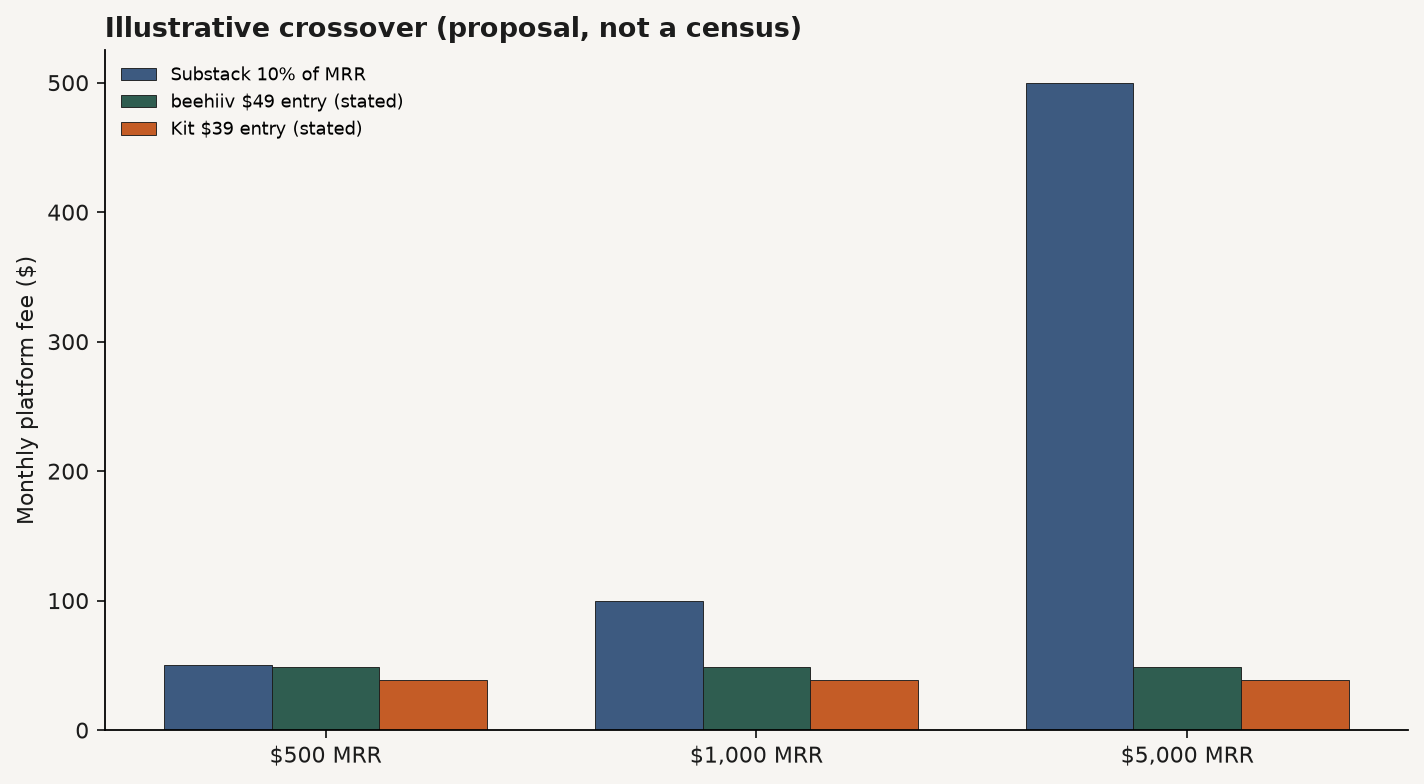
Source: Editorial arithmetic from Substack Support 10%, beehiiv pricing from $49/mo, Kit Creator from $39/mo. Not a migration census. Confirm list-tier pricing on vendor calculators. Stripe/Billing fees excluded for clarity.
Read the table carefully. beehiiv and Kit bills rise with subscriber count even when paid-sub MRR is low. Substack’s platform fee rises with paid revenue even when the list is huge and the SaaS bill is $0. Letterbench’s May 28, 2026 annual Scale vs Creator figures (about $84 vs $113/mo at 10K, about $262 vs $566/mo at 100K, beehiiv affiliate disclosed) are the flat-fee slope check for the two SaaS tools (Letterbench; detail on beehiiv vs Kit).
Exports are rarely the expensive part. Paid-subscriber re-authorization, recommendation networks, and rebuilt automations are. Letterbench’s beehiiv-vs-Kit migration notes still apply when Substack is in the mix: budget rebuild days before you chase a monthly savings number (Letterbench). If you also sell products outside email, map fees on creator platform fee comparison and storefront fit on what is a creator storefront.
Choosing among Substack, beehiiv, and Kit is a worksheet job, not a Twitter poll. Name the primary revenue line, price the fee curve at your real numbers, stress-test free-tier traps, then pick the OS you will still want after the next 12 months of growth.
These answers cover the three-way questions creators ask first: how Substack vs beehiiv vs Kit differ, what Substack’s 10% includes, when flat fees beat the percentage, whether Kit still wins for products, and whether you should run two platforms together.
Q: What is the main difference in Substack vs beehiiv vs Kit? A: Substack is free to publish and takes about 10% of paid subscription transactions plus Stripe fees. beehiiv charges a flat plan with a 0% paid-subscription platform cut. Kit optimizes for selling products and automations, with a small commerce fee inside a 3.5% + $0.30 bundle and a 23.5% Paid Recommendations fee.
Q: How much does Substack take from paid subscriptions? A: Substack’s Support fee page states a 10% platform fee on each paid subscription transaction, plus Stripe’s card fee (2.9% + $0.30) and a Billing fee for recurring payments (0.7% as of July 2024 on that page, with a legacy note for older creators).
Q: When do beehiiv or Kit beat Substack on cost? A: When 10% of your paid-subscription revenue exceeds the flat monthly plan you would pay on beehiiv or Kit at your list size. That crossover depends on your MRR and subscriber tier. There is no official public median switch point.
Q: Should course creators pick Kit over Substack or beehiiv? A: Often yes when most revenue is digital products, coaching, and multi-step automations. If most revenue is newsletter ads and paid subscriptions, beehiiv usually fits better. If you want network discovery and accept a percentage take, Substack can still win early.
Q: Can I use Substack for writing and Kit or beehiiv for marketing? A: Some operators split tools, but two primary stacks double migration and support cost. Pick one operating system for the majority revenue line, then integrate the minority. Re-read beehiiv vs Kit when the finalists are only those two.
Substack vs beehiiv vs Kit is a fee-curve and job-fit choice, not a template war. Price Substack’s 10% against beehiiv’s 0% plus flat plan and Kit’s commerce-first fees, then pick the OS that matches how you actually get paid. If you want creators selling a product you built under clear economics, list it on feat..
Turn your audience into a distribution channel with a five-rung ladder—attention, trust, offer, sales surface, and economics—not follower vanity.
Affiliate marketing for small creators works on trust density: one problem, one offer class, one surface, EPC math (median ~$0.14), FTC disclosure—not a follower floor.
How to create a storefront as a creator: name the job (route, sell-own, sell-others), pick Linktree, Stan, Beacons, or a co-branded page, then ship one hero offer.