How to Turn Your Audience Into a Distribution Channel
Turn your audience into a distribution channel with a five-rung ladder—attention, trust, offer, sales surface, and economics—not follower vanity.
Digital products vs sponsorships: Circle 2026 vs IMH 2025 show different creator samples. Pick by ownership, margin, and cash timing, not follower vanity.

TL;DR: Digital product vs sponsorship revenue is a sample-and-job choice. Circle’s 2026 community builders adopt digital products (37%) far more than sponsorships (18%). Influencer Marketing Hub’s 2025 survey still shows brand deals as the majority share for over 49% of creators, while over 64% prefer that path. Pick by ownership, margin, and cash timing.
Creators keep asking which pays more: a digital product or a sponsorship. The internet answers with one chart and one personality. That is how you get wrong advice.
Digital product vs sponsorship revenue only makes sense when you name the sample. Community builders who already sell memberships look nothing like creators whose media kits still live on brand-deal rates. One survey can show sponsorships as peripheral. Another can show brand deals as the majority share people still earn and still want.
Key takeaways:
Digital product vs sponsorship revenue is the comparison between money you earn by selling an owned offer (templates, courses, downloads, prompt packs, and similar SKUs) and money a brand pays you to endorse or feature its offer in your content.
It is not the same as platform ad revenue (YouTube, TikTok Creativity, and similar shares). It is not the same as affiliate commission, where you take a cut of tracked sales of someone else’s SKU. Those lanes matter. They are not this head-to-head.
A digital product is an asset you can price, update, and resell without a new brand contract for every buyer. A sponsorship is a campaign payment (flat, hybrid, or usage-based) that buys attention, endorsement, and usually a delivery window. One compounds when the offer is good. The other clears when the brand’s budget clears.
If you confuse “I posted a brand deal” with “I own a product business,” your P&L will teach you the difference.
Wrong priority burns months. You either grind media-kit outreach while a $49 template would have paid the rent, or you disappear into course production while a clean brand retainer would have funded the build.
Why the ledger matters:
There is no honest single winner for every niche. There is an honest way to choose.
Sponsorships buy a window of attention with cash that lands when the contract pays. Digital products sell an owned SKU that can keep earning after the post ends. Affiliate and co-selling sit between them: you promote without owning inventory, and you get paid when a tracked sale clears. Run the comparison on ownership, margin, cash timing, and how hard the offer depends on follower count.
Treat these as different populations, not as one blended “creator average.”
| Signal | Circle 2026 community builders | IMH / NeoReach 2025 creators |
|---|---|---|
| Sample | 750+ community builders; product overlay from 18,000+ Circle communities | 3,000+ creators; 1.1B+ combined followers |
| Memberships / subscriptions | 88% monetize with paid memberships | Not the same stack question in the earn-most cut |
| Digital products | 37% sell digital products | Shift noted toward self-owned businesses; not the same % question |
| Sponsorships / brand deals | 18% earn from sponsorships | Over 49% earn most revenue from brand deals (−10 pts YoY) |
| Preference | Owned/recurring stack is the reported foundation | Over 64% prefer brand deals as majority income |
| How to read it | Community-led operators already sell owned access; sponsorship is supplemental | Influencer-shaped sample still centers brand deals as majority share and aspiration |
Sources: Circle creator economy statistics; IMH Creator Earnings Report 2025; NeoReach report hub.
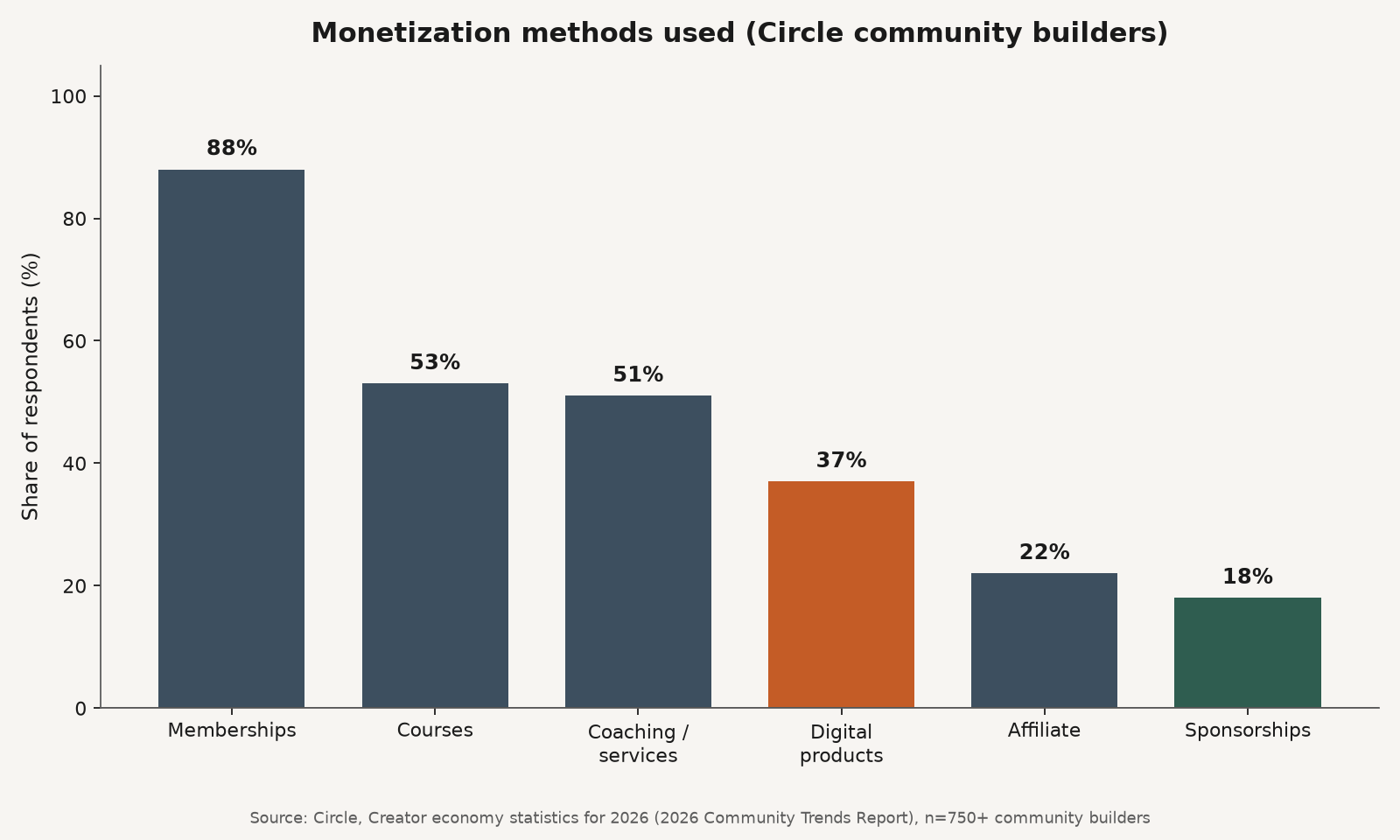
Source: Circle, Creator economy statistics for 2026 (citing 2026 Community Trends Report), published 2026-01-31. https://circle.so/blog/creator-economy-statistics
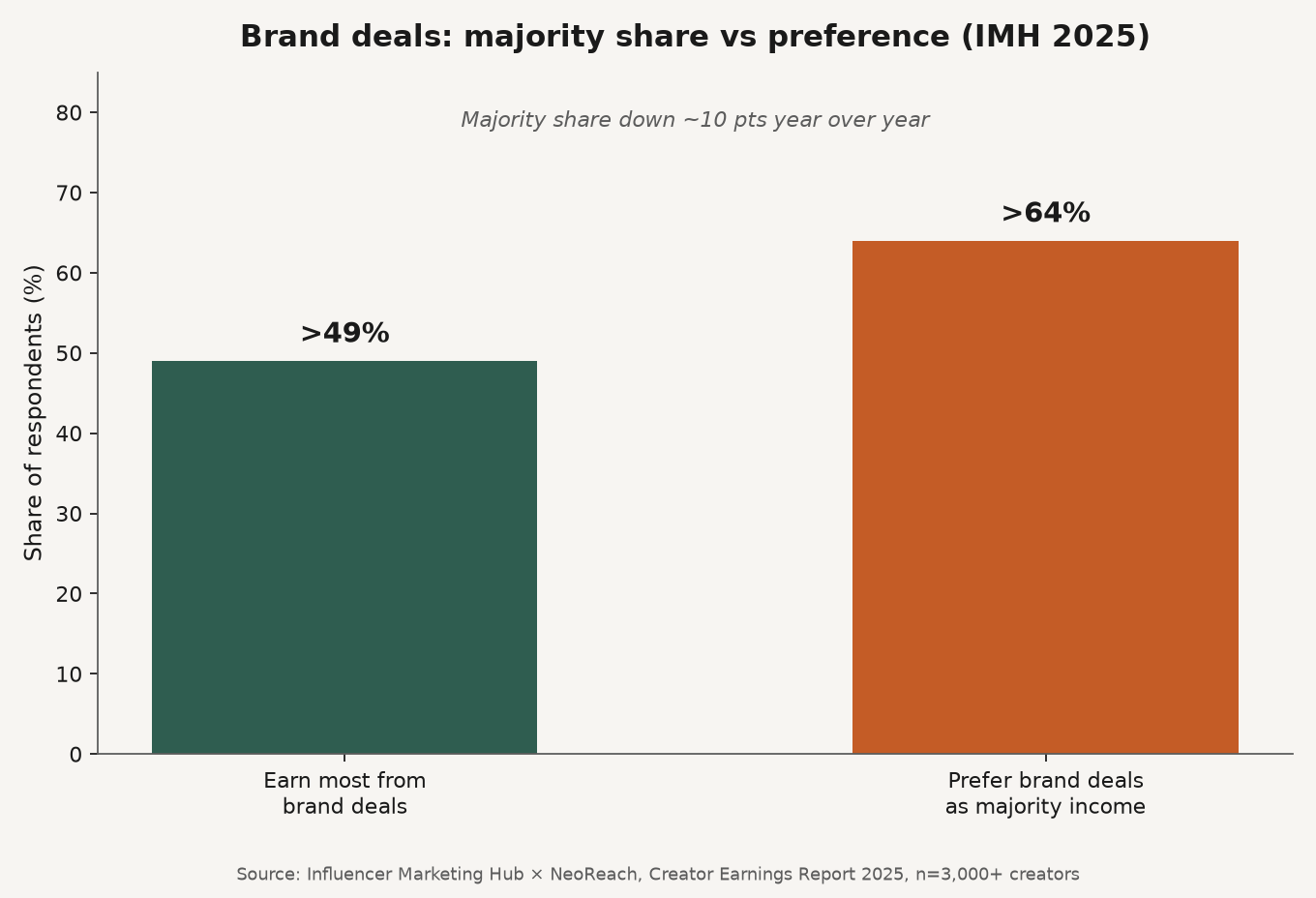
Source: Influencer Marketing Hub × NeoReach, Creator Earnings Report 2025. https://influencermarketinghub.com/creator-earnings-report-2025/
Sponsorship / brand deal. The brand buys creative, audience access, and usually usage rights for a period. Cash is front-loaded relative to a product that still needs buyers. Risk sits with the brand’s budget cycle and your deliverables. Measurement for the brand is a separate problem (see how brands calculate influencer marketing ROI). For you, the risk is concentration: when the deal ends, the line item ends unless you renew.
Owned digital product. You sell a SKU (or a small catalog) to people who already trust your framing of a problem. Cash arrives per sale after checkout fees and refunds. Risk sits with product quality, positioning, and distribution you control. Upside is reuse: the fifth sale does not need a fifth brand negotiation.
Membership / course stack (related, not identical). Circle’s ordering puts memberships (88%) and courses (53%) above one-off digital products (37%) among community builders (Circle). If your “product” is really recurring access, compare against sponsorships with retention math, not only launch-week GMV.
Affiliate / co-selling. You do not own the SKU. You own the relationship and the tracked click. Economics follow commission structures and, for digital vs physical offers, the margin stack on affiliate products. This is often the bridge when you want product-shaped income without building the whole catalog yet.
| If your constraint is… | Lean sponsorship when… | Lean digital product when… | Mix / bridge when… |
|---|---|---|---|
| Cash this month | A signed deal clears faster than building and selling a SKU | You already have a shippable offer and a list or community that buys | Take the deal and earmark a fixed % of fee to product build |
| Ownership | You accept rented demand for a known fee | You want an asset that survives a platform or brand cycle | License or affiliate first, own later |
| Margin after work | Flat fee covers production hours with buffer | Unit economics beat fee after refunds and support | Hybrid: fee + affiliate on the same brand |
| Follower dependency | Brands still pay for your reach tier | Your offer converts a small, dense audience | Sell product to the engaged core; use sponsorships for discovery |
| Proof you can sell | Media kit and past CPMs are your proof | Sales, refund rate, and repeat buyers are your proof | Use one successful affiliate SKU as proof before building your own |
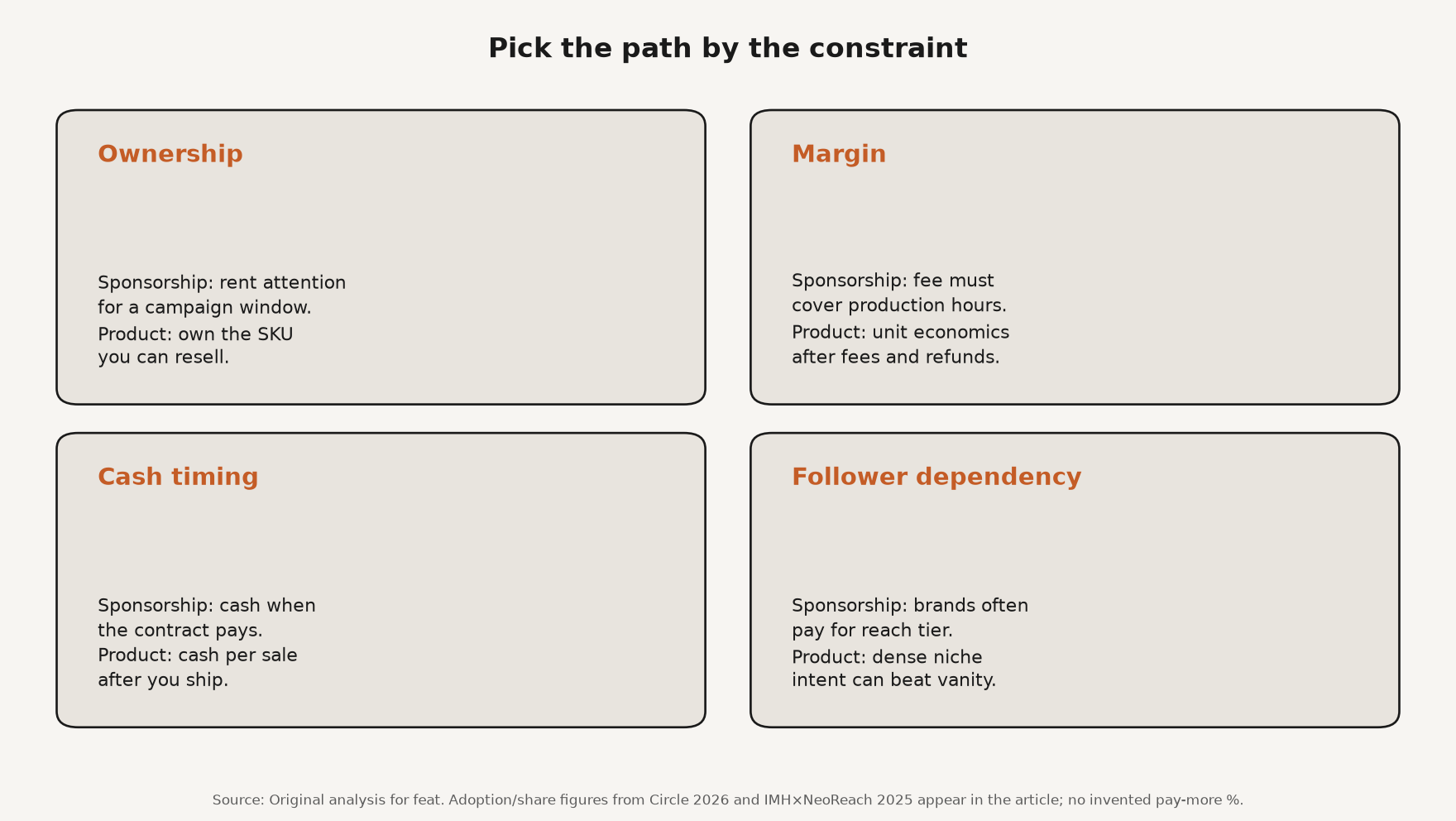
Source: Original analysis for feat. (decision framework). Adoption and majority-share figures cited in the article come from Circle (2026) and Influencer Marketing Hub × NeoReach (2025); this diagram does not invent a universal pay-more percentage.
On a widely discussed r/youtubers thread about agency-secured sponsorship volume, operators pushed back that selling your own products and services to your own audience often beats chasing open sponsor slots on pure ROI, even when brand work still has a place (r/youtubers). Treat that as demand language and operator opinion, not as a survey. It matches the Circle adoption pattern more than the IMH preference pattern.
Assumptions for a thought experiment, not a survey result:
What the exercise shows: at small scale, product revenue can clear a weak sponsorship quote if conversion exists. What it does not show: that every niche converts at 2%, or that a mid-tier creator should refuse a $15,000 brand package to babysit a $19 pack. Run your own numbers. Refuse fake certainty.
If you choose products, the bio link and checkout stack matter. A route-only link hub is a different job from a storefront that sells (Linktree vs storefront platforms). Fee shape (percentage vs flat vs Merchant of Record) changes take-home at the same GMV (creator platform fee comparison). None of that replaces the sponsorship-vs-product choice. It prices the product path after you pick it.
Q: Which makes more money, digital products or sponsorships? A: It depends on the sample and your constraints. Circle’s 2026 community builders adopt digital products (37%) more than sponsorships (18%), while IMH’s 2025 creators still report brand deals as the majority share for over 49%. There is no public universal pay-more table that settles every niche.
Q: Why do creators still prefer brand deals if owned products compound? A: In the IMH 2025 report, over 64% want brand deals as their majority income even as that majority share fell about 10 points year over year. Preference tracks familiarity, media-kit culture, and cash timing, not only long-run margin.
Q: Can a small audience sell digital products without sponsorships? A: Yes, if the offer solves a paid problem for a dense niche. Circle’s data even shows many communities staying small (44% with 1 to 100 members in their write-up) while prioritizing retention and recurring value (Circle). Small is not a blocker. Vague positioning is.
Q: How should I mix sponsorships and digital products? A: Use sponsorships for cash and discovery when the fee clears with margin. Use products for ownership and repeatable margin. Cap concentration so one brand cannot zero your quarter, and fund product build from a fixed slice of deal income when you are early.
Q: Is affiliate marketing the same as a digital product business? A: No. Affiliate pays you a commission on someone else’s SKU with tracked attribution. A digital product business owns the offer. Many creators use affiliate as a bridge before or beside owned products. See affiliate vs influencer marketing for the risk split.
Digital product vs sponsorship revenue is not a morality play about “real” creators. It is a ledger problem with two loud samples. Community builders in Circle’s 2026 work already live in owned memberships and products, with sponsorships at 18%. Creators in IMH’s 2025 work still often earn most from brand deals and still prefer that path, even as the majority-share number slipped. Choose for ownership, margin, and cash timing. Then mix on purpose.
If you want a storefront where you sell products people already trust (including offers from merchants, not only your own SKUs), browse the feat. marketplace.
Turn your audience into a distribution channel with a five-rung ladder—attention, trust, offer, sales surface, and economics—not follower vanity.
Affiliate marketing for small creators works on trust density: one problem, one offer class, one surface, EPC math (median ~$0.14), FTC disclosure—not a follower floor.
How to create a storefront as a creator: name the job (route, sell-own, sell-others), pick Linktree, Stan, Beacons, or a co-branded page, then ship one hero offer.