Affiliate Marketing for Startups: Complete Guide
Affiliate marketing for startups is an operating system—locks, cost, recruit, rates, tracking, first 100 sales, then diagnose a flat roster.
Find affiliates who actually sell with a sale-first filter: open signup, network vetting, or approve-then-storefront. Rewardful: 1.28% sell; PartnerStack 43% vs 3%.

TL;DR: How to find affiliates who actually sell is a filter problem, not a sourcing problem. Open signup buys joiners. PartnerStack-style network gates buy a 43% vs 3% commission-earner split. An approve-then-storefront flow buys a named page before the first pitch. Rewardful’s SaaS sample (n=2,847) finds only 1.28% of affiliates generate a sale. Score that meter, not headcount.
Merchants keep asking how to find affiliates who actually sell, then ship a public signup form and celebrate the join count. That is how you buy a graveyard. Rewardful’s analysis of 2,847 SaaS programs finds 7.6% of affiliates generate a referral and 1.28% generate a sale (Rewardful). PartnerStack’s Network chart puts earners at 43% of Network-approved partners versus 3% outside (PartnerStack). Those two numbers are the whole argument.
How to recruit affiliates already owns where to look (the Warm-to-Cold Ladder). Why the program stays flat owns the diagnosis after you already over-recruited. This page owns the intake filter: which signup shape produces sellers.
Key takeaways:
Finding affiliates who actually sell means selecting partners who will produce an attributed sale, then giving them a surface that can convert, rather than maximizing applications.
“Actually sell” is not “posted once” and not “clicked apply.” Rewardful’s funnel is three gates: referral (7.6%), sale (1.28%), and sale among referrers (16.8%) (Rewardful). A partner who never refers cannot sell. A partner who refers junk traffic can still fail the third gate. Your CRM should store all three, the same way the flat-program scorecard already tells you to.
Quality is not follower count. Reddit operators say the quiet part: “Don’t optimize for a number of affiliates, optimize for a handful of quality partners” (r/Affiliatemarketing). Directories “mostly attract coupon and incentive sites looking for any program, not partners who’ll actually move volume” (r/Affiliatemarketing). That is Mode 2 language, not a census. The census is Rewardful and PartnerStack.
feat. is the third intake: merchants approve a pitch, then feat. forks a co-branded storefront. Marketplace listing is optional. feat. does not find the affiliates. If you wanted a 90,000-partner cloud, that is Impact’s job. If you wanted a B2B partner marketplace with Network gates, that is PartnerStack’s job. If you wanted a named page on an existing offer, that is feat.
The affiliate channel is large enough that a sloppy filter is expensive. PMA’s 2025 study put 2024 U.S. affiliate-driven e-commerce at $113B, 9.4% of the market (PMA). Most of that money did not come from unvetted footer signups.
Why the filter beats another recruit wave:
Vendor blogs will quote 5–10× revenue from customers versus marketplace recruits, or a 95/5 rule. Those figures are not a public census. Do not chart them.
The Sale-First Filter Stack is three intake shapes you pick before you publish a join URL: open signup, network filters, and approve-then-storefront. Open signup optimizes for applications. Network filters optimize for a vetted marketplace. Approve-then-storefront optimizes for a named sell page. You can run a hybrid. You cannot pretend they are the same funnel.
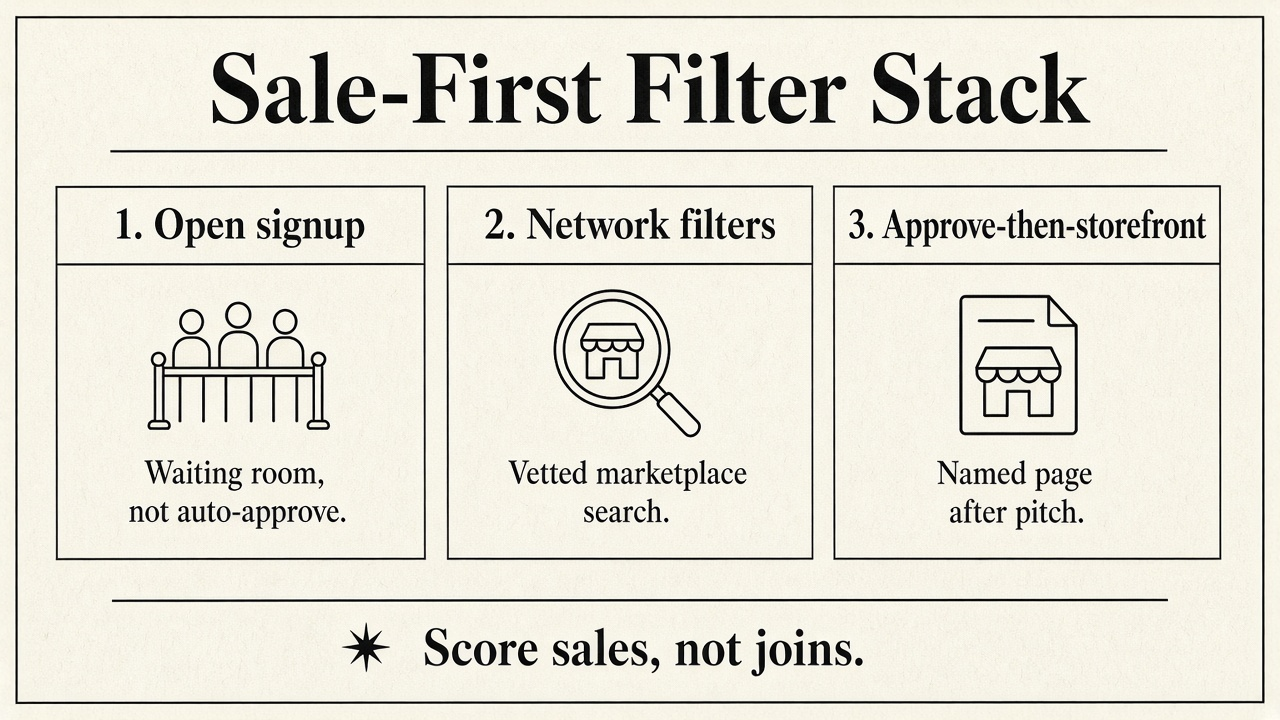
Source: Editorial framework synthesized from Rewardful activation, PartnerStack Network charts, Hubfluence open-invite language, and feat. approve-then-storefront mechanics. Taxonomy diagram, no invented conversion rates.
Open signup is a public form, auto-approve, unique link. It is the default in Rewardful, FirstPromoter, Tapfiliate, and most Shopify apps. It is also how you print Rewardful’s 1.28% world. Use it only as a waiting room: collect applications, then manually promote the ones with a named distribution surface.
Illustrative planning math from Rewardful’s rates, not a promise for your niche:
| Roster you approve | Expect referring (≥1 referral) | Expect selling (≥1 sale) |
|---|---|---|
| 50 | ~4 (7.6%) | ~1 (1.28%) |
| 100 | ~8 | ~1 |
| 1,000 | ~76 | ~13 |
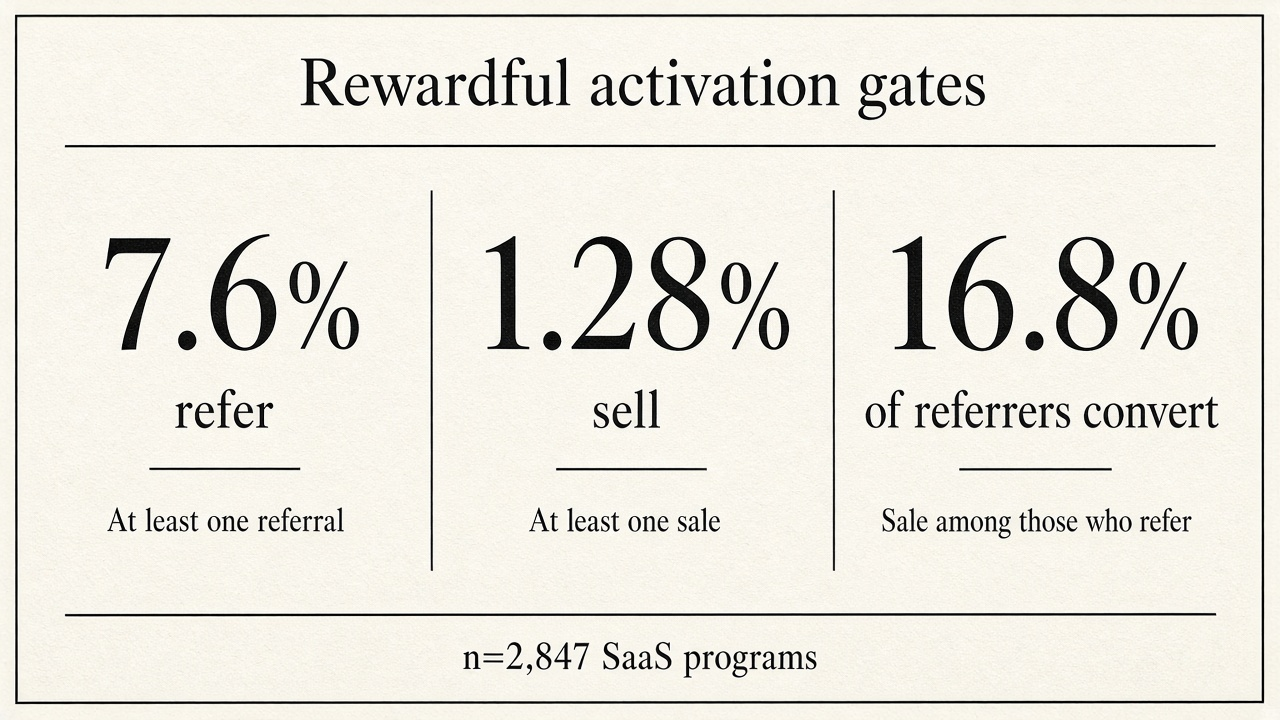
Source: Rewardful, State of SaaS Affiliate Programs (n=2,847). Planning math applies 7.6% and 1.28% to roster sizes. https://www.rewardful.com/articles/state-of-saas-affiliate-programs-report
If you already opened the floodgates, stop recruiting and run the flat-program three-meter export. Finding sellers starts with pruning.
Network filters are PartnerStack, Impact, CJ, Awin: a catalog of partners you can search, plus an application that is not “anyone with an email.” PartnerStack’s published split is the citable quality claim: 43% of Network-approved partners earn a commission vs 3% non-Network (PartnerStack). That is still not “they will sell your product.” It is “they have sold someone’s product on this rails.”
Use this shape when you need B2B partner ops, agencies, and a discovery marketplace. PartnerStack still wins that job. Impact still wins enterprise partnership cloud, fraud tooling, and a large publisher roster. feat. is not a replacement for those clouds. See PartnerStack vs Impact for B2B affiliates.
Approve-then-storefront is feat.’s default. The affiliate pitches. You approve. feat. forks a co-branded storefront on your locked offer. Attribution sits on that URL. The split settles in the charge. You still disclose the material connection (FTC Endorsement Guides).
This shape does not recruit. Founders on r/SaaS say the first affiliates “are existing customers who were already recommending you for free” and that “a large share of affiliates never send a single click” until you remove the work: a link that already exists and a message they can paste (r/SaaS). A storefront is that pasteable surface. A dashboard login is not.
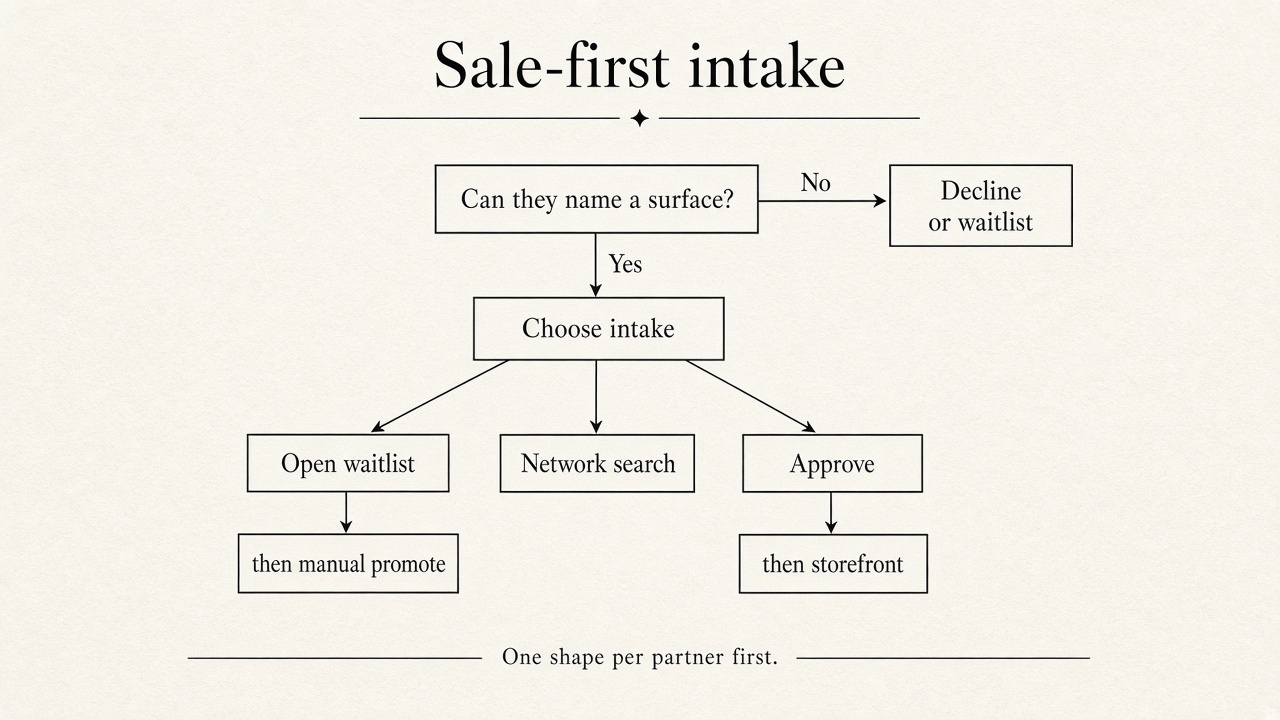
Source: Editorial decision flow from Rewardful activation constraints, PartnerStack Network gating, and feat. pitch-approve-storefront path. https://www.rewardful.com/articles/state-of-saas-affiliate-programs-report
| Intake | What you optimize | Published quality signal | When it wins | When it loses |
|---|---|---|---|---|
| Open signup (Rewardful, Tapfiliate, Shopify apps) | Application volume | Rewardful 1.28% sell / 7.6% refer | Waiting room + manual promote | Auto-approve the internet |
| Network filters (PartnerStack, Impact, CJ, Awin) | Searchable vetted roster | PartnerStack 43% vs 3% earners; 2.25× after 2023 gating | B2B partners, agencies, publisher discovery | You only have ten named promoters |
| Approve-then-storefront (feat.) | Named sell page on your SKU | Product path: pitch → approve → fork | Existing offer, named people, co-branded checkout | You need enterprise partner ops or a catalog network |
Commission still sits inside Shopify’s bands: physical 5%–15%, digital 20%–50%, subscriptions 15%–30% recurring (Shopify). Rate is not the filter. The filter is who gets a link, a network seat, or a storefront.
These six steps install a sale-first filter. Each step is at most two sentences.
There is no public dataset for time-to-first-sale after a storefront fork across verticals. Promise a page in minutes after approval. Do not promise a seller.
Q: How do you find affiliates who actually sell instead of affiliates who only join? A: Filter intake before you scale outreach. Require a named distribution surface, score sale activation not join count, and pick an open waitlist, a network gate, or an approve-then-storefront flow. Rewardful finds only 1.28% of SaaS affiliates generate a sale.
Q: Is open signup a bad way to recruit affiliates? A: Open signup is a waiting room, not a sales channel. Auto-approve recreates Rewardful’s 1.28% sale-activation world and Hubfluence’s joiner problem. Collect applications, then promote the ones who can name where they will sell.
Q: How do PartnerStack-style network filters differ from a storefront approve flow? A: Network filters search a vetted partner marketplace; PartnerStack publishes 43% vs 3% commission earners for Network vs non-Network. A storefront approve flow (feat.) does not recruit; it forks a co-branded page after you approve a named person on your existing offer.
Q: What sale-activation rate should I expect? A: Rewardful’s SaaS sample (n=2,847) puts sale activation at 1.28%, referral activation at 7.6%, and sale-among-referrers at 16.8%. Your cohort export beats any blog default. There is no public census that customer-affiliates convert at 5–10× marketplace recruits.
Q: Do more affiliates always mean more sales? A: No. Rewardful finds 56% of programs stay under 50 affiliates and only 15.6% survive long-term. Adding 1,000 unfiltered joins expects about 13 sellers. Quality filters and a sell surface beat roster theater.
How to find affiliates who actually sell is a Sale-First Filter Stack, not another directory blast. Open signup buys joiners at Rewardful’s 1.28% sale rate. Network gates buy PartnerStack’s 43% vs 3% earner split when you need a B2B marketplace. Named people who should sell your existing offer get a co-branded storefront after you approve them. List that offer on feat. if you already know who should get the page.
Affiliate marketing for startups is an operating system—locks, cost, recruit, rates, tracking, first 100 sales, then diagnose a flat roster.
How to track affiliate sales: pick link cookie, coupon, pixel, S2S postback, or storefront checkout—then match Rewardful, Tapfiliate, or Impact.
Best affiliate programs for SaaS companies pass the Recurring Cap Test: labeled duration, cookie, seat type, payout rails—plus Rewardful’s ~24% planning band.