Affiliate Marketing for Startups: Complete Guide
Affiliate marketing for startups is an operating system—locks, cost, recruit, rates, tracking, first 100 sales, then diagnose a flat roster.
How to recruit affiliates for your product: Warm-to-Cold Ladder, Rewardful 1.28% sale activation, PartnerStack 43% vs 3%, manual vet before volume.

TL;DR: How to recruit affiliates for your product means climbing a Warm-to-Cold Ladder, not blasting directories. Start with buyers and creators who already monetize your category, vet by hand, and enable a first promotion. Rewardful finds only 1.28% of affiliates generate a sale. PartnerStack Network partners earn at 43% vs 3% outside the Network.
Most merchants recruit the wrong way. They publish a footer link, buy a directory slot, and celebrate applications while attributed sales stay flat. That is headcount theater. Partners who never promote your product are not distribution. They are support tickets.
How to recruit affiliates for your product is a sourcing order problem: who you invite first, what you put in the pitch, and what you measure after they join. SaaS bucket depth lives on how to recruit affiliates for SaaS. Flat-roster diagnosis lives on why is our affiliate program flat even though we keep adding creators. Go-live locks live on how to start an affiliate program for your business. This page owns the general-product recruit ladder.
Recruiting affiliates for your product means inviting third-party promoters who already reach your buyers, approving the fit ones, and getting them to a first tracked promotion, instead of waiting for strangers to discover a signup page and never sell.
It is sales for partnerships on an existing offer. Referral rewards friends of buyers. Affiliate recruitment targets people who treat promotion as a job. Keep the fork on affiliate vs referral marketing. If the end state is a named person selling through a co-branded storefront rather than a cookie alone, pair this ladder with how to turn anyone into a seller.
It is also not the same job as setting the percentage. Pitch with a published band and a dollar example. Shopify still frames subscriptions near 15%-30% recurring (Shopify). Rate depth for SaaS lives on SaaS affiliate commission rates. Do not cold-email creators with a made-up number.
Recruit order matters because most enrollments never earn, and cold volume multiplies dormancy faster than warm invites. You do not need a thousand partners. You need a short list that already talks to your buyer and a process that forces a first promotion.
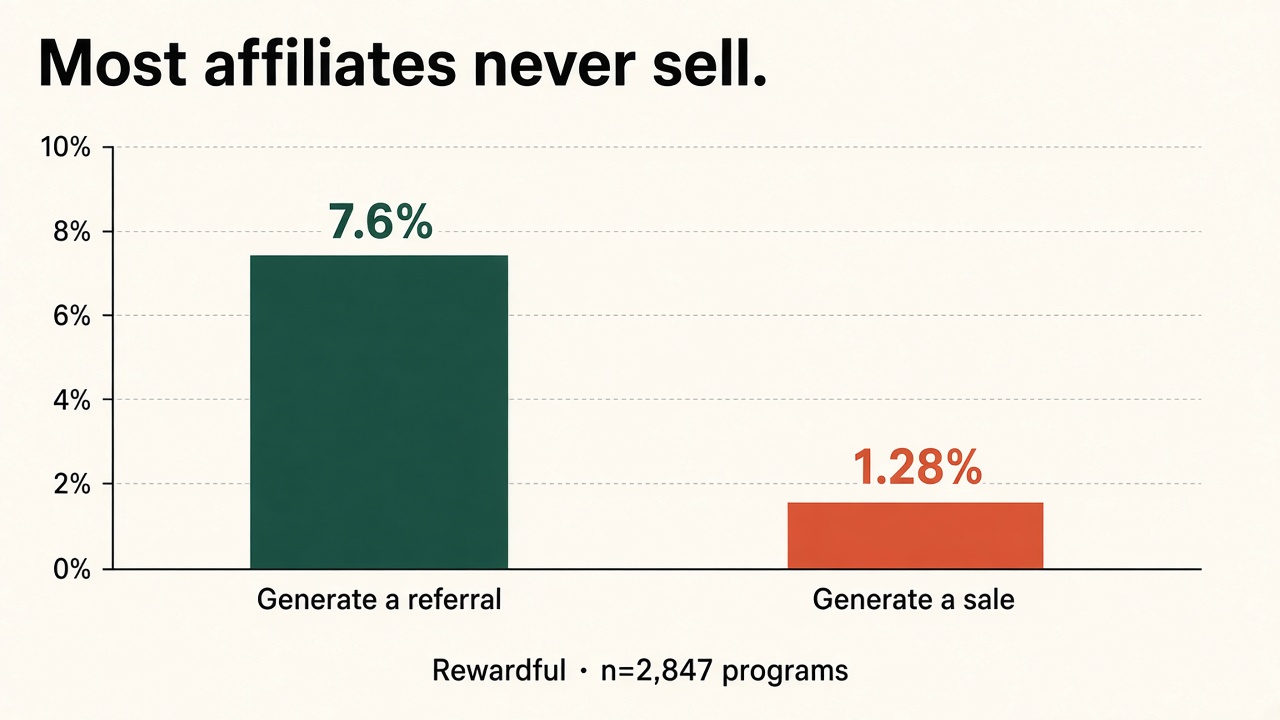
Source: Rewardful State of SaaS Affiliate Programs Report (updated July 21, 2026), analysis of 2,847 SaaS affiliate programs. https://www.rewardful.com/articles/state-of-saas-affiliate-programs-report
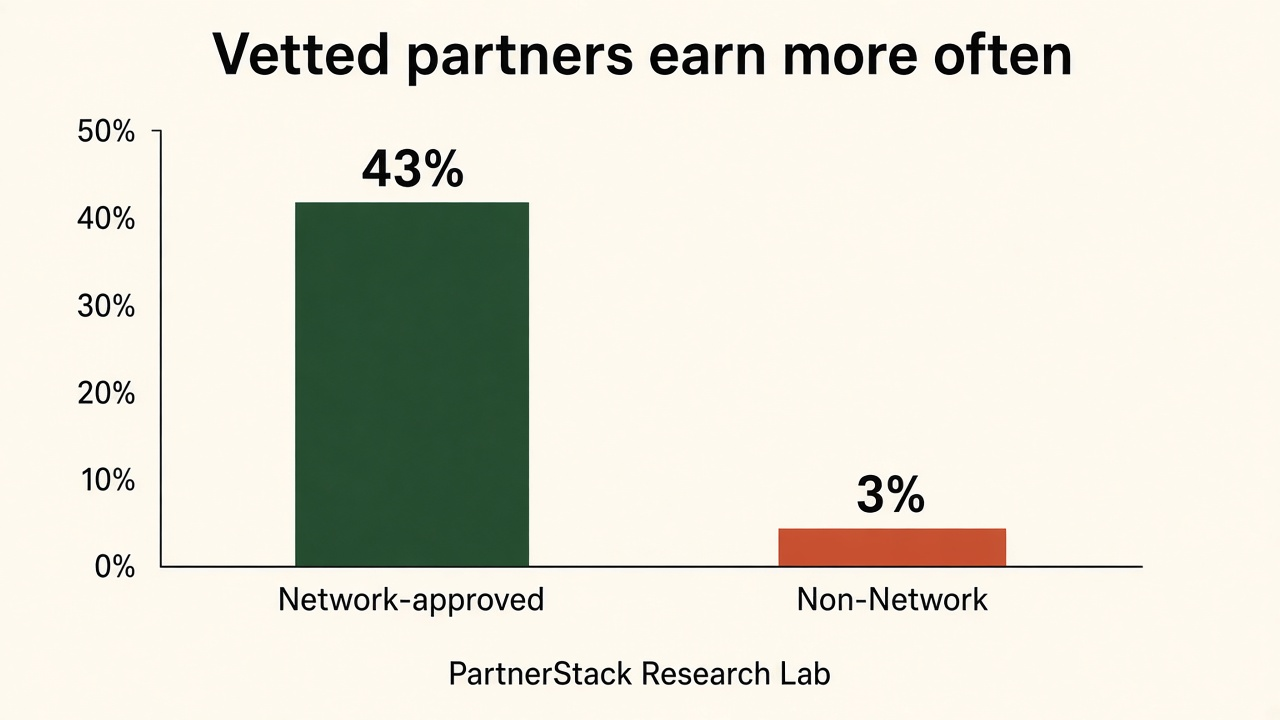
Source: PartnerStack Research Lab chart on Network-approved partners earning commissions vs non-Network partners. https://partnerstack.com/resources/research-lab/charts/partnerstack-network-approved-partners-are-far-more-likely-to-earn-a-commission-compared-to-non-network-partners
How to recruit affiliates for your product works as a Warm-to-Cold Ladder. Invite the warmest sources first. Pitch economics in one screen. Vet for audience fit. Ship three assets and one first-promotion ask. Score joined, referred, and sold. Skip the ladder and you will buy volume that never promotes.
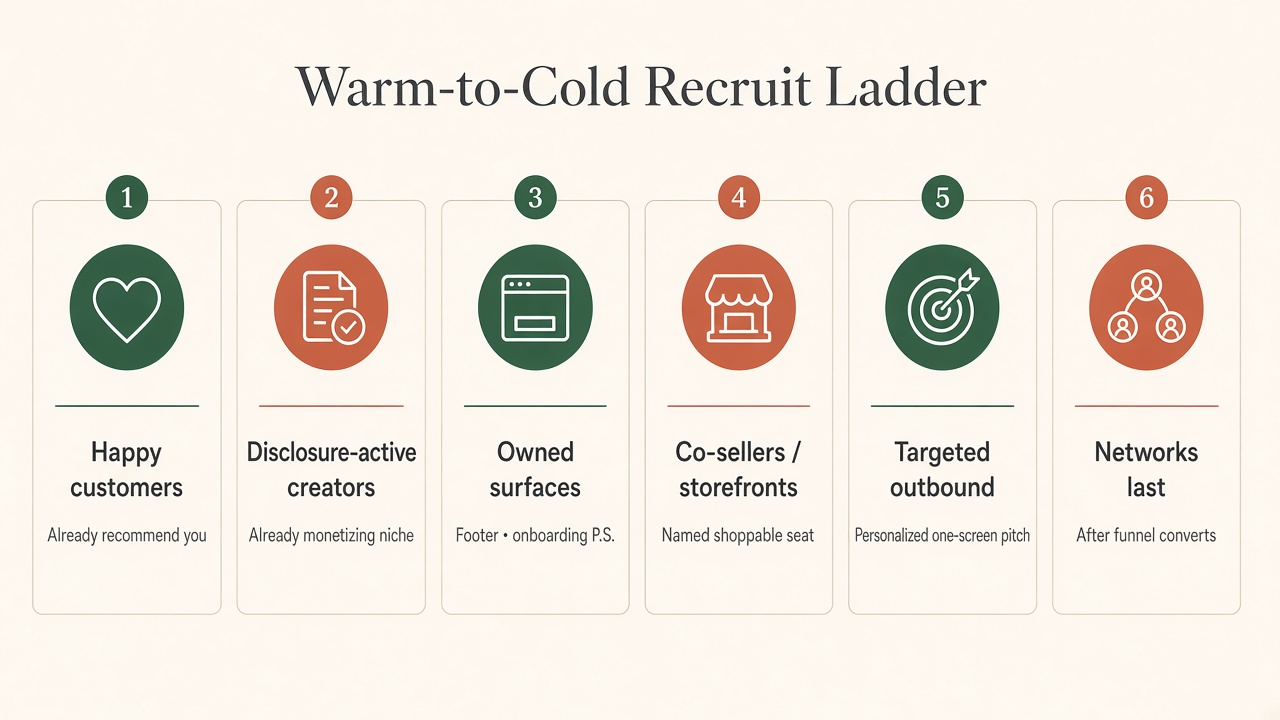
Source: Editorial Warm-to-Cold Recruit Ladder for product affiliate recruitment; activation constraints from Rewardful (n=2,847, updated July 21, 2026) and quality filter from PartnerStack Network chart. https://www.rewardful.com/articles/state-of-saas-affiliate-programs-report · https://partnerstack.com/resources/research-lab/charts/partnerstack-network-approved-partners-are-far-more-likely-to-earn-a-commission-compared-to-non-network-partners
Buyers who already send Slack intros, leave reviews, or answer support questions for peers are the shortest path to a first sale. They know the pitch. Operators on r/digital_marketing say early affiliates come from people who already believe in the product, not from networks (thread). Invite at the moment the product just worked: post-purchase email, NPS follow-up, or a one-line ask from support. Cap the ask at a tracked link or storefront seat plus a dollar example.
Look for newsletters, YouTubers, and review sites that already disclose affiliate relationships in your category. An FTC material-connection disclosure is a signal they know the job (FTC). Search “best [category]”, “[competitor] alternatives”, and disclosure language on ranking posts. Prefer creators with buyer comments over follower counts. r/Affiliatemarketing operators say the annoying manual filter still beats marketplace tire-kickers (thread).
Footer link, account area banner, help-doc CTA, and onboarding P.S. will not fill a roster alone. They catch people who already trust you and tell you whether the signup page converts. Rewardful’s own outbound article still keeps passive surfaces on while outbound fills the gaps (Rewardful / Hunter). Treat owned surfaces as a trickle, not the plan.
Some partners should sell the offer as a shoppable page, not pass a cookie. Consultants, community owners, and creators who want a named storefront fit here. That is the feat. motion: merchants list, affiliates promote through co-branded storefronts, buyers purchase with a revenue split. Tool and surface taxonomy live on best affiliate marketing tools and affiliate marketing vs storefront. Do not invent feat. fees. List when you can name the sellers.
Outbound is prospecting for partnerships. Hunter.io’s labeled case grew affiliate revenue 10x after leaving set-and-forget, with outbound driving >50% of affiliate revenue (Rewardful / Hunter). Build a short list from SERP winners, competitor backlinks, and creators already reviewing adjacent products. Personalize one detail from their work. Put rate, cookie window, and a dollar example in the first message. One ask. One nudge. Then stop.
Networks help when publishers already live there and you can staff enablement. They are a poor first rung when your funnel is unproven. PartnerStack’s 43% vs 3% earner gap is the quality argument for vetted marketplaces, not a reason to skip warm invites (PartnerStack). Job-fit network choice lives on best affiliate marketing network.
| Ladder rung | Who | First move | Fail mode |
|---|---|---|---|
| Customers | Buyers who already recommend | Post-purchase invite with dollar example | Treating referral-only friends as a full affiliate channel |
| Disclosure-active creators | Publishers already monetizing the category | Personalized note + clear CPS terms | Follower-count vanity |
| Owned surfaces | Site, product, email | Footer + onboarding P.S. | Expecting trickle to replace outreach |
| Co-sellers / storefronts | Named sellers who need a shoppable page | Offer a co-branded seat on the existing SKU | Cookie-only when they need a storefront |
| Targeted outbound | Niche creators from SERP and competitor links | One-screen pitch; one nudge | Volume sequences with no personalization |
| Networks / directories | Marketplace publishers | Join when you can vet and enable | Paying for placement before the funnel converts |
Q: How is recruiting affiliates for your product different from SaaS affiliate recruitment? A: The activation math is the same. The ladder is broader. SaaS pages lean on consultants, integration partners, and PartnerStack-class networks. Product merchants still start with customers and category creators, then add co-sellers and storefront partners. Use the SaaS recruit article when your ICP is B2B software.
Q: Where should I find affiliates if I have no audience yet? A: Start with disclosure-active creators ranking for your category queries, complementary sellers who already reach your buyer, and a public program page that states terms clearly. Networks are optional later. Cold volume without warm names usually inflates dormancy against Rewardful’s 1.28% sale rate.
Q: Should I auto-approve affiliate applications? A: Usually no at the start. LinkJolt finds 83% of campaigns review manually. Open signup grows the flat pile when most partners never sell. Loosen only after you know which sources produce referred and sold meters.
Q: How many affiliates do I need for the program to work? A: Fewer than vanity dashboards suggest. Rewardful finds 56% of programs operate with fewer than 50 affiliates. Ten partners who match your buyer will beat two hundred who joined from a directory and never promote.
Q: Is outbound worth it, or should I only use inbound? A: Keep inbound surfaces on. Add outbound once tracking works and you can name fit partners. Hunter.io’s labeled case shows outbound driving >50% of affiliate revenue after a set-and-forget year. One company. Still enough to reject inbound-only as a strategy.
Recruiting affiliates for your product is a Warm-to-Cold Ladder judged by partners who refer and sell, not by application count. Invite buyers and disclosure-active creators first, vet by hand, enable week-one promotions, and treat networks as a later rung against Rewardful’s harsh activation numbers. When those partners should sell your existing offer through co-branded storefronts with a revenue split on every sale, list on feat..
Affiliate marketing for startups is an operating system—locks, cost, recruit, rates, tracking, first 100 sales, then diagnose a flat roster.
How to track affiliate sales: pick link cookie, coupon, pixel, S2S postback, or storefront checkout—then match Rewardful, Tapfiliate, or Impact.
Best affiliate programs for SaaS companies pass the Recurring Cap Test: labeled duration, cookie, seat type, payout rails—plus Rewardful’s ~24% planning band.