How to Build a Product Distribution Network
Build a product distribution network on four rails—DTC, wholesale, commission sellers, co-branded storefronts. Densify before you scale; Lowe’s pays up to 20% on storefronts.
Turn anyone into a seller of your existing offer: give them a co-branded storefront, lock the SKU, attribute checkout, and split revenue automatically.

TL;DR: How to turn anyone into a seller is not a unique tracking cookie. It is four rails: a named seat on your existing offer, a co-branded storefront they can share, attribution on that storefront’s checkout, and an automatic revenue split in the payment. Skip any rail and you still have a promoter, not a seller.
You already have people who talk about the event, the book, or the Shopify product. What you do not have is a system. You still rebuild a page, a link, and a payout for every promoter by hand. That is why how to turn anyone into a seller keeps getting answered with “give them an affiliate link,” which is a tracking trick, not a selling job.
The Performance Marketing Association’s 2025 U.S. study put 2024 affiliate spend at $13.62B, generating $113B in e-commerce sales (9.4% of U.S. e-commerce) (PMA). The money is real. The operator work is still a spreadsheet. Rewardful’s SaaS sample (n=2,847 programs) finds only 1.28% of affiliates generate a sale (Rewardful). Recruiting “anyone” without a storefront, a locked offer, and a split is how you inflate a roster.
Key takeaways:
Turning anyone into a seller is the practice of letting a named person sell a merchant’s existing offer through a co-branded storefront, with tracked checkout and an automatic revenue split, without that person owning the product.
“Anyone” is not “strangers from a Facebook group with a coupon site.” It is anyone you are willing to approve: a customer who already bought, a creator who already posts, a colleague who already DMs the link. The seat is a seller seat. The SKU stays yours. Shopify’s published commission bands still bound the envelope: physical 5%-15%, digital 20%-50%, subscriptions 15%-30% recurring (Shopify). You pick a rate inside that envelope. You do not ask the seller to source inventory.
A storefront is the difference between a promoter and a seller. A promoter forwards your homepage. A seller has a page that looks like a collaboration: your brand kit, their handle, one offer, one checkout. feat. calls that fork “one listing, many storefronts.” Approval spins the page up. You are not hiring an agency to clone ClickFunnels for each name.
This is not a customer referral program with a give/get code, and it is not a Stan-style shop of the seller’s own PDFs. Those jobs are real. They are different contracts. If the buyer is purchasing your offer because they recommended it, you are in anyone-seller territory.
A unique link without a page still leaves the buyer on your generic PDP, the seller with nothing to show, and you reconciling commissions in a sheet. The channel is big enough that sloppy ops are expensive. PMA’s 2025 study put affiliate at 9.4% of U.S. e-commerce sales, and 15%-20% of sales for companies that actually run the channel (PMA).
Why the stack beats a dumped URL:
Vendor blogs will quote thank-you-page conversion bands and 3-5x lifts for customer-to-affiliate invites. Those figures are not a public census. Do not chart them. Chart the rails you can name.
The Existing-Offer Seller Stack is four rails you name before you invite anyone: seat, surface, signal, settlement. Seat is who may sell. Surface is the co-branded storefront. Signal is storefront-level attribution. Settlement is the automatic split. Miss one rail and you are back to links, codes, and invoices.
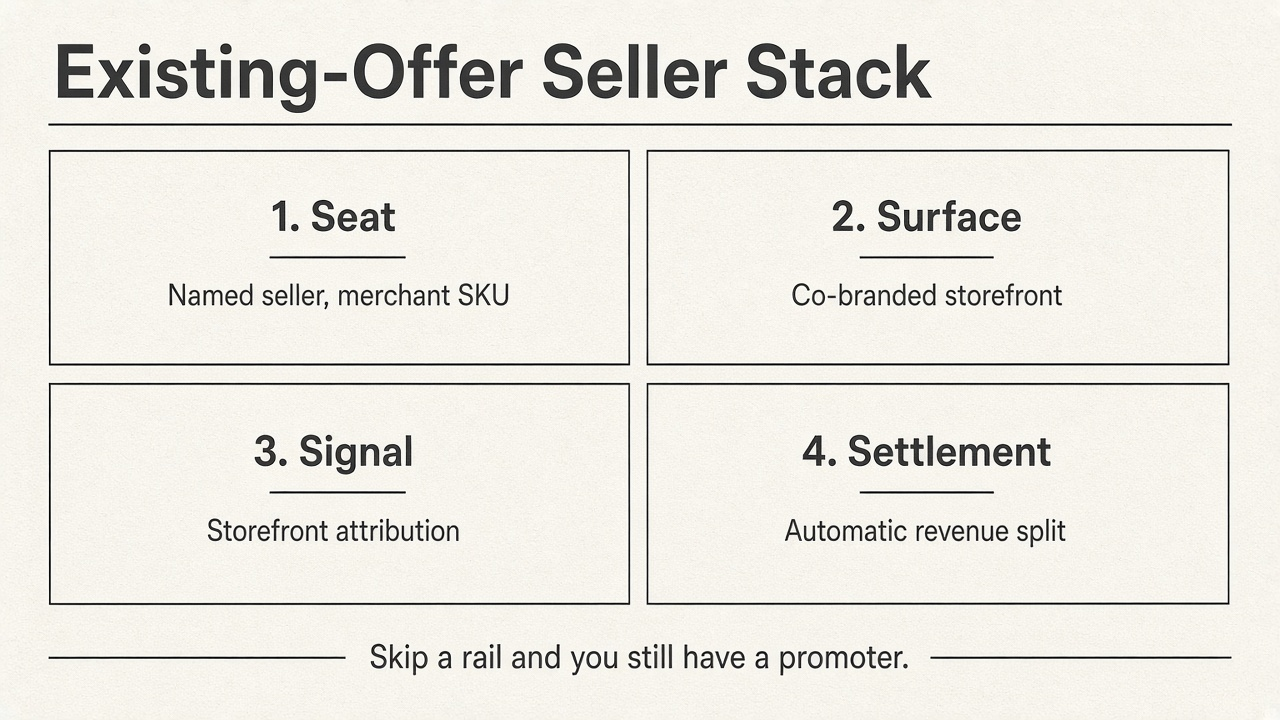
Source: Editorial framework synthesized for this article from feat. product mechanics and public affiliate/Connect sources. Taxonomy diagram, no invented conversion rates.
The seller does not need a warehouse, a Stripe catalog, or a followership floor. feat. does not require a minimum follower count to browse or pitch. Merchants approve on fit. Results still scale with audience quality and offer fit. feat. does not guarantee sales, and feat. does not recruit affiliates for you. Name the people who already promote the event, the book, or the product. That list is the first roster.
Customer-to-affiliate widgets (Refersion, UpPromote, Kickbooster) solve a narrower seat: the buyer who just checked out. That is a valid source. It is not the whole job. A creator who never bought can still be a seller if you approve them and lock the same offer.
Give them a page they can screenshot. Same brand kit, their face or handle, your price, one checkout. Unbounce’s 83% mobile-visit share is why that page has to work in a thumb, not in a desktop theme you never tested (Unbounce).
Compare the surfaces a merchant actually ships:
| Surface | What the buyer sees | Attribution | Payout | Fit |
|---|---|---|---|---|
| Tracking link | Merchant PDP | Cookie or last click | Network or app | Classic publishers |
| Coupon code | Merchant PDP | Code at checkout | Often manual or app | Stories, podcasts, offline |
| Link hub | List of destinations | Fragmented per URL | Per program | Bio routing |
| Co-branded storefront | Named seller + locked offer | Storefront URL | Automatic split | Existing-offer anyone-seller |
A Linktree-class hub routes. A storefront sells. If you only need routing, stop here. If you need a seller, fork the page.
Each storefront carries tracking so the sale attaches to that promoter. UTM-style parameters and platform events sit on the URL. Cookie duration still exists as a window, which we unpacked in affiliate cookie duration and attribution windows. The anyone-seller move is to stop arguing about a 30-day cookie while two creators share one generic link.
Reddit operators are blunt: “if your attribution isn’t airtight you’ll have partner disputes that damage relationships way more than a slow payout does” (r/Affiliatemarketing). A named storefront is how you make the dispute boring. Leaderboards then rank attributed revenue, not “storefronts launched” vanity, unless you are measuring interest instead of sales.
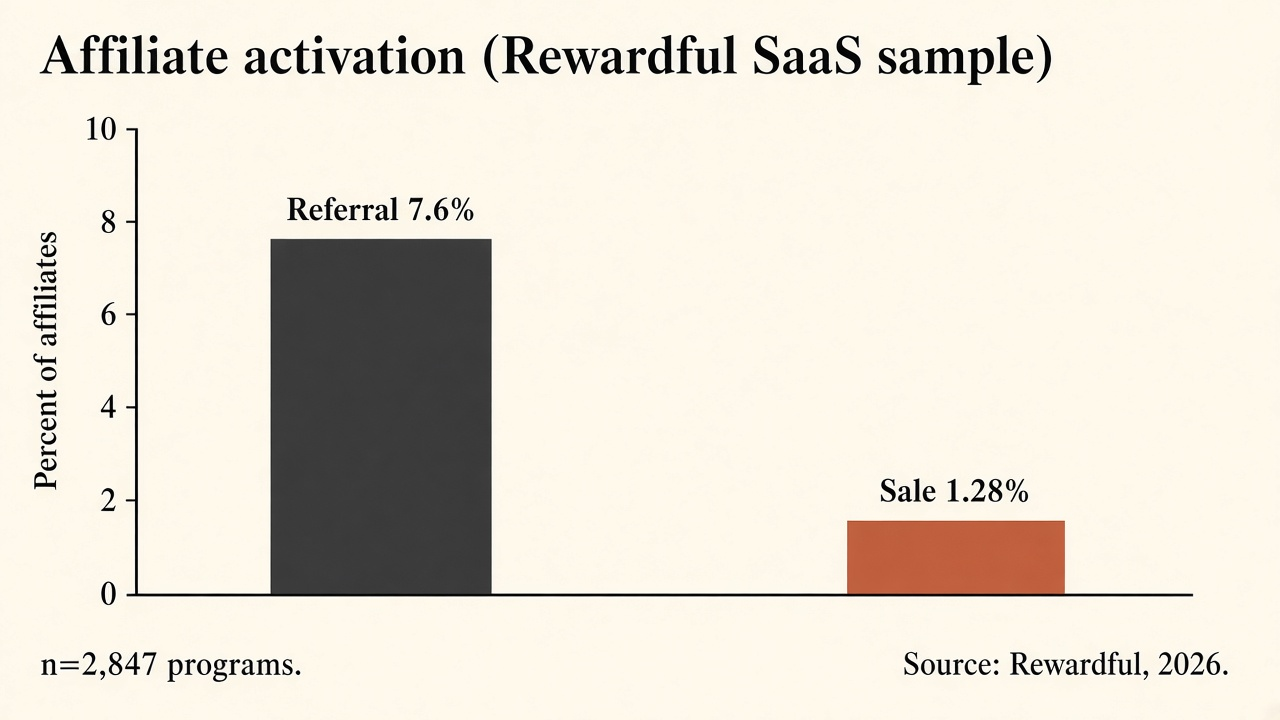
Source: Rewardful, State of SaaS Affiliate Programs, 2026 (n=2,847 programs). https://www.rewardful.com/articles/state-of-saas-affiliate-programs-report
Only 15.6% of those programs continue operating long-term (Rewardful). Programs die when the signal is a signup count.
Automatic revenue split means the processor allocates merchant net, affiliate commission, and any platform application fee when the charge succeeds. Stripe Connect documents three charge types for that job: direct charges, destination charges, and separate charges and transfers (Stripe Docs: charges). Destination charges fit branded marketplaces where the buyer pays the platform for a connected account’s offer. Direct charges fit tools where the seller looks like the merchant of record.
Do not invent a feat. platform percentage. Live listing fees and application fees appear in-product. Stripe’s published fork, when you handle pricing, includes $2 per monthly active account and 0.25% + 25¢ per payout, plus card processing that starts at 2.9% + 30¢ (Stripe Connect pricing). Model that stack before you promise a 50% digital commission you cannot fund after refunds.
Shopify’s category bands are the merchant-affiliate envelope, not a feat. rate card:
| Category | Typical commission band | Source |
|---|---|---|
| Physical goods | 5%-15% per sale | Shopify |
| Digital products and courses | 20%-50% per sale | Shopify |
| Subscriptions | 15%-30% recurring | Shopify |
| B2B software / first contract | 10%-30% | Shopify |
| High-ticket (furniture, mattresses) | 3%-8% | Shopify |
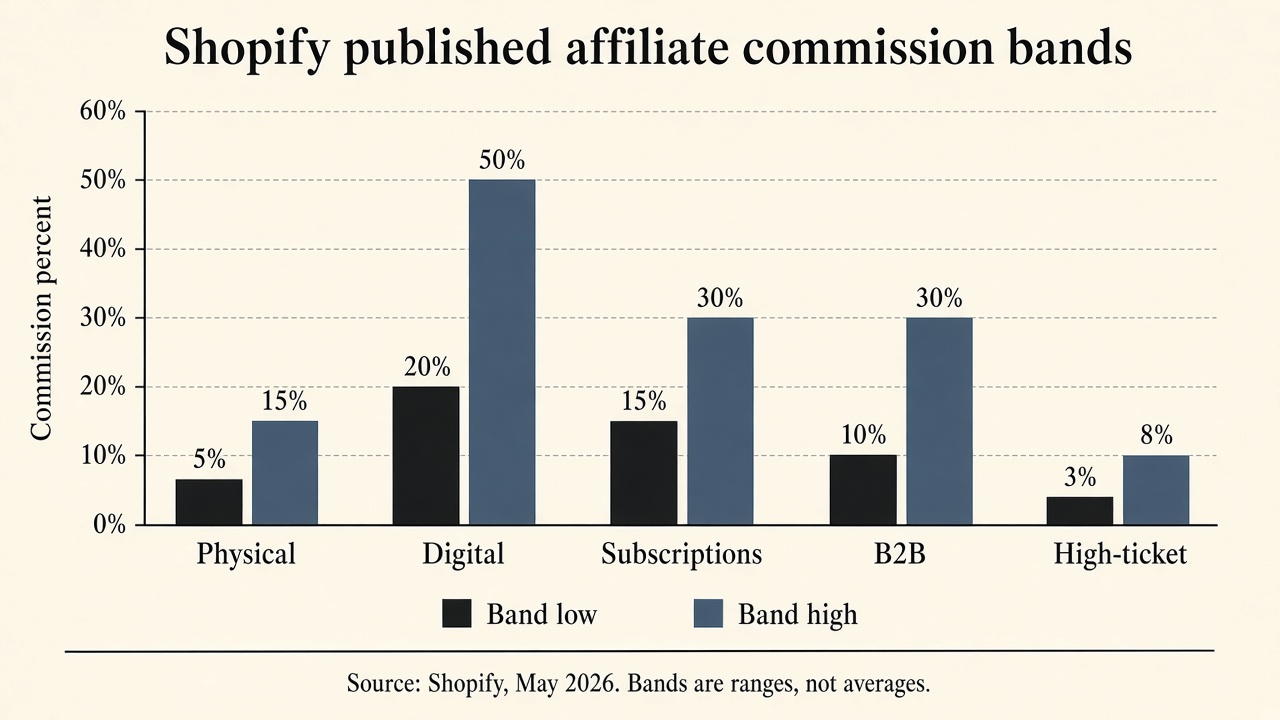
Source: Shopify, Affiliate Commission Guide, May 11, 2026. https://www.shopify.com/blog/affiliate-commission
The split article owns the $100 collaborative-dollar waterfall. This page owns the rule: if the money still waits for a monthly CSV, you did not finish turning them into a seller.
Fold these failures into the stack instead of a separate mistakes list:
These six steps turn a named person into a seller of an existing offer. Each step is one rail of the stack plus the operational click. Do not start at marketplace discovery if you cannot name the first five people.
There is no public dataset for time-to-first-sale after a storefront fork across all verticals. Promise a page in minutes after approval, which is the product path. Do not promise a payout calendar you have not configured.
Q: How do you turn anyone into a seller of your existing offer? A: Approve a named person, fork a co-branded storefront on your locked offer, send buyers to that URL, and split the attributed checkout automatically. A unique cookie without a page still leaves you with a promoter, not a seller.
Q: Does a seller need their own product catalog? A: No. The job is to sell someone else’s existing offer. The merchant owns price, fulfillment, and refunds. The seller owns distribution and the storefront identity.
Q: How does storefront attribution work compared with a cookie? A: The storefront URL is the identity. Cookies and windows still record whether a later visit counts, which is the usual affiliate contract. Two creators sharing one homepage link cannot be attributed, even with a 90-day window.
Q: How does an automatic revenue split work at checkout? A: Connect-style charges allocate merchant net, affiliate commission, and any platform application fee when payment succeeds. Stripe documents direct, destination, and separate charges and transfers for that routing (Stripe Docs). Live feat. percentages appear in-product.
Q: Is an affiliate link the same as a co-branded storefront? A: No. An affiliate link is a tracking parameter on someone else’s page. A co-branded storefront is a sell page with the seller’s identity, the merchant’s offer, attribution, and a path to split. Links route. Storefronts sell.
How to turn anyone into a seller is a stack, not a slogan. Lock the offer. Name the people. Fork a storefront they can actually share. Attribute the checkout to that page. Split the dollar in the payment. PMA’s $113B sales figure is what the channel can do. Rewardful’s 1.28% is what happens when you only issue links. List the offer on feat. if you already know who should sell it for you.
Build a product distribution network on four rails—DTC, wholesale, commission sellers, co-branded storefronts. Densify before you scale; Lowe’s pays up to 20% on storefronts.
Create a startup partner program by picking one seat—affiliate, agency, reseller, or tech—then PartnerStack, a $49 tracker, or feat.
Marketplace take rates compared: take rate is revenue divided by GMS, not the seller sticker. Etsy, Fiverr, eBay, Apple 30/15, Amazon referrals.