How to Build a Product Distribution Network
Build a product distribution network on four rails—DTC, wholesale, commission sellers, co-branded storefronts. Densify before you scale; Lowe’s pays up to 20% on storefronts.
Create a startup partner program by picking one seat—affiliate, agency, reseller, or tech—then PartnerStack, a $49 tracker, or feat.

TL;DR: How to create a partner program for a startup starts with a seat, not a PRM. Name whether you need affiliates, agency/referral partners, resellers, or tech integrations—then match PartnerStack’s multi-type ecosystem, a ~$49 Stripe tracker, or a co-branded storefront. PartnerStack’s 2026 Network report puts Network partners at 14× the earn rate of non-Network partners; Rewardful still finds only 1.28% of affiliates sell.
Most founders ask “how to create a partner program for a startup” and then buy software that assumes every partner is the same job.
They are not. A newsletter that drops a tracked link, an agency that submits a qualified lead, a reseller that bills the customer, and an integration that co-sells into an existing stack need different contracts, enablement, and payout rails. HubSpot and Webflow split affiliate tracks from partner tracks for that reason (HubSpot; Webflow). Reddit operators selling into SMBs say the same thing in plainer words: treat agencies and accountants like a partner program, not “the usual affiliate crowd” (r/AffiliateMarket).
This page is the seat fork. Pure affiliate go-live locks live on how to start an affiliate program for your business. Seed-stage affiliate constraints live on how to create an affiliate program for a startup. Tool vs marketplace framing lives on PartnerStack vs feat.
A startup partner program is a written set of seats, incentives, and ops that lets outside companies or creators refer, sell, implement, or integrate your product for a defined reward—before you staff a partner team.
It is broader than an affiliate program (tracked CPS/CPL content partners) and narrower than “anyone who likes us.” PartnerStack markets affiliate, referral/co-sell, and reseller motions side by side for that reason (PartnerStack). If your only seat is Stripe CPS affiliates, you are building an affiliate program—use the Seed-Stage Stack article, not a full PRM narrative.
Seat choice matters because one commission and one portal cannot serve a blogger and an agency at once without burning one of them.
How to create a partner program for a startup works as a Partner Seat Ladder: name the primary seat, write seat-specific economics and rules, pick the surface that matches that seat, invite a tiny warm roster, and measure activation before you add a second seat.
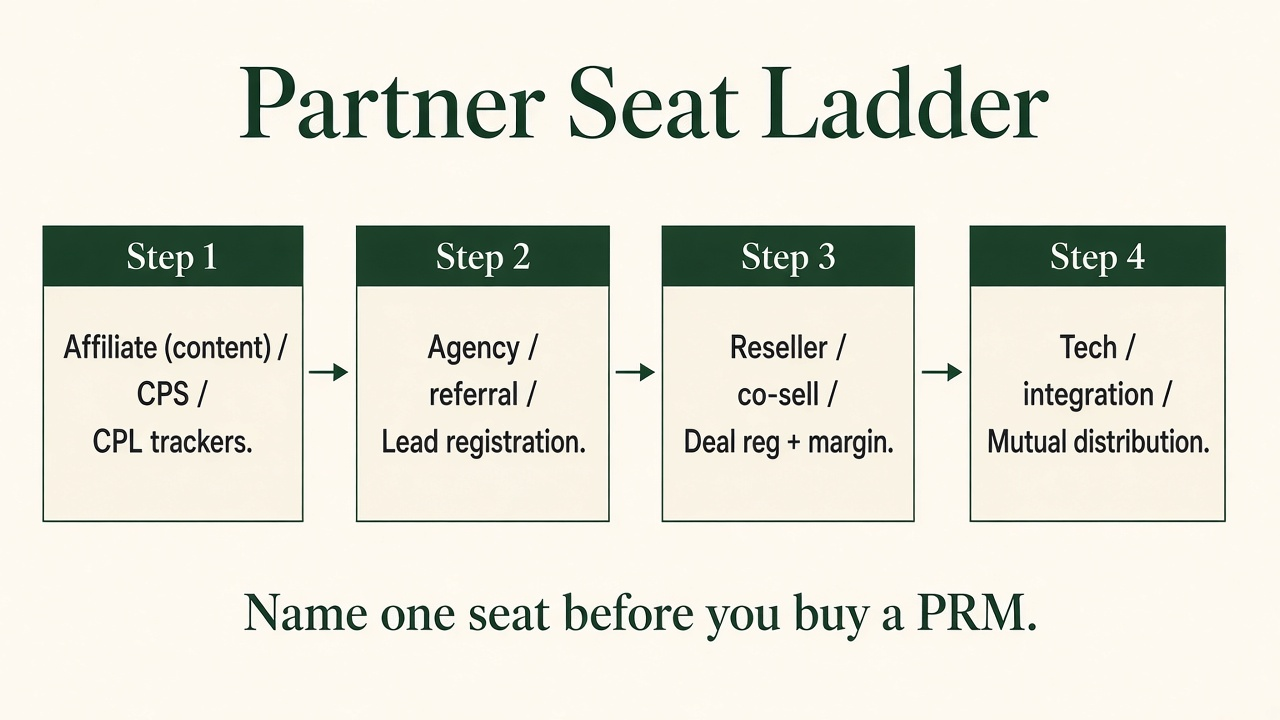
Source: Editorial Partner Seat Ladder for startup partner programs; seat types aligned with PartnerStack affiliate / referral / reseller framing and HubSpot–Webflow affiliate-vs-partner splits. Accessed 2026-10-07.
Publishers, creators, and niche sites drive tracked traffic. Pay on a clear event (CPS, CPL, or capped revshare). Default surface for early SaaS with Stripe: a tracker near $49/month, not an enterprise network (Rewardful; FirstPromoter/Rewardful pricing). Soft-launch 10–15 named people—same discipline as the startup affiliate article.
Consultants, accountants, and agencies fold you into client work. They often need lead submission, not only links, and may deserve different duration (PartnerStack’s Apollo play notes agencies vs affiliates as a strategic split with different applications and commission shapes) (PartnerStack Playbook). This is where “partner program” language usually beats “affiliate signup.”
Agencies or vendors sell (and sometimes bill) your product. Expect deal registration, enablement, and margin—not a footer link. PartnerStack positions reseller partners to sell software directly alongside affiliate and referral motions (PartnerStack). Skip this seat until you can staff support and pricing floors.
Product works with theirs; value is mutual distribution more than a CPS check. Often no revshare. Do not pretend an integration directory is a commission program.
| Primary seat | Usual surface | Published cost signal | When it wins | When it loses |
|---|---|---|---|---|
| Affiliate (Stripe CPS) | Rewardful / FirstPromoter-class tracker | About $49/month starters | One product, founder-run, content partners | You need agency lead registration + Network discovery |
| Multi-seat B2B ecosystem | PartnerStack (affiliate + referral + reseller) | Demo / quote-only (pricing) | You will run Network recruitment and co-sell ops | You only needed ten Stripe affiliates |
| Co-branded creator selling | Marketplace storefront (e.g. feat.) | Do not invent feat. fees | Creators need a shop, not a lead form | You need enterprise partner CRM + deal reg |
PartnerStack’s 2026 report says top vendors’ best-performing offers cluster at 20% / 25% / 30% and Network partners deliver the 14× earn lift (PartnerStack). That is a recruiting and quality argument for the B2B ecosystem seat—not a reason to buy the platform on day one of a content-only program.
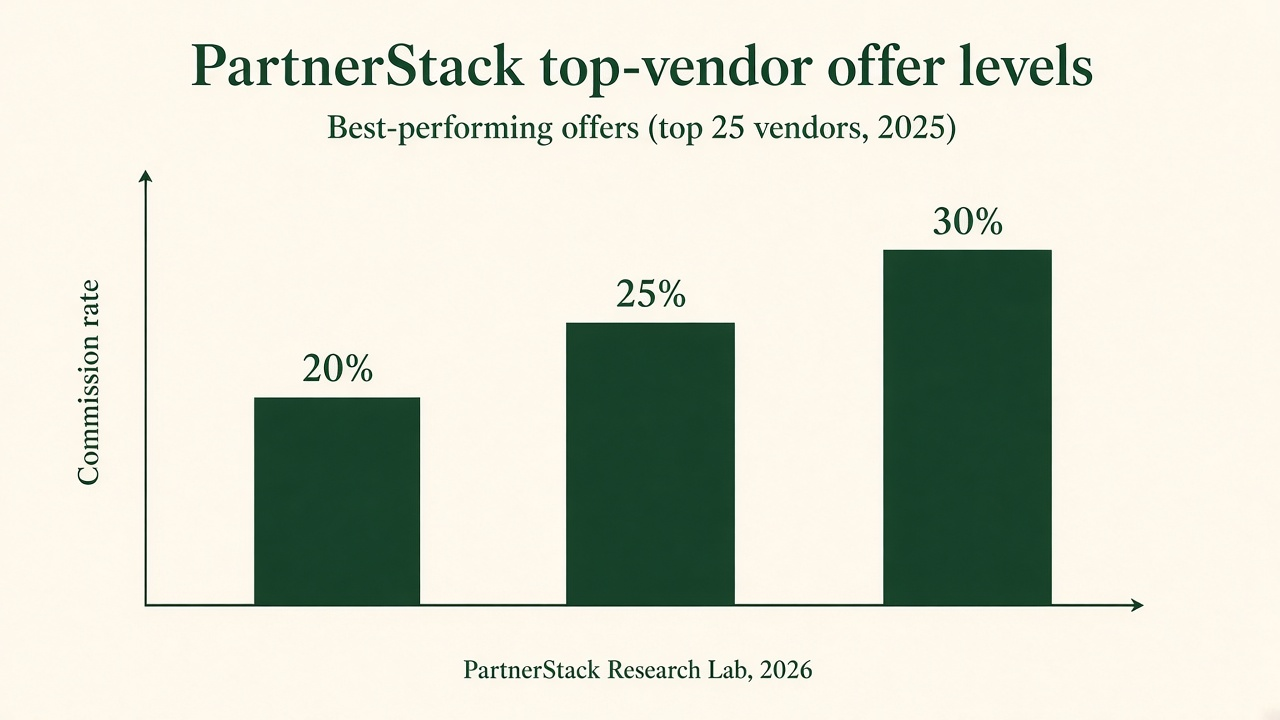
Source: PartnerStack Research Lab, “PartnerStack is Scaling Revenue Precision in 2026” (top 25 vendors’ best-performing offer ranges). https://partnerstack.com/resources/research-lab/report-partnerstack-is-scaling-revenue-precision-in-2026
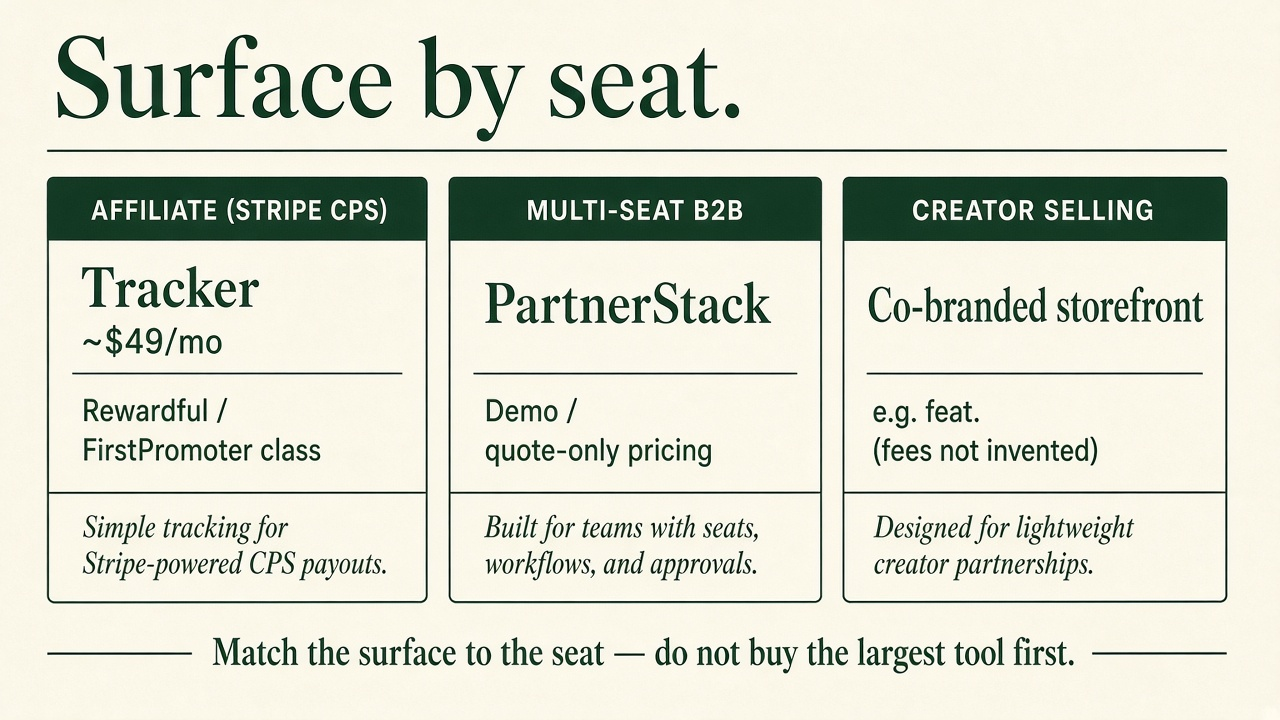
Source: Editorial surface-by-seat comparison; Rewardful/FirstPromoter ~$49 starters; PartnerStack pricing demo-only; feat. fees not invented. Accessed 2026-10-07.
Publish a rate a partner can calculate without a call. Cap duration if LTV is unknown (recurring vs one-time affiliate commissions). Separate terms if you later add agencies—do not stretch one CPS agreement across resellers. Cover disclosure, clawbacks, and payout timing (affiliate program terms of service; how do affiliate marketers get paid).
Invite people who already touch your buyer. Measure Joined → Referred → Sold weekly. If nobody sells, fix enablement—do not open a second seat. PartnerStack’s Network quality story (14×) only helps after you know which seat you are filling (PartnerStack).
Q: How do I create a partner program for a startup? A: Name one primary seat (affiliate, agency/referral, reseller, or tech), publish seat-specific economics and rules, pick the matching surface, soft-launch a small warm roster, and measure sold partners before you add seats or buy a larger PRM.
Q: Is a partner program the same as an affiliate program? A: No. An affiliate program is usually one seat—tracked content or traffic partners on CPS/CPL. A partner program can include agencies, resellers, and tech partners with different ops. Startups often need only the affiliate seat at first.
Q: When should a startup use PartnerStack? A: When you will run B2B multi-seat motions and Network recruitment. PartnerStack reports Network partners are 14× more likely to earn than non-Network partners, but pricing is demo-quoted—do not buy it solely to track ten Stripe links.
Q: How much do startup partner programs pay? A: It depends on seat and margin. PartnerStack’s 2026 report shows top vendors’ best-performing offers at 20%, 25%, and 30%. That is a labeled sample, not a law for every startup.
Q: Can feat. replace PartnerStack for a partner program? A: Not as an enterprise PRM. feat. fits when creators need co-branded storefronts and an automatic revenue split. Use PartnerStack or a tracker when the job is lead registration, multi-seat B2B ecosystem ops, or simple Stripe CPS without a storefront.
How to create a partner program for a startup is a seat decision before it is a software decision. Climb the Partner Seat Ladder once, match PartnerStack, a ~$49 tracker, or a storefront marketplace to that seat, and earn the right to add complexity.
If your seat is creators selling your product through co-branded storefronts with a revenue split on every sale, start at feat..
Build a product distribution network on four rails—DTC, wholesale, commission sellers, co-branded storefronts. Densify before you scale; Lowe’s pays up to 20% on storefronts.
Turn anyone into a seller of your existing offer: give them a co-branded storefront, lock the SKU, attribute checkout, and split revenue automatically.
Marketplace take rates compared: take rate is revenue divided by GMS, not the seller sticker. Etsy, Fiverr, eBay, Apple 30/15, Amazon referrals.