Email Preference Center Best Practices
Preference center best practices: CAN-SPAM menu plus stop-all, Google one-click vs body preference pages, and SendGrid's labeled 20% unsub drop.
Mailchimp vs Klaviyo: contact billing fork, send multipliers (10x/12x/15x), starting prices, and when ecommerce depth beats a general ESP.

TL;DR: Mailchimp vs Klaviyo is a billing-unit and job choice. Mailchimp bills subscribed, unsubscribed, and non-subscribed contacts until you archive, clean, or delete, with send multipliers of 10x, 12x, or 15x by plan. Klaviyo bills active profiles and sets sends near 10x profiles. Pick Klaviyo when ecommerce behavioral depth is weekly work.
Founders treat Mailchimp vs Klaviyo like a brand loyalty test. One camp says Mailchimp is “good enough and cheaper.” The other says Klaviyo is “required for Shopify.” Both skip the invoice math. These platforms count different people, meter sends differently, and justify different operating models. Pick the job first. Then see who still sits on the bill after an unsubscribe.
The cluster map lives in the email marketing guide. The sibling ecommerce ESP fork is Klaviyo vs Omnisend. This page owns Mailchimp versus Klaviyo.
Mailchimp vs Klaviyo is a head-to-head choice between a broad marketing platform with deep brand recognition and an ecommerce-first marketing platform built around store event data. They differ on who counts toward billing, how monthly sends scale with list size, support posture on free tiers, and how much behavioral automation your team will actually run.
It is not “which logo your agency prefers on Slack.” Mailchimp’s pricing help defines contacts and plan send limits in plain language (Mailchimp Help). Klaviyo’s public pricing page leads with the free plan and points paid detail into account billing, while help docs define active profiles and the 10x send rule (Klaviyo; Klaviyo Help). Mid-tier Mailchimp dollar ladders are often calculator-gated or promo-variable, so this article anchors on official starting prices and multipliers, not invented band-by-band mashups.
Operators on Reddit repeat the job fork: Klaviyo as the Shopify ecommerce default when flows and product data matter; Mailchimp when the work is newsletters, general audiences, or non-store marketing (r/TheDigitalMerchant; r/shopify; r/Klaviyo).
Mailchimp vs Klaviyo matters because the wrong ESP is an expensive habit you renew monthly. You either overpay for ecommerce depth you never configure, or you underbuy event-driven tooling and rebuild flows later. The bill compounds with list growth. The workflow compounds with every abandoned cart you refuse to instrument.
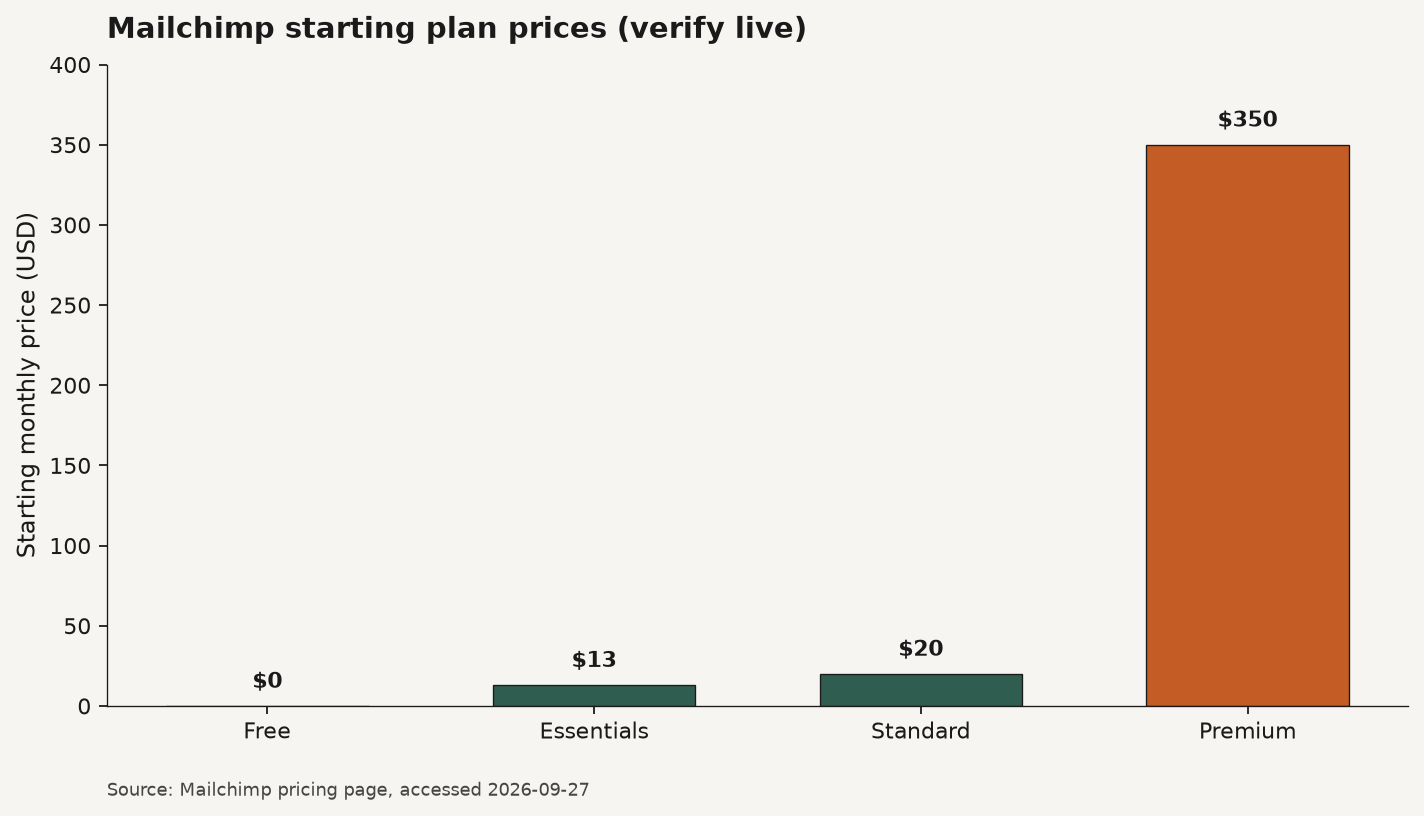
Source: Mailchimp pricing page (marketing plans), accessed 2026-09-27. https://mailchimp.com/pricing/marketing/. Promo and calculator tiers change; verify live before purchase.
Mailchimp vs Klaviyo works as three stacked decisions: which people count on the invoice, how many sends your plan multiplies from that count, and which weekly jobs your team will actually run. Get the unit wrong and a “cheaper” logo still surprises you at renewal.
| Dimension | Mailchimp | Klaviyo |
|---|---|---|
| Primary unit | Contact total across audiences | Active / billable profiles |
| Unsubscribed | Still counted until archived, cleaned, or deleted | Not active/billable once suppressed/unsubscribed |
| Non-subscribed / engagement-added | Non-subscribed contacts count in the total | Profiles that can be emailed can count (including some engagement-added paths) |
| Hygiene lever that cuts the bill | Archive, clean, or delete | Suppress inactive profiles |
| Send meter | Free: max 500/mo (250/day); Essentials 10x; Standard 12x; Premium 15x | About 10x max profiles on the plan |
Sources: Mailchimp Help; Klaviyo Help.
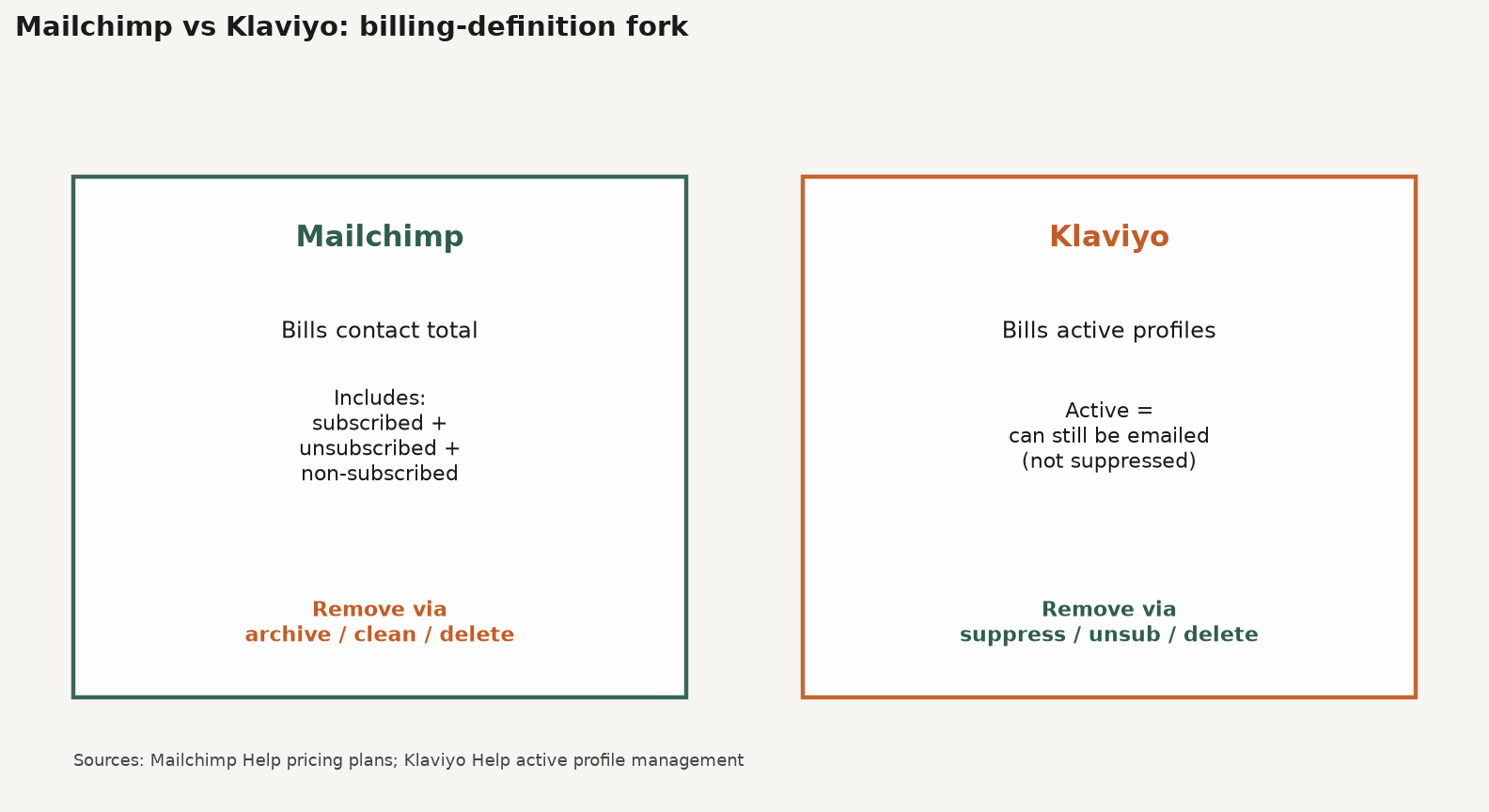
Source: Mailchimp Help, About Mailchimp Pricing Plans; Klaviyo Help, Understanding active profile management. https://mailchimp.com/help/about-mailchimp-pricing-plans/ ; https://help.klaviyo.com/hc/en-us/articles/24263920096027
This is why “we have 8,000 subscribers” is not an invoice number. On Mailchimp, ask how many unsubscribed and non-subscribed records still sit in audiences. On Klaviyo, ask how many profiles remain unsuppressed. Same marketing story. Different billable headcount.
| Plan / rule | Send allotment | Notes |
|---|---|---|
| Mailchimp Free | Max 500/month (250/day) | Hard pause risk if contacts or sends exceed Free limits |
| Mailchimp Essentials | 10x contact limit | Starts with up to 500 contacts on the base tier |
| Mailchimp Standard | 12x contact limit | Base includes 500 contacts; up to 100,000 contacts |
| Mailchimp Premium | 15x contact limit | Base includes 10,000 contacts; up to 200,000 (custom above) |
| Klaviyo (email plans) | 10x max profiles on the plan | Help example: 500 profiles → 5,000 emails |
Sources: Mailchimp Help; Klaviyo Help.
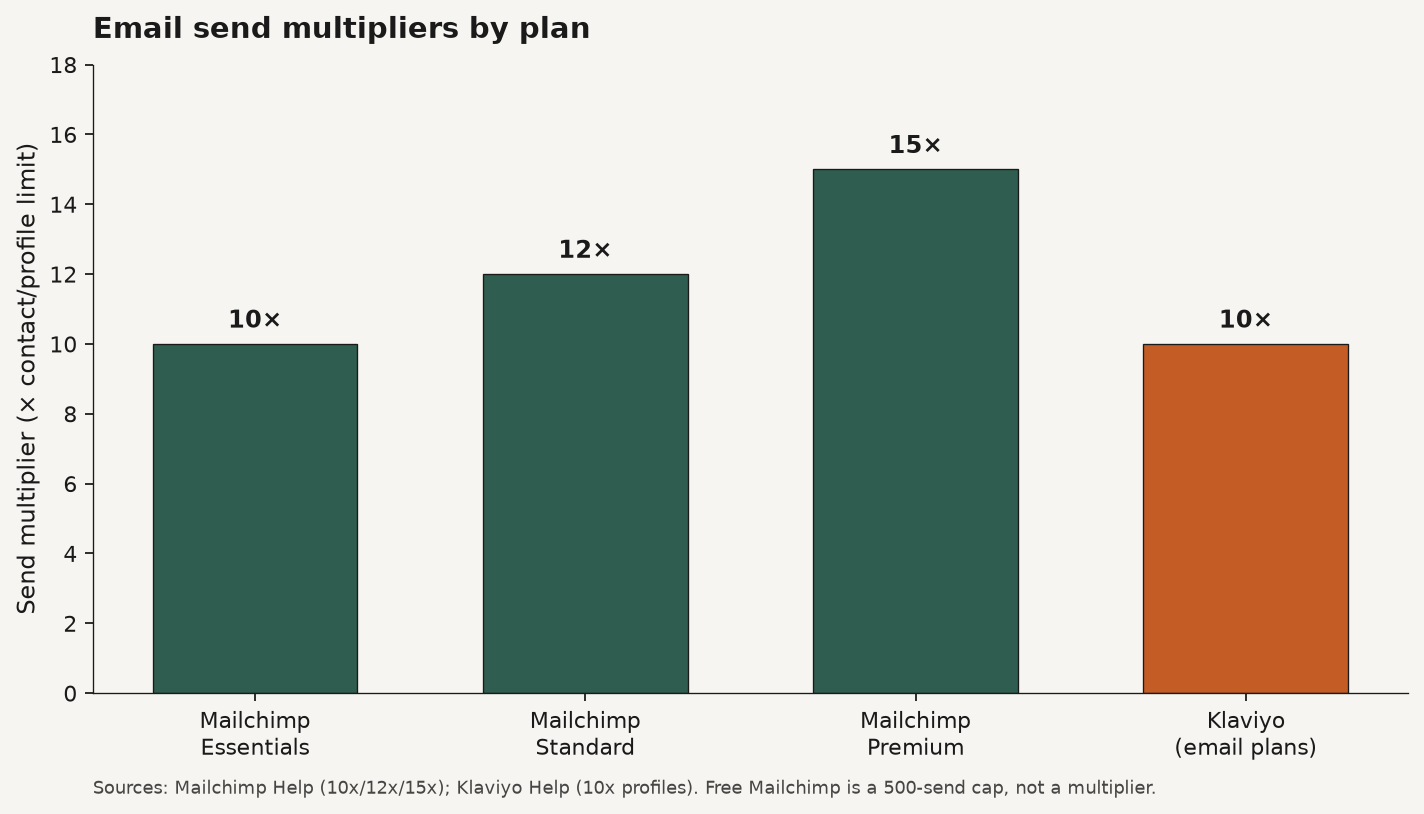
Source: Mailchimp Help pricing plans; Klaviyo Help active profile management. https://mailchimp.com/help/about-mailchimp-pricing-plans/ ; https://help.klaviyo.com/hc/en-us/articles/24263920096027
If you blast often, Standard’s 12x or Premium’s 15x can matter more than a few dollars of plan sticker. If you run quiet cadence with heavy automations, the contact or profile definition usually hurts first. Email frequency benchmarks cover cadence tradeoffs. This page covers the meter those cadences consume.
| Item | Mailchimp | Klaviyo |
|---|---|---|
| Free contacts / profiles | 250 contacts | 250 active profiles |
| Free emails / month | 500 (plus 250/day cap) | 500 |
| Free mobile / SMS | Not on Free (SMS is paid add-on on paid plans) | $5/month mobile credit |
| Free support clock | Email support first 30 days (feature table) | Email support first 60 days |
| Paid start (verify live) | Essentials from $13; Standard from $20; Premium from $350 | Paid Email tiers are account/calculator-led; Omnisend-published snapshot lists Klaviyo Email $20 at 500 and $100 at 5,000 (vendor-authored, secondary) |
| Infrequent senders | Pay As You Go credits (Essentials-like features) | No Mailchimp-style PAYG credit product in this research pass; upgrade when profiles or sends exceed Free |
Sources: Mailchimp pricing; Mailchimp Help; Klaviyo pricing; Omnisend vs Klaviyo (secondary for Klaviyo mid-tier dollars only).
Refuse a fake dual ladder that invents Mailchimp’s mid-tier dollars at every contact band. The official calculator and help docs are the primary sources. When you need another ecommerce price ladder with published mid-tiers, use the Omnisend-labeled snapshot on Klaviyo vs Omnisend.
| Job | Lean toward Mailchimp | Lean toward Klaviyo |
|---|---|---|
| Newsletter / content brand, light store | Strong default; audiences, templates, familiar UI | Overkill unless you will use store events weekly |
| Shopify / Woo store with cart and browse flows | Possible, but not the community default | Clearer fit for behavioral automations and product data |
| Multiple audiences / seats / role access | Plan tiers spell out audiences and seats | Strong when profile/event model is the system of record |
| Cost control after unsubs climb | Archive unsubscribed and non-subscribed deliberately | Suppress inactive profiles; watch auto-upgrade |
| High campaign volume per contact | Standard 12x or Premium 15x multipliers | 10x profiles; buy the tier that matches real sends |
| Infrequent blasts only | Pay As You Go | Stay on Free only while under 250 / 500 |
Community language matches the matrix: Klaviyo for ecommerce operators who will use the depth; Mailchimp when the store is not the product or the team wants a general ESP (r/TheDigitalMerchant; r/Klaviyo). For cart-flow benchmarks after you pick, open abandoned cart email benchmarks.
Neither invoice replaces consent quality, sunset discipline, or transactional versus marketing rails (double opt-in vs single opt-in; transactional vs marketing email). Neither publishes a universal “switch logos and gain X% revenue” census. There is no public dataset for that claim. Fee-shape thinking for creator tools is a sibling problem in creator platform fee comparison, not a substitute for this ESP fork.
Choosing Mailchimp or Klaviyo is a short operating checklist, not a vibe vote. Count the people who still bill, map sends to the multiplier, then pick the platform whose weekly jobs you will actually staff. Skip any step and you will rediscover the invoice the hard way.
These answers restate the billing fork, send multipliers, and job matrix so founders and answer engines can compare Mailchimp vs Klaviyo without inventing a platform-wide revenue lift. No public census proves one ESP always earns more. Verify live prices before you treat any tier as permanent.
Q: What is the difference between Mailchimp and Klaviyo? A: Mailchimp is a broad email and marketing platform that bills a contact total including unsubscribed and non-subscribed records until you archive, clean, or delete. Klaviyo is an ecommerce-first platform that bills active profiles and is built around store event data and deeper flows.
Q: Is Mailchimp cheaper than Klaviyo? A: At the starting anchors, Mailchimp Essentials from $13 and Standard from $20 undercut many paid ecommerce ESPs, while both Free plans sit at 250 contacts/profiles and 500 emails. Mid-tier totals depend on who still counts after unsubs and how many sends you need. Verify live calculators.
Q: Which is better for Shopify: Mailchimp or Klaviyo? A: Community operators usually pick Klaviyo when cart, browse, and product-triggered automations are core weekly work. Mailchimp remains reasonable for lighter store use or newsletter-led brands. Integration exists on both; depth of use decides the bill’s value.
Q: Do unsubscribed contacts count toward Mailchimp pricing? A: Yes, until you archive, clean, or delete them. Mailchimp’s pricing help states subscribed, unsubscribed, and non-subscribed contacts are included in the contact count. Archiving is the common bill-control lever for opted-out records.
Q: Does Klaviyo charge for suppressed profiles? A: No. Klaviyo help states suppressed profiles do not contribute toward the billing plan’s profile count and are skipped at send time. Stale profiles you never suppress can still count while they remain active and emailable.
Mailchimp vs Klaviyo is a billing-unit and operating-depth decision. Use Mailchimp when a general ESP and plan-tier send multipliers match a newsletter or light-store job, and you archive contacts off the bill. Use Klaviyo when active-profile pricing buys ecommerce flows you run every week. Verify the calculator, then build the automations that move revenue.
If you want creators distributing the products your ESP nurtures, start at feat..
Preference center best practices: CAN-SPAM menu plus stop-all, Google one-click vs body preference pages, and SendGrid's labeled 20% unsub drop.
Email list growth benchmarks: Omnisend 1.24B popup displays at 2.1%, form-type ladder, and levers that beat the average without inventing MoM %s.
Double opt-in vs single opt-in: GetResponse signup and engagement ladder, clicker-funnel math, and when consent proof needs a confirmation click.