Email Preference Center Best Practices
Preference center best practices: CAN-SPAM menu plus stop-all, Google one-click vs body preference pages, and SendGrid's labeled 20% unsub drop.
Abandoned cart email benchmarks: Baymard 70.22% abandonment vs Klaviyo 3.33% placed-order and $3.65 RPR. Stop mixing recovery metrics.

TL;DR: Abandoned cart email benchmarks only work when you name the denominator. Baymard puts average cart abandonment near 70.22%. Klaviyo’s 143K+ flows put average placed-order at 3.33% and RPR at $3.65 (top 10% 7.69% / $28.89). Operator “5%-10% recovery” talk is a third metric. Do not average them.
Founders ask for “a good abandoned cart recovery rate” and paste three incompatible numbers into one slide. Seventy percent abandonment. Three percent conversion. Ten percent recovery. Those are not the same scorecard. Treat them like interchangeable KPIs and you will “fix” a healthy flow or celebrate a fake win.
The full cluster map lives in the email marketing guide.
Abandoned cart email benchmarks are planning numbers for high-intent recovery sequences. This page sits next to email marketing benchmarks by industry, marketing funnel benchmarks by stage and industry, how to build a digital product funnel, how to run a limited-time promotion that converts, and storefront vs landing page for selling digital products.
Abandoned cart email benchmarks are reference metrics for automated messages sent after a shopper adds items or starts checkout but does not buy. They are not one industry average. They are a stack of rates with different denominators: carts started, emails delivered, and carts recovered. Name the unit or the number is theater.
In practice, ecommerce teams mix three jobs under one phrase. Baymard measures how often carts die. Klaviyo measures how email flows perform for people who already entered an abandoned-cart automation. Operators on Shopify threads measure how many abandoned carts come back as orders. All three can be true at once. None of them licenses inventing a fourth “industry recovery rate” by averaging them.
This page is the email recovery spoke. Broader ESP open and click ladders live in email marketing benchmarks by industry. Checkout UX and abandonment causes live in Baymard’s research and in our digital product funnel and launch playbooks pieces.
These benchmarks matter because abandoned carts are the highest-intent unpaid traffic most stores already own. Misread the metric and you underfund the flow, over-discount the wrong carts, or blame email for a checkout tax Baymard has measured for years.
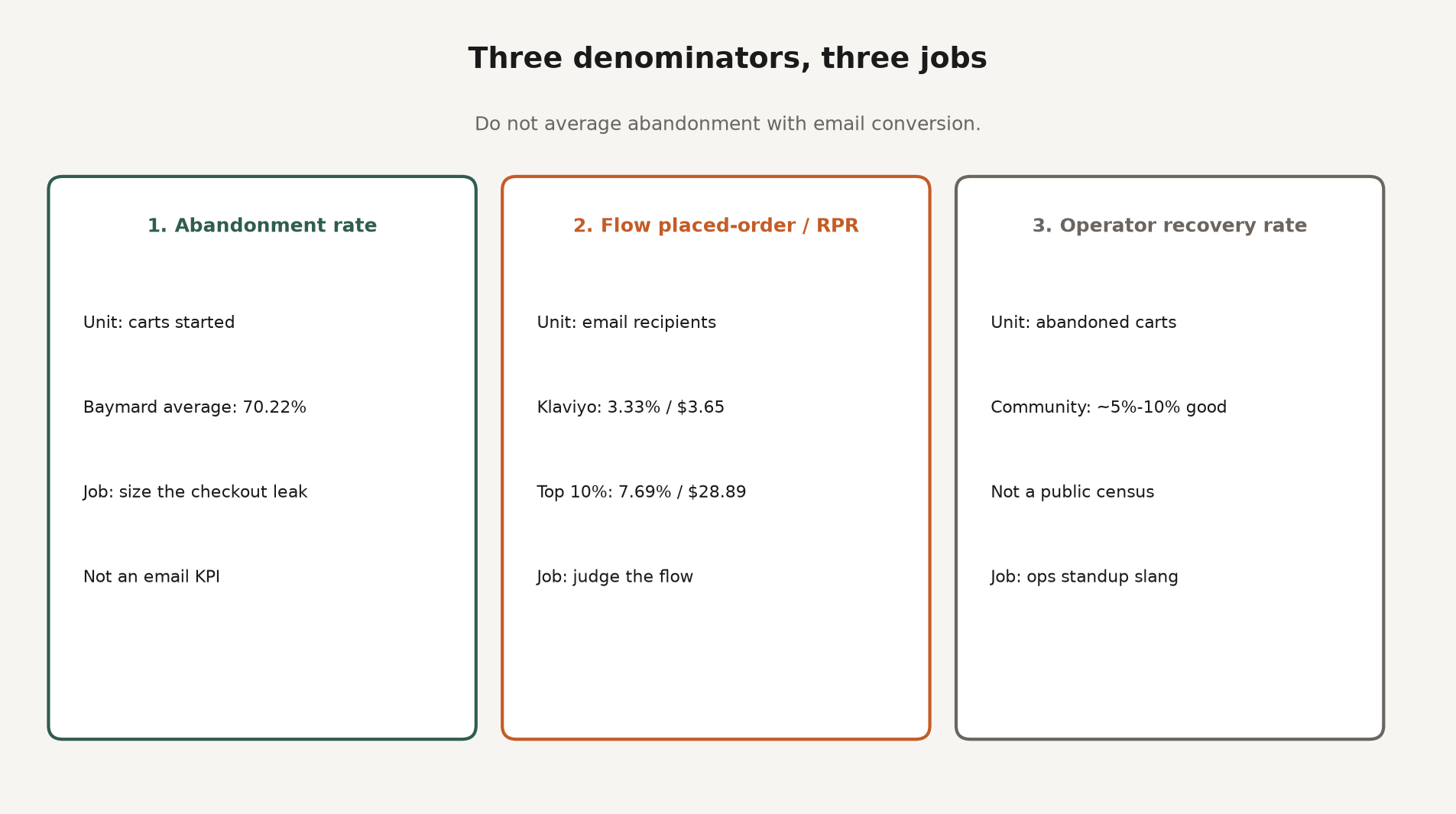
Source: Editorial framework synthesizing Baymard abandonment definitions with Klaviyo flow metrics. https://baymard.com/lists/cart-abandonment-rate · https://www.klaviyo.com/blog/abandoned-cart-benchmarks
Read abandoned cart email benchmarks by locking the denominator first, then comparing like with like. Start with abandonment to size the leak. Use Klaviyo-style placed-order and RPR to judge the email system. Use operator recovery language only when your analytics define recovered carts the same way every week.
| Metric | Definition | Published figure | Source |
|---|---|---|---|
| Cart abandonment rate | Carts started that do not become orders | 70.22% average across 50 studies | Baymard |
| “Just browsing” share | Shoppers who abandoned because not ready | 42% of US online shoppers (reason study) | Baymard |
| Flow open rate | Opens ÷ delivered (ESP; MPP-aware) | Avg 50.5%; top 10% 65.34% | Klaviyo |
| Flow click rate | Clicks ÷ delivered | Avg 6.25%; top 10% 13.33% | Klaviyo |
| Flow placed-order rate | Orders attributed ÷ recipients | Avg 3.33%; top 10% 7.69% | Klaviyo |
| Flow RPR | Attributed revenue ÷ recipients | Avg $3.65; top 10% $28.89 | Klaviyo |
| Operator recovery rate | Abandoned carts recovered ÷ abandoned carts | Often ~5%-10% “good” in threads | Community; not a census |
Do not put 70.22% and 3.33% on one bar chart as if they were peers. One is a cart outcome. The other is an email-recipient outcome. Apple Mail Privacy Protection also makes opens directional; prefer click, placed-order, and RPR when you argue with finance (email benchmarks).
| Metric | Average | Top 10% |
|---|---|---|
| Open rate | 50.5% | 65.34% |
| Click rate | 6.25% | 13.33% |
| Placed-order rate | 3.33% | 7.69% |
| Revenue per recipient | $3.65 | $28.89 |
| Unsubscribe rate | 0.60% | 0.00% |
Source: Klaviyo Abandoned Cart Benchmark Report (143K+ flows, 2023 data).
Klaviyo also notes abandoned cart flows show a relatively small gap between average and top 10% on engagement and conversion versus other automations. Translation for founders: a basic three-email reminder still pays. The upside is real, but you are not starting from zero.
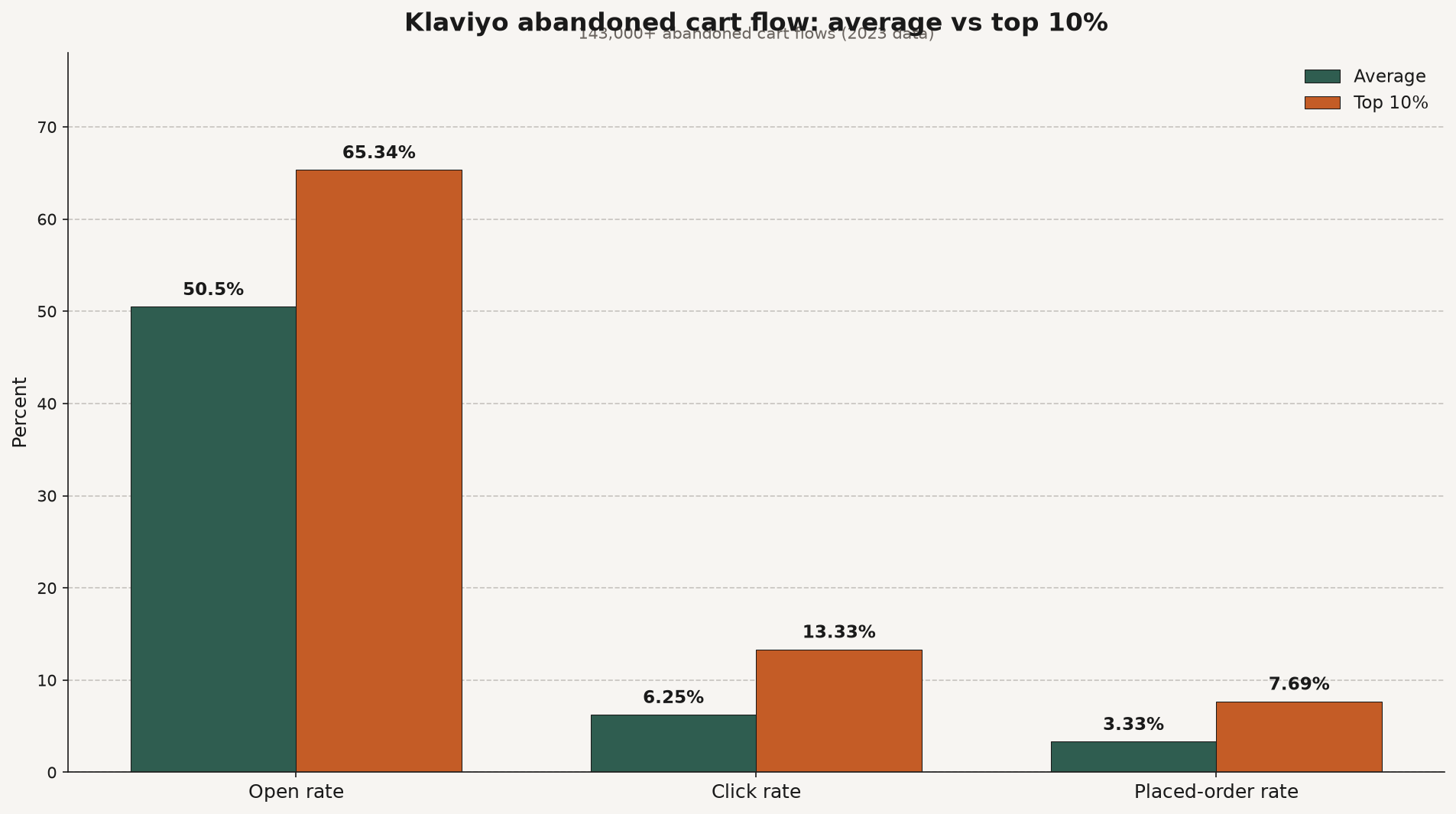
Source: Klaviyo, Abandoned Cart Benchmark Report (May 15, 2024). https://www.klaviyo.com/blog/abandoned-cart-benchmarks
RPR is the money metric. Klaviyo reports average abandoned-cart RPR at $3.65, about 37.74% higher than the next-highest flow (welcome) on average, with top 10% RPR at $28.89 (Klaviyo).
Industry context from the same report (averages, not guarantees):
| Industry signal | Figure |
|---|---|
| Automotive / hardware & home improvement average RPR | Near $10 |
| Home & garden / electronics average RPR | Near $6 |
| Top 10% hardware & home improvement RPR | $75.66 |
| Top 10% electronics RPR | $66.89 |
| Top 10% home & garden RPR | $64.52 |
| Top 10% automotive RPR | $52.35 |
| Food & beverage avg open / click / conversion | 52.16% / 6.63% / 3.66% |
| Sporting goods avg open / click / conversion | 51.69% / 6.95% / 3.50% |
| Apparel avg open / conversion | 51.43% / 3.42% |
High RPR often tracks higher AOV categories. Do not copy a hardware top-decile RPR onto a $28 cosmetic SKU and call your flow broken.
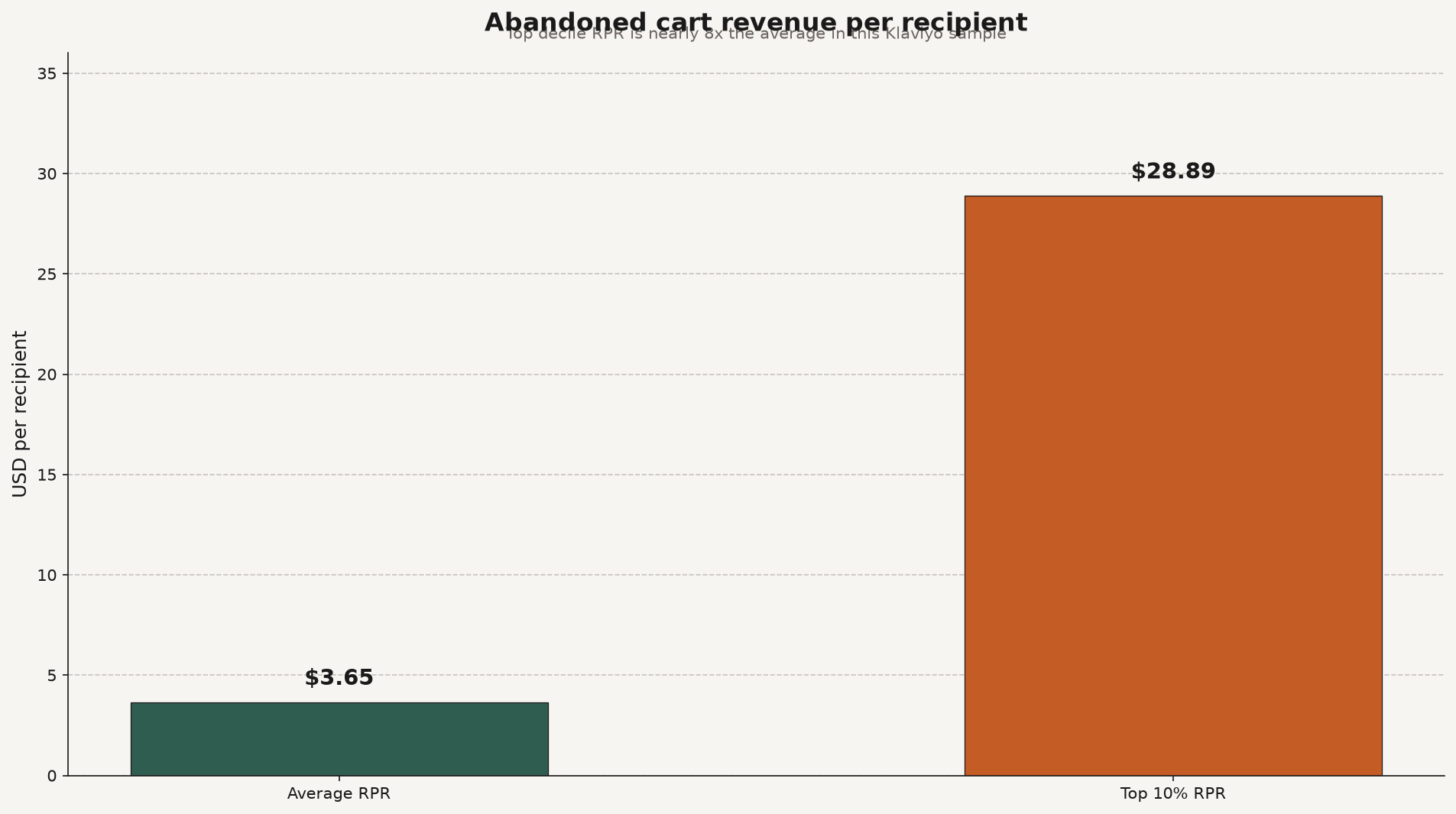
Source: Klaviyo, Abandoned Cart Benchmark Report. https://www.klaviyo.com/blog/abandoned-cart-benchmarks
Run a labeled example, not a fake store mean. If 1,000 people enter an abandoned-cart flow and you hit Klaviyo’s average 3.33% placed-order rate, that is about 33 attributed orders. At average $3.65 RPR, attributed revenue is about $3,650. At top-decile 7.69% and $28.89 RPR, the same 1,000 recipients imply about 77 orders and about $28,890 attributed revenue. Those are ESP attribution figures from Klaviyo’s sample, not incrementality-proofed cash (incrementality testing).
| Labeled scenario (1,000 recipients) | Placed-order rate | Implied orders | RPR | Implied attributed revenue |
|---|---|---|---|---|
| Klaviyo average | 3.33% | ~33 | $3.65 | ~$3,650 |
| Klaviyo top 10% | 7.69% | ~77 | $28.89 | ~$28,890 |
When Shopify merchants say recovery rate, they usually mean recovered orders ÷ abandoned carts (or abandoned checkouts), not placed-order ÷ email recipients. Thread answers cluster around 5%-10% as acceptable and 10%+ as strong (r/shopify_growth). That language is useful for ops standups. It is not a substitute for Klaviyo’s published placed-order and RPR tables, and it is not a Baymard abandonment figure.
There is no public dataset in this article that publishes one audited abandoned-cart recovery-rate census across every vertical, ESP, and incentive policy. Pages that invent vertical medians without a primary sample get cut here.
| Job | Metric to watch | Primary source | Common mistake |
|---|---|---|---|
| Size the checkout leak | Abandonment rate | Baymard 70.22% | Treating all abandoners as recoverable buyers |
| Judge email creative and timing | Placed-order + RPR | Klaviyo 3.33% / $3.65 | Optimizing opens under MPP |
| Talk ops in merchant slang | Recovery rate (define it) | Your analytics + peer bands | Importing a vendor’s undefined % |
| Fix structural drop-off | Checkout UX + cost clarity | Baymard causes + 35.26% lift framing | Discounting every cart before fixing fees |
Q: What are good abandoned cart email benchmarks in 2026? A: Use Klaviyo’s abandoned-cart flow averages as an ESP planning floor: about 50.5% open, 6.25% click, 3.33% placed-order, and $3.65 RPR, with top 10% near 7.69% placed-order and $28.89 RPR. Keep Baymard’s 70.22% abandonment rate as the cart-leak context, not as an email KPI.
Q: What is the difference between cart abandonment rate and recovery rate? A: Abandonment rate is the share of carts that never become orders. Recovery rate usually means the share of abandoned carts that later convert after outreach. Placed-order rate on an email flow is a third denominator: orders among people who received the automation.
Q: What is a good abandoned cart recovery rate? A: Merchant communities often call about 5%-10% recovery acceptable. That is peer language, not a public multi-vertical census. Prefer placed-order rate and RPR from your ESP when you set targets, and write down your recovery formula if you use one.
Q: How many abandoned cart emails should I send? A: Klaviyo describes a common three-message pattern and stresses A/B testing delays, subject lines, and offers. There is no single proven universal cadence in the public sources used here. Start simple, then test.
Q: Do abandoned cart emails need a discount? A: Not by default. Klaviyo notes discounts can help and can also train shoppers to wait. Segment by cart value and margin before you discount every abandoner. Fix surprise shipping and checkout friction first when those are the Baymard-style failure modes.
Abandoned cart email benchmarks are a grammar problem before they are a creative problem. Hold Baymard’s abandonment rate, Klaviyo’s placed-order and RPR scorecard, and operator recovery slang in separate columns. Optimize the flow you can measure. Fix the checkout you can redesign. If you want partners distributing products through co-branded storefronts while you keep owning retention, start at feat..
Preference center best practices: CAN-SPAM menu plus stop-all, Google one-click vs body preference pages, and SendGrid's labeled 20% unsub drop.
Mailchimp vs Klaviyo: contact billing fork, send multipliers (10x/12x/15x), starting prices, and when ecommerce depth beats a general ESP.
Email list growth benchmarks: Omnisend 1.24B popup displays at 2.1%, form-type ladder, and levers that beat the average without inventing MoM %s.