Affiliate Marketing for Startups: Complete Guide
Affiliate marketing for startups is an operating system—locks, cost, recruit, rates, tracking, first 100 sales, then diagnose a flat roster.
Recurring vs one-time affiliate commissions: Shopify bands, lifetime vs capped terms, and break-even months for merchants and affiliates.

TL;DR: Recurring vs one-time affiliate commissions is a duration bet on retention. One-time pays once on a qualified sale. Recurring pays on renewals for a term or for life. Shopify puts subscription services near 15% to 30% recurring. Cap the term when you need recruiting power without open-ended liability.
Affiliates argue about 20% recurring versus 50% one-time as if the higher sticker always wins. Merchants copy “lifetime” from a competitor pitch deck and hope finance never asks about churn. Both sides are solving the wrong first problem.
Recurring vs one-time affiliate commissions is not a rate fight. It is a duration fight. The rate sits inside a structure you already chose (sale, lead, or revenue share). Duration decides how long that structure keeps paying after the first invoice clears.
Key takeaways:
Recurring vs one-time affiliate commissions is the choice of how long a partner keeps earning after they refer a customer: a single payout on the first qualifying event, or ongoing payouts on renewals for a defined term or for the customer’s life.
One-time (often pay-per-sale on the first order) is simple. The partner gets a percentage or fixed amount once. Then that referral is done for commission purposes, even if the customer renews for years.
Recurring pays a percentage (or fixed amount) on each eligible billing cycle while the customer stays active, or until your written cap. Shopify lists recurring commissions as a distinct model for software, memberships, and digital subscription products (Shopify). PartnerStack splits the recurring seat further into limited (for example first year) and unlimited lifetime (PartnerStack Support).
This is not the same job as picking digital versus physical offer economics. Physical SKUs usually have nowhere for true recurring share to attach unless you sell a subscription box. Digital and SaaS often do.
Duration changes who you recruit, how hard they promote, and whether your unit economics survive month six.
Why the choice sticks:
There is no public dataset that crowns one duration as best for every niche. Anyone who says “always lifetime” without your churn and margin is selling certainty they do not have.
You pick a base event, then you pick how many times that event (or its renewals) pays. Duration is a second axis on top of commission structure, not a replacement for it.
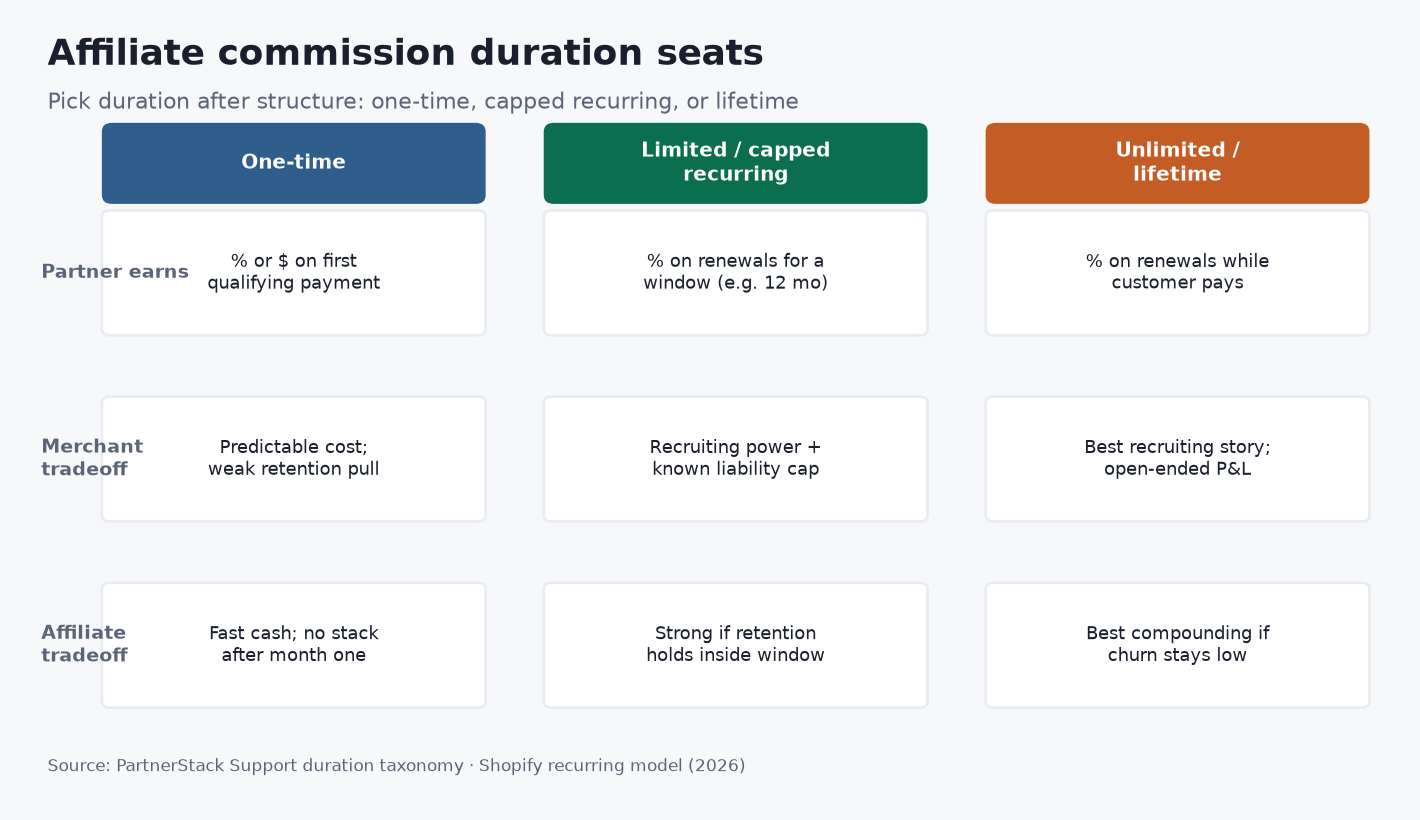
| Duration seat | What the partner earns | Merchant tradeoff | Affiliate tradeoff | Source |
|---|---|---|---|---|
| One-time | % or $ on first qualifying payment only | Predictable cost; weak retention incentive | Fast cash; zero stack after month one | PartnerStack; Shopify |
| Limited / capped recurring | % on renewals for a window (e.g. 12 months) or until a $ cap | Recruiting power with a known liability ceiling | Strong if retention is real inside the window | PartnerStack |
| Unlimited / lifetime recurring | % on renewals while the customer pays | Best recruiting story; open-ended P&L | Best compounding if churn is low and clawbacks are fair | PartnerStack |
PartnerStack’s own examples: 30% on the first transaction (one-time), 50% for the first year (limited), 30% lifetime (unlimited) (PartnerStack Support). Treat those as illustrations of shape, not as your mandatory rates.
Source: PartnerStack Support, Build your partner commission structure; Shopify Affiliate Commission Guide, 2026. https://support.partnerstack.com/hc/en-us/articles/14657461808275-Recruiting-partners-step-2-Build-your-partner-commission-structure
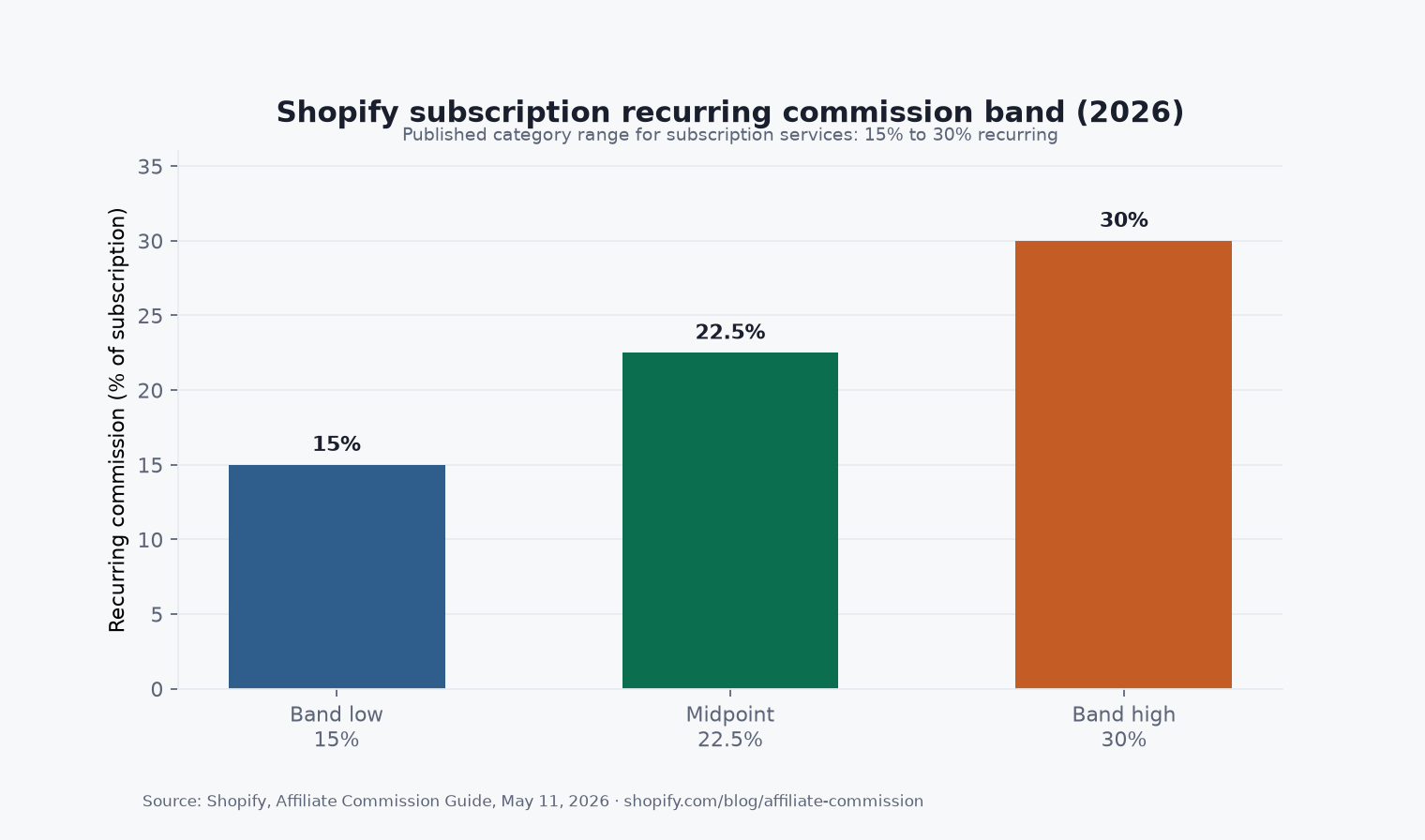
Shopify’s category bands (May 11, 2026):
| Category | Published band | Duration note |
|---|---|---|
| Physical goods | 5%-15% per sale | Usually one-time |
| Digital products / courses | 20%-50% per sale | Usually one-time unless subscribed |
| Subscription services | 15%-30% recurring | Ongoing while subscribed |
| B2B software / services | 10%-30% of first contract value | Often front-loaded one-time on contract |
| High-ticket physical | 3%-8% per sale | Usually one-time |
Shopify also notes that some subscription brands pay 75% to 100% of first-month revenue as commission because later months recover the cost (Shopify). That is a one-time-heavy hybrid, not the same thing as 20% lifetime.
On PartnerStack, an analysis of programs on that platform finds top performers often pay recurring for at least one year, many with no time limit, and popular percentages among those top programs in a 20% to 40% band, with some at 50% for the first year only (PartnerStack Support). That is platform-specific, not a census of all SaaS.
Source: Shopify, Affiliate Commission Guide, May 11, 2026. https://www.shopify.com/blog/affiliate-commission
Community threads obsess over “50% one-time or 20% recurring.” The honest answer is months-to-parity under your churn, not a slogan.
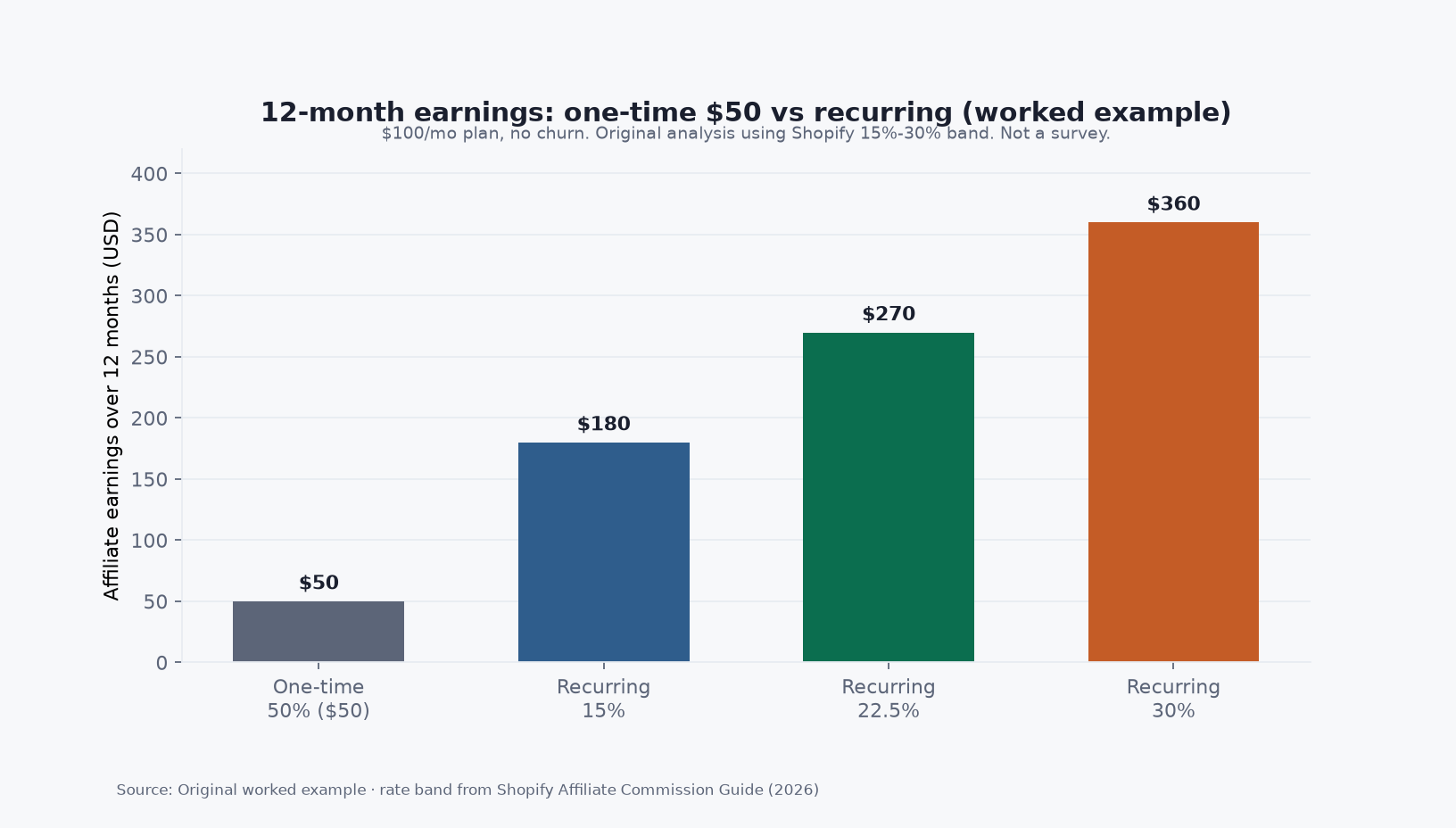
Assumptions (original analysis for this article, not a survey): $100/month plan. One-time comparison payout of $50 (50% of month one). Recurring rates at Shopify’s 15%, 22.5% midpoint, and 30%. No churn in the long column. Separate short column if the customer cancels after month 2.
| Recurring rate | Monthly payout | Months until cumulative ≥ $50 one-time | Affiliate total if stays 12 months | Affiliate total if churns after month 2 |
|---|---|---|---|---|
| 15% | $15 | 4 months ($60) | $180 | $30 |
| 22.5% (midpoint) | $22.50 | 3 months ($67.50) | $270 | $45 |
| 30% | $30 | 2 months ($60) | $360 | $60 |
| One-time 50% | $50 once | n/a | $50 | $50 |
Read the churn column twice. At 15% or 22.5%, early cancel leaves the affiliate behind a fat one-time. At 30%, month-two churn still beats $50. Merchants with leaky onboarding should not market “lifetime” as a recruiting cheat code. Affiliates should ask for retention signals before they treat recurring as free money.
Source: Original worked example for this article using Shopify’s 15%-30% subscription band. Not a public survey. https://www.shopify.com/blog/affiliate-commission
Common honest hybrids:
Write clawbacks in the same paragraph as the rate. Refund in month one reverses commission or it does not. Downgrade from $99 to $29 follows the new price or it does not. Silence here is how programs get roasted in public.
For negotiating inside a band after duration is set, use how to negotiate affiliate commission rates. For picking a SaaS partner platform that expects recurring, see best affiliate marketing platforms.
Q: What is the difference between recurring and one-time affiliate commissions? A: One-time pays the partner once when a referred customer completes a qualifying purchase or contract. Recurring pays again on each eligible renewal while the customer stays (or until a written cap). Shopify lists recurring as its own model for subscription products.
Q: What is a typical recurring affiliate commission rate for subscriptions? A: Shopify’s 2026 guide cites 15% to 30% recurring for subscription services. PartnerStack reports that among top-performing programs on its platform, popular percentages often fall between 20% and 40%, with some first-year offers up to 50%. Your margin and churn still decide the sustainable number.
Q: When do recurring commissions beat a high one-time payout? A: When the referred customer stays long enough for cumulative renewals to pass the one-time check. In a worked $100/mo example, 22.5% recurring passes a $50 one-time payout in three months if the customer does not churn. Early churn can flip the winner back to one-time.
Q: Is lifetime affiliate commission better than a 12-month cap? A: Lifetime is better for affiliates when retention is strong and terms are honest. Caps are better for merchants who need a liability ceiling and still want a recurring recruiting story. PartnerStack notes many strong programs pay for at least a year, and many top programs have no time limit, which is a platform observation, not a law.
Q: Should physical-product brands use recurring commissions? A: Usually no, unless you sell subscriptions or replenishment. Shopify’s physical-goods band is framed as a per-sale percentage. Force-fitting “lifetime” onto a one-shot SKU creates accounting fiction. Prefer one-time CPS and invest in how affiliate marketing works tracking instead.
Recurring vs one-time affiliate commissions is a retention bet dressed up as a percentage. Use one-time when value is front-loaded or churn is a mystery. Use capped recurring when you want partners without writing a blank check. Use lifetime only when your cohorts and clawbacks can carry the story. Run break-even months before you publish the rate card.
If you are a merchant who wants tracked partners selling through co-branded storefronts with a clear revenue split on every sale, start at https://www.feat.press.
Affiliate marketing for startups is an operating system—locks, cost, recruit, rates, tracking, first 100 sales, then diagnose a flat roster.
How to track affiliate sales: pick link cookie, coupon, pixel, S2S postback, or storefront checkout—then match Rewardful, Tapfiliate, or Impact.
Best affiliate programs for SaaS companies pass the Recurring Cap Test: labeled duration, cookie, seat type, payout rails—plus Rewardful’s ~24% planning band.