Affiliate Marketing for Startups: Complete Guide
Affiliate marketing for startups is an operating system—locks, cost, recruit, rates, tracking, first 100 sales, then diagnose a flat roster.
Rewardful vs feat: Rewardful is $49/mo up to $7,500 in affiliate revenue, unlimited affiliates, 0% fees. When a tracker is enough, and when it isn't.

TL;DR: Rewardful vs feat is a question of whether a tracker is enough. Rewardful costs $49/month up to $7,500 in monthly affiliate-attributed revenue, with unlimited affiliates and a 0% transaction fee. It’s enough when you bill through Stripe and your affiliates already have an audience. feat. is for named sellers who need a co-branded page, not just a
?via=link.
If you run a SaaS product on Stripe and you’re looking at Rewardful vs feat, my honest first answer is that you may only need Rewardful. It’s cheap, it’s clean, and it was built for exactly that stack. A founder writing about a competitor should say that plainly.
The harder question is when it stops being enough. A tracker gives an affiliate a link to your pricing page and counts what comes back. It does not give them anything to sell from. For a YouTuber with 50,000 subscribers, that’s fine. For a customer who loves your product and has no site, it’s a link they won’t know what to do with.
Key takeaways:
Rewardful vs feat is a comparison between Rewardful, Stripe-first affiliate tracking software that gives each affiliate a link into your own site and prices by monthly affiliate-attributed revenue, and feat., a marketplace that gives each seller a merchant approves a co-branded storefront for that merchant’s product.
Rewardful is narrow on purpose. Links use a clean URL parameter like ?via=justin on any page of your domain, or direct page tracking with no link at all. It syncs both ways with Stripe, so affiliate data shows up in your Stripe dashboard. It adjusts commissions automatically when a referred customer upgrades, downgrades, cancels, or starts a free trial (Rewardful pricing). Those subscription edge cases are where generic trackers get messy, and they’re Rewardful’s strongest point.
feat. starts somewhere else. A merchant lists a product and sets the revenue split. An approved seller gets their own co-branded page to share, and the split applies to the attributed sale. feat. does not recruit sellers. Affiliate software vs storefront covers that first-screen difference across ten tools. This page is the Rewardful version, with the meter priced out.
Rewardful charges by how much revenue your affiliates bring in, not by how many affiliates you approve. That makes it cheap to approve generously and cheap while you’re small. At the four revenue points priced below, the subscription runs about 0.5% to 2.45% of attributed revenue, before commissions and optional payout fees.
What the meter means in practice:
Here is the subscription as a share of monthly affiliate-attributed revenue at four points. Every figure is arithmetic on Rewardful’s published tiers.
| Monthly affiliate-attributed revenue | Plan | Subscription | Share of attributed revenue |
|---|---|---|---|
| $2,000 | Starter | $49 | 2.45% |
| $7,500 (Starter cap) | Starter | $49 | about 0.65% |
| $15,000 (Growth cap) | Growth | $99 | 0.66% |
| $30,000 (entry Enterprise cap) | Enterprise | $149+ | about 0.50% |
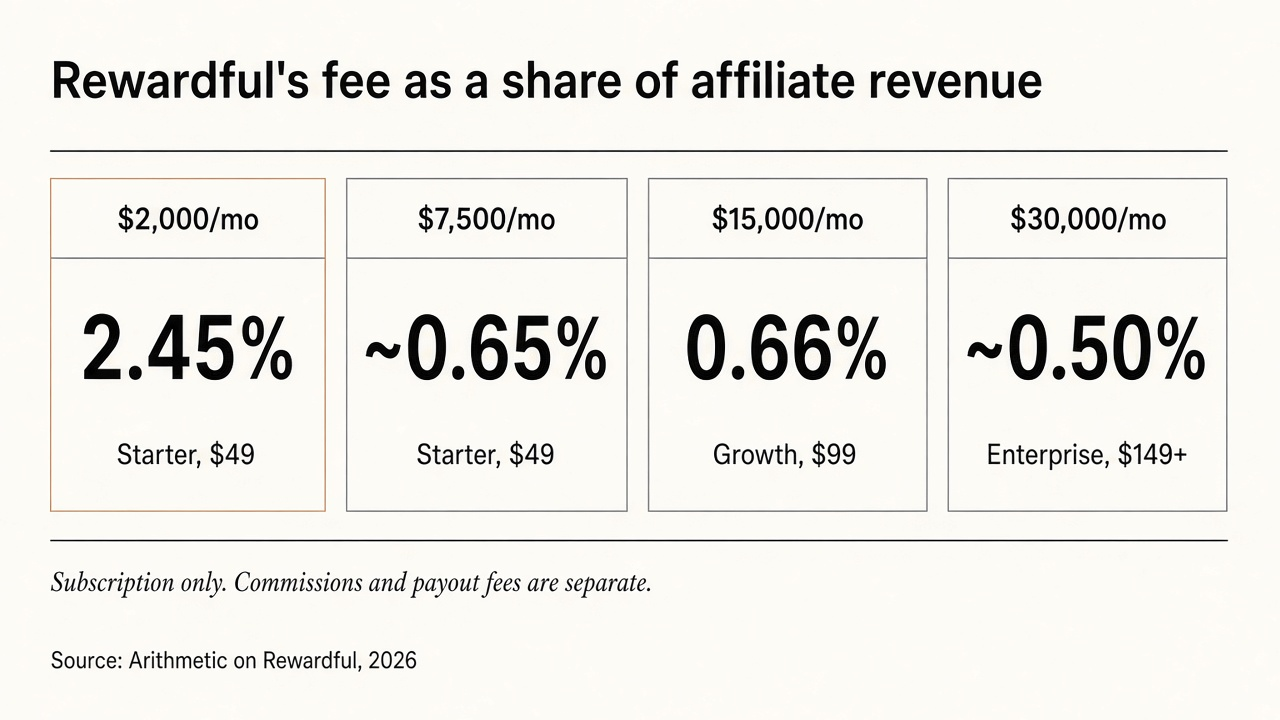
Source: Arithmetic on Rewardful, 2026. https://www.rewardful.com/pricing
Add Managed Payouts and the picture changes a little. At Rewardful’s reported average commission of 24.16%, $7,500 in attributed revenue pays about $1,812 in commissions. A 3% payout fee on that is about $54, which more than doubles the $49 subscription. That’s arithmetic on Rewardful’s average, not your program. Paying affiliates yourself through PayPal mass payouts or Wise bulk payouts avoids it. SaaS affiliate commission rates covers where that 24.16% sits against other samples.
The Tracker-Is-Enough Test is three questions. Do you bill through Stripe or Paddle? Do your affiliates already have an audience and a place to post? Should the buyer land on your own pricing page? If all three are yes, Rewardful alone is enough. If any is no, the seller needs a page, and that’s a storefront job.
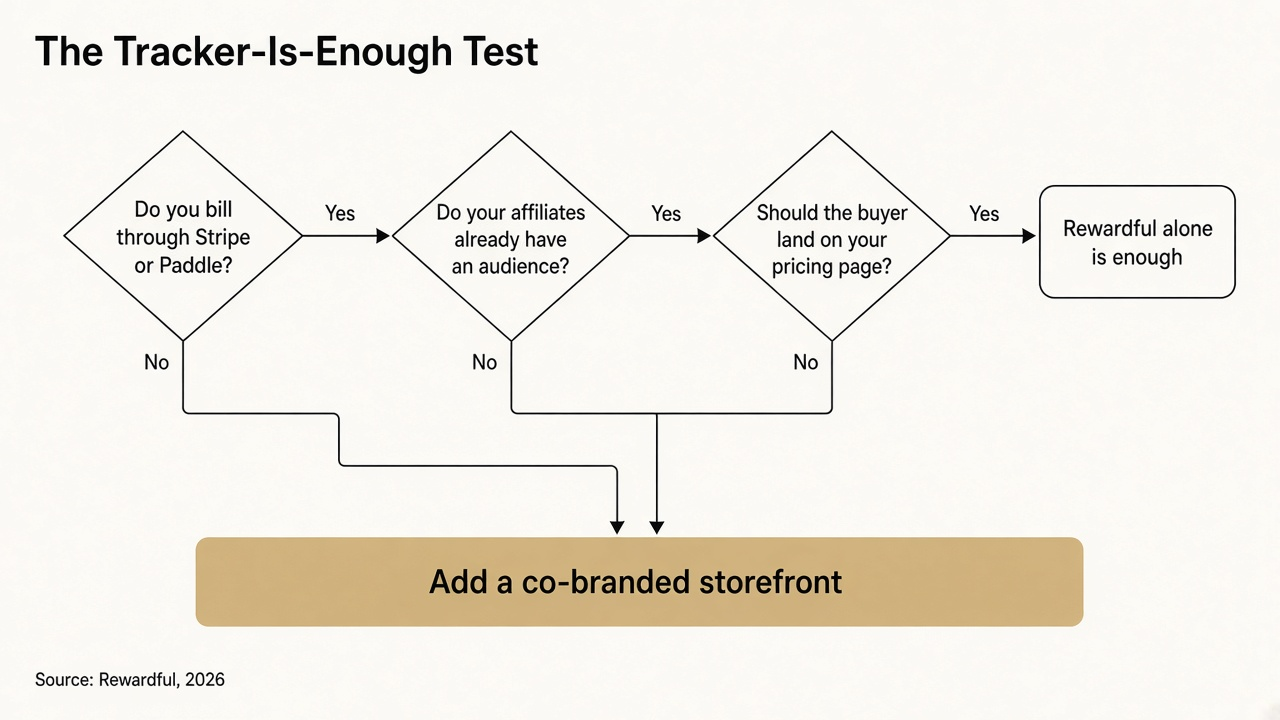
Source: Editorial decision flow based on Rewardful, 2026. https://www.rewardful.com/pricing
That describes a lot of SaaS programs. If it describes yours, stop reading and start the 14-day trial.
?via= link with nothing around it doesn’t give them a pitch.This is the gap feat. is built for. Rewardful’s own data shows how big it is: 7.6% of affiliates in the 2,847-program sample ever make a referral, and 1.28% generate a sale. The link was always there. Most affiliates never used it. How to get your first 100 affiliate sales works through what that activation math means for a new program.
| Rewardful | Tapfiliate | feat. | |
|---|---|---|---|
| What it meters | Monthly affiliate-attributed revenue | Approved affiliates, clicks, conversions | No public fee sheet; terms in-product |
| Entry price | $49/mo up to $7,500 | $89/mo for 50 affiliates, 500 conversions | Not published here |
| First step up | $99 above $7,500 (+$50) | $179 at affiliate 51 (+$90) | Not published here |
| Affiliates | Unlimited on every plan | 50 on Launch, unlimited on Scale | Each approved seller |
| Transaction fee | 0% (Managed Payouts 3% optional) | None, per Tapfiliate | Do not invent |
| What the seller gets | ?via= link or direct page tracking |
Link, coupon, branded dashboard | Co-branded storefront |
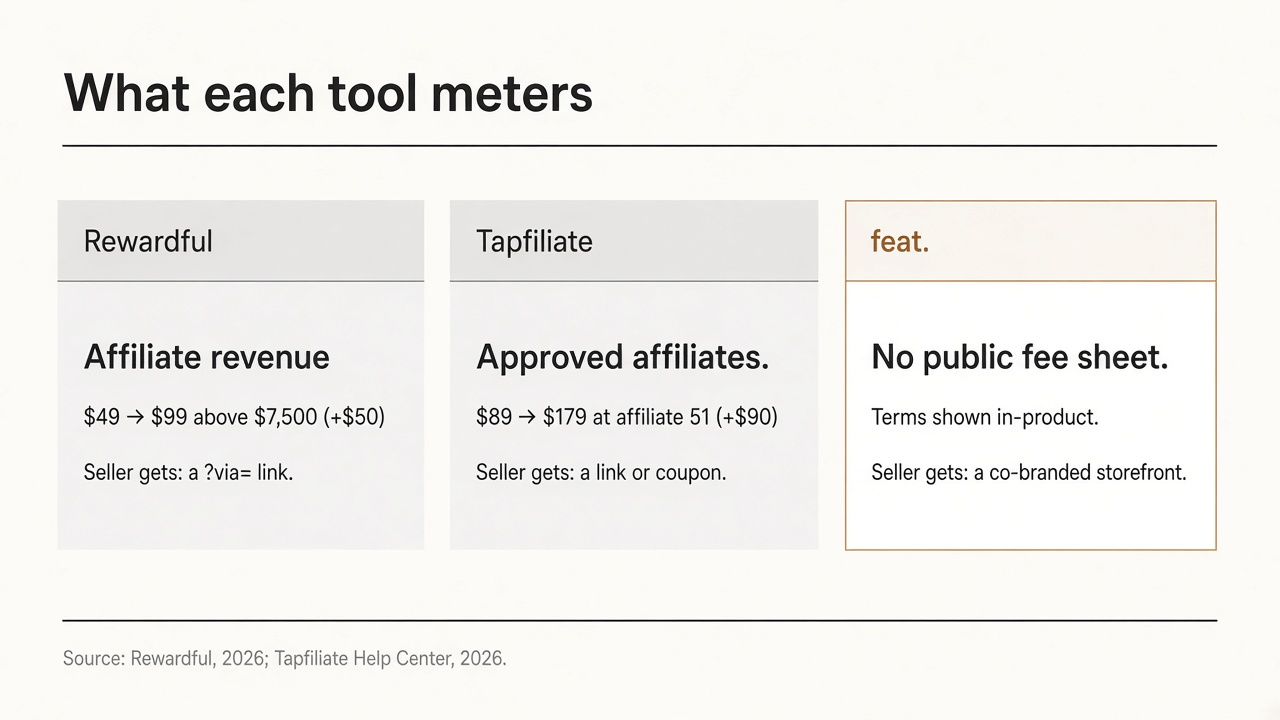
Source: Rewardful, 2026, https://www.rewardful.com/pricing · Tapfiliate Help Center, 2026, https://support.tapfiliate.com/en/articles/12791930-find-the-ideal-tapfiliate-plan-to-maximize-your-affiliate-revenue
The feat. column is thin on purpose. feat. doesn’t publish a fee sheet on this page, and a comparison table is exactly where people are tempted to fill in a number that wins. I’d rather leave it blank and tell you the live terms are in the product. For a loaded-cost model across trackers, see how much it costs to build an affiliate program.
Yes. A SaaS merchant can keep Rewardful for creators and agencies who only need a link, and give a storefront to the handful of named sellers who need a page. The rule is to attribute each sale once. Decide up front which system owns a given seller, so the same conversion isn’t paid twice.
These five steps settle it. Each step is at most two sentences.
Q: What is the difference between Rewardful and feat.? A: Rewardful is Stripe-first affiliate tracking software that gives each affiliate a link into your own site and charges by monthly affiliate-attributed revenue. feat. gives each seller you approve a co-branded storefront for your product. Rewardful counts the referral; feat. gives the seller a page to sell from.
Q: How much does Rewardful cost? A: Rewardful is $49/month up to $7,500 in monthly affiliate-attributed revenue, $99 up to $15,000, and $149+ on the entry Enterprise tier up to $30,000. Annual billing is $490, $990, and from $1,490 a year. Every plan has a 14-day free trial (checked 2026-10-06).
Q: When is Rewardful alone enough? A: When you bill through Stripe or Paddle, your affiliates already have an audience and a place to post, and the buyer should land on your own pricing page. If all three hold, a tracker is enough. If your sellers have no site, they need a page.
Q: Does Rewardful take a percentage of sales? A: No. Rewardful charges a 0% transaction fee on affiliate-attributed revenue. Commissions, optional Managed Payouts at 3% of payouts, and payment-provider fees are separate.
Q: Is feat. a replacement for Rewardful? A: Not for most Stripe SaaS programs whose affiliates already have audiences; Rewardful is the right tool there. feat. is for sellers who need a co-branded page, and a merchant can run both as long as each sale is attributed once.
Rewardful vs feat comes down to whether a tracker is enough. Rewardful is $49 a month up to $7,500 in affiliate-attributed revenue, with unlimited affiliates and a 0% transaction fee, and it’s enough when you’re on Stripe and your affiliates already have an audience. When the people you can name have no site and need something to sell from, list your product on feat.
Affiliate marketing for startups is an operating system—locks, cost, recruit, rates, tracking, first 100 sales, then diagnose a flat roster.
How to track affiliate sales: pick link cookie, coupon, pixel, S2S postback, or storefront checkout—then match Rewardful, Tapfiliate, or Impact.
Best affiliate programs for SaaS companies pass the Recurring Cap Test: labeled duration, cookie, seat type, payout rails—plus Rewardful’s ~24% planning band.