Affiliate Marketing for Startups: Complete Guide
Affiliate marketing for startups is an operating system—locks, cost, recruit, rates, tracking, first 100 sales, then diagnose a flat roster.
How much does it cost to build an affiliate program? Software from $49, plus commissions and unpaid time. Impact adds 2.5%. feat. fees stay in-product.

TL;DR: How much it costs to build an affiliate program is a loaded stack, not a SaaS sticker. Rewardful and FirstPromoter publish $49/month starters. Tapfiliate Launch is $89/month with a 500-conversion cap. Impact starts at $30/month plus 2.5% on partner-driven sales. You still owe commissions and unpaid operator time. feat. fees stay in-product. There is no public dataset for founder hours.
Founders Google how much it costs to build an affiliate program and get a $49 card. Then they are surprised when the real bill is commissions, a usage meter, and a morning every week in the queue. The sticker is real. It is not the stack.
The Performance Marketing Association put 2024 U.S. affiliate spend at $13.62B, generating $113B in e-commerce sales (PMA). That money is mostly commissions, not software. How to start an affiliate program owns the go-live locks. Best affiliate marketing tools owns what to buy. This page owns the loaded cost.
Key takeaways:
How much it costs to build an affiliate program is the sum of four rungs: the published software sticker, any usage meter on that software, the commissions you promised partners, and the unpaid time you spend recruiting, approving, and paying them.
It is not the first row of a comparison table. SaaS trackers meter on affiliate-attributed revenue. Impact meters partner-driven transactions. Tapfiliate Launch meters conversions. PartnerStack hides the dollars behind a demo. Shopify still frames the commission envelope you will pay regardless of which logo you buy: physical 5%–15%, digital 20%–50%, subscriptions 15%–30% recurring (Shopify).
Reddit’s vernacular is sticker anxiety. Operators call Rewardful “very expensive when you’re getting started: $49/month whatever it brings you in revenue” (r/SaaS). Another thread: “paying $49–$99/month for an affiliate tool before you even have affiliate revenue is a huge margin killer” (r/indiehackers). Those comments are about rung one. The expensive rungs are three and four.
This page does not replace how to create an affiliate program for a startup. That spoke is constraints. This spoke is the bill.
Wrong rung, wrong year. A founder who budgets only the sticker underfunds commissions. A founder who buys Impact’s Essentials for a ten-name roster overpays for a marketplace they will not use.
Why the stack is the decision:
The Loaded Program Cost Stack is four rungs you actually pay: software sticker, usage meter, affiliate commissions, unpaid operator time. Publish the sticker. Name the meter. Set the commission. Admit the hours you do not have a census for. feat. sits on the storefront rung with fees in-product, not as a fake fifth sticker.
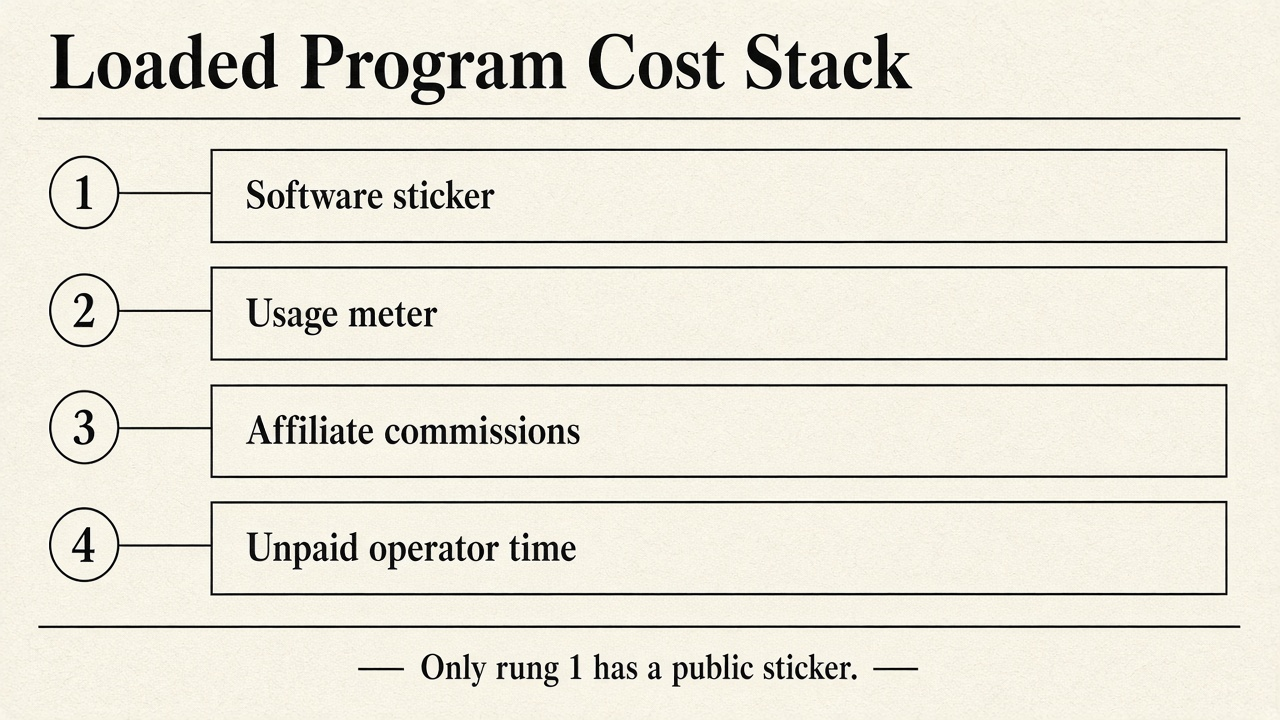
Source: Editorial cost stack synthesizing live 2026-10-06 software cards. Taxonomy diagram, no invented founder hours or feat. fees.
| Tool | Published entry | Next rungs | Meter | Trial |
|---|---|---|---|---|
| Rewardful | $49/mo up to $7,500 aff. revenue | $99 / $15,000; $149+ / $30,000 | 0% txn; optional Managed Payouts 3% | 14 days |
| FirstPromoter | $49/mo up to $5,000 aff. revenue | $99 / $15,000; $149 above $15,000 | Starter 1,000 affiliates | 14 days, no card |
| Tapfiliate | Launch $89/mo ($74 annual) | Scale $179/mo ($149 annual); Enterprise quote | Launch 500 conversions/mo | Launch 7 days |
| Impact | Starter from $30/mo | Essentials $500; Pro $2,500; Enterprise quote | 2.5% on partner-driven txns; unpublished setup fee | — |
| PartnerStack | Launch / Growth / Enterprise | Dollars in a demo | Unpublished on the pricing page | Demo |
| feat. | In-product (no public fee sheet) | In-product | Do not invent | — |
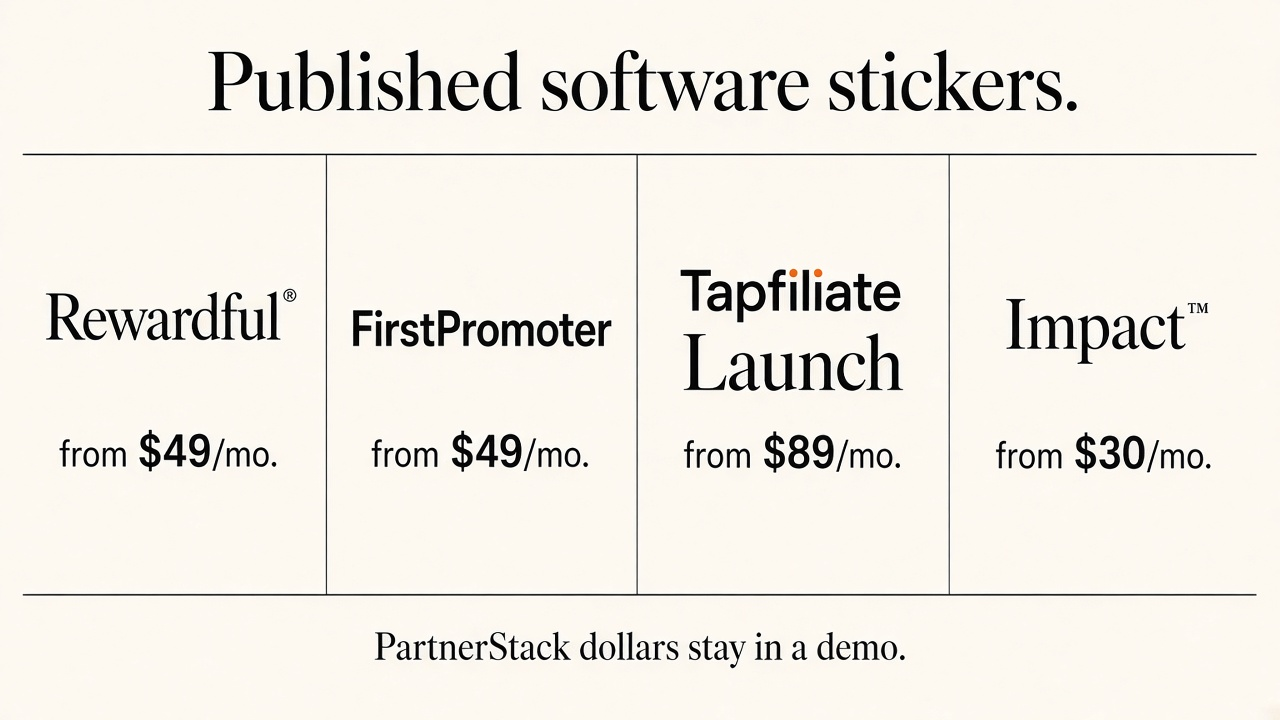
Source: Vendor pricing pages fetched 2026-10-06. https://www.rewardful.com/pricing · https://firstpromoter.com/pricing · https://tapfiliate.com/pricing/ · https://impact.com/integrated-platform-prices/
One Reddit comment upgrades Rewardful at $5,000 of affiliate revenue (r/SaaS). That is FirstPromoter’s Starter cap. Rewardful’s live Starter cap is $7,500. Use the live page.
Another thread says Impact “costs 500 a month however plus a setup fee” (r/SaaS). That matches Essentials, not Starter. Impact’s setup fee exists; the dollar amount is unpublished. There is no public dataset for it.
Pick the meter that matches the motion.
This is the line that will exceed software. Shopify’s planning bands still hold: physical 5%–15%, digital 20%–50%, subscriptions 15%–30% recurring (Shopify). A 25% SaaS cut on $10,000 of referred MRR is $2,500 a month — larger than Impact Pro’s $2,500 sticker before the 2.5% meter.
Do not forecast that $10,000 from roster size. Rewardful’s 1.28% sale activation is the cold-water number (Rewardful). Ten named sellers who already promote you beat 400 open signups.
There is no public dataset for hours per week to run a program. What vendors will say: Rewardful setup is two scripts. PartnerStack implementation is “weeks.” A FirstPromoter customer describes the ongoing work as weekly applications, monthly data, and campaign emails (FirstPromoter). A Tapfiliate customer said building in-house “would have been expensive, especially since we couldn’t predict its success” (Tapfiliate). Those are anecdotes. Do not chart them as a census.
Budget a named owner. If no one owns approvals and payouts, you did not buy a program. You bought a login.
feat. is not a $49 tracker. It is a co-branded storefront fork after you approve a named seller of an existing offer. Live fees stay in-product. Do not invent a public cut to “beat” Rewardful’s $49. If the job is a ?via= on Stripe, buy Rewardful or FirstPromoter. If the job is a page the seller can share, the tracker sticker is the wrong comparison. List the offer on feat. when you can name the people.
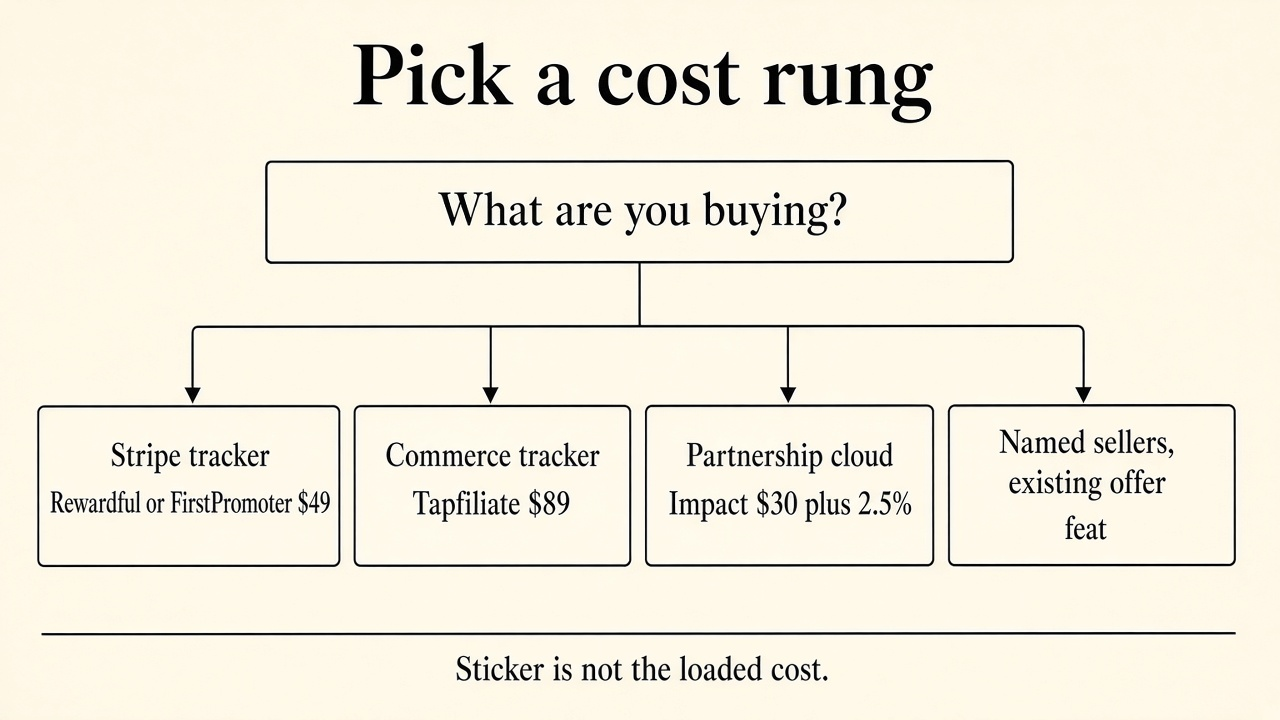
Source: Editorial decision flow from live 2026-10-06 vendor cards. https://www.rewardful.com/pricing · https://tapfiliate.com/pricing/ · https://impact.com/integrated-platform-prices/
These five steps set the loaded cost. Each step is at most two sentences.
Q: How much does it cost to build an affiliate program? A: The loaded cost is software plus a usage meter plus commissions plus unpaid operator time. Published starters are Rewardful and FirstPromoter at $49/month, Tapfiliate Launch at $89/month, and Impact from $30/month plus 2.5% on partner-driven sales. There is no public dataset for founder hours, and feat. fees stay in-product.
Q: How much is Rewardful vs Tapfiliate vs Impact? A: Rewardful starts at $49/month up to $7,500 in affiliate-attributed revenue with a 0% transaction fee. Tapfiliate Launch is $89/month with 500 conversions. Impact starts at $30/month plus 2.5% on partner-driven transactions, with Essentials at $500 and Pro at $2,500.
Q: Do I have to pay commissions on top of software? A: Yes. Software is the tracker or cloud. Commissions are the promise you made to partners. Shopify still frames physical 5%–15%, digital 20%–50%, and subscriptions 15%–30% recurring. Those percents will exceed the sticker once anyone sells.
Q: How long does it take to set up an affiliate program? A: Rewardful describes setup as two scripts. PartnerStack says most teams are up and running in weeks. There is no public dataset for weekly founder hours after go-live. Budget a named owner for approvals and payouts.
Q: Is feat. cheaper than Rewardful? A: That question mixes two jobs. Rewardful publishes $49/month for a Stripe tracker. feat. issues a co-branded storefront and shows live fees in-product. Do not invent a feat. sticker to win a spreadsheet. Pick the destination, then open the live fee screen.
How much it costs to build an affiliate program is a Loaded Program Cost Stack: a public sticker, a usage meter, the commissions you promised, and unpaid time you cannot census. Rewardful and FirstPromoter start at $49. Tapfiliate Launch is $89. Impact starts at $30 plus 2.5%. PartnerStack stays behind a demo. feat. wins when named people should sell an existing offer through a co-branded page — list that offer on feat. and read the in-product fees.
Affiliate marketing for startups is an operating system—locks, cost, recruit, rates, tracking, first 100 sales, then diagnose a flat roster.
How to track affiliate sales: pick link cookie, coupon, pixel, S2S postback, or storefront checkout—then match Rewardful, Tapfiliate, or Impact.
Best affiliate programs for SaaS companies pass the Recurring Cap Test: labeled duration, cookie, seat type, payout rails—plus Rewardful’s ~24% planning band.