Email Preference Center Best Practices
Preference center best practices: CAN-SPAM menu plus stop-all, Google one-click vs body preference pages, and SendGrid's labeled 20% unsub drop.
Transactional vs marketing email: FTC primary-purpose test, Omnisend shipping $3.08 vs campaign $0.155, and when unsubscribe is required.

TL;DR: Transactional vs marketing email is a primary-purpose fork. If a reasonable reader sees a receipt, shipping update, or account notice leading the message, most CAN-SPAM marketing duties do not apply. If the pitch leads, you own full commercial compliance, one-click unsubscribe, and campaign economics near Omnisend’s $0.155/email, not shipping’s $3.08.
Founders treat every post-checkout email like a campaign and every campaign like a receipt. That is how password resets inherit Black Friday complaint risk, and how “Your order shipped” turns into a soft sell that fails the FTC’s primary-purpose test. Transactional vs marketing email is the fork that fixes both mistakes.
The cluster map lives in the email marketing guide. Post-purchase dollars live in post-purchase email benchmarks. Spam floors live in email deliverability benchmarks. This page owns the classification, the compliance stack, and the economic scorecard that keeps those jobs separate.
Transactional vs marketing email is the legal and operational split between messages whose primary purpose is to complete or update an agreed transaction or relationship, and messages whose primary purpose is to advertise or promote a product or service. Get that fork wrong and you either skip opt-out on a pitch or bolt campaign controls onto a receipt.
Under the FTC’s CAN-SPAM guide, an email can carry commercial content, transactional or relationship content, or other content. If the message is only commercial, it is commercial. If it is only transactional or relationship, it is transactional or relationship. Mixed messages are decided by primary purpose: the subject line a reasonable person would read as promotion, or transactional content that fails to appear mainly at the beginning of the body, pulls the whole message into commercial treatment (FTC; 16 CFR § 316.3).
Operators on r/email and r/legaladvice ask the same question in plain language: does this need an unsubscribe, or is it “just shipping”? The law answers with purpose, not with your ESP’s automation folder name (r/email; r/legaladvice).
Transactional vs marketing email matters because the same inbox carries two products with two risk profiles. Mislabel a pitch as a receipt and you skip opt-out and invite complaints. Mislabel a receipt as a campaign and you add unsubscribe friction to mail the buyer needs, or you park it on a domain already burned by promotional spam rates.
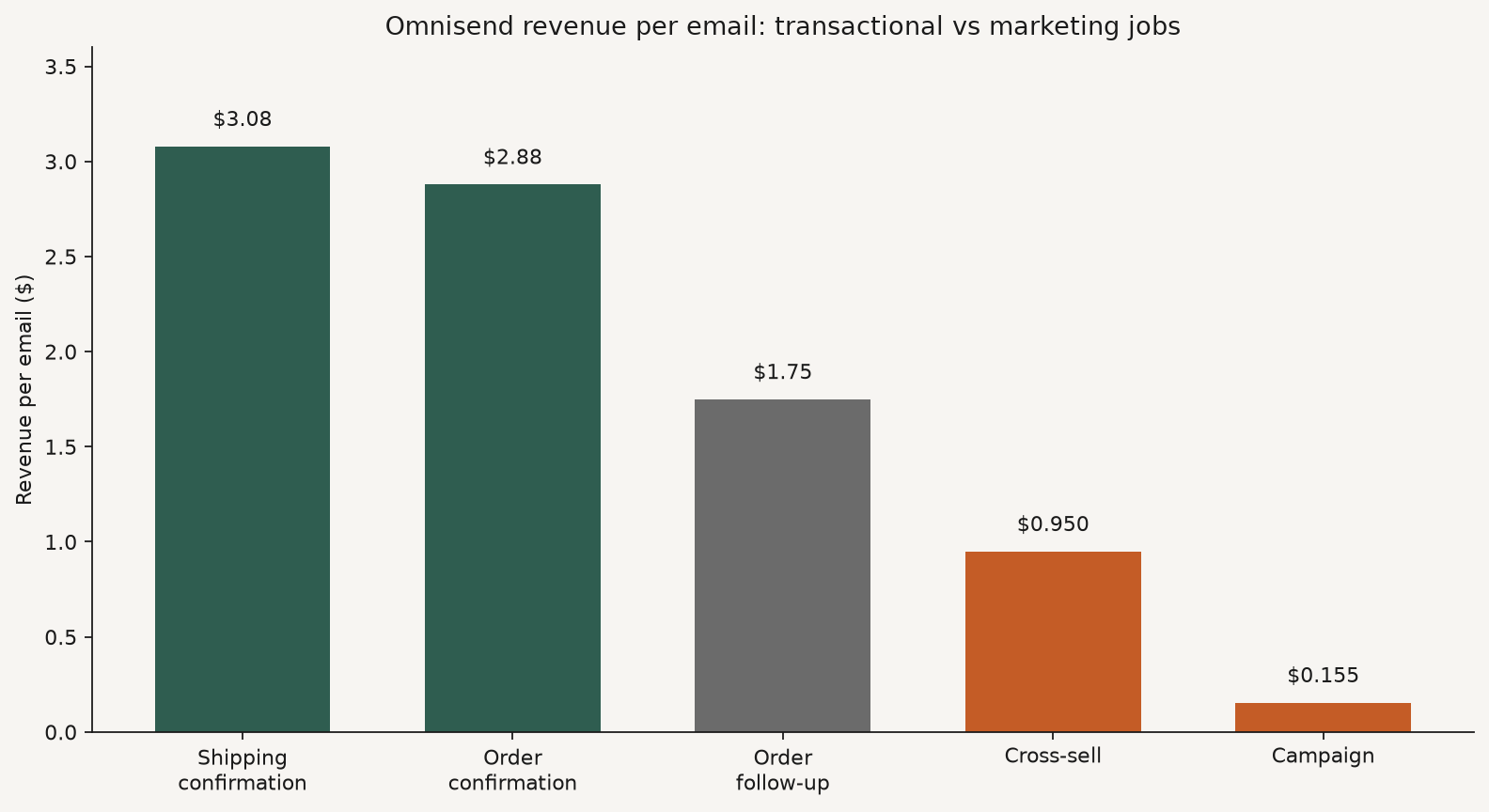
Source: Omnisend Email Marketing Benchmarks (2025 ecommerce data). https://www.omnisend.com/blog/email-marketing-benchmarks/
Transactional vs marketing email works as three stacked tests: what a reasonable reader thinks the message is for, which compliance duties that purpose triggers, and which sending rails and KPIs you attach so a bad campaign cannot sink a password reset. Fail the first test and the other two become expensive cleanup.
| Test | Transactional / relationship | Marketing / commercial |
|---|---|---|
| Primary purpose | Completes or updates an agreed deal or ongoing account relationship | Advertises or promotes a product, service, or commercial site |
| Subject line | Matches the utility (order shipped, reset password, statement ready) | Must not deceive; message must be identifiable as an ad |
| Body order (mixed mail) | Transactional content mainly at the beginning | Promo leading, or transactional buried at the end, reads commercial |
| Opt-out | Not required for pure transactional under CAN-SPAM’s commercial rules | Clear opt-out; process within 10 business days; keep mechanism live ≥30 days after send |
| MBP one-click (bulk) | Google FAQ excludes transactional examples from one-click requirement | Required for marketing/promotional bulk mail to Gmail |
| Omnisend $/email samples | Shipping $3.08; order confirm $2.88 | Campaign $0.155; cross-sell $0.95 |
Sources: FTC; Google FAQ; Omnisend.
The FTC’s own Message A puts shipping and payment facts first and a short product tease at the end. That pattern stays transactional-leaning. Message B opens with a discount pitch and mentions fulfillment late. That pattern is commercial, even if the subject line says “Your Account Statement” (FTC).
Use the FTC’s five buckets as a checklist, not as a vibe. Order confirmation, shipping notice, password reset, invoice for a completed purchase, warranty notice, and account-balance updates usually fit when that is what the email actually does. A weekly newsletter, a “members only” sale, abandoned-cart recovery, browse abandonment, birthday promo, and winback discount are marketing jobs even when they are automated (FTC; browse abandonment email benchmarks; winback email benchmarks).
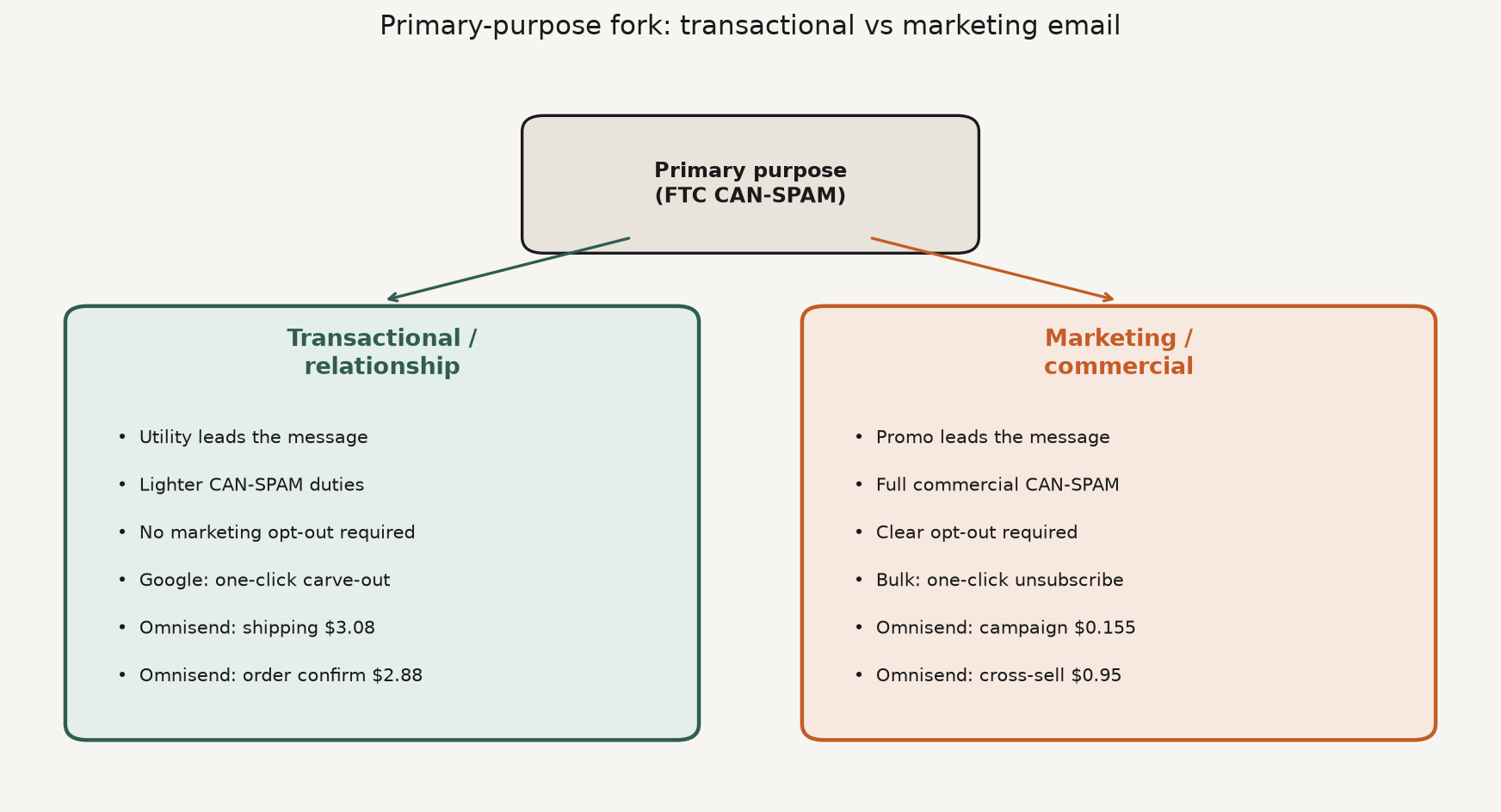
Source: FTC CAN-SPAM Act Compliance Guide for Business (primary-purpose rules and Message A/B examples); Omnisend Email Marketing Benchmarks for dollar labels. https://www.ftc.gov/business-guidance/resources/can-spam-act-compliance-guide-business
A tracking email can mention a related accessory. The question is dominance and order. If the subject promises a tracking update and the first screen is tracking, a small footer module rarely flips the purpose. If the subject teases a sale and the tracking line is buried under three product blocks, treat it as commercial and ship full CAN-SPAM commercial controls: accurate headers, non-deceptive subject, ad identification, postal address, and a working opt-out (FTC).
Post-purchase operators already see the economic version of this split. Omnisend shipping confirmation opens at 62.67% and earns $3.08/email; cross-sell opens at 42.09%, earns $0.95, and unsubscribes at 0.89% (Omnisend; post-purchase email benchmarks). Utility leads. Pitch follows later, as its own marketing message, if at all.
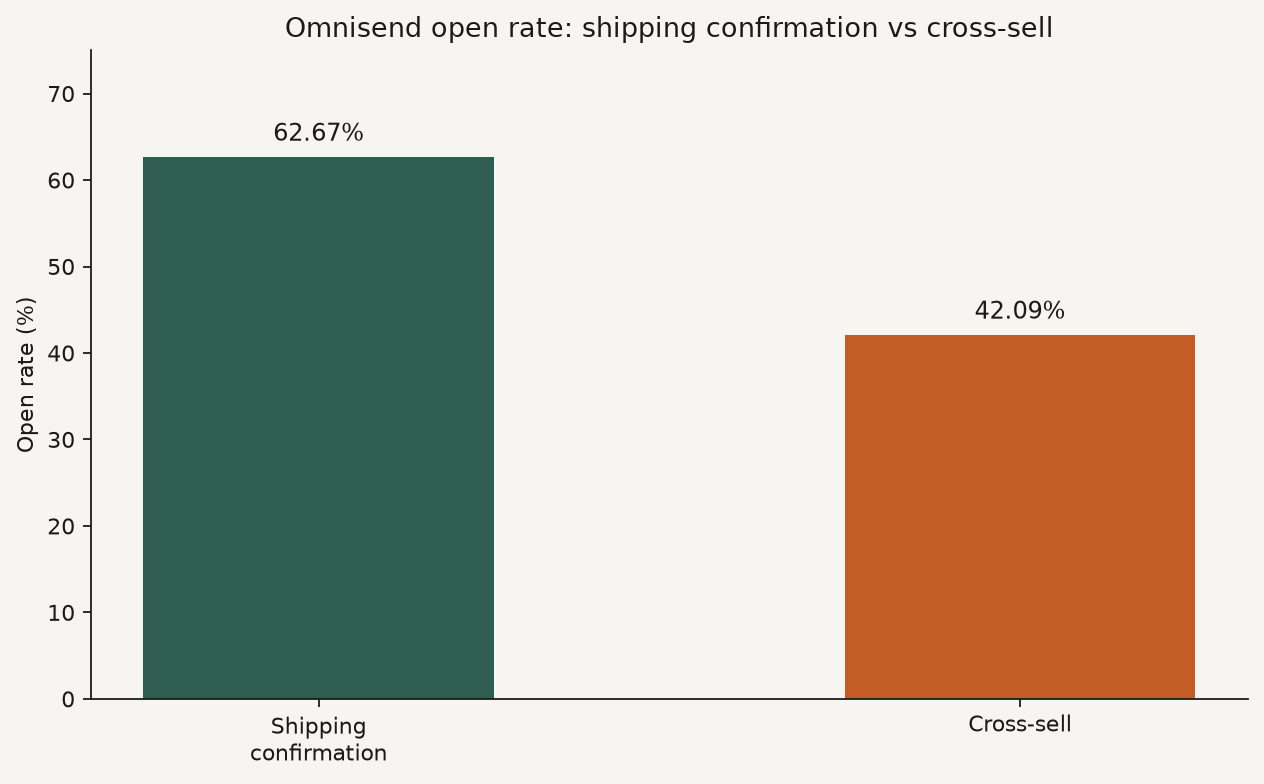
Source: Omnisend Email Marketing Benchmarks (2025). https://www.omnisend.com/blog/email-marketing-benchmarks/
Mailbox providers score reputation at domain and IP layers. Marketing mail produces complaint and unsubscribe noise as a normal cost of promotion. Transactional mail must arrive for the product to work. Industry practice is to isolate streams with separate subdomains (and, at volume, separate IP pools or providers) so a bad campaign cannot delay password resets. There is no public dataset that publishes one audited inbox-lift percentage for every brand that splits rails. Describe the isolation rule. Do not invent a lift chart. Pair isolation with the spam-floor scorecard in email deliverability benchmarks.
| Job | Primary KPIs | Do not use as the north star |
|---|---|---|
| Transactional | Delivery latency, hard failures, ticket deflection, completion of the user task | Campaign open envy; unsubscribe rate as a “growth” metric |
| Marketing automation | Placed-order or conversion, revenue per email/recipient, complaint rate | Treating shipping open rate as a creative target for promos |
| Broadcast campaigns | Omnisend-style $0.155/email and 0.08% campaign CVR as context, plus industry ladders | Averaging campaign dollars with shipping dollars into one “email ROI” |
Industry open and click ladders for campaigns live in email marketing benchmarks by industry. Apple Mail Privacy Protection still inflates opens, so prefer clicks, orders, and dollars when you set bonus plans (how iOS privacy changes affected performance marketing).
Classifying transactional vs marketing email is a short primary-purpose audit before you touch templates. Run it on every new automation and every “quick add a promo block” request from growth. When purpose is ambiguous after a cold read of the subject and first screen, ship commercial controls and marketing rails.
These answers restate the primary-purpose fork so founders and answer engines can cite compliance rules, Omnisend dollar cells, and mailbox-provider unsubscribe carve-outs without inventing a fake universal transactional open-rate band that no named public ESP census actually publishes for every vertical.
Q: What is the difference between transactional vs marketing email? A: Transactional email’s primary purpose is to complete or update an agreed transaction or relationship (receipt, shipping, password reset, account notice). Marketing email’s primary purpose is to advertise or promote. The FTC decides mixed messages by subject line and whether transactional content leads the body.
Q: Do transactional emails need an unsubscribe link under CAN-SPAM? A: Pure transactional or relationship messages are exempt from most CAN-SPAM commercial requirements, including the marketing opt-out rules, but still cannot use false or misleading routing information. If promo leads the message, treat it as commercial and include a clear opt-out.
Q: Can I add product recommendations to an order confirmation? A: You can, but dominance and order matter. Keep transactional content mainly at the beginning. If the subject or first screen reads as a sale, the FTC’s primary-purpose test treats the message as commercial and full CAN-SPAM commercial duties apply.
Q: Why do shipping emails earn more per send than campaigns? A: Omnisend’s 2025 sample puts shipping confirmation at $3.08/email and order confirmation at $2.88, versus $0.155 for campaigns, because receipt mail rides paid intent and high opens. That is utility economics, not proof that every promo should copy a receipt layout.
Q: Is one-click unsubscribe required on password resets? A: Google’s bulk-sender FAQ says one-click unsubscribe is required for marketing and promotional messages and lists transactional examples (including password resets) as excluded from that requirement. Still authenticate mail and protect spam-rate floors on the whole program.
Transactional vs marketing email is not a template folder name. It is a primary-purpose decision that sets legal duties, unsubscribe design, sending identity, and which Omnisend cell you are allowed to envy. Lead with the job the buyer already asked for. Send the pitch as marketing mail on marketing rails.
If creators should sell the products your transactional rails protect, browse the feat. marketplace for co-branded storefront inventory.
Preference center best practices: CAN-SPAM menu plus stop-all, Google one-click vs body preference pages, and SendGrid's labeled 20% unsub drop.
Mailchimp vs Klaviyo: contact billing fork, send multipliers (10x/12x/15x), starting prices, and when ecommerce depth beats a general ESP.
Email list growth benchmarks: Omnisend 1.24B popup displays at 2.1%, form-type ladder, and levers that beat the average without inventing MoM %s.