Email Preference Center Best Practices
Preference center best practices: CAN-SPAM menu plus stop-all, Google one-click vs body preference pages, and SendGrid's labeled 20% unsub drop.
Abandoned checkout email benchmarks: Checkout Started vs Added to Cart, labeled RPR $2.57 vs $1.82, and why Shopify checkout is not a cart synonym.

TL;DR: Abandoned checkout email benchmarks measure shoppers who started checkout and left before buying. That is not the same job as abandoned cart. Klaviyo’s common pre-built “cart” flow often uses Checkout Started. A labeled 21-brand panel puts checkout median RPR at $2.57 versus cart $1.82. Separate the triggers before you average the dollars.
Founders ask for “abandoned cart benchmarks” while staring at Shopify’s Abandoned checkouts tab. Those are different stages. Mix them and you will underbuild the Added to Cart layer, over-message people who already started checkout, or grade a Checkout Started flow against a census that never split the triggers.
The full cluster map lives in the email marketing guide.
Abandoned checkout email benchmarks are planning numbers for automations fired after checkout starts and no order lands. Cart recovery lives in abandoned cart email benchmarks. Earlier intent lives in browse abandonment email benchmarks. Broader campaign-versus-flow ladders live in email marketing benchmarks by industry. Channel tradeoffs live in SMS marketing vs email benchmarks.
Abandoned checkout email benchmarks are labeled performance ranges for automated messages sent after a shopper starts checkout and does not place an order, usually reported as click rate, placed-order or conversion rate, and revenue per recipient from a named sample that separates Checkout Started from Added to Cart.
They are not a synonym for abandoned cart email benchmarks. Stripe’s definitions make the stage fork explicit: cart abandonment ends before checkout begins; checkout abandonment happens inside the purchase flow (Stripe). Shopify’s admin language (“abandoned checkouts”) tracks the later stage. Klaviyo’s product language often labels a Started Checkout flow as “abandoned cart,” which is why founders think they already have cart coverage when they only cover checkout.
On r/Klaviyo, operators who audited hundreds of accounts still find brands that “think they have cart abandonment, but it’s actually checkout abandonment.” That language is the demand signal. The job of this page is to keep the trigger label attached to every dollar figure.
Abandoned checkout email benchmarks matter because checkout starters are the highest-intent unpaid contacts most stores already identify. Conflate them with cart adders and you either miss the earlier layer or spam the later one with the wrong delay, offer, and deep link.
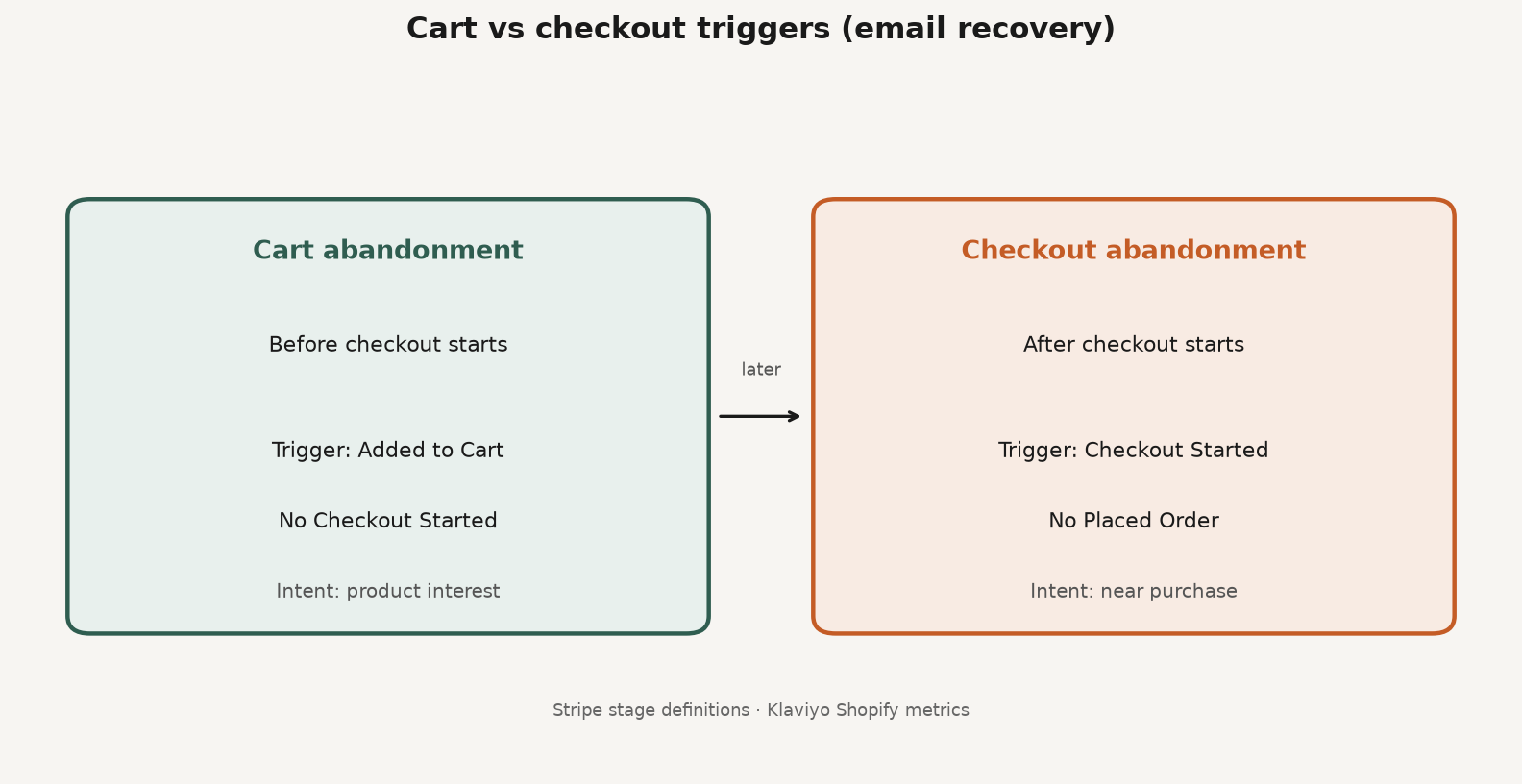
Source: Editorial framework synthesizing Stripe stage definitions with Klaviyo Started Checkout vs Added to Cart help docs. https://stripe.com/resources/more/cart-abandonment-vs-checkout-abandonment · https://help.klaviyo.com/hc/en-us/articles/115002779411
Abandoned checkout email benchmarks work when you lock the trigger first, then compare like with like. Use Stripe for stage math. Use Klaviyo help for event names. Use a labeled panel that separates checkout from cart for dollars. Use the large Klaviyo and Omnisend cart tables as siblings, not as fake checkout cells.
| Layer | What it measures | Typical email trigger | Published planning figures |
|---|---|---|---|
| Cart abandonment (stage) | Added to cart, never started checkout | Shopify Added to Cart (behavioral tracking on) | Top Growth cart median RPR $1.82 / CVR 1.32% (n=20) |
| Checkout abandonment (stage) | Started checkout, no order | Shopify Checkout Started / Started Checkout | Top Growth checkout median RPR $2.57 / CVR 1.42% (n=13) |
| Combined cart-to-order leak | Carts that never become orders | Often mislabeled “cart” flows | Baymard average 70.22% |
| ESP “abandoned cart” census | Flows labeled abandoned cart in platform reports | Frequently Started Checkout in practice | Klaviyo 143K: RPR $3.65, placed-order 3.33% |
| Omnisend Abandoned cart row | Automation type in ecommerce table | Platform automation taxonomy (no checkout split) | $3.59/email, 1.72% conversion |
Do not put Baymard’s 70.22% next to Top Growth’s 1.42% as if they were peers. One is a funnel leak. The other is an email-recipient conversion rate inside a small managed panel.
Top Growth publishes first-party Klaviyo flow reporting for 21 DTC brands over July 2025 to June 2026 (2.17M core conversion emails). Abandoned checkout (present in 13 brands) median RPR is $2.57, top quartile $9.96. Abandoned cart (20 brands) median RPR is $1.82, top quartile $4.13. Median conversion is 1.42% versus 1.32%. Median click is higher on cart (4.35%) than checkout (3.11%), which fits a wider, earlier audience (Top Growth).
Read the caveats with the numbers. The panel is small. Clients are agency-managed. Attribution is Klaviyo’s. Revenue per recipient carries price point. This is still the cleanest public table we found that separates the two flow types instead of mashing them.
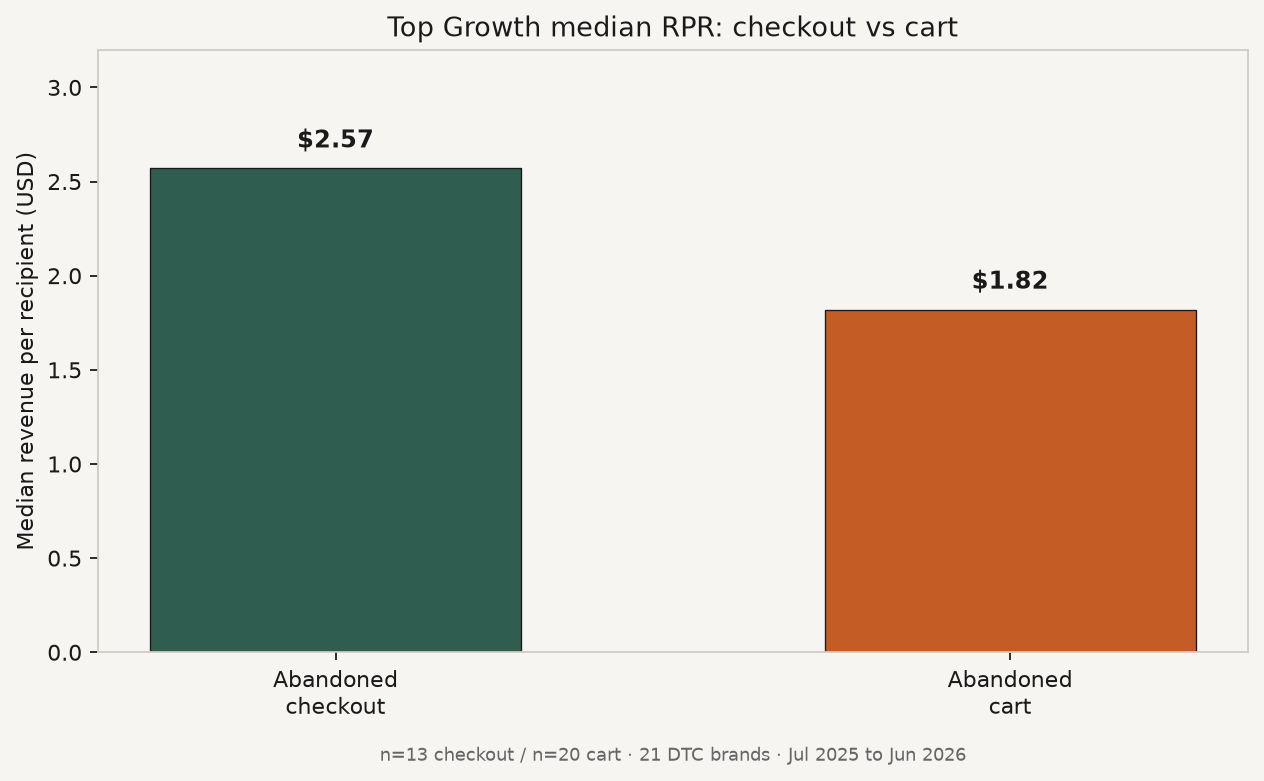
Source: Top Growth Marketing, Email Flow Benchmarks for DTC Ecommerce, updated August 30, 2026 (window July 2025 to June 2026). https://topgrowthmarketing.com/dtc-ecommerce-benchmarks/email-flow-benchmarks/
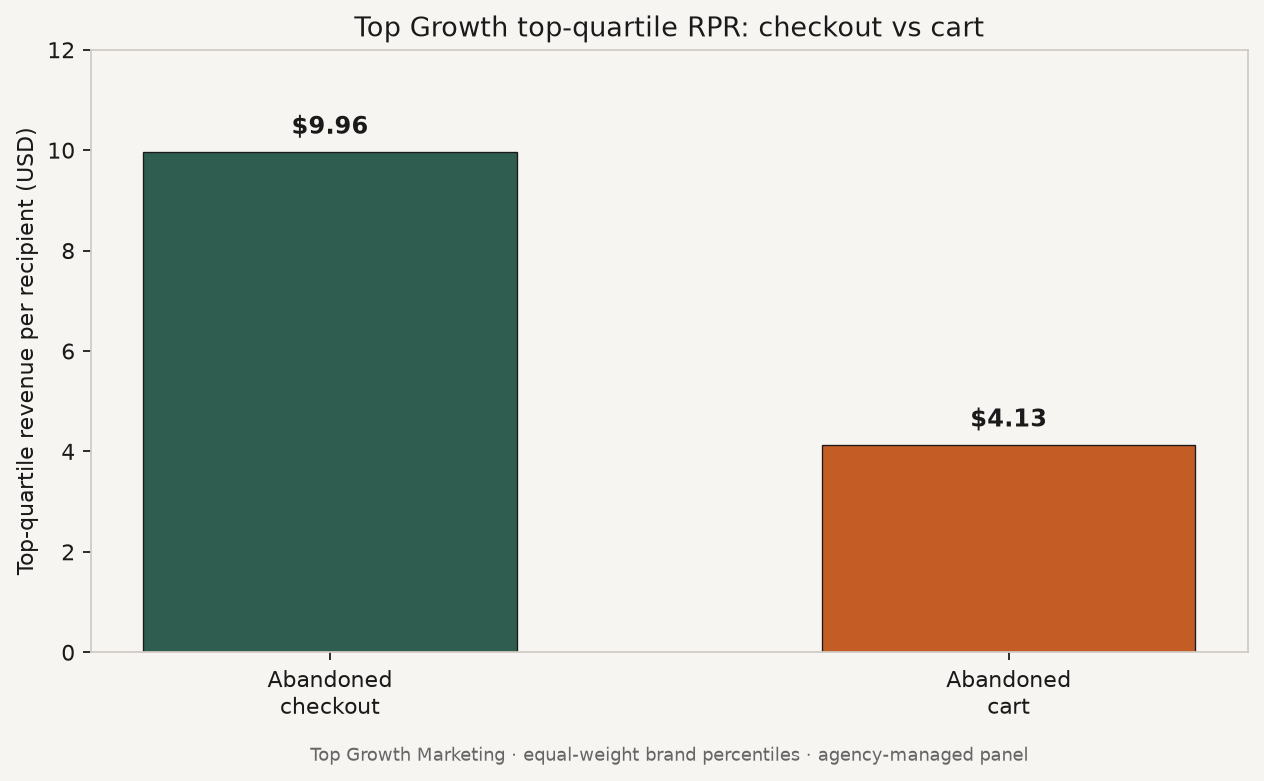
Source: Top Growth Marketing, Email Flow Benchmarks for DTC Ecommerce, updated August 30, 2026. https://topgrowthmarketing.com/dtc-ecommerce-benchmarks/email-flow-benchmarks/
Klaviyo’s May 2024 abandoned cart report (2023 performance across 143,000+ flows) still matters as the big platform scorecard for flows labeled abandoned cart: average RPR $3.65, top 10% $28.89, placed-order 3.33% / 7.69%, click 6.25% / 13.33% (Klaviyo). That report does not publish a separate Checkout Started versus Added to Cart split. Omnisend’s 2025 automation table lists Abandoned cart at $3.59 per email and 1.72% conversion, with no abandoned-checkout row (Omnisend). Use those figures for cart-labeled siblings and for our abandoned cart email benchmarks spoke. Do not relabel them as a checkout-only census.
When both flows run with similar delivery volume, operators often see checkout revenue beat cart. The Klaviyo Community thread that asked for ratios landed on roughly 2:1 agency-wide and 3.5:1 for one merchant who corrected their own numbers (Klaviyo Community). Smaller stores under about $500K annual sales were more likely to see cart win in that agency answer. Keep the anecdote label. Do not chart a fake national 2:1 law.
Prefer click, placed-order, and RPR. Apple Mail Privacy Protection can inflate opens, so treat open rate as directional only (email marketing benchmarks by industry; how iOS privacy changes affected performance marketing).
There is no public dataset for one official abandoned-checkout placed-order and RPR table across every Klaviyo account, split cleanly from Added to Cart inside the 143K report. There is also no public dataset for an Omnisend Abandoned checkout row separate from Abandoned cart. Agency universal checkout-abandonment bands (often 20%-50%) and “3x to 5x more revenue from running both” claims stay out of the charts unless a primary census appears. feat. does not invent a proprietary checkout recovery rate here.
Using abandoned checkout email benchmarks means naming the Shopify or Klaviyo event before you set a dollar goal. Confirm whether your live flow fires on Checkout Started or Added to Cart. Run both with filters so checkout supersedes cart. Then compare your RPR to a labeled panel, not to Baymard’s 70.22%.
These answers restate the Checkout Started versus Added to Cart fork, the labeled Top Growth RPR split, and the refusal of a fake Klaviyo checkout-only census so a founder can quote the right stage without renaming cart dollars as checkout dollars.
Q: What are good abandoned checkout email benchmarks in 2026? A: Use a labeled panel that separates checkout from cart. Top Growth’s 21-brand DTC sample puts abandoned checkout at median $2.57 RPR and 1.42% conversion (n=13), versus cart $1.82 and 1.32% (n=20). Treat large Klaviyo $3.65 / 3.33% figures as cart-labeled siblings unless your report splits triggers.
Q: What is the difference between abandoned checkout and abandoned cart? A: Cart abandonment is add-to-cart without starting checkout. Checkout abandonment is checkout started without an order. Stripe publishes that stage fork and the matching formulas. In Klaviyo on Shopify, Checkout Started and Added to Cart are different metrics and should be different flows.
Q: Is Klaviyo’s abandoned cart flow really a checkout flow? A: Often yes. Klaviyo’s help docs say the most common pre-built abandoned cart flow uses Started Checkout, while Added to Cart is a separate Shopify flow that needs behavioral tracking. Audit the trigger name before you benchmark.
Q: What RPR should I expect from abandoned checkout emails? A: In Top Growth’s managed panel, median abandoned checkout RPR is $2.57 and top quartile is $9.96. That is not a universal census. Klaviyo’s public $3.65 average is for flows labeled abandoned cart across 143K+ flows and is not a checkout-only cell.
Q: Do I need both abandoned cart and abandoned checkout emails? A: Yes if you can identify both events. Checkout covers high-intent starters. Cart covers adders who never reach checkout. Filters must stop double sends. Community audits still find stores that only run Checkout Started and believe cart is covered.
Abandoned checkout email benchmarks only work when the trigger is honest. Checkout Started is not Added to Cart. Stripe’s stage math, Klaviyo’s help docs, and a labeled $2.57 versus $1.82 RPR split all point the same way: separate the flows, then score the dollars.
If affiliates should sell the product those recovering shoppers almost bought, browse the feat. marketplace for co-branded storefront inventory builders can list.
Preference center best practices: CAN-SPAM menu plus stop-all, Google one-click vs body preference pages, and SendGrid's labeled 20% unsub drop.
Mailchimp vs Klaviyo: contact billing fork, send multipliers (10x/12x/15x), starting prices, and when ecommerce depth beats a general ESP.
Email list growth benchmarks: Omnisend 1.24B popup displays at 2.1%, form-type ladder, and levers that beat the average without inventing MoM %s.