Affiliate Marketing for Startups: Complete Guide
Affiliate marketing for startups is an operating system—locks, cost, recruit, rates, tracking, first 100 sales, then diagnose a flat roster.
Affiliate vs referral marketing: customer rewards vs partner commissions, ReferralCandy 2.35% vs Rewardful 1.28% activation, and when to run both.

TL;DR: Affiliate vs referral marketing is an identity fork first. Referral pays existing customers (often double-sided) to bring friends. Affiliate pays external partners commission for tracked sales. Plan referral with ReferralCandy’s ~2.35% referral-rate baseline and affiliate with Rewardful’s 1.28% sale-activation reality, then run both only with separate structures.
Founders say they launched an “affiliate program” when they really emailed customers a give-$20-get-$20 link. That mix-up burns trust twice. Affiliates quit when the reward looks like a coupon. Customers feel bribed when you talk like a network. Separate the jobs before you pick software.
Affiliate vs referral marketing is the choice between paying existing buyers to recruit friends and paying external partners to distribute. It sits next to brand ambassador vs affiliate, how affiliate marketing works, referral program benchmarks, affiliate commission structures, revenue split models, and FTC disclosure rules.
Affiliate vs referral marketing means comparing two performance acquisition programs by who promotes: an existing customer (referral) versus an external partner such as a creator or publisher (affiliate). Same tracking idea. Different relationship, reward shape, and success metric. Get the identity wrong and every later choice is noise.
Shopify’s 2026 explainer draws the same line: the referrer is usually a customer, while the affiliate is a professional partner with an audience (Shopify). Community threads say the quiet part out loud: if you launch an “affiliate program” but only recruit customers, you built a referral program and should pay like one.
Do not confuse this fork with affiliate vs influencer. Influencer deals can be flat fee, hybrid, or CPS. Referral is not a creator rate card. It is friendship with a tracking code.
The distinction matters because the wrong reward and the wrong scorecard make a working channel look broken. Friendship scales with your customer base. Distribution scales with partner recruitment. Merge them and you underpay the partner who needs cash and overcomplicate the customer who wanted a simple credit.
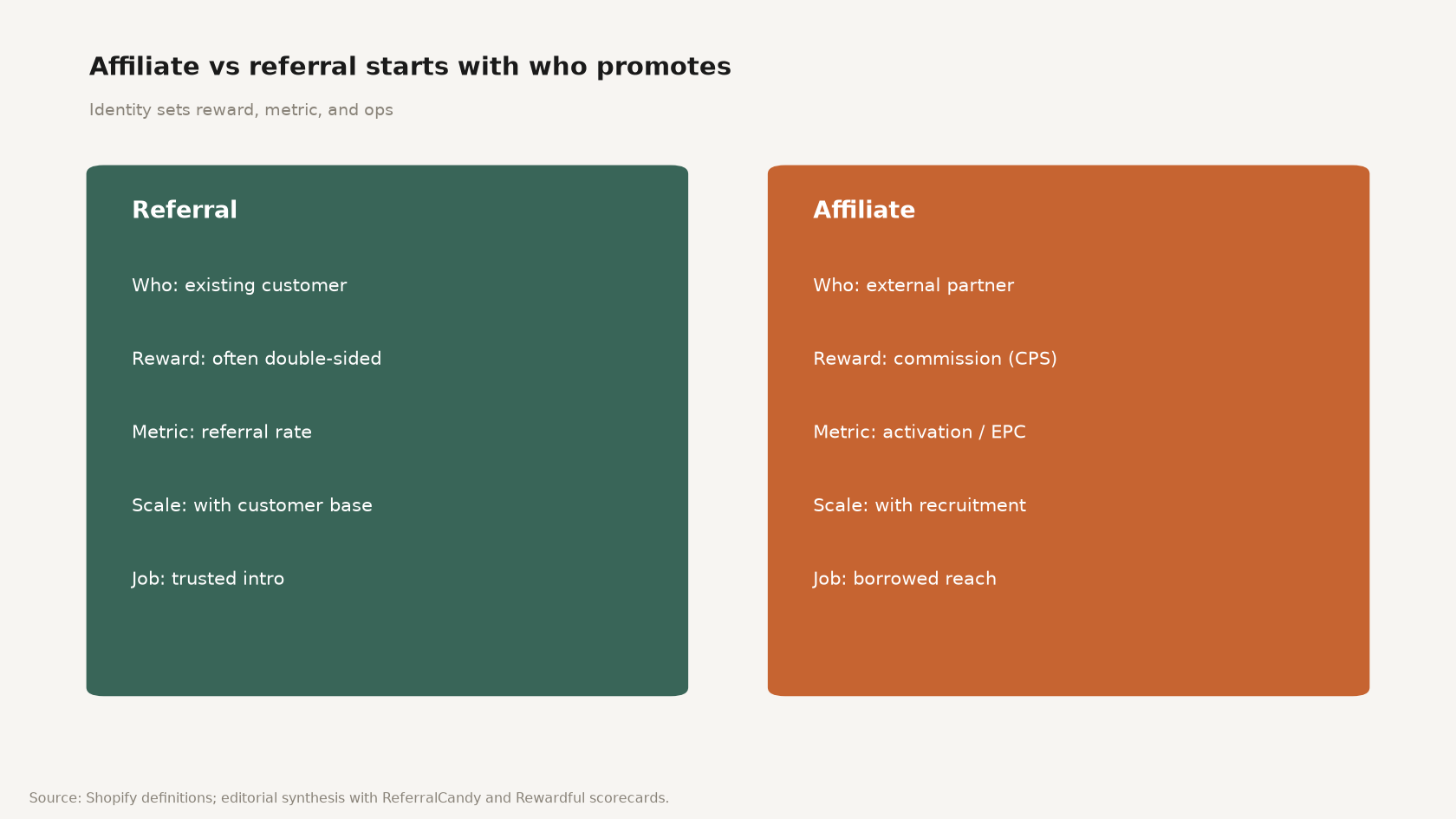
Source: Editorial framework synthesizing Shopify definitions with ReferralCandy and Rewardful scorecards. https://www.shopify.com/blog/referral-vs-affiliate-marketing
Affiliate and referral programs differ in practice across promoter, reward, metric, ops load, and disclosure surface. Start with identity. Then pick the scorecard that matches that identity. Only then set the dollar math on a real order size you can defend.
| Dimension | Referral marketing | Affiliate marketing |
|---|---|---|
| Who promotes | Existing customers / users | External partners (creators, publishers, agencies) |
| Typical reward | Double-sided credit, discount, or gift | Percentage or flat commission (CPS/CPA/etc.) |
| Core metric | Referral rate (referred purchases ÷ total purchases) | EPC, CVR, activation %, partner revenue |
| Scale path | Grows with customer base and product love | Grows with recruitment and partner enablement |
| Message control | Often templates and share cards | Partner creative; needs guidelines and vetting |
| Primary risk | Weak product or awkward bribe feel | Fraud, brand mismatch, idle signups |
| Disclosure | Material connection when incentives exist | Material connection for commissions / free product |
Definitions align with Shopify. Metrics align with ReferralCandy and Rewardful. Commission event types live in affiliate commission structures.
| Scorecard | Published figure | What it measures | Source |
|---|---|---|---|
| Referral rate (global) | ~2.35% | Share of purchases that came through referral | ReferralCandy |
| Referral rate (software / digital) | ~4.75% | Same metric in that industry tag | ReferralCandy |
| Affiliates who generate a referral | 7.6% | Partner activation into traffic | Rewardful (SaaS) |
| Affiliates who generate a sale | 1.28% | Partner activation into revenue | Rewardful (SaaS) |
| Average affiliate commission rate | 24.16% | Typical percentage payout in sample | Rewardful (SaaS) |
These rows are not interchangeable percentages of the same thing. 2.35% is a share of store purchases. 1.28% is a share of enrolled affiliates. Founders who average them invent a fake KPI. There is no public dataset in this article that publishes one universal conversion lift of “referral vs affiliate” across every category.
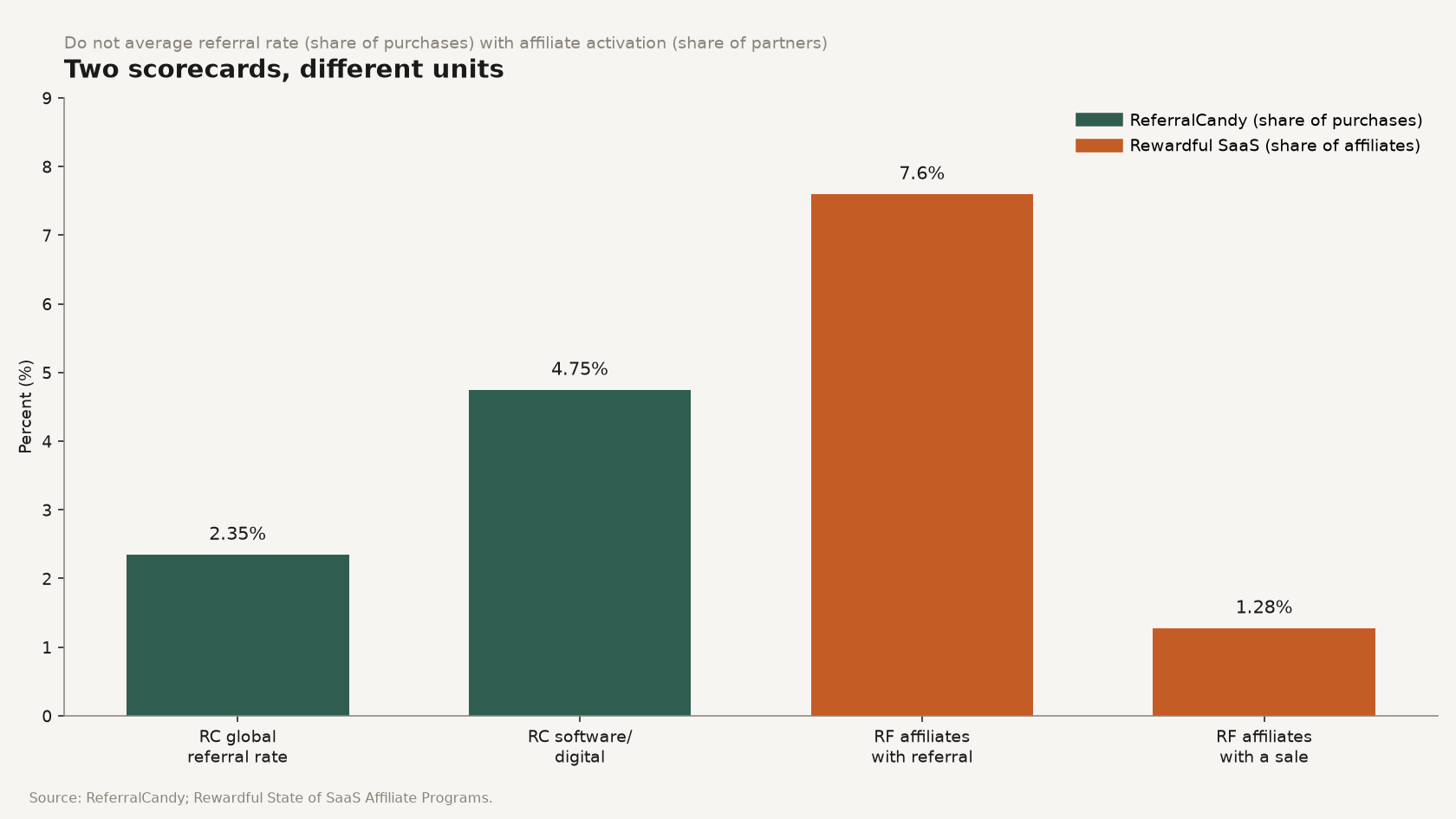
Source: ReferralCandy referral rates (global 2.35%, software/digital 4.75%); Rewardful State of SaaS Affiliate Programs (7.6% referral / 1.28% sale). https://www.referralcandy.com/blog/referral-rates/ ; https://www.rewardful.com/articles/state-of-saas-affiliate-programs-report
Run a labeled example, not a fake industry mean. ReferralCandy’s offer guidance puts advocate discounts often in the 10%-25% of AOV band, cash rewards in a similar band of the friend’s purchase, and friend incentives at a minimum near 10% of AOV (ReferralCandy). On a $100 order, a clean give $20 / get $20 double-sided offer is $40 of incentive cost if both sides redeem.
On the affiliate side, Rewardful’s SaaS sample averages 24.16% commission (Rewardful). On that same $100 sale, commission is about $24.16 before holds and refunds. Shopify’s published category bands still matter for program design: physical goods often near 5%-15%, digital near 20%-50%, subscriptions near 15%-30% recurring (Shopify).
| Labeled $100 sale | Referral example (give $20 / get $20) | Affiliate example (24.16% CPS) |
|---|---|---|
| Cash leaving the merchant | $40 incentives (if both redeem) | ~$24.16 commission |
| Who gets paid | Advocate + friend | Affiliate partner |
| What you bought | A trusted intro inside a personal network | Distribution from a partner audience |
| Caveat | Inside RC guidance bands; not a census mean | Rewardful SaaS average; set your own band |
The cheaper line item is not automatically the better channel. Referral can raise retention and CLV quality. Affiliate can open markets your customers will never reach. Price the job.
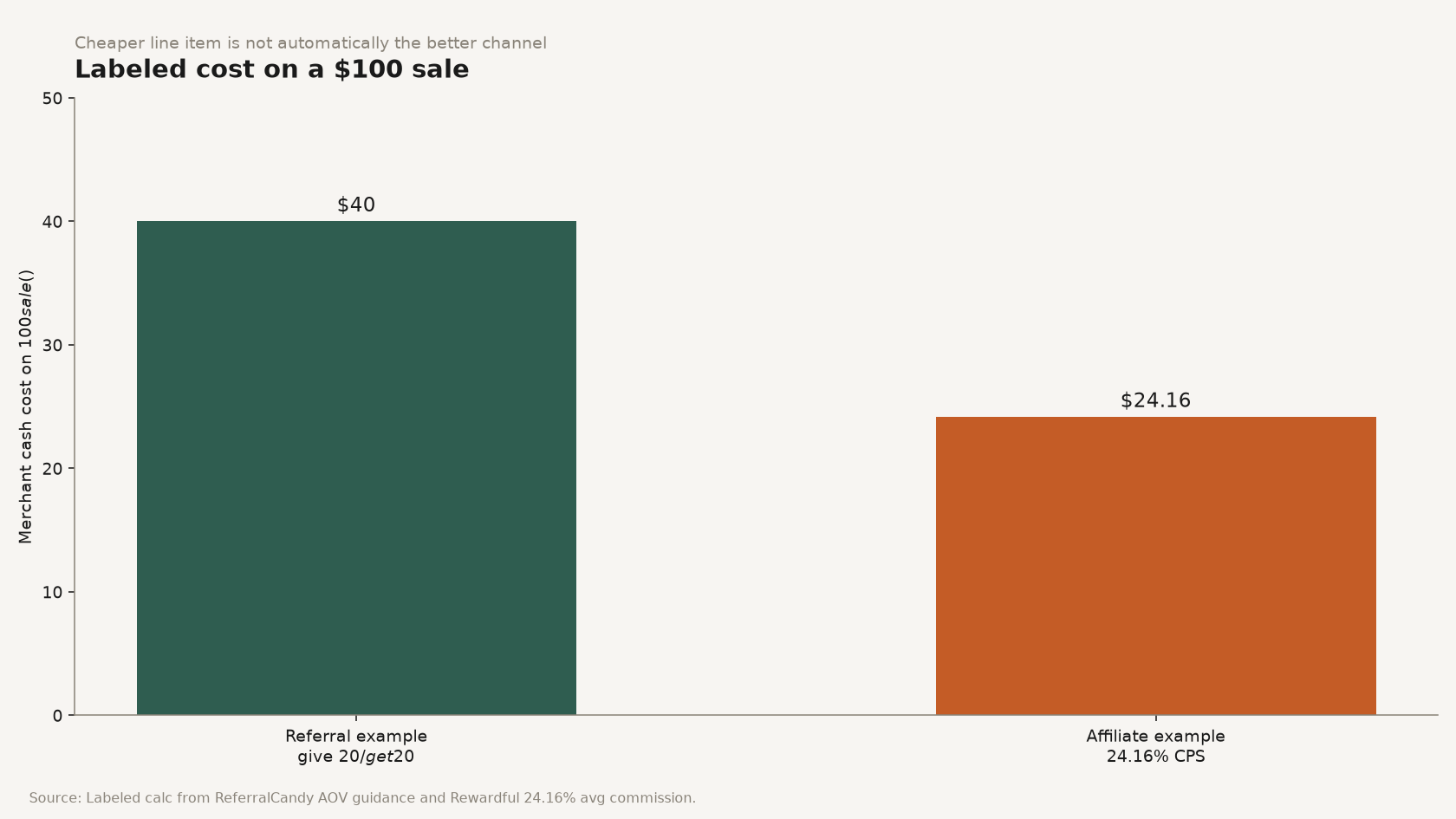
Source: Labeled calculation from ReferralCandy 10%-25% of AOV guidance and Rewardful 24.16% average commission. https://www.referralcandy.com/blog/referral-rates/ ; https://www.rewardful.com/articles/state-of-saas-affiliate-programs-report
These answers restate the identity fork, the two scorecards, and the labeled $100 cost example. Use them when someone asks which program to launch first. Open the comparison table before you pick software or a single blended payout rate.
Q: What is the difference between affiliate vs referral marketing? A: Referral marketing pays existing customers to recommend you, often with double-sided rewards. Affiliate marketing pays external partners a commission for tracked conversions. The promoter identity, reward shape, and primary metric all change.
Q: Is a referral program the same as an affiliate program? A: No. If only customers promote you for credits or discounts, it is a referral program. If external creators or publishers promote you for commission, it is an affiliate program. Using one label for both usually means the wrong payout design.
Q: What referral rate and affiliate activation numbers should I plan around? A: ReferralCandy’s global referral-rate baseline is about 2.35% of purchases after roughly six months (software/digital near 4.75%). In Rewardful’s SaaS affiliate sample, about 1.28% of affiliates generate at least one sale. Do not average those figures.
Q: Which costs more on a $100 sale, referral or affiliate? A: It depends on the offer. A labeled give $20 / get $20 referral costs $40 if both redeem. A 24.16% CPS affiliate costs about $24.16 in that Rewardful average sample. Compare jobs and LTV, not only the line item.
Q: Can I run affiliate and referral marketing together? A: Yes, and many brands should. Keep separate reward structures, dashboards, and onboarding. Disclose material connections on both. Treat influencer flat fees as a third lane when you are buying a post rather than a tracked sale.
Affiliate vs referral marketing is who you pay and what scoreboard you trust. Referral turns happy customers into advocates against a ~2.35% purchase-share baseline. Affiliate turns external partners into distribution against a harsh activation funnel. Price honestly, disclose incentives, and refuse one blended program.
If you want a marketplace path where merchants list and affiliates sell through co-branded storefronts, start at feat..
Affiliate marketing for startups is an operating system—locks, cost, recruit, rates, tracking, first 100 sales, then diagnose a flat roster.
How to track affiliate sales: pick link cookie, coupon, pixel, S2S postback, or storefront checkout—then match Rewardful, Tapfiliate, or Impact.
Best affiliate programs for SaaS companies pass the Recurring Cap Test: labeled duration, cookie, seat type, payout rails—plus Rewardful’s ~24% planning band.