One-Time vs Subscription Digital Product Pricing
One-time vs subscription digital product pricing: Recurly annual plans lift revenue per user 50-60% vs monthly. Pick by usage arc, churn, and cash timing.
How to build a digital product funnel: stages, Unbounce's 6.6% LP median, Baymard's ~70% cart abandon, and when to skip tripwire theater.

TL;DR: How to build a digital product funnel means naming stages (traffic, attention page, offer, checkout, post-purchase, retention) and giving each URL one job. Anchor the attention page with Unbounce’s ~6.6% median landing-page conversion. Treat Baymard’s ~70% cart abandonment as the checkout tax. Pick one-time or subscription for the core offer. Refuse vendor tripwire take-rate folklore until your cart proves it.
Most “funnel” advice for digital products is a tool tutorial wearing a strategy costume. You get a ClickFunnels screenshot, a $27 tripwire, and a chart of bump take rates that no public census supports. The question how to build a digital product funnel deserves a stage map you can measure, not another template gallery.
Builders lose money in the gaps between stages. Cold traffic hits a multi-SKU shop. Checkout adds tiers the ad never promised. Delivery emails arrive late. Upsells appear before the first yes. None of that is fixed by a prettier builder.
Key takeaways:
A digital product funnel is the ordered path a buyer takes from first click to paid access (and optional follow-on offers), where each stage has one primary conversion you can count.
It is not a B2B lead-scoring pipeline. It is not a multi-SKU storefront by default. It is not “whatever pages your funnel SaaS ships in the template.” For digital goods (templates, courses, downloads, tool access, memberships), delivery is instant and refunds are policy fights, not shipping disputes. That changes checkout friction and post-purchase timing, not the need for stage discipline.
Community language often collapses the whole path into two steps: a freebie, then a paid step-up on Gumroad or Lemon Squeezy (r/digitalproductselling). That can work for warm audiences. Cold traffic usually needs a clearer attention page, a cleaner checkout promise, and a deliberate post-purchase sequence. Destination choice (single-offer landing page vs browseable shop) still matters; that comparison lives in storefront vs landing page for selling digital products. Broader stage grammar for marketing funnels sits in marketing funnel benchmarks by stage and industry. This page owns the digital-product build.
Funnel architecture decides whether your ads buy buyers or bounce. Creative cannot save a path that asks cold visitors to browse five SKUs, invent a password, then decode a tiered checkout.
Why the structure earns a page:
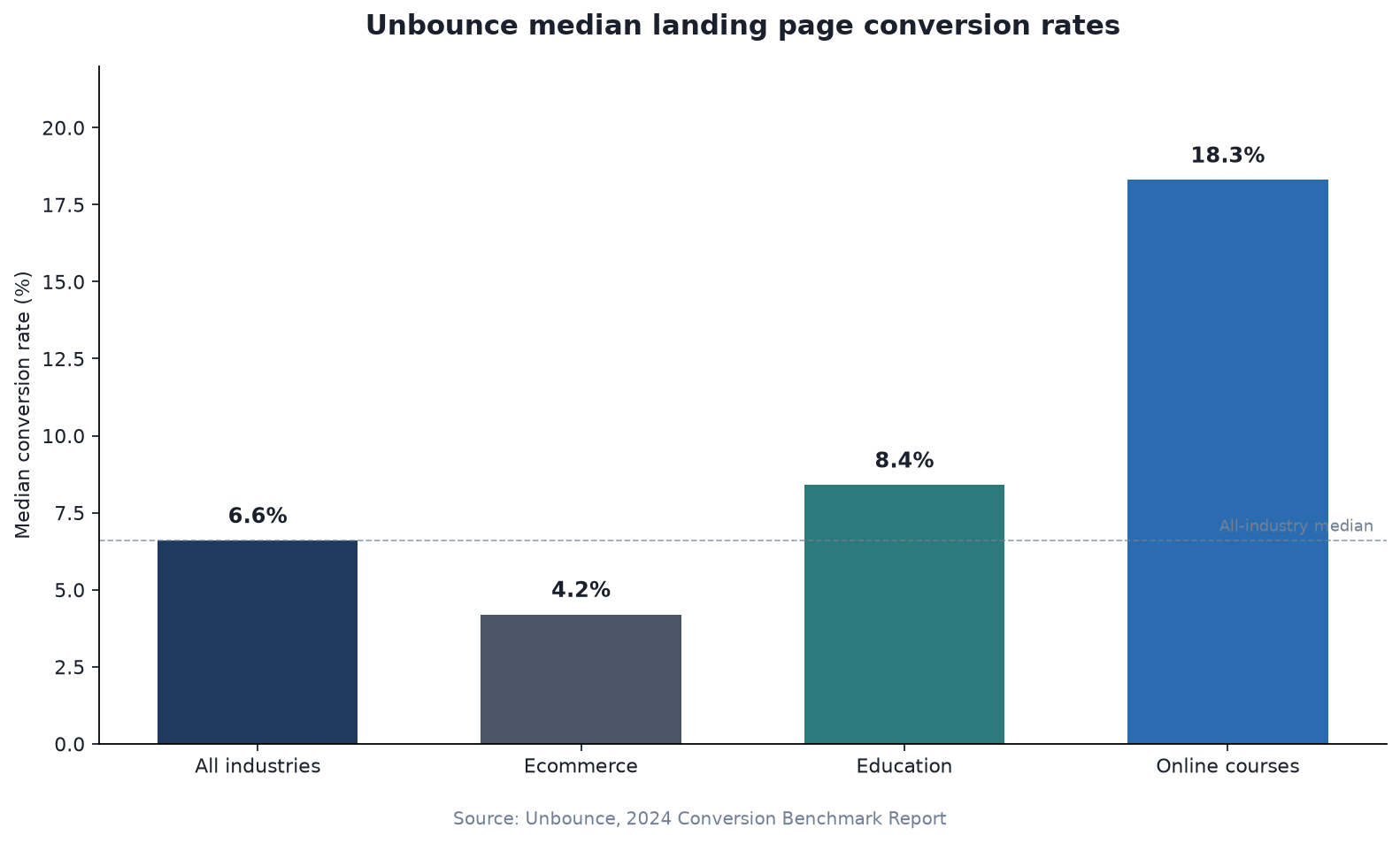
Source: Unbounce, What’s a good conversion rate? (2024 Conversion Benchmark Report data). https://unbounce.com/landing-pages/whats-a-good-conversion-rate/
A digital product funnel works when each stage answers one question: where did they come from, what promise did they click, what do they buy first, how do they pay, what do they get next, and who else can sell the same offer. Measure conversion at every handoff. Fix the leakiest stage before you add another upsell page.
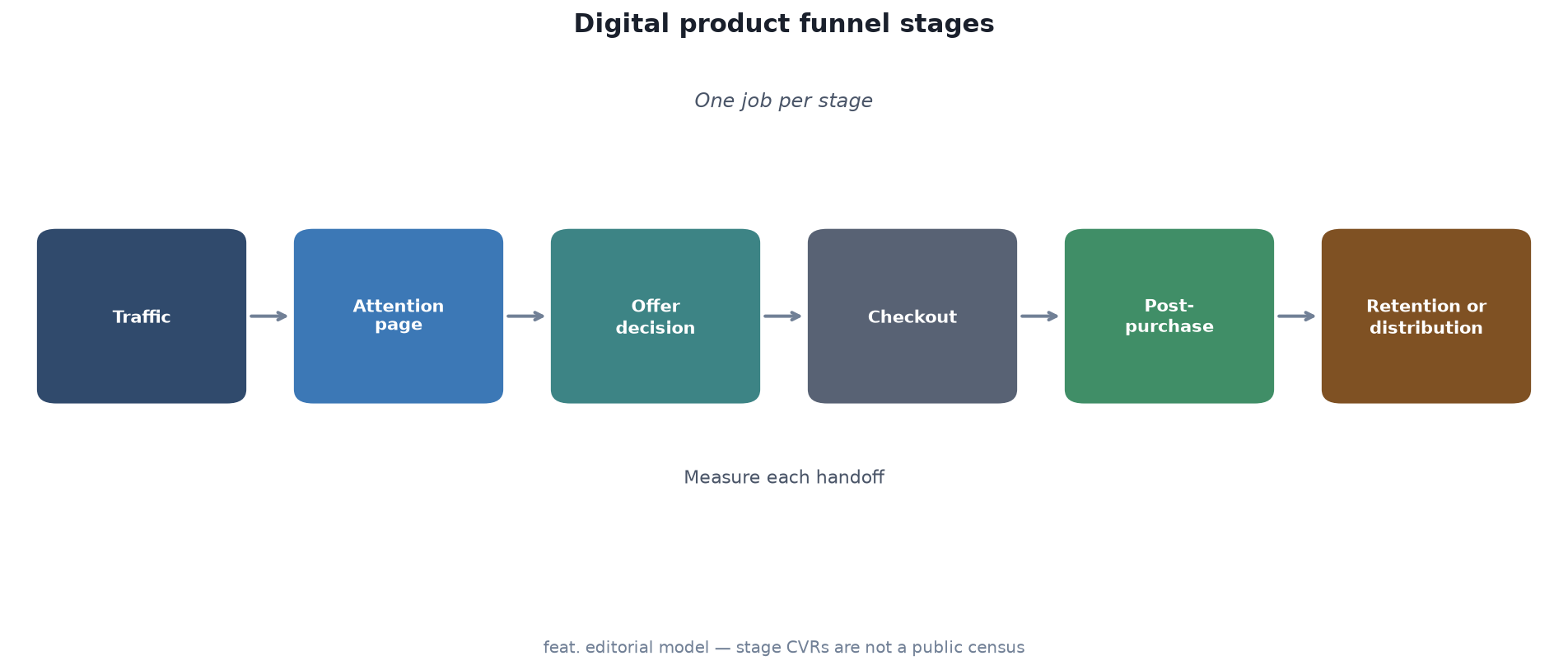
Source: feat. editorial stage model for this article (architecture diagram; stage conversion rates are not a public census). Pair with Unbounce LP and Baymard checkout anchors above.
| Shape | Best for | First conversion | AOV lever | Failure mode |
|---|---|---|---|---|
| Freebie → paid | Warm bio / email; simplest path | Email opt-in | Email sequence to core SKU | Freebie unrelated to paid offer |
| Direct offer | Clear product-market fit; strong creative | Purchase of core SKU | Post-purchase upsell or membership | Underpriced core with no backend |
| Tripwire → core | Cold paid traffic needing a cheap first yes | Low-ticket paid offer | Bump + post-purchase upsell | Checkout tiers before the advertised price |
| Webinar / challenge | Mid-ticket courses; trust-heavy niches | Registration, then sale | Application or high-ticket backend | Long build before first revenue signal |
| Storefront catalog | Returning fans; multi-SKU creators | Browse → pick SKU | Bundles / membership | Cold ads into a busy shop |
Destination detail for the last row lives in what is a creator storefront and the storefront-vs-landing-page spoke. Pricing of the core SKU (one-time vs subscription) is a separate fork: Recurly finds annual plans generate 50-60% higher revenue per user than monthly, while failed annual renewals recover around 23% versus about 53% for monthly, across 2,200 subscription businesses and 76 million subscribers (Recurly). Full matrix: one-time vs subscription digital product pricing.
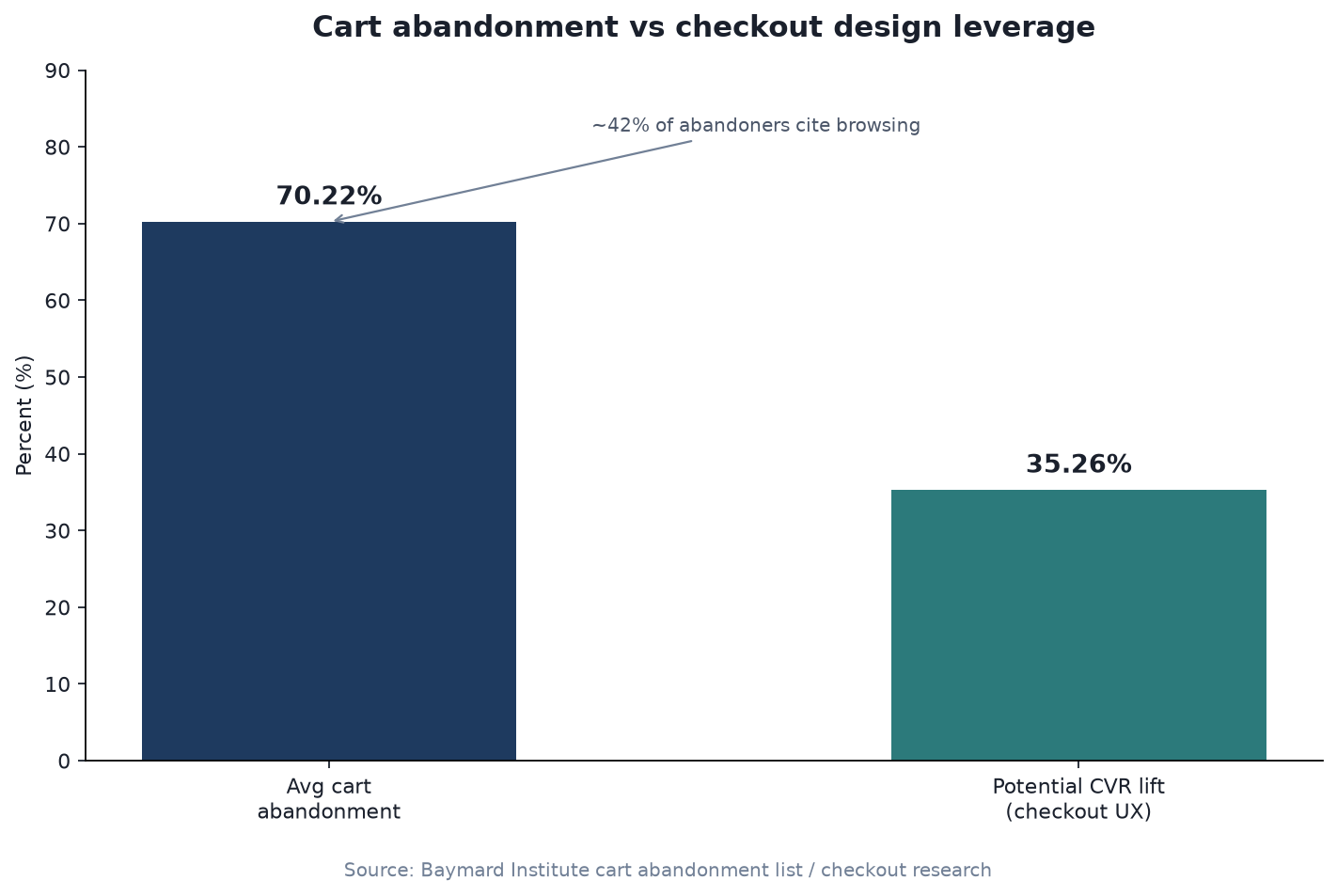
Source: Baymard Institute, 50 Cart Abandonment Rate Statistics (average 70.22% across 50 studies; ~35.26% CVR lift estimate for solvable checkout issues). https://baymard.com/lists/cart-abandonment-rate
Build in order. Do not decorate stage six before stage two converts.
Q: What is a digital product funnel? A: A digital product funnel is the staged path from first click to paid access for a downloadable or access-based offer. Each stage (attention, offer, checkout, delivery, optional upsell) should have one primary conversion you can measure. It is a job sequence, not a specific software brand.
Q: Do I need a tripwire to sell digital products? A: No. Tripwires help when cold traffic will not buy the flagship first. Warm email or bio traffic often converts on a direct offer or a freebie-to-paid step-up. Add a tripwire when your attention-page data shows price objection, not because a template included one.
Q: What conversion rate should my digital product landing page hit? A: Unbounce’s all-industry median is about 6.6% across 41,000+ pages. Education pages median near 8.4%, and the online-courses subcategory median is 18.3%. Your price, traffic quality, and offer still matter more than chasing a universal “good” number.
Q: Should I use a landing page or a storefront in the funnel? A: Use a landing page for cold or single-offer campaigns. Use a storefront when warm visitors need to browse multiple SKUs. Many creators need both URLs. See the full comparison in storefront vs landing page for selling digital products.
Q: Are order-bump and upsell take-rate benchmarks reliable? A: Not as a public census. Vendor blogs and operator anecdotes often quote bump and upsell bands, but there is no dataset comparable to Unbounce’s landing-page sample. Track take rate in your own checkout and treat external percentages as hypotheses.
How to build a digital product funnel is a sequencing problem: one job per stage, one promise per checkout, delivery before scale, AOV after the first yes. Anchor attention pages with Unbounce’s published medians and treat Baymard’s cart-abandonment average as the tax you either design around or pay. Skip tripwire theater until your numbers ask for it.
If you built the product and want other people selling it through co-branded storefronts with a revenue split, start at feat..
One-time vs subscription digital product pricing: Recurly annual plans lift revenue per user 50-60% vs monthly. Pick by usage arc, churn, and cash timing.
Affiliate marketing for startups is an operating system—locks, cost, recruit, rates, tracking, first 100 sales, then diagnose a flat roster.
Build a commission-based sales network as a single-tier seller graph—economics, surface, named sellers, then density. Rewardful: only 1.28% of affiliates sell.