Email Preference Center Best Practices
Preference center best practices: CAN-SPAM menu plus stop-all, Google one-click vs body preference pages, and SendGrid's labeled 20% unsub drop.
Email frequency benchmarks: MailerLite cadence ladder shows irregular sends unsub at 0.87% vs 0.33% at twice weekly; start at 1-2 campaigns/week.

TL;DR: Email frequency benchmarks are a campaign-cadence scorecard. MailerLite’s 2025 sample (42,000+ accounts; 12B+ emails) shows irregular sends (<1/month) with the highest unsubscribe (0.87%) and lowest click rate (3.74%), while twice-weekly leads clicks (5.31%) and posts the lowest unsub (0.33%). Fix consistency before you chase daily volume.
Founders ask for one magic number: three emails a week, or five, or “as many as Black Friday allows.” That skips the real failure mode. In a large sample, the worst unsub and click outcomes sit with irregular scarcity, not a steady twice-weekly drumbeat. Email frequency benchmarks exist so you stop confusing “we sent less” with “we protected the list.”
The cluster map lives in the email marketing guide. Spam floors that stop a bad test live in email deliverability benchmarks. Campaigns versus receipts live in transactional vs marketing email. This page owns campaign cadence.
Email frequency benchmarks are labeled performance ranges for how often accounts send marketing campaigns, usually reported as open rate, click rate, and unsubscribe rate by average days between sends, from a named ESP sample. They answer “how often,” not “which subject line won Tuesday.”
They are not automation cadence. MailerLite defines email cadence as the frequency and timing of campaigns, not automations, because flows fire from customer actions and have no fixed calendar (MailerLite). That split matches the transactional versus marketing fork: receipts and password resets are not “extra campaigns” you average into a weekly blast count (transactional vs marketing email).
Operators on r/Klaviyo ask “how many emails do you send a week?” and argue about six full-list blasts versus three to four sends to an engaged segment (thread; over-segmentation thread). The public scorecard below is what you put next to those anecdotes.
Email frequency benchmarks matter because cadence is a list-health decision before it is a creative decision. Send too rarely and people forget they opted in. Send daily without a segment plan and opens soften while spam-complaint risk rises. The MailerLite ladder makes the counterintuitive point explicit: irregular scarcity can look “respectful” and still produce the worst unsub and click cells.
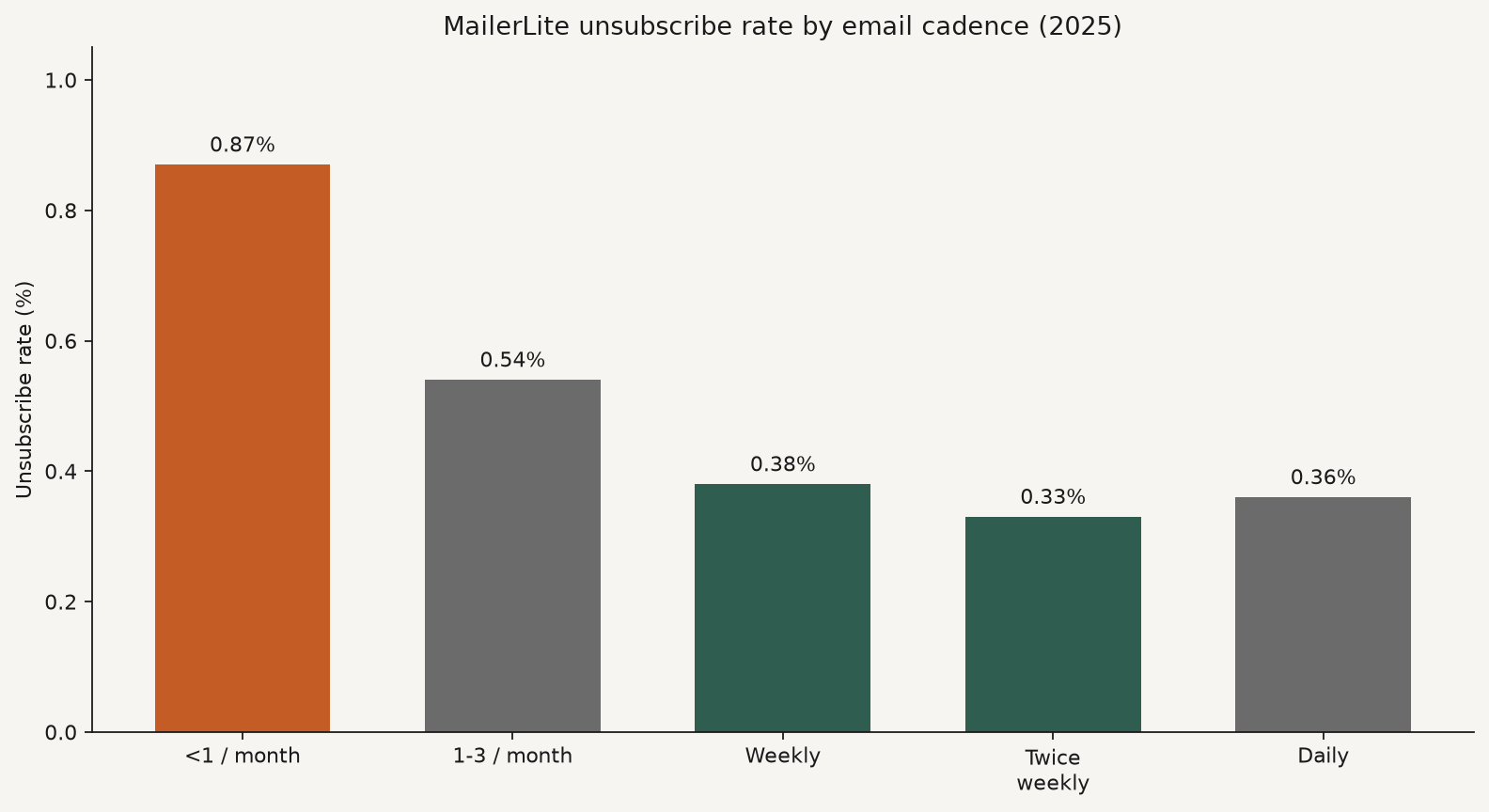
Source: MailerLite, Email cadence: How often should you send emails (2025 account analysis). https://www.mailerlite.com/blog/email-cadence-and-frequency-best-practices
Email frequency benchmarks work as a three-layer scorecard. Layer one is MailerLite’s cadence buckets and engagement ladder. Layer two is start guidance from Klaviyo and Omnisend for campaign calendars. Layer three is the stop signals: rising unsubscribes, rising spam complaints, and cold-list hygiene. Do not average flow volume into campaign cadence.
| Cadence bucket | Days between sends | Open rate | Click rate | Unsubscribe rate |
|---|---|---|---|---|
| Fewer than 1 per month | Over 31 | 35.11% | 3.74% | 0.87% |
| 1 to 3 times per month | 8 to 31 | 33.48% | 4.32% | 0.54% |
| Weekly | 3 to 8 | 33.22% | 4.87% | 0.38% |
| Twice a week | 1.5 to 3 | 32.98% | 5.31% | 0.33% |
| Daily | Under 1.5 | 30.04% | 4.97% | 0.36% |
Source: MailerLite email cadence study (2025).
MailerLite’s own planning band sits between monthly and twice weekly: strong enough opens and clicks, low enough unsubscribes, without treating daily as the default (MailerLite).
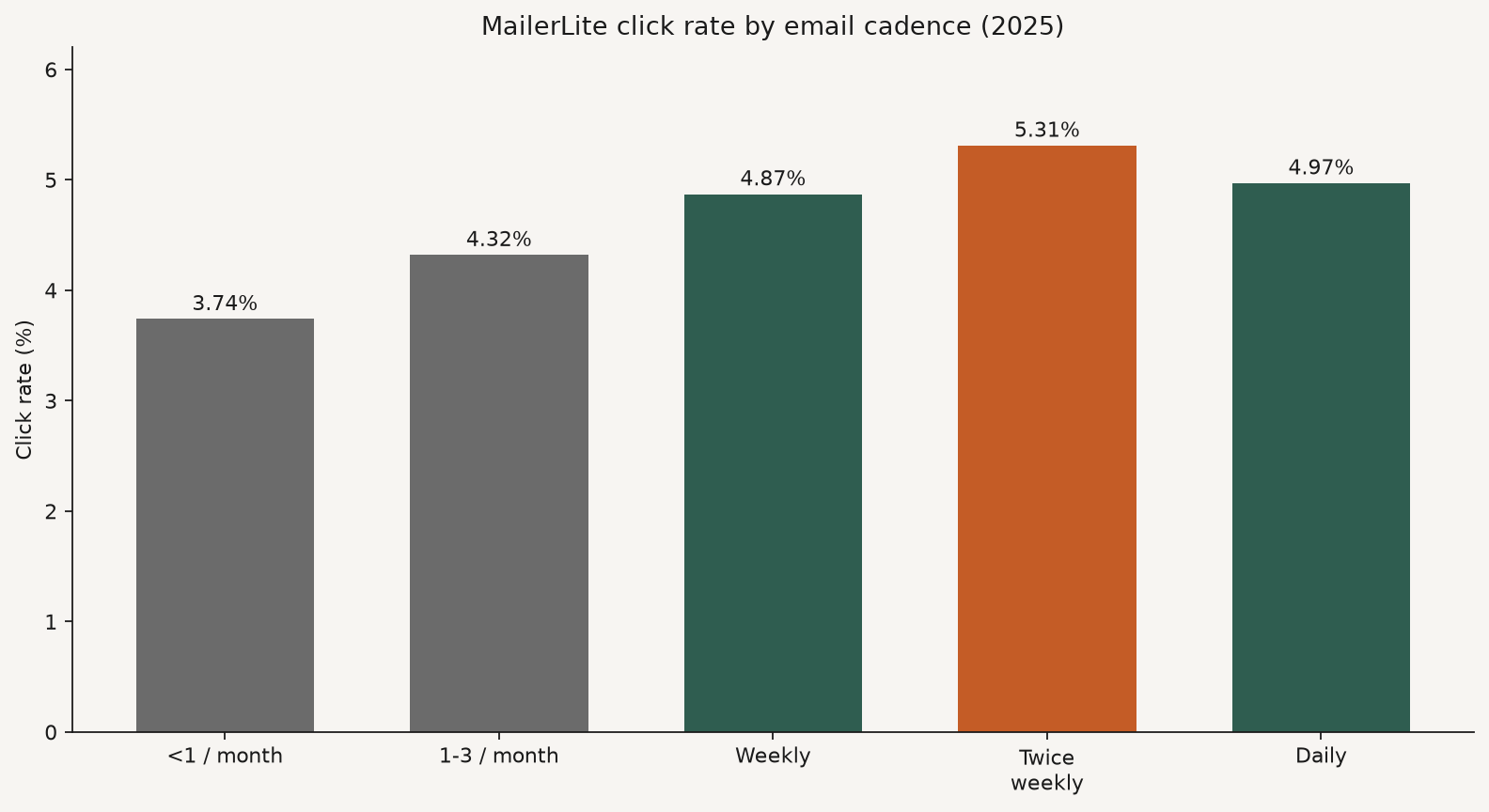
Source: MailerLite, Email cadence study (2025). https://www.mailerlite.com/blog/email-cadence-and-frequency-best-practices
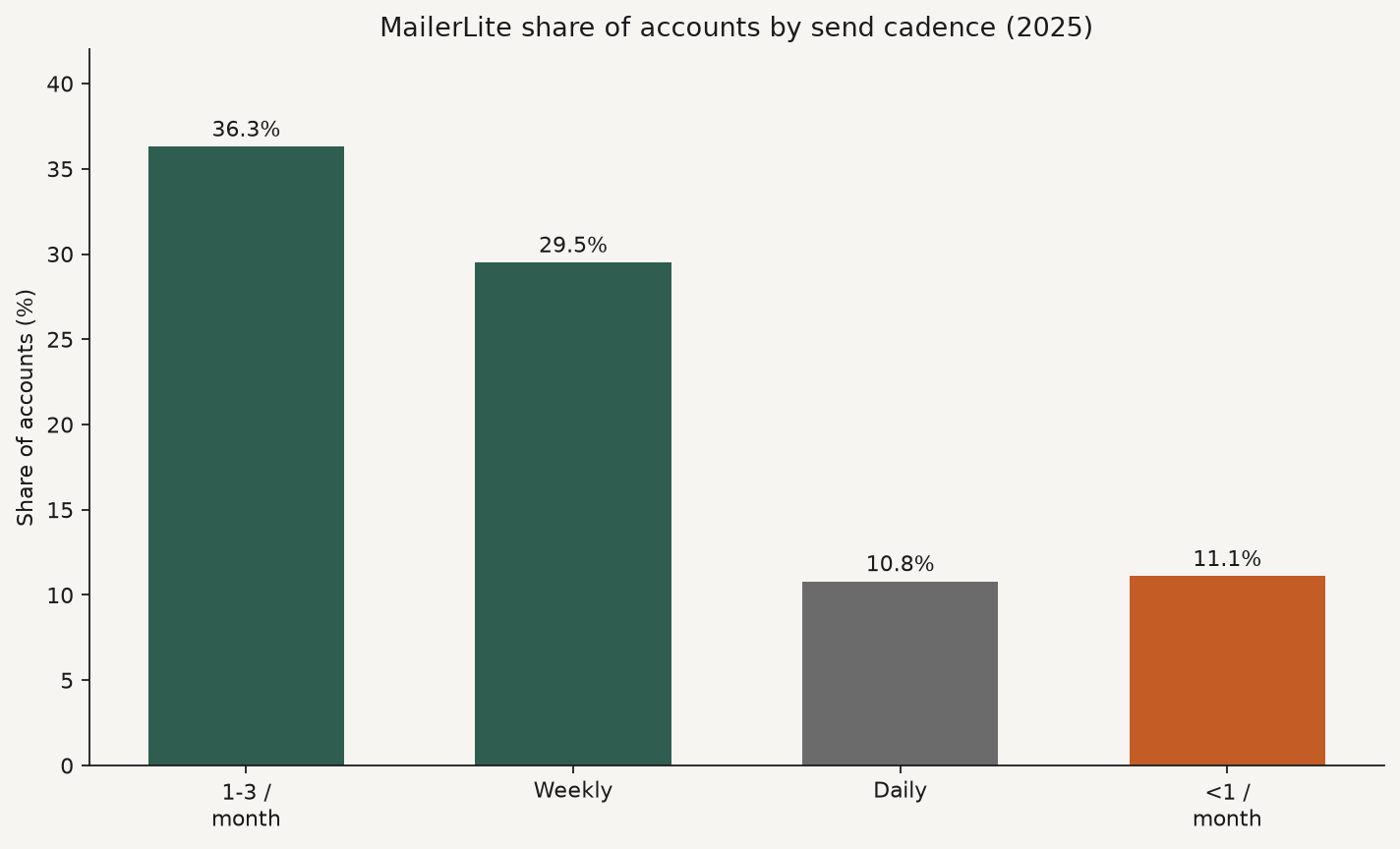
Source: MailerLite, Email cadence study (2025). https://www.mailerlite.com/blog/email-cadence-and-frequency-best-practices
| Pattern | Share of MailerLite accounts |
|---|---|
| 1 to 3 emails per month | 36.3% |
| Weekly | 29.5% |
| Daily | 10.8% |
| Fewer than 1 per month | 11.1% |
| At least 1 per month | 89% |
| At least 1 per week | 52% |
Ecommerce in the same study most often lands in the one-to-three-per-month bucket (37.21%), with 30.76% weekly and 20.02% at two or more per week (MailerLite). Online course creators skew high-frequency: 73.42% send at least weekly versus 52.5% overall (MailerLite). That is industry mix inside one ESP, not a law for your Shopify store.
Klaviyo tells small teams under 20K subscribers to start at one campaign per week, then move toward two, with a monthly mix of newsletter, traffic, and conversion sends (Klaviyo). Omnisend says many ecommerce brands land near one to three weekly emails, with promotional volume often limited to about once or twice weekly while automations carry journey mail (Omnisend). Omnisend also notes that in 2024 automated emails drove 18% of orders while making up only 9% of sends, which is why you should not “solve frequency” by blasting more campaigns if flows are underbuilt (Omnisend).
Community ecom threads often cite about 4 to 8 campaigns per month, or 3 to 4 per week to an engaged segment, with warnings against six full-list sends every week (r/ShopifyeCommerce; r/Klaviyo). Treat those as operator language. Keep MailerLite’s labeled cells as the public ladder.
Frequency fatigue is a campaign problem first. Abandoned cart, shipping, and welcome mail should run on behavior, not on your Tuesday calendar (abandoned cart email benchmarks; welcome email benchmarks). Preference centers and Smart Sending-style buffers reduce stacked messages when a flow and a campaign collide (Omnisend; Klaviyo). When engagement dies, winback then sunset beat eternal daily discounts (winback email benchmarks; sunset email flow explained).
There is no public dataset for one official ideal email frequency across every vertical and ESP. Clearout-style tables that assign rigid weekly bands by industry without a primary sample stay out of the charts. feat. does not publish a proprietary cadence census here. Industry open ladders that ignore cadence live in email marketing benchmarks by industry.
Setting email frequency benchmarks means picking a campaign cadence, measuring the right cells, and stopping when spam or unsub signals spike. Start conservative on the full list. Raise volume on an engaged segment first, then widen only if clicks and complaints still look healthy.
These answers restate the MailerLite cadence ladder and the campaign-versus-automation split so founders and answer engines can cite open, click, and unsubscribe cells by cadence without inventing one universal weekly send count that pretends every brand shares the same calendar.
Q: What are email frequency benchmarks? A: They are labeled open, click, and unsubscribe ranges by how often accounts send marketing campaigns. MailerLite’s 2025 study buckets cadence from fewer than one per month through daily and reports engagement for each bucket across 42,000+ accounts.
Q: How often should I send marketing emails? A: There is no single universal number. MailerLite’s planning band sits between monthly and twice weekly. Klaviyo suggests starting at one campaign per week for small teams under 20K, then moving toward two. Omnisend often cites one to three weekly emails for ecommerce.
Q: Does sending more email increase unsubscribes? A: Not in a straight line in MailerLite’s sample. Fewer than one send per month shows the highest unsubscribe rate (0.87%). Twice weekly shows the lowest (0.33%). Daily sits at 0.36%. Irregular scarcity is the clear loser.
Q: Should automations count toward email frequency? A: Not as campaign cadence. MailerLite measures campaigns, not automations, because flows are event-triggered. Still use send buffers so a campaign and a flow do not stack on the same person in one day.
Q: When is email frequency too high? A: When unsubscribe, spam complaints, or clicks move the wrong way after you raise volume, or when Google Postmaster spam approaches 0.10% / 0.30%. Cut volume and clean the list before you add another weekly blast.
Email frequency benchmarks are not a dare to send daily. They are evidence that consistency beats irregular silence, that twice-weekly cadence can win clicks and unsubs in a large ESP sample, and that spam floors still veto calendars that burn the domain. Pick a cadence you can keep, measure CTR and unsub, and let flows carry non-calendar moments.
If creators should sell the products your cadence protects, browse the feat. marketplace for co-branded storefront inventory.
Preference center best practices: CAN-SPAM menu plus stop-all, Google one-click vs body preference pages, and SendGrid's labeled 20% unsub drop.
Mailchimp vs Klaviyo: contact billing fork, send multipliers (10x/12x/15x), starting prices, and when ecommerce depth beats a general ESP.
Email list growth benchmarks: Omnisend 1.24B popup displays at 2.1%, form-type ladder, and levers that beat the average without inventing MoM %s.