Affiliate Marketing for Startups: Complete Guide
Affiliate marketing for startups is an operating system—locks, cost, recruit, rates, tracking, first 100 sales, then diagnose a flat roster.
Sponsored content vs affiliate links disclosure: same FTC material-connection test, different plain-language scripts, and what hybrid posts must say.

TL;DR: Sponsored content vs affiliate links disclosure is one legal test with two disclosure jobs. Both are material connections. Sponsored posts need clear “ad” or “sponsored by [brand]” language. Affiliate posts need commission language people understand, such as “Paid link” or commissions through links. Hybrid posts must disclose both. This is compliance education, not legal advice.
Creators treat “#ad” like a universal solvent. Brands treat affiliate links like a cheaper sponsorship. Audiences treat both as “someone got paid,” then stop reading. That laziness is why disclosure fights keep repeating across blogs, short video, and email newsletters.
Sponsored content vs affiliate links disclosure is the fork that affiliate marketing disclosure rules open but do not finish. Pair this page with affiliate vs influencer marketing, influencer contract terms explained, and affiliate program terms of service. Newsletter publishers labeling a paid slot should also see newsletter insertion order explained.
Sponsored content vs affiliate links disclosure is the comparison between two ways creators get paid to recommend products, and the plain-language statements each arrangement usually needs under the FTC’s Endorsement Guides. Both are material connections when the relationship might affect how audiences weigh the endorsement. They are not the same commercial deal, and they are not the same disclosure script.
Sponsored content (paid partnership, brand deal, native ad) usually means a brand pays a flat or package fee for defined deliverables: a post, a newsletter slot, a video segment. The money does not wait for a tracked sale. Affiliate links usually mean a commission when someone buys through a tracked URL. The creator may write independently and still earn on the click (16 CFR § 255.5, Example 11).
The disclosure job follows the money the audience cannot see. A flat-fee sponsor needs language that marks the post as advertising or sponsored by a named brand. An affiliate recommendation needs language that marks the commission interest. A hybrid piece that includes both needs both facts, not one lazy hashtag.
This fork matters because audiences cannot reverse-engineer your contract from a hashtag pile. Merchants also cannot run a monitoring program if every partner invents a different label. Clear scripts reduce “I thought #ad covered commissions” fights after a post ships.
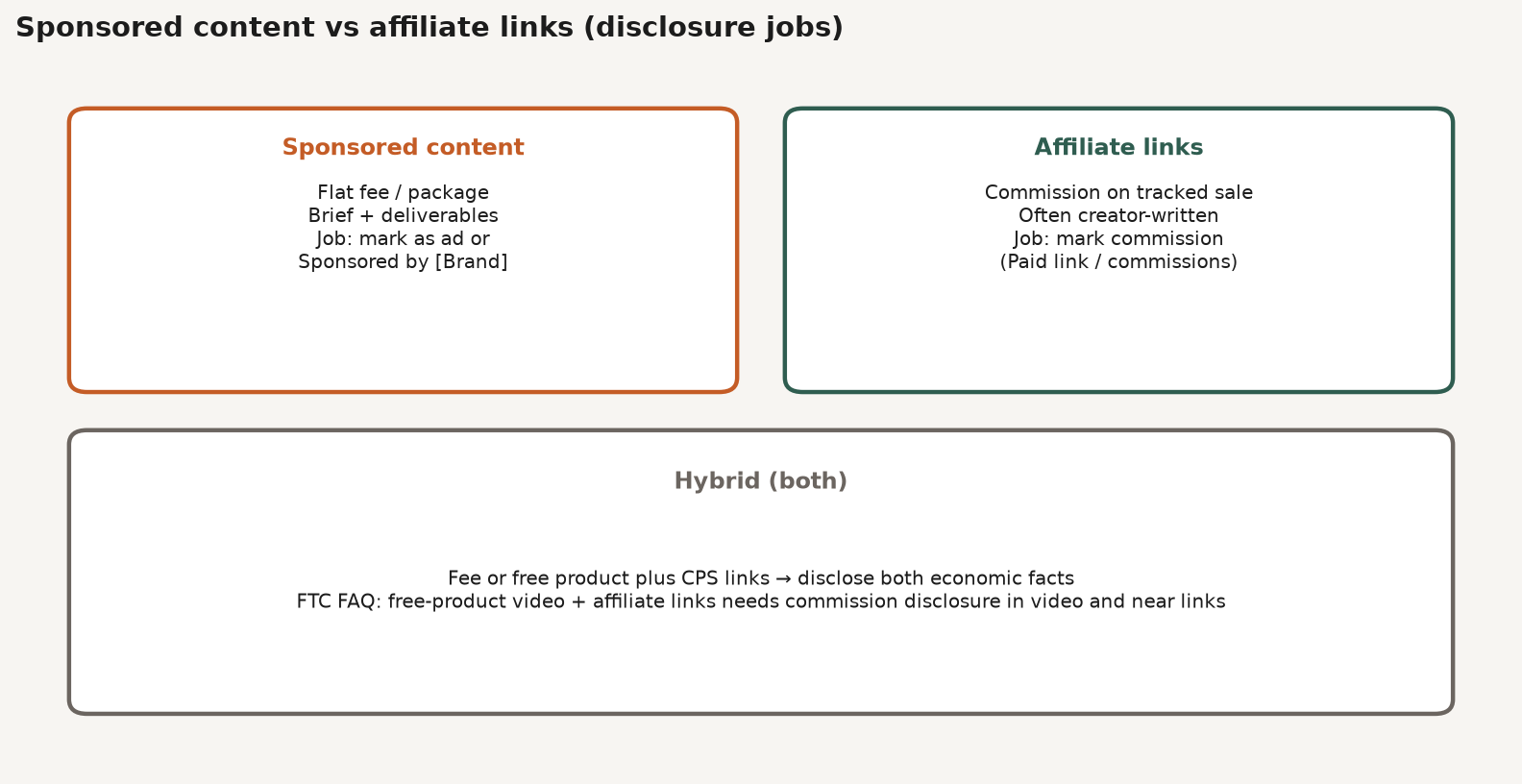
Source: Editorial comparison. Disclosure language anchored to FTC Endorsement Guides FAQ and Disclosures 101 (Nov 2019). https://www.ftc.gov/business-guidance/resources/ftcs-endorsement-guides-what-people-are-asking
Sponsored content vs affiliate links disclosure works by matching the commercial fact pattern to a plain-language statement audiences can notice on the same surface as the endorsement. Start with the contract type. Pick wording staff have already stress-tested. Place it so skipping it takes effort. If both pay models appear in one piece, disclose both.
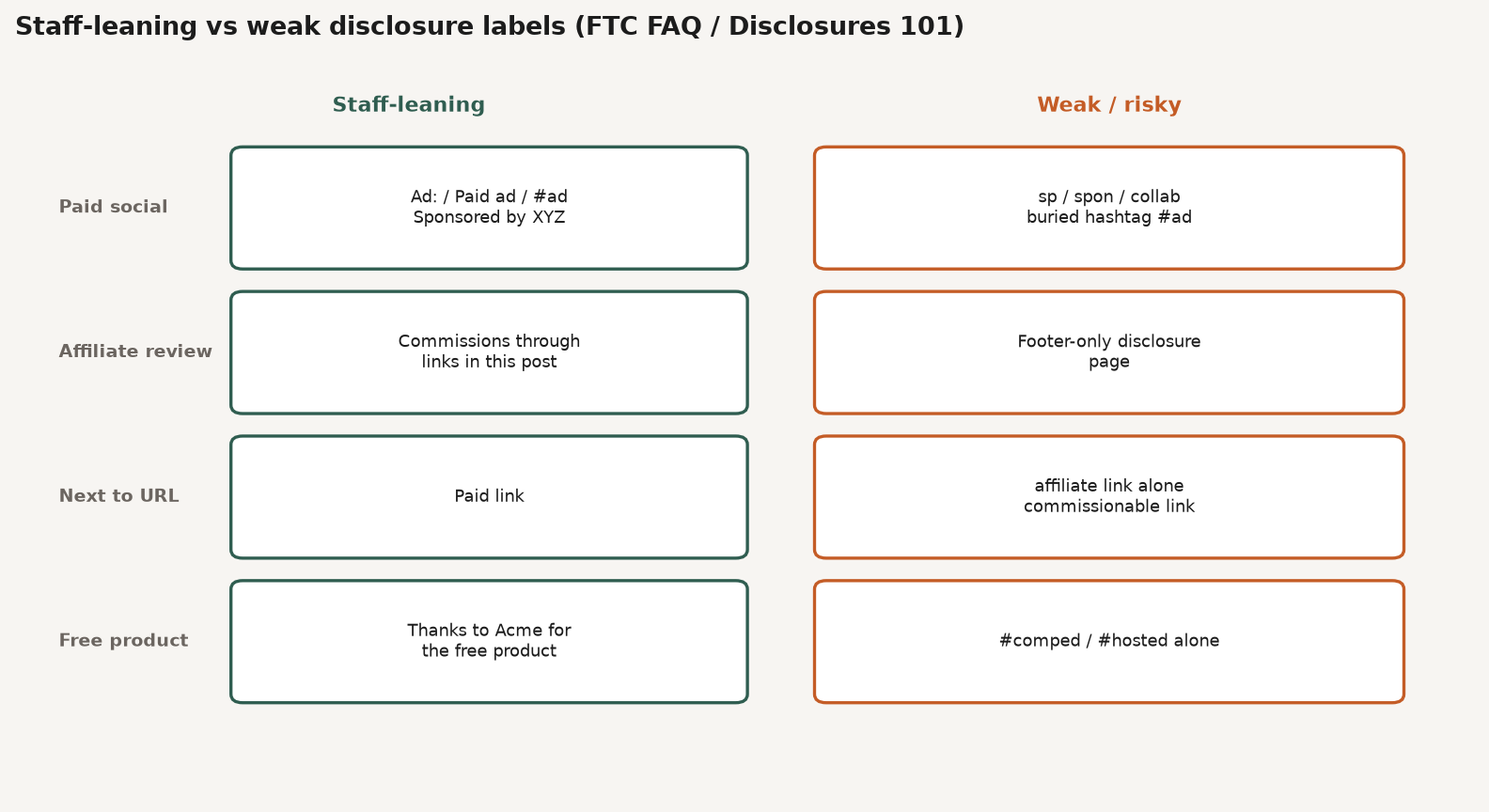
Source: FTC Endorsement Guides FAQ (Ad / Sponsored by XYZ / Paid link / affiliate link / commissionable link). https://www.ftc.gov/business-guidance/resources/ftcs-endorsement-guides-what-people-are-asking
| Arrangement | Typical pay | Typical control | Primary disclosure job |
|---|---|---|---|
| Sponsored content / paid partnership | Flat fee, package, or media buy | Brief, deliverables, usage rights (influencer contracts) | Mark the post as an ad or sponsored by a named brand |
| Affiliate links | Commission on tracked sale | Often creator-written; program TOS binds promo rules | Mark the commission interest near the recommendation or link |
| Hybrid | Fee or free product plus CPS links | Both | Disclose free/paid relationship and commissions |
| Newsletter sponsorship slot | Insertion-order fee | Placement, date, creative (IO guide) | Label the send as sponsored advertising, not neutral editorial |
Affiliate marketing pays for outcomes. Influencer sponsorship pays for attention and content. That commercial fork is why affiliate vs influencer is a strategy page and this page is a disclosure page. Do not paste an affiliate FAQ into a brand-deal caption and call it done.
| Situation | Staff-leaning language | Weak or risky language |
|---|---|---|
| Paid social / sponsored post | “Ad:”, “Paid ad”, “#ad”, “Advertising:”, “Advertisement”; “Sponsored by XYZ” clearer than bare “Sponsored” (FTC FAQ) | “sp”, “spon”, “collab”, stand-alone “thanks” or “ambassador” (Disclosures 101) |
| Affiliate blog / review | “I get commissions for purchases made through links in this post.” (FTC FAQ) | Footer-only “Disclosure” page; “buy now” with no payment context |
| Next to a tracked URL | “Paid link” (FTC FAQ) | “affiliate link” alone; “commissionable link” |
| Free product | “Thanks to Acme brand for the free product” when hard to miss (Disclosures 101) | “#comped” or “#hosted” alone (staff say neither is sufficiently clear) (FTC FAQ) |
The FTC does not mandate one magic script. Staff care whether ordinary people can notice and understand the connection (FTC FAQ). “#ad” is not better than “Ad:” because it is a hashtag. It works when it is clear and hard to miss. Burying “#ad” in twenty hashtags fails that test (Disclosures 101; FTC FAQ).
Staff wrote the exact hybrid many creators run: free products disclosed at the start of a YouTube review, affiliate links in the description that pay a commission. Is the free-product line enough? No. “You should disclose the affiliate relationship both in the videos and in the description near the links” (FTC FAQ).
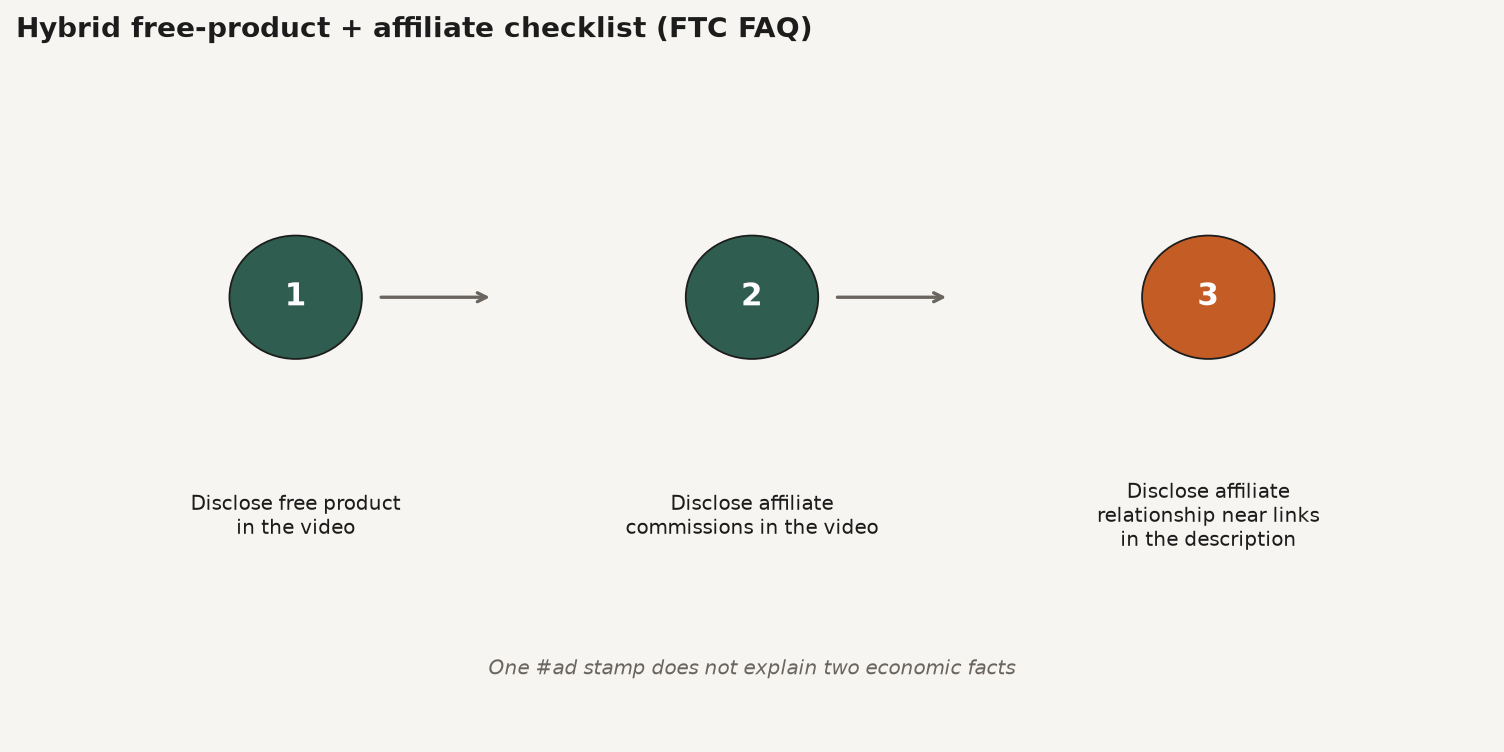
Source: FTC Endorsement Guides FAQ, free-product review channel with affiliate links Q&A. https://www.ftc.gov/business-guidance/resources/ftcs-endorsement-guides-what-people-are-asking
That answer kills three lazy habits:
Disclosures 101: place the disclosure with the endorsement message, hard to miss. Do not rely on ABOUT pages, profile pages, end-of-post dumps, or behind “more.” For Stories-style images, superimpose the disclosure and give people time to read it. For video, put it in the video, not only the description. Consider platform tools in addition to your own clear language, not instead of it (Disclosures 101).
Affiliate proximity rule: when the review and the link are visible together, one clear disclosure can suffice. When they are separated, reconnect them (FTC FAQ). Cloaked URLs do not erase the duty. See affiliate link cloaking and tracking explained.
The Guides’ headphone rankings example draws a hard line. If a review site accepts money in exchange for higher rankings, disclosing that it receives manufacturer payments is inadequate because the payments determine the rankings. If the site does not sell rankings but earns affiliate referral payments from some manufacturers, it should clearly and conspicuously disclose those payments (§ 255.5). Transparency language is not a license to sell the scoreboard.
Practical disclosure for sponsored content and affiliate links is a pre-publish checklist, not a footer project. Identify every material connection on the piece, pick wording that names that connection, place it on the same surface as the endorsement, and if you are the merchant, monitor what actually shipped.
These answers cover the comparison creators ask first: how sponsored content vs affiliate links disclosure differs, whether #ad covers commissions, what “Paid link” means, how hybrid free-product videos should disclose, and whether a footer disclosure page is enough. This is not legal advice.
Q: What is the difference between sponsored content and affiliate links disclosure? A: Both require disclosing a material connection, but they communicate different facts. Sponsored content usually needs clear advertising or “sponsored by [brand]” language for a paid placement. Affiliate links need commission language audiences understand, such as commissions through links or “Paid link” next to the URL.
Q: Does #ad cover affiliate commissions? A: Not reliably by itself. Staff treat “#ad” as likely effective for marking advertising, while affiliate guidance emphasizes commission language and “Paid link.” If a post is both a paid placement and commissionable, disclose both economic facts in language ordinary people understand.
Q: Is “affiliate link” enough under FTC guidance? A: Staff say consumers might not understand that “affiliate link” means you get paid for purchases through the link. “Paid link” placed right next to the link should be adequate. “Commissionable link” is probably not clear.
Q: I got a free product and also use affiliate links. What do I disclose? A: Disclose the free product and the affiliate commissions. For a YouTube-style review, staff say disclose the affiliate relationship both in the videos and in the description near the links, not only beside the URL.
Q: Can I put one disclosure on my About page for all sponsored and affiliate posts? A: No. Staff say obscure placements such as About pages, poorly labeled links, or terms-of-service burials are not good enough. Place the disclosure with the endorsement so people do not have to hunt.
Sponsored content vs affiliate links disclosure is one material-connection test with two scripts and a hybrid rule. Mark paid placements as ads or sponsored by a named brand. Mark commissions in words people understand. When both appear, say both where people actually look. List products you want creators to sell under clear rules on feat..
Affiliate marketing for startups is an operating system—locks, cost, recruit, rates, tracking, first 100 sales, then diagnose a flat roster.
How to track affiliate sales: pick link cookie, coupon, pixel, S2S postback, or storefront checkout—then match Rewardful, Tapfiliate, or Impact.
Best affiliate programs for SaaS companies pass the Recurring Cap Test: labeled duration, cookie, seat type, payout rails—plus Rewardful’s ~24% planning band.