Email Preference Center Best Practices
Preference center best practices: CAN-SPAM menu plus stop-all, Google one-click vs body preference pages, and SendGrid's labeled 20% unsub drop.
Newsletter insertion order explained: five lines that lock placement, dates, price, creative deadlines, and cancellation before the sponsored send.

TL;DR: A newsletter insertion order is a short written confirmation of placement, send date, price and payment terms, creative deadlines, and cancellation rules. It does not need twelve pages. It needs five clear lines before you hold inventory. Not legal advice.
“Sounds great, send the banner Friday” is not a contract. It is a memory contest waiting for a late creative swap. When the sponsor “remembers” a dedicated send and you sold a mid-roll, the media kit cannot save you.
The full cluster map lives in the email marketing guide.
A newsletter insertion order freezes the deal after the pitch works. Pair this ops page with how to build a newsletter media kit, newsletter sponsorship rates by subscriber count, dedicated email sponsorship pricing, Paved vs beehiiv ad network, and affiliate marketing disclosure rules.
A newsletter insertion order is a written confirmation between publisher and advertiser that names the placement, flight or send date, price and payment terms, creative specs and deadlines, and cancellation rules for a sponsorship. It is the purchase order for the slot your media kit sold.
General advertising glossaries define an IO as the signed contract that authorizes a campaign with flight dates, placements, pricing, and cancel terms (Publift; Improvado). Newsletter operators do not need a display-media novella. CrossLetter’s point is blunt: a clean email that says “confirming the below for our records” with five fields is enough for most indie deals (CrossLetter).
Agencies may still attach IAB-style terms. Your job is to make the newsletter-specific lines unambiguous: primary vs secondary vs dedicated, which issue, which dollar amount from your rate card.
The insertion order matters because sponsorship inventory is time-bound. When you hold a Tuesday primary for Brand A, you turned Brand B away. Without written terms, every date move and creative swap becomes a he-said argument after you already spent the slot.
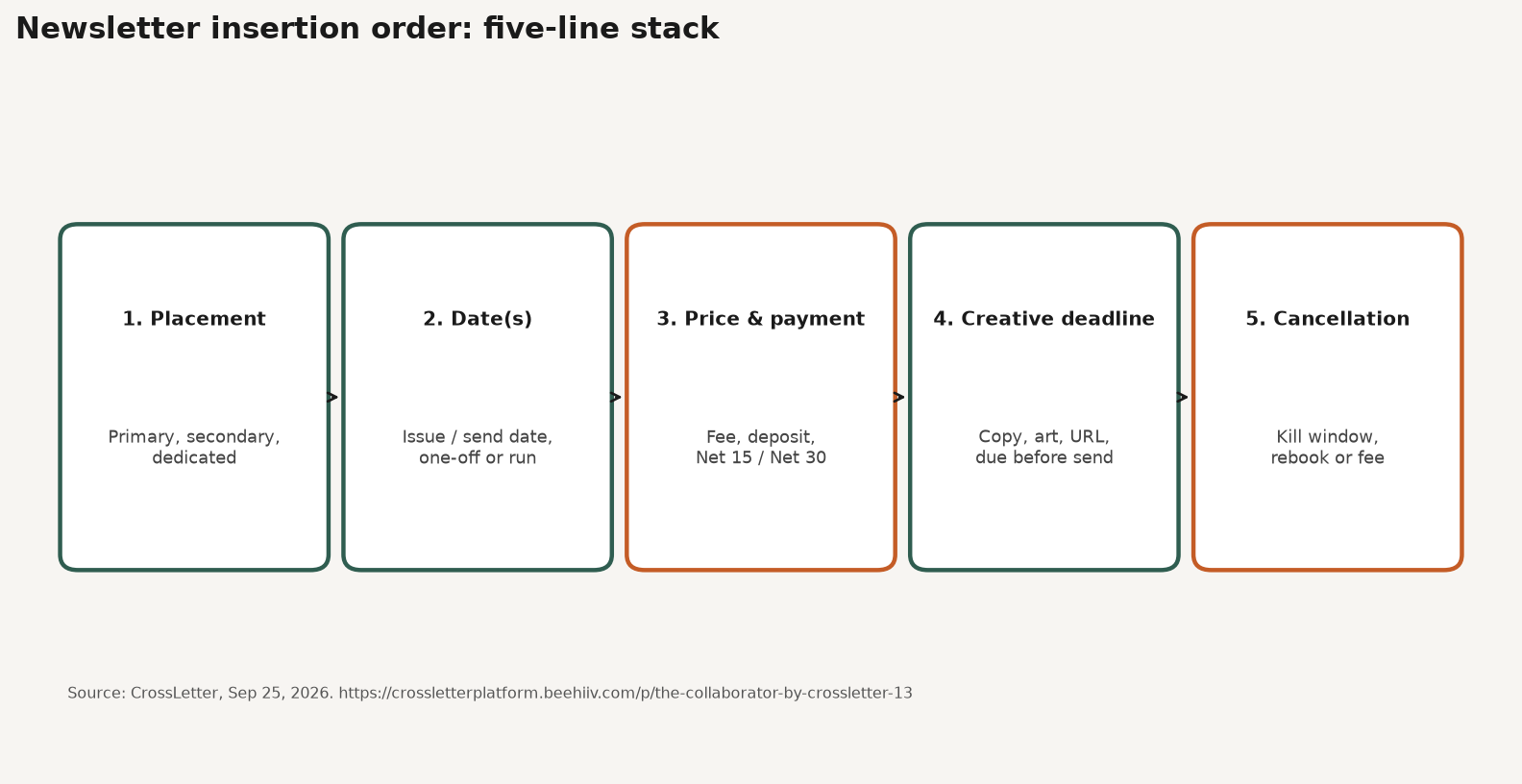
Source: CrossLetter, The Sponsorship Paperwork Nobody Warns You About (Sep 25, 2026). https://crossletterplatform.beehiiv.com/p/the-collaborator-by-crossletter-13
A newsletter insertion order works as a five-field freeze plus payment and cancel rules. Write the placement in plain English, lock the send date, state the fee and net terms, set the creative deadline, and define what happens if either side pulls out. Then ship the issue you actually sold.
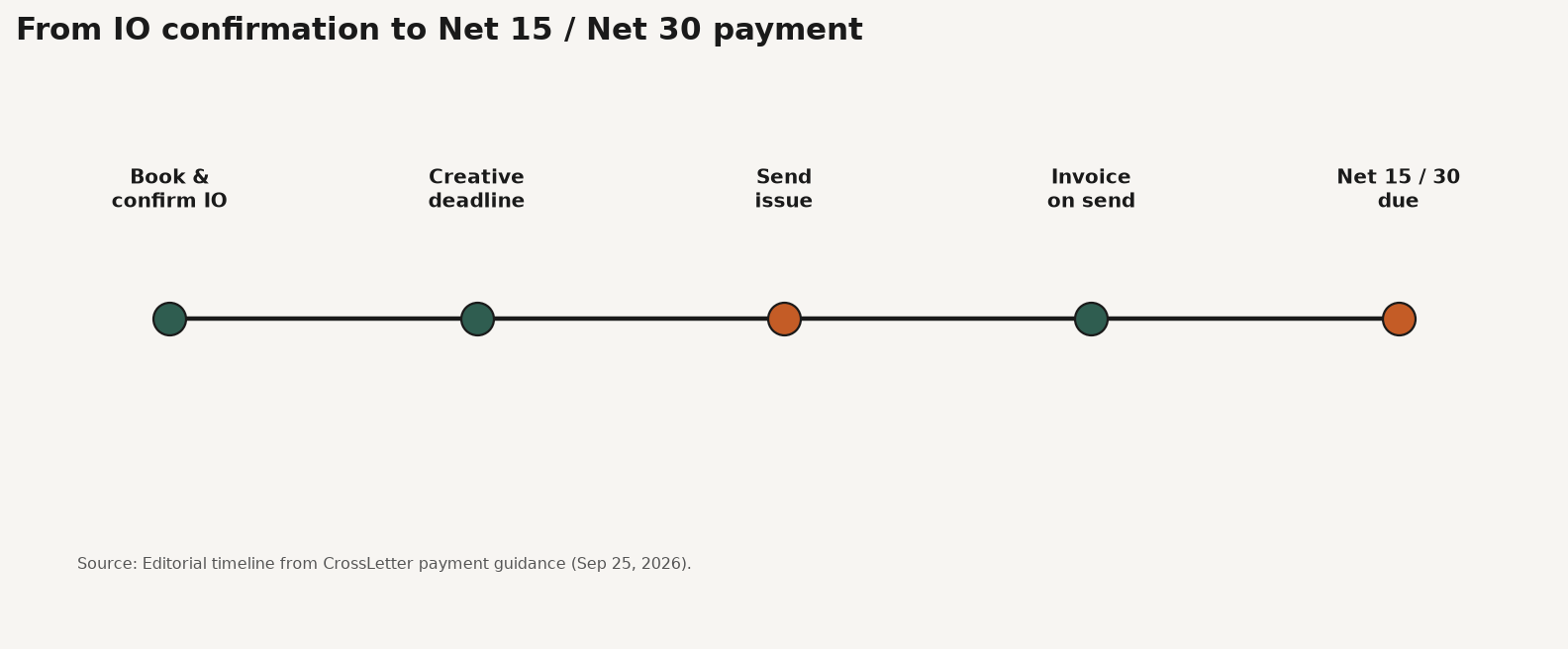
Source: Editorial timeline from CrossLetter payment and cancellation guidance. https://crossletterplatform.beehiiv.com/p/the-collaborator-by-crossletter-13
| Field | What to write | Failure mode if vague |
|---|---|---|
| Placement | Primary, secondary, classified, or dedicated; position in the issue | Sponsor “remembers” a dedicated send |
| Date(s) | Issue date / send date; one-off vs multi-issue run | Endless reschedules with no paper trail |
| Price and payment | Flat fee or package total; deposit; Net 15 / Net 30 and from which date | Invoice chase after the send |
| Creative deadline | Copy, image, URL, UTM, pixel; due date before send | Banner arrives an hour before send |
| Cancellation | Window + kill fee or rebooking option | Late cancel with no remedy |
Source: CrossLetter sponsorship paperwork. Save it as a template. Tweak five fields. Stop rewriting from scratch.
CrossLetter recommends a deposit even when small, then clear net terms before the placement runs, often Net 15 or Net 30 from the send date (CrossLetter). InfluencersKit’s contract guidance stresses Net 30 from the invoice date as a common phrase, and notes that real-world cash can land about six to eight weeks after send when payment runs intervene (InfluencersKit). Put the same terms on the IO and the invoice. Mismatch is where disputes start.
Invoice on send day when your terms allow it. Do not wait for month-end “campaign completion” language that never ends. If a sponsor goes silent, a short follow-up that names the placement and send date beats an apologetic essay.
CrossLetter’s simple version: full payment due if cancelled inside a set window of send (a week is a common planning example); partial payment or rebooking outside that window (CrossLetter). That is publisher planning language, not a statute.
The IAB/4A’s Standard Terms for internet advertising (buys of one year or less) give industry cancel baselines that many agency deals still reference:
| Deliverable type (IAB terms) | Without-cause cancel notice (no penalty) |
|---|---|
| Guaranteed (e.g. CPM) | 14 days’ prior written notice |
| Non-guaranteed (e.g. CPC / CPA) | 7 days’ prior written notice |
| Flat fee / fixed placement (roadblocks, some sponsorships) | 30 days’ prior written notice |
Source: IAB/4A’s Standard Terms PDF, Section V. Newsletter flat fees often behave like fixed placements. Many indie publishers still use a shorter kill window (about one week of send) because weekly inventory turns faster than a 30-day roadblock. Name your window in the IO. Do not assume the sponsor read the IAB PDF.
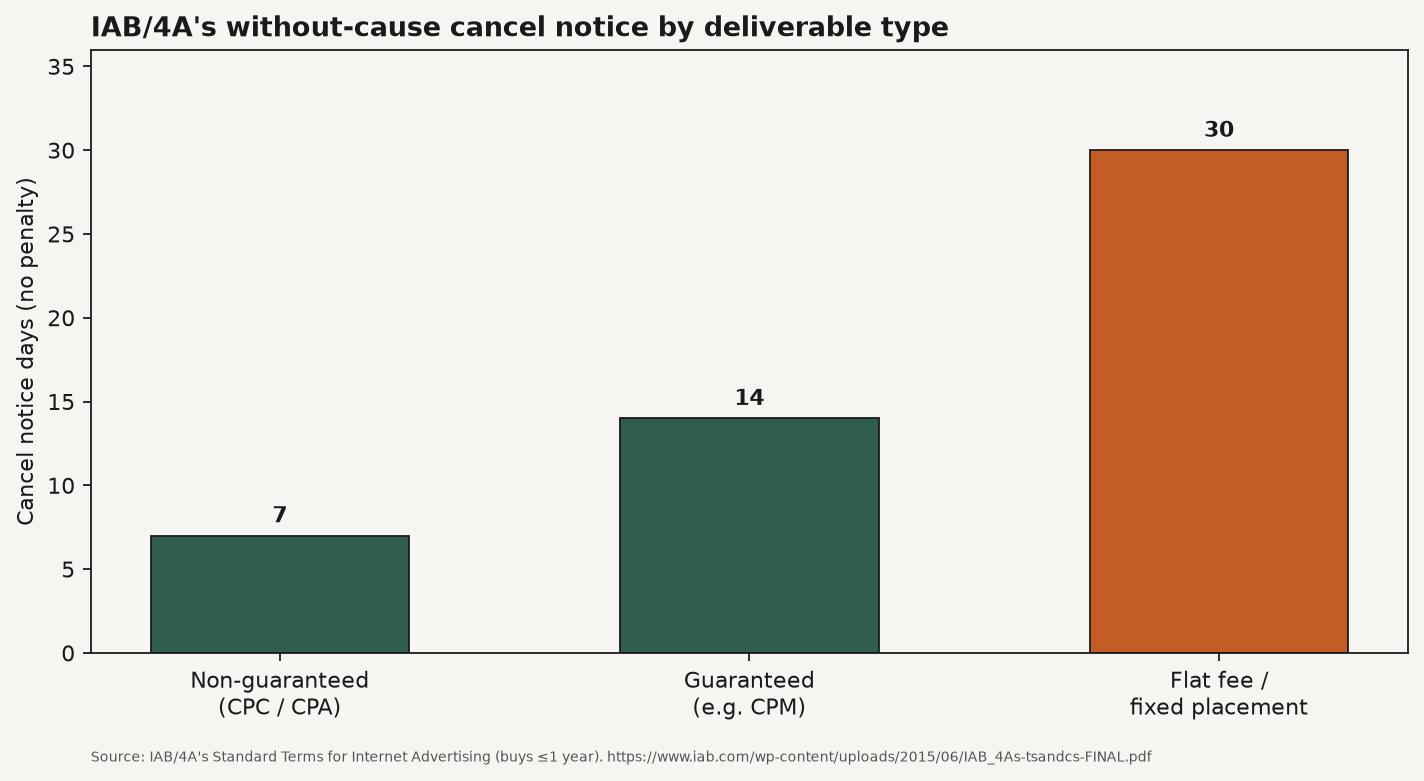
Source: IAB/4A’s Standard Terms for Internet Advertising for Media Buys One Year or Less. https://www.iab.com/wp-content/uploads/2015/06/IAB_4As-tsandcs-FINAL.pdf
If you cancel on the sponsor, CrossLetter’s advice is early notice plus a fair alternative: rebook, discount, or refund. Reliability is part of what sponsors evaluate for renewals.
There is no public dataset for one official average kill-fee percentage across newsletters. InfluencersKit describes kill fees as a percentage scaled by notice, without publishing a universal median (InfluencersKit). State your number. Do not invent “the industry standard.”
CrossLetter’s minimum: a “Sponsored” or “In partnership with [brand]” label above the placement, with an optional footer line (CrossLetter). Material-connection disclosure is also an FTC expectation for endorsements and affiliate-style relationships. Keep the disclosure rules page nearby when you draft the label. Skipping the label does not raise CTR. It does risk trust when a reader clocks an undisclosed ad.
Shipping a newsletter insertion order template is a one-hour ops job. Copy the five fields, add your kill window and net terms, and paste them into every “yes” email before you hold the slot. Then stop renegotiating from memory.
These answers cover the IO questions operators ask first: what a newsletter insertion order is, what belongs in one, how it differs from a media kit, what kill fees and net terms mean, and whether a short email counts. This is planning language, not legal advice.
Q: What is a newsletter insertion order? A: It is a written confirmation of a sponsorship buy: placement, send date, price and payment terms, creative deadlines, and cancellation rules. It turns a verbal or Slack “yes” into a shared reference before you hold inventory.
Q: What should a newsletter IO include? A: CrossLetter’s five lines are the practical minimum: placement, date(s), price and payment, what the sponsor provides and by when, and cancellation terms. Add disclosure requirements and invoice timing so accounts payable is not guessing.
Q: How is an IO different from a media kit? A: The media kit proves audience and shows packages so sponsors decide whether to buy. The IO freezes one purchase. Build the kit first (media kit guide), then confirm every booking with an IO.
Q: What is a sponsorship kill fee on a newsletter? A: A kill fee is what the advertiser owes if they cancel after you held the slot. CrossLetter’s planning example is full payment inside about a week of send, with partial payment or rebooking outside that window. There is no official public average percentage for all newsletters.
Q: Do I need a lawyer for every newsletter IO? A: Most indie flat-fee deals start as a five-line confirmation email. Agency buys may attach IAB-style terms, including the 30-day flat-fee cancel baseline. Complex or high-dollar contracts may need counsel. This page is not legal advice.
A newsletter insertion order is the short written stack that keeps placement, date, price, creative, and cancellation from dissolving into memory. Use five lines, name your kill window and net terms, label the send as sponsored, and file the confirmation next to the invoice. If you also sell a product through creators, list it on feat..
Preference center best practices: CAN-SPAM menu plus stop-all, Google one-click vs body preference pages, and SendGrid's labeled 20% unsub drop.
Mailchimp vs Klaviyo: contact billing fork, send multipliers (10x/12x/15x), starting prices, and when ecommerce depth beats a general ESP.
Email list growth benchmarks: Omnisend 1.24B popup displays at 2.1%, form-type ladder, and levers that beat the average without inventing MoM %s.