Email Preference Center Best Practices
Preference center best practices: CAN-SPAM menu plus stop-all, Google one-click vs body preference pages, and SendGrid's labeled 20% unsub drop.
Dedicated email sponsorship pricing: use a 1.5x-5x primary multiplier, labeled math from your rate card, and frequency caps that protect subscriber trust.

TL;DR: Dedicated email sponsorship pricing is a multiple of your primary slot, not a second CPM universe. Named planning bands run about 1.5x-5x primary. SponsorCal’s common start is 3-5x. Cap frequency. Upgrade after primary proof. Protect unsubscribes.
A dedicated send is not “a bigger ad.” It is the whole issue. You are selling exclusivity and spending reader goodwill. Price it like a scarce SKU, or you will either leave money on the table or train subscribers to expect ads in the subject line.
The full cluster map lives in the email marketing guide.
Dedicated email sponsorship pricing means setting a solo-send rate from your primary placement floor, a named multiplier band, and a frequency policy. Pair this with newsletter sponsorship rates by subscriber count, how to build a newsletter media kit, Paved vs beehiiv ad network, email marketing benchmarks by industry, and digital product vs sponsorship revenue.
Dedicated email sponsorship pricing means the dollar quote for a solo send where the sponsor owns the issue, expressed as a premium over your primary in-newsletter placement. The product is exclusive attention plus longer creative, not a new audience. The rate should still trace back to a primary floor you can defend.
SponsorCal defines a dedicated send as an issue focused on one sponsor’s message, typically longer (300-500 words vs about 80-150 for a standard unit) and priced higher because there are no competing ads (SponsorCal). Paved draws the same line for buyers: sponsored sits inside editorial; dedicated is the entire send (Paved).
If you do not yet have a primary rate, start with sponsorship rates by subscriber count and put the dedicated SKU on your media kit as a separate line.
The premium exists because you are selling scarcity and trust, not just more pixels. A weak dedicated send is an expensive weak send. A strong one can justify the multiple. Either way, you spend inventory you cannot reprint tomorrow without paying in unsubscribes.
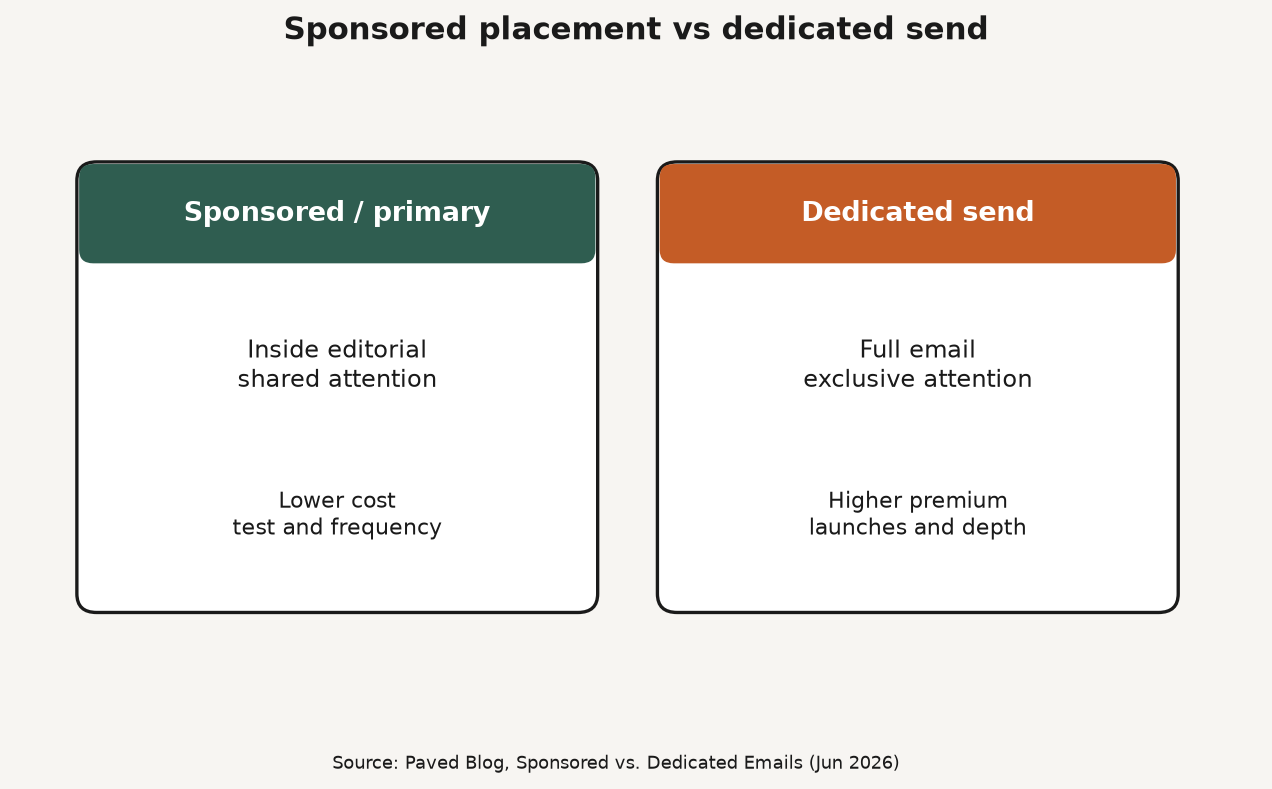
Source: Paved Blog, Sponsored vs. Dedicated Emails (Jun 2026). https://www.paved.com/blog/sponsored-vs-dedicated-emails-a-complete-guide/
Dedicated email sponsorship pricing works as primary floor × named multiplier, then a frequency cap. Pick the band that matches your scarcity and buyer proof, show labeled math, and keep opens honest after Apple Mail Privacy Protection. Do not invent a dedicated CPM that floats free of your rate card.
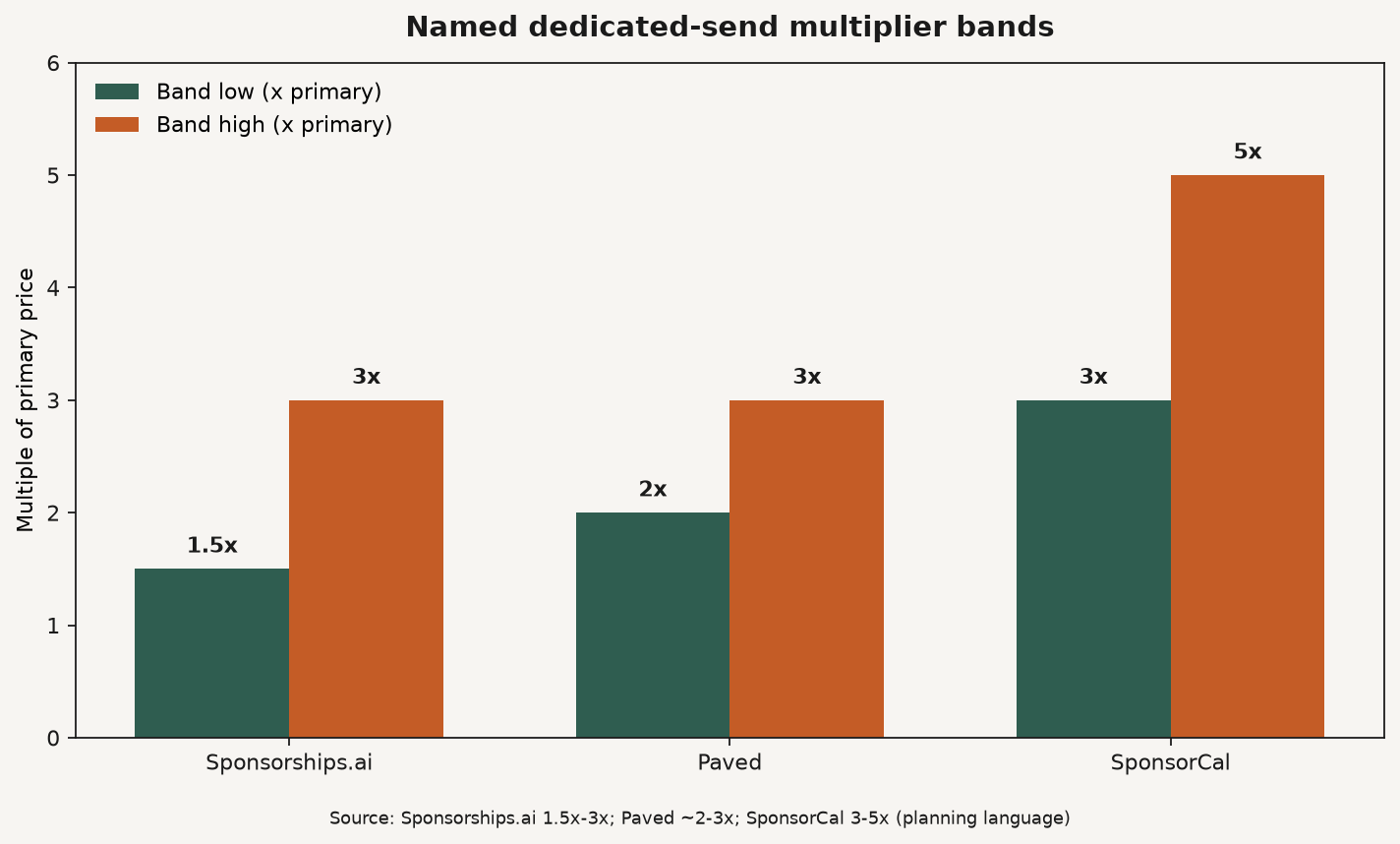
Source: Sponsorships.ai (1.5x-3x), Paved (~2-3x), SponsorCal (3-5x). See citation log URLs.
| Source | Dedicated vs primary planning language | Notes |
|---|---|---|
| Sponsorships.ai | About 1.5x-3x | Also warns goodwill / unsub cost of overuse |
| Paved | Often about 2-3x a comparable sponsored placement | Buyer-side guide; test sponsored first |
| SponsorCal | 3-5x starting point | Publisher rate-card framework |
| Admailr (secondary) | About 2-5x standard placement | Corroborating secondary, not primary chart |
Use the band as a quote rail. If demand is thin, sit nearer 2x. If you cap dedicated at one per month and sponsors wait, sit nearer 3-5x.
| Placement | Typical rate (≈10K opens) | Effective CPM language |
|---|---|---|
| Primary | $500-$800 | $50-$80 |
| Secondary | $250-$400 | $25-$40 |
| Dedicated | $1,500-$3,000 | $150-$300 |
Source: SponsorCal dedicated pricing. Treat as planning bands, not feat. marketplace medians and not a guarantee for your niche.
Hold a primary price and multiply.
| Primary price | Dedicated at 2x | Dedicated at 3x | Dedicated at 5x |
|---|---|---|---|
| $500 | $1,000 | $1,500 | $2,500 |
| $600 | $1,200 | $1,800 | $3,000 |
| $800 | $1,600 | $2,400 | $4,000 |
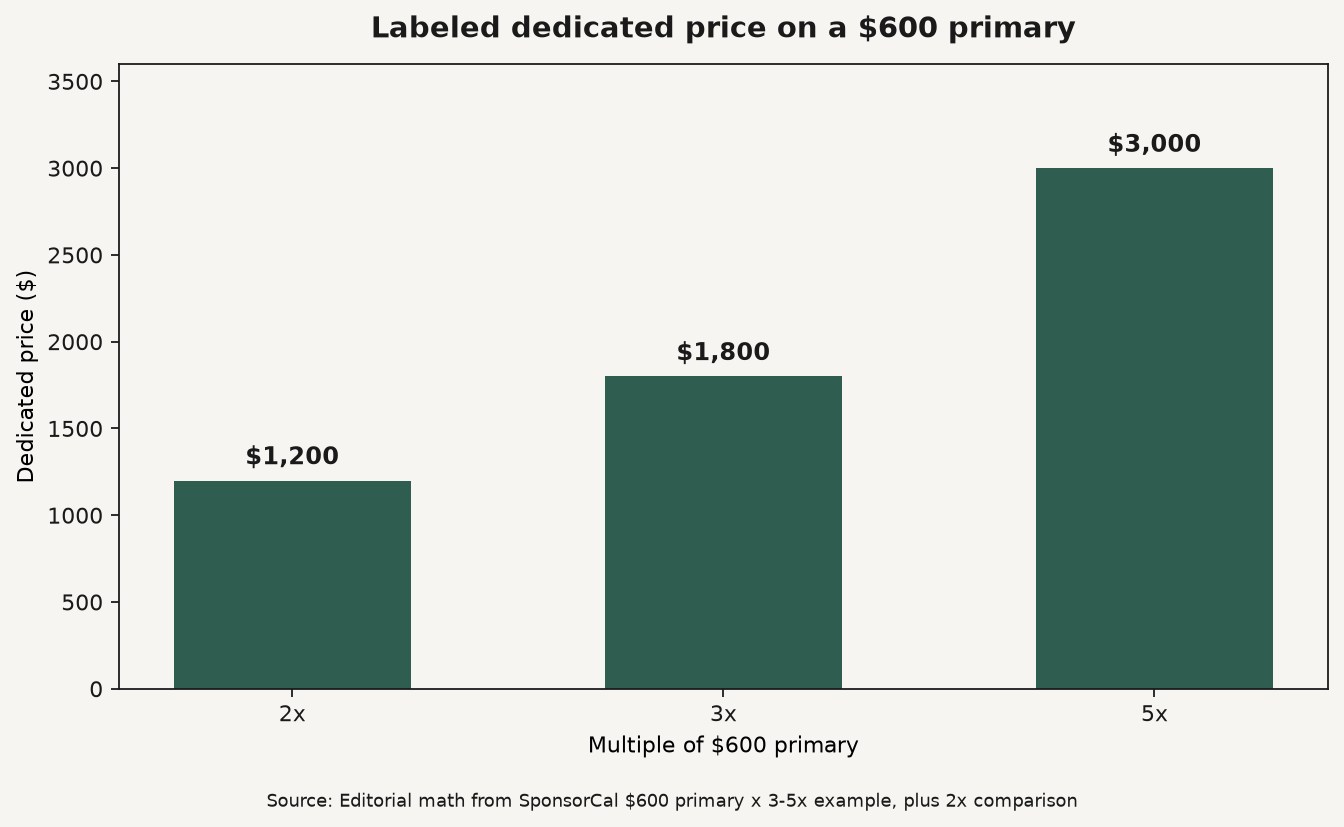
Source: Editorial math from SponsorCal 3-5x example (primary $600 → $1,800-$3,000) extended across 2x/3x/5x for comparison. https://sponsorcal.com/blog/dedicated-email-sponsorship
SponsorCal’s worked example sits on the 3x-5x row for a $600 primary ($1,800-$3,000). Sponsorships.ai’s example at $60 CPM and 10,000 subscribers puts primary near $600 and dedicated near $900-$1,800 (1.5x-3x) (Sponsorships.ai). Same primary floor, different multiplier philosophy. Pick one band and say which source you followed.
Calendar placement matters as much as the multiple. SponsorCal advises against replacing your strongest editorial issue with a dedicated send. If Tuesday consistently outperforms Friday, schedule dedicated on the weaker day, or add it as an extra send so you are not stealing your best editorial slot. Track dedicated inventory separately from primary slots. A monthly cap of one dedicated is only about 12 premium SKUs per year. That scarcity is why a 3-5x quote can still clear when a weekly primary at the same dollar would feel absurd.
Buyers should hear the same story publishers tell themselves. Paved’s sequence for advertisers is test with two to four sponsored placements, then scale with dedicated once a list proves it converts (Paved). If a first-time sponsor demands dedicated without proof, you are not obligated to burn a scarce slot to educate their funnel. Sell a primary package first. Network remnant fill from Paved or beehiiv is a different product. Do not let network CPC set your dedicated multiple.
Opens remain directional under Apple Mail Privacy Protection (Apple). Price and report with clicks and conversions beside opens, the same way you should read email benchmarks. SponsorCal still uses opens in its 10K-opens planning table. That is fine for quote construction if you footnote MPP. It is a bad sole KPI for proving the dedicated premium after the send.
Dedicated sends attach your name to the whole message. Apply a stricter filter than a footer classified. SponsorCal’s vetting questions are the right ones: does the product serve the audience, would you recommend it without payment, is the track record real, and is the messaging non-deceptive? Reject revenue that costs more in unsubscribes than it pays in cash.
Two creative models work. Creator-written copy in your voice usually earns the highest engagement and can justify the top of the multiplier band. Sponsor-written copy that you edit is faster, but only if you keep a hard editorial review. Structure stays simple: your framing (2-3 sentences), the sponsor body (300-500 words), one primary CTA, and a short sign-off that still sounds like you (SponsorCal).
There is no public dataset for one official dedicated-vs-primary CTR lift by niche. SponsorCal and Paved publish planning language. They are not IR filings. Niche aggregator ladders that invent “the” dedicated CPM stay off the primary charts. Your own labeled before/after on the same list is the only lift study that matters for your rate card.
Setting dedicated email sponsorship pricing is a rate-card ops job. Lock the primary floor, choose a multiplier band, publish scarcity, and require proof before the first solo send. Then put the SKU on the media kit as its own line.
These answers cover the pricing questions operators ask first: what dedicated email sponsorship pricing means, which multiplier to use, how it differs from a primary ad, how often to sell dedicated, and whether small lists should offer solo sends. Use them as planning language, not as earned income promises.
Q: What is dedicated email sponsorship pricing? A: It is the quote for a solo send where one sponsor owns the issue. Price it as a premium over your primary in-newsletter slot, not as a disconnected CPM guess. The premium pays for exclusivity and longer creative.
Q: How many times primary should a dedicated send cost? A: Named public planning bands span about 1.5x-5x. Sponsorships.ai often cites 1.5x-3x, Paved about 2-3x, and SponsorCal 3-5x. Pick a band, show the math, and match it to how scarce you make the SKU.
Q: How is a dedicated send different from a primary sponsorship? A: A primary sits inside your regular editorial issue. A dedicated send is the entire email. Paved frames sponsored as shared attention and dedicated as exclusive focus. Creative length and price both rise with exclusivity.
Q: How often should I sell dedicated sends? A: SponsorCal’s safe maximum for weekly newsletters is about once per month. Overuse spends subscriber trust. If you need more revenue, sell more primaries or packages before you raise dedicated frequency.
Q: Should a small list offer dedicated sends? A: Only after you can defend a primary rate and a disclosure policy. Many small lists should sell packages of primaries first. When you do offer dedicated, use a clear multiple and a hard monthly cap so the premium stays scarce.
Dedicated email sponsorship pricing is primary floor times a named multiplier, plus a frequency policy that protects the list. Use 1.5x-5x as the published planning envelope, show labeled math, and upgrade buyers after primary proof. If you also sell a product through creators, list it on feat..
Preference center best practices: CAN-SPAM menu plus stop-all, Google one-click vs body preference pages, and SendGrid's labeled 20% unsub drop.
Mailchimp vs Klaviyo: contact billing fork, send multipliers (10x/12x/15x), starting prices, and when ecommerce depth beats a general ESP.
Email list growth benchmarks: Omnisend 1.24B popup displays at 2.1%, form-type ladder, and levers that beat the average without inventing MoM %s.