Affiliate Marketing for Startups: Complete Guide
Affiliate marketing for startups is an operating system—locks, cost, recruit, rates, tracking, first 100 sales, then diagnose a flat roster.
How to create an affiliate program for a startup: Seed-Stage Stack, Rewardful 56% under 50 affiliates / 15.6% survive, tracker not network.

TL;DR: How to create an affiliate program for a startup means filtering for runway, not cloning an enterprise network. Use a Seed-Stage Stack: product already converts, capped economics, a Stripe-class tracker, 10-15 named partners, and a weekly hours budget. Rewardful finds 56% of SaaS programs run with fewer than 50 affiliates and only 15.6% continue long-term.
Startups copy Impact pages, then wonder why nobody promotes a product with no brand search and no partner manager. That is the wrong object. You do not need a partnership cloud. You need a program a founder can run between customer calls.
How to create an affiliate program for a startup is a constraint job: unknown LTV, thin ops hours, and a roster that will stay small. The generic go-live checklist lives on how to start an affiliate program for your business. Rate samples live on SaaS affiliate commission rates. This page owns the seed filter: when to wait, what to cap, which surface to buy, and whom to invite first.
Creating an affiliate program for a startup means publishing a small, tracked performance contract that a founder can fund after churn and staff in a few weekly hours, instead of buying a publisher marketplace you cannot activate.
It is not a tiny version of ShareASale. Operators on r/Affiliatemarketing tell small SaaS teams to skip PartnerStack-class clouds until agencies actually show up, and to start on Rewardful, FirstPromoter, or similar Stripe-connected tools (thread). That vernacular matches the public samples: most programs never become large (Rewardful).
It is also not a customer referral widget with a new name. Referral rewards friends of buyers. Affiliate programs recruit third-party promoters. Keep the fork on affiliate vs referral marketing. If you already have people who want to sell the offer through a storefront rather than a cookie, how to turn anyone into a seller is the adjacent feat. motion.
Startups need a different launch because durability is poor, rosters stay small, and setup itself drops founders. You are not late if v1 is ten named partners on a tracker. You are late if you signed a network you cannot staff.
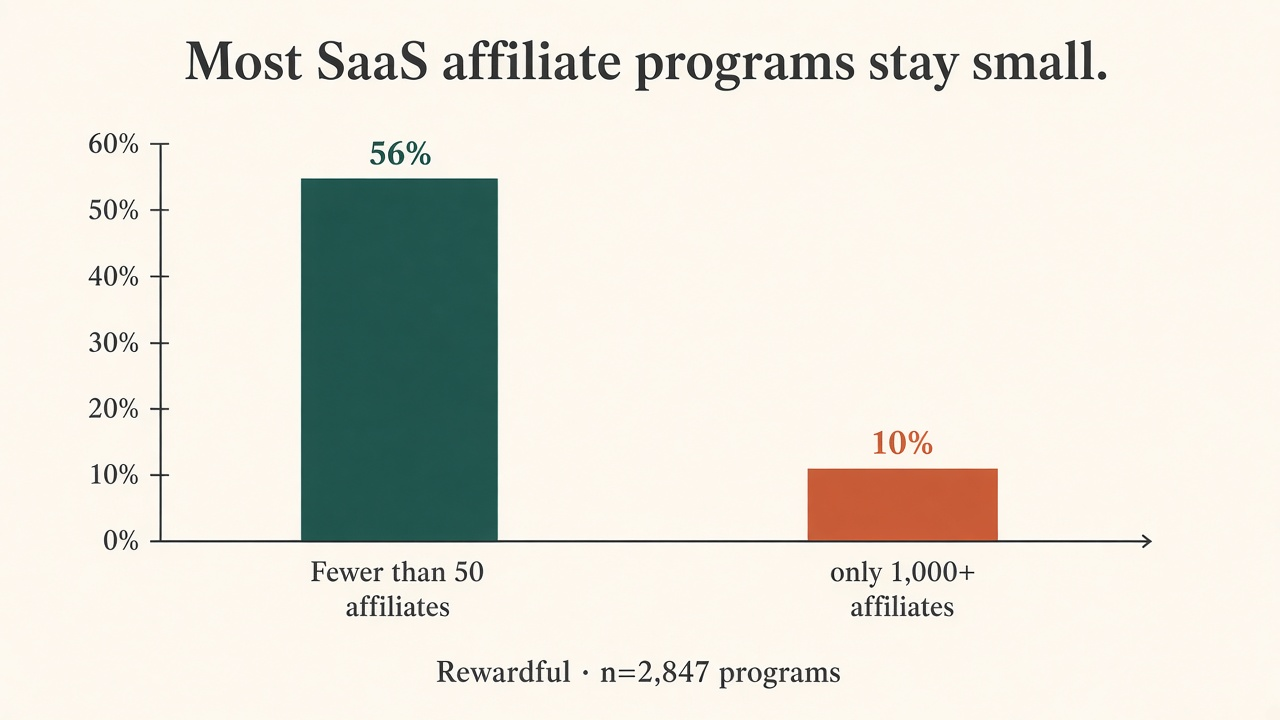
Source: Rewardful State of SaaS Affiliate Programs Report (updated July 21, 2026), analysis of 2,847 SaaS affiliate programs. https://www.rewardful.com/articles/state-of-saas-affiliate-programs-report
How to create an affiliate program for a startup works as a Seed-Stage Stack. Confirm the product converts without partners. Cap the economics to current churn. Buy a tracker, not a network. Invite 10-15 named people. Budget founder hours for activation. Skip a rung and you will either overpay a dormant roster or underpay the few who would actually sell.
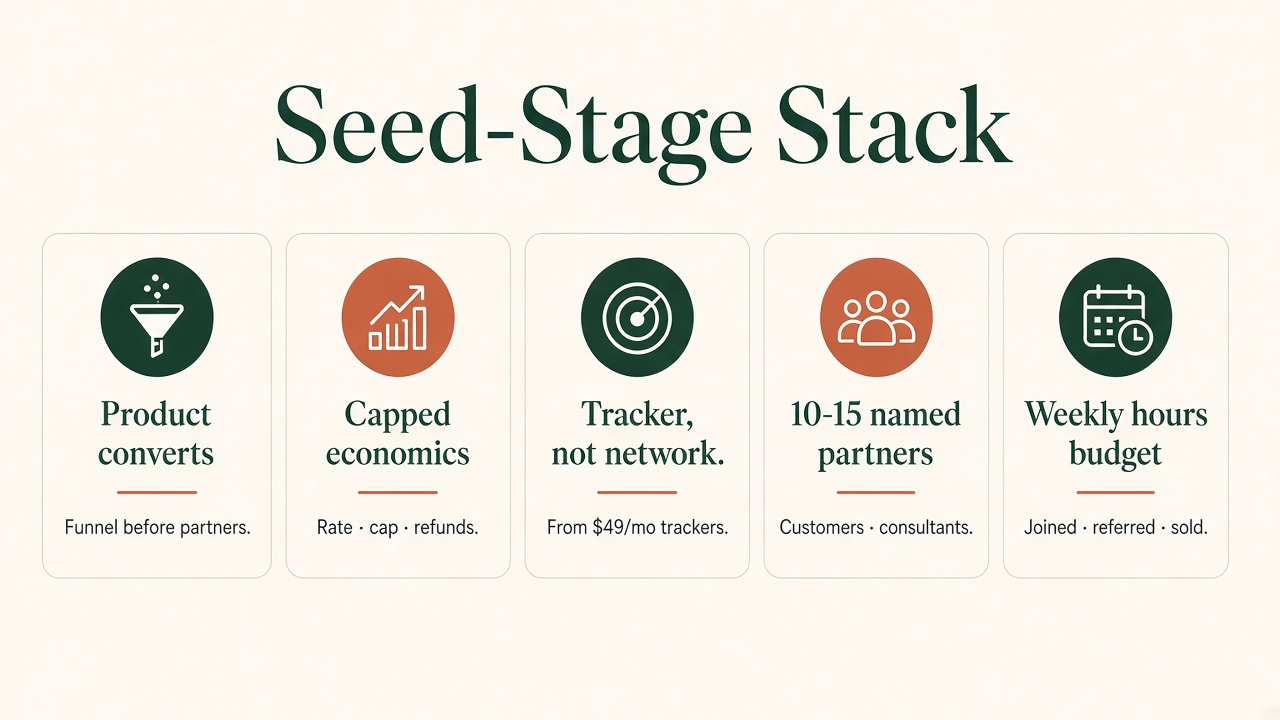
Source: Editorial Seed-Stage Stack for startup affiliate program creation; roster and durability benchmarks from Rewardful (n=2,847, updated July 21, 2026). https://www.rewardful.com/articles/state-of-saas-affiliate-programs-report
Affiliates amplify a funnel. They do not invent one. If your own signup-to-paid path is leaky, partners send traffic that never pays, then quit. Founders on r/growthmarketing say the early unlock is customers who already send Slack and email referrals, not a directory (thread). If you cannot name those people, wait. The go-live locks (test purchase, terms, meters) still apply on the business launch article.
Write one offer: event, rate, cookie window, payout hold, refund clawback, and duration cap. Shopify’s subscription planning band is 15%-30% recurring (Shopify). LinkJolt’s early-stage-skewed median is 20%, and 26% of those campaigns pay recurring at all (LinkJolt). Rewardful’s average selected rate is 24.16% (Rewardful).
If you do not know LTV, do not publish lifetime. Cap months (12-24 is the operator vernacular on r/Affiliatemarketing) or pay first-invoice plus a smaller renewal share. Duration math lives on recurring vs one-time affiliate commissions. Publish a dollar example: “If they stay 12 months at $X/month, you earn $Y.” Vague percentages stall the 10-15 partners you actually need.
| Startup constraint | Default to | Avoid until you have data |
|---|---|---|
| Unknown churn | 12-24 month cap or first-year heavier / renewal lighter | Open-ended lifetime |
| Thin margin | Stay near LinkJolt 20% median | Matching a 30% footer you cannot fund |
| Refund risk | Pending commissions through the refund window | Paying on click or unpaid trial |
| No partner manager | One public rate | Five unpublished custom deals |
PartnerStack’s 2023 top-vendor offers of 20% / 25% / 30% are a recruiting headline, not a reason to buy that network on day one (PartnerStack).
Pick a Stripe-class tracker you can install this week. Rewardful Starter is $49/month (up to $7,500/month affiliate-attributed revenue, 0% take of that revenue on the subscription, 14-day trial). FirstPromoter Starter is $49/month (up to $5,000/month affiliate-driven revenue, 14-day trial, no card) (Rewardful pricing; FirstPromoter pricing).
| Surface | Seed fit | Public cost signal | When you outgrow it |
|---|---|---|---|
| Standalone tracker | Default | $49/month Rewardful or FirstPromoter starters | Agencies and multi-product partner ops |
| Co-branded storefront (feat.) | When named people should sell the offer, not just pass a link | Do not invent feat. fees | Still list; add a tracker if you also run cookie programs |
| Partnership network | Later | Demo / sales-led; skip until you can staff enablement | When publishers refuse a new portal |
| Build-your-own sheets | Almost never | “Free” until it costs founder nights | Immediately |
The broader tool taxonomy is on best affiliate marketing tools. Surface vs cookie is the job on affiliate marketing vs storefront. Finish click → paid invoice → pending commission → refund reversal before anyone real joins.
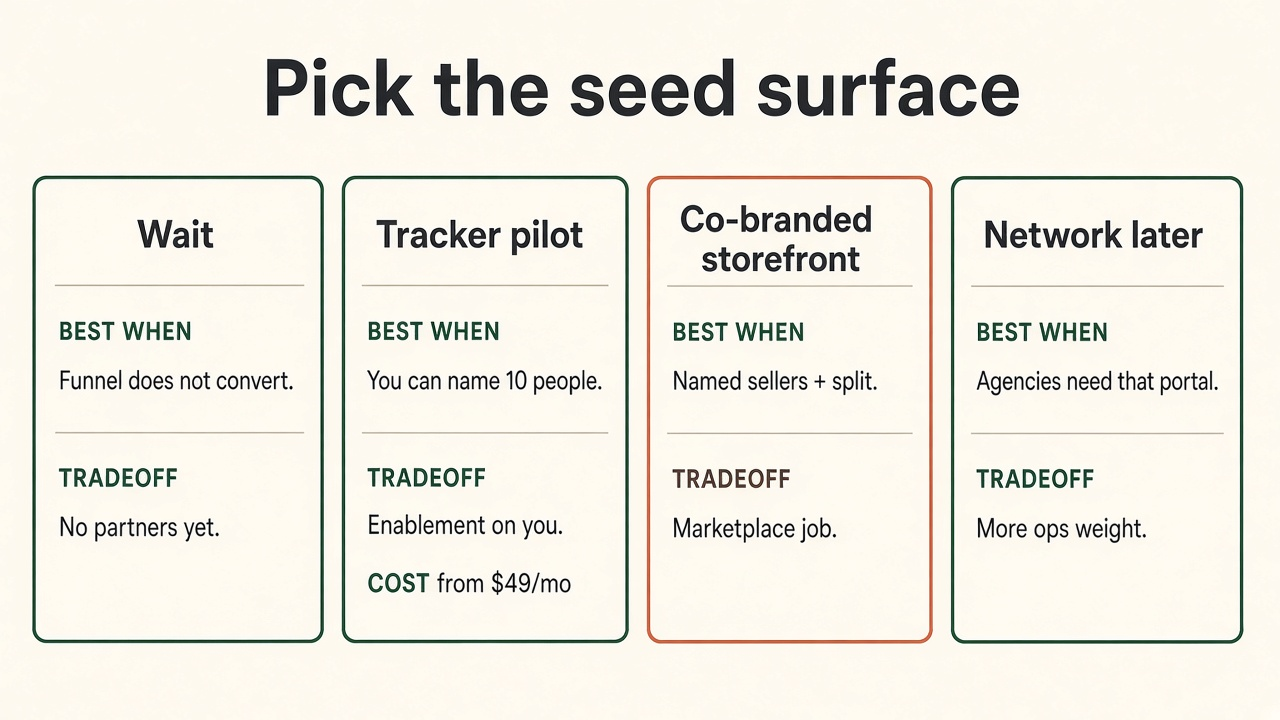
Source: Surface choice for seed-stage programs using Rewardful and FirstPromoter published starter prices (accessed 2026-10-05) and Rewardful durability context. https://www.rewardful.com/pricing · https://firstpromoter.com/pricing · https://www.rewardful.com/articles/state-of-saas-affiliate-programs-report
Invite people who already reach your buyer: happy customers, consultants who implement adjacent tools, and niche creators covering the category. r/growthmarketing operators describe treating affiliates as 10-15 key partners with a one-pager, not a giant directory (thread). Keep applications manual. LinkJolt finds 83% of campaigns review every partner (LinkJolt). When you are ready to industrialize outreach, use how to recruit affiliates for SaaS.
Software is not the program. Someone has to approve, send three assets, ask for a first promotion, and reconcile payouts. There is no public dataset for a universal hours-per-week number. Plan a recurring block anyway. Measure joined / referred / sold, the same three meters as the business launch article. Only 7.6% of affiliates generate a referral and 1.28% generate a sale (Rewardful). If those meters stay at zero after 30 days, the bug is enablement or fit, not “we need Impact.”
Q: How is creating an affiliate program for a startup different from a normal business launch? A: The go-live locks are the same (economics, surface, contract, soft-launch, meters). The seed difference is constraint: cap recurring until you know churn, buy a tracker instead of a network, and treat 10-15 named partners as v1. Rewardful’s sample says most programs stay under 50 affiliates anyway.
Q: What should a startup pay affiliates? A: Plan near public SaaS samples: LinkJolt median 20%, Rewardful average 24.16%, Shopify subscription envelope 15%-30% recurring. Publish a 12-month dollar example. Do not copy a lifetime 30% footer you cannot fund after refunds.
Q: Can I create an affiliate program for a startup with no budget? A: You can start on a 14-day Rewardful or FirstPromoter trial. After that, starter plans are $49/month, plus commissions you only owe on attributed sales. The unpaid cost is founder hours. Spreadsheets are not free if they eat engineering nights.
Q: Do startups need PartnerStack or Impact on day one? A: Usually no. Those clouds help when publishers already live there and you can staff enablement. Early operators on r/Affiliatemarketing tell small SaaS to start on Rewardful-class tools. Move up when agencies and marketplace partners become the bottleneck.
Q: Should I wait until we have product-market fit? A: Wait until the unpaid funnel converts and you can name people who already recommend you. Affiliates will not repair a leaky checkout. They will advertise it, then churn.
Creating an affiliate program for a startup is a Seed-Stage Stack, not a miniature enterprise network. Cap what you cannot forecast, install a tracker you can afford after trial, and activate 10-15 named partners against Rewardful’s harsh durability numbers. When those partners should sell your existing offer through co-branded storefronts with a revenue split on every sale, list on feat..
Affiliate marketing for startups is an operating system—locks, cost, recruit, rates, tracking, first 100 sales, then diagnose a flat roster.
How to track affiliate sales: pick link cookie, coupon, pixel, S2S postback, or storefront checkout—then match Rewardful, Tapfiliate, or Impact.
Best affiliate programs for SaaS companies pass the Recurring Cap Test: labeled duration, cookie, seat type, payout rails—plus Rewardful’s ~24% planning band.