Affiliate Marketing for Startups: Complete Guide
Affiliate marketing for startups is an operating system—locks, cost, recruit, rates, tracking, first 100 sales, then diagnose a flat roster.
PartnerStack vs feat is ecosystem vs offer. Quote-only pricing. Network 43% vs 3%. feat. forks a page. PartnerStack still wins B2B ecosystems.

TL;DR: PartnerStack vs feat is an ecosystem-versus-offer fork, not a feature bake-off. PartnerStack publishes Launch, Growth, and Enterprise and confirms dollars only in a demo. Its Network partners earn at 43% versus 3% outside. feat. forks a co-branded storefront after you approve a named seller of an existing offer. Pick PartnerStack for B2B partner ecosystems. Pick feat. when people you can name should sell the SKU.
Most “PartnerStack vs feat” roundups pretend these products compete for the same first screen. They do not. PartnerStack’s demo ends in a partner ecosystem: marketplace discovery, deal registration, MDF, LMS, CRM-shaped workflows. feat.’s demo ends in a page: a co-branded storefront on your locked offer.
The Performance Marketing Association put 2024 U.S. affiliate spend at $13.62B, generating $113B in e-commerce sales (PMA). That money runs through PRMs like PartnerStack, clouds like Impact, and trackers like Rewardful. A storefront is a different asset. Affiliate software vs storefront already named the first-screen gap. Impact vs feat owns the partnership-cloud fork. This page owns PartnerStack vs feat.
Key takeaways:
PartnerStack vs feat is a comparison between PartnerStack’s B2B SaaS partner ecosystem — marketplace recruitment, affiliate, referral, and co-sell motions in one PRM — and feat., a marketplace that forks a co-branded storefront when a merchant approves a seller on an existing offer.
They are not two flavors of the same tracker. PartnerStack’s pricing page is an ecosystem ladder: Launch for first programs (link tracking or lead/deal registration, Marketplace access, partner payments), Growth for LMS, MDF, challenges, and segmentation, Enterprise for every motion plus a designated CSM and Network success (PartnerStack). feat. is one listing, many storefronts. Approval spins the page. Marketplace listing is optional.
Reddit’s vernacular matches the fork. Operators say the site “doesn’t show pricing — they just want me to ‘book a demo’” (r/Affiliatemarketing). Another thread calls PartnerStack “more of a directory than a growth engine” (r/Affiliatemarketing). On r/b2bmarketing: “Don’t expect Partnerstack to bring you new partners… It’s a good tool if you have GTM towards agency / partners / affiliates recruitment already” (r/b2bmarketing). Those are fit comments, not a price census.
This page does not replace PartnerStack vs Impact for B2B affiliates. That spoke is two ecosystems. This spoke is ecosystem versus offer.
Buying PartnerStack when you needed a storefront, or feat. when you needed a B2B partner ecosystem, wastes a procurement cycle. One side has no public dollars. The other side has no public fee sheet. The job is the expensive part.
Why the fork is the decision:
Ecosystem vs Offer Fork is the decision rule: buy PartnerStack when you need a B2B marketplace, deal registration, MDF, and partner enablement under one PRM; buy feat. when you need each approved person to share a co-branded page of your existing offer. Same sale can exist on both. The first screen after approval is different.
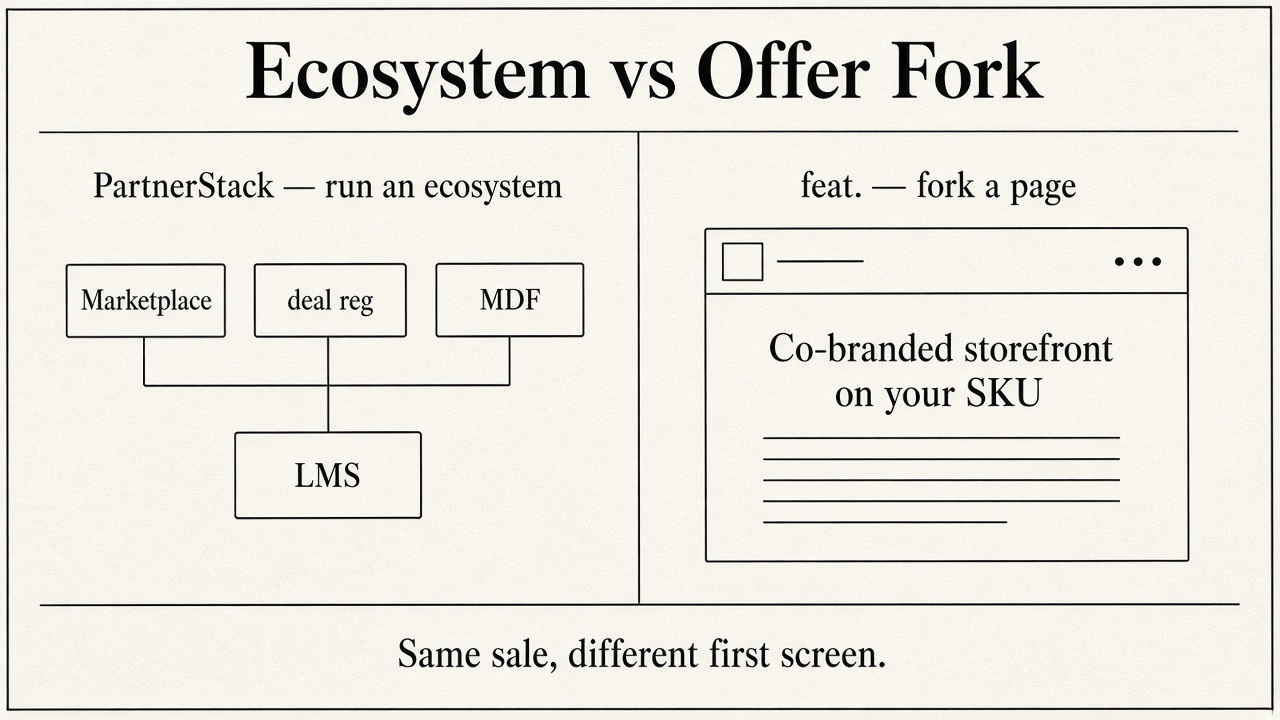
Source: Editorial job-fit framework from PartnerStack’s published Launch/Growth/Enterprise ladder and feat. approve-then-storefront mechanics. Taxonomy diagram, no invented fees.
PartnerStack wins when the merchant is recruiting B2B partners — agencies, affiliates, co-sell motions — not a founder with ten names. The platform page claims 135,000+ active partners and 600+ SaaS companies; Marketplace copy on the same property also cites 116K+, and FAQs cite 115,000+ and 118,000. Treat that as a vendor-stated band, not a third-party census (PartnerStack platform).
Growth adds an LMS, partner challenges, MDF management, and advanced segmentation. Enterprise adds full access to link tracking plus lead and deal registration, custom workflows, a designated CSM, and Network success (introductions and recruitment support) (PartnerStack). Implementation, PartnerStack says, is “weeks,” depending on complexity.
If you need those controls, feat. is the wrong buy. Say that out loud. A co-branded storefront does not replace MDF, deal registration, or a gated B2B Network.
feat. wins when you can name the promoters — customers, creators, colleagues — and the job is distribution of an existing product. Approval forks their handle onto your brand kit. Attribution sits on the storefront URL. The split settles in the charge. See how to turn anyone into a seller. feat. does not recruit. If you wanted PartnerStack to find agencies, stay on PartnerStack’s Marketplace and Network success rungs.
Live feat. fees stay in-product. Do not invent a public cut to “beat” a PartnerStack quote you have not seen. The honest comparison is destination plus ops, not a fake sticker war.
| Tool | Published entry | Next published rungs | Usage meter | First screen after approve |
|---|---|---|---|---|
| PartnerStack | Launch / Growth / Enterprise (dollars in demo) | Growth: LMS, MDF, challenges; Enterprise: CSM, Network success | Unpublished on the pricing page | Partner portal, link or deal registration |
| Impact Partnership Cloud | from $30/mo Starter | $500 Essentials; $2,500 Pro; Enterprise quote | 2.5% on partner-driven transactions | Link, code, contract, cloud dashboard |
| Rewardful (Stripe tracker, not feat.) | $49/mo up to $7,500 aff. revenue | $99 / $15,000; from $149 / $30,000 | 0% of affiliate-attributed revenue; optional Managed Payouts 3% | Tracked link / ?via= |
| feat. | In-product (no public fee sheet) | In-product | Do not invent | Co-branded storefront |
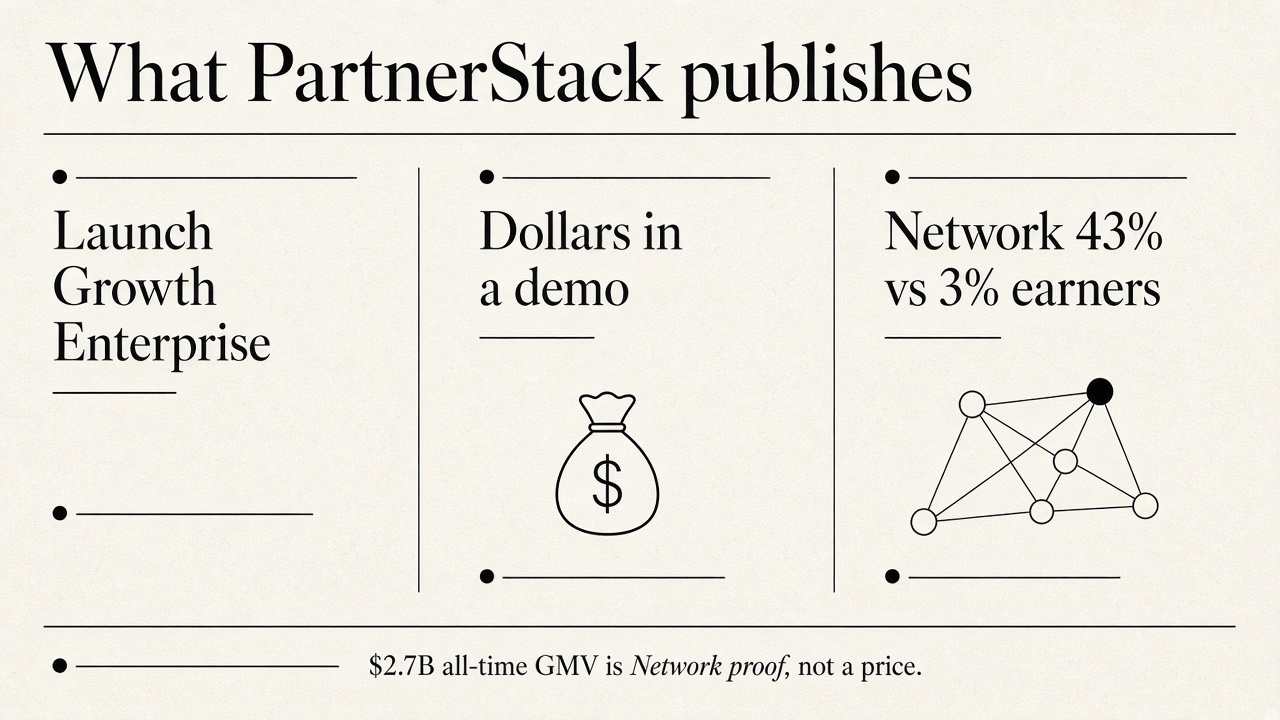
Source: PartnerStack pricing and Network Report, fetched 2026-10-06. https://partnerstack.com/pricing/ · https://partnerstack.com/resources/research-lab/report-partnerstack-is-scaling-revenue-precision-in-2026
Rewardful and Impact sit in the table as the published alternatives operators actually name next to PartnerStack, not as feat. proxies (Rewardful pricing; Impact). If all you need is a ?via= on Stripe, PartnerStack is overkill and feat. is the wrong job. If you need a page the seller can share, the tracker is the wrong job. If you need agency co-sell and MDF, feat. is the wrong job.
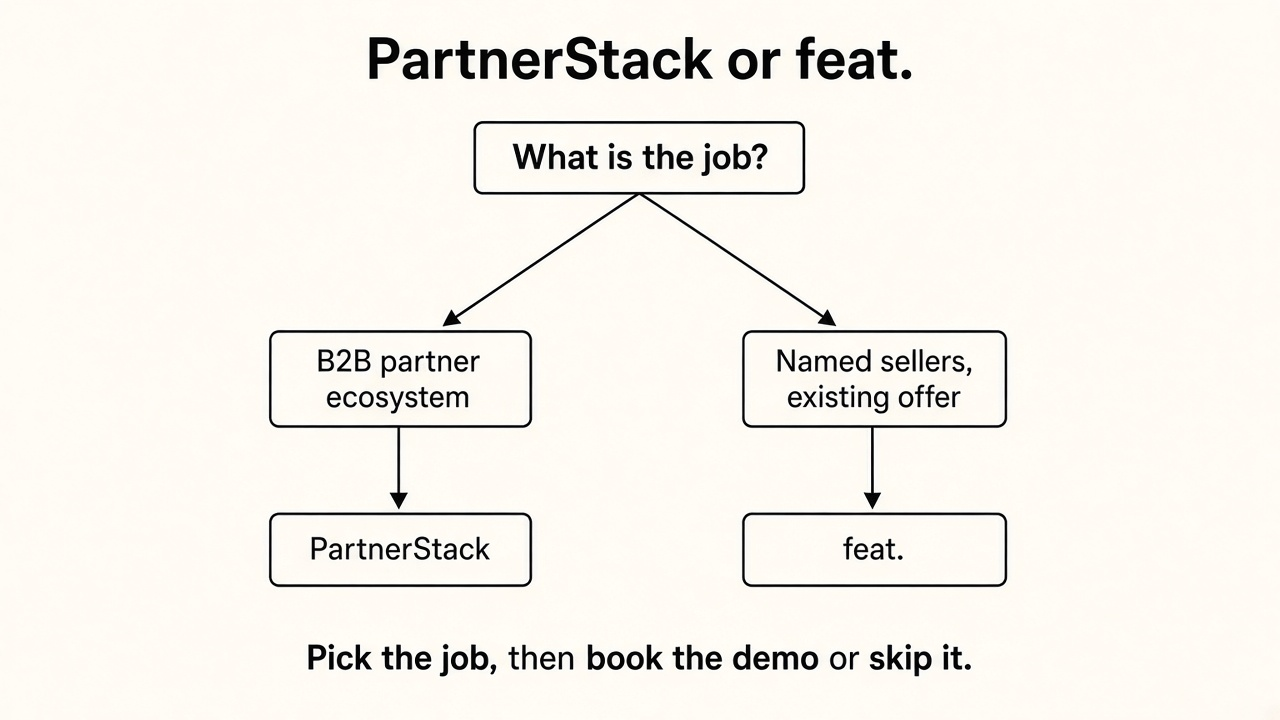
Source: Editorial decision flow from PartnerStack’s published plans and feat. storefront mechanics. https://partnerstack.com/pricing/
These five steps pick the product. Each step is at most two sentences.
Q: What is the difference between PartnerStack vs feat? A: PartnerStack is a B2B partner ecosystem for recruiting and operating affiliates, referrals, and co-sell partners, with dollars confirmed in a demo. feat. is a co-branded storefront fork after you approve a named seller of your existing offer. They compete on job, not on identical feature lists.
Q: How much does PartnerStack cost compared with feat.? A: PartnerStack publishes Launch, Growth, and Enterprise and confirms pricing in a demo (checked 2026-10-06). There is no public monthly floor. feat. does not publish a public fee sheet; live percentages appear in-product. Reddit’s $12,000/year AE quote is an anecdote, not PartnerStack’s published price.
Q: When does PartnerStack still beat a storefront? A: When you need a B2B Marketplace, deal registration, MDF, an LMS, or Enterprise Network success. A storefront does not replace those controls. Buy the ecosystem for partner ops. Buy the fork for a sell page.
Q: Is feat. a PartnerStack alternative for startups? A: Only if the job is named people selling an existing offer through a co-branded page. If you needed PartnerStack’s marketplace or PRM stack, Rewardful or FirstPromoter at $49/month is the usual small-tracker alternative, not a pretend PartnerStack clone. Stage comments about $50k MRR are vernacular, not a census.
Q: Does PartnerStack’s marketplace replace recruiting? A: Marketplace listing is discovery against a vendor-stated partner band. Network-approved partners earn at 43% versus 3% outside, which is a quality filter, not a guaranteed seller. feat. does not recruit; approval is on you.
PartnerStack vs feat is Ecosystem vs Offer Fork. PartnerStack publishes Launch / Growth / Enterprise, confirms dollars in a demo, and still wins when you need a B2B partner ecosystem, a gated Network, and PRM ops. feat. wins when you can name the sellers and want each one to share a co-branded page of your existing offer. List that offer on feat. if the job is the fork.
Affiliate marketing for startups is an operating system—locks, cost, recruit, rates, tracking, first 100 sales, then diagnose a flat roster.
How to track affiliate sales: pick link cookie, coupon, pixel, S2S postback, or storefront checkout—then match Rewardful, Tapfiliate, or Impact.
Best affiliate programs for SaaS companies pass the Recurring Cap Test: labeled duration, cookie, seat type, payout rails—plus Rewardful’s ~24% planning band.